
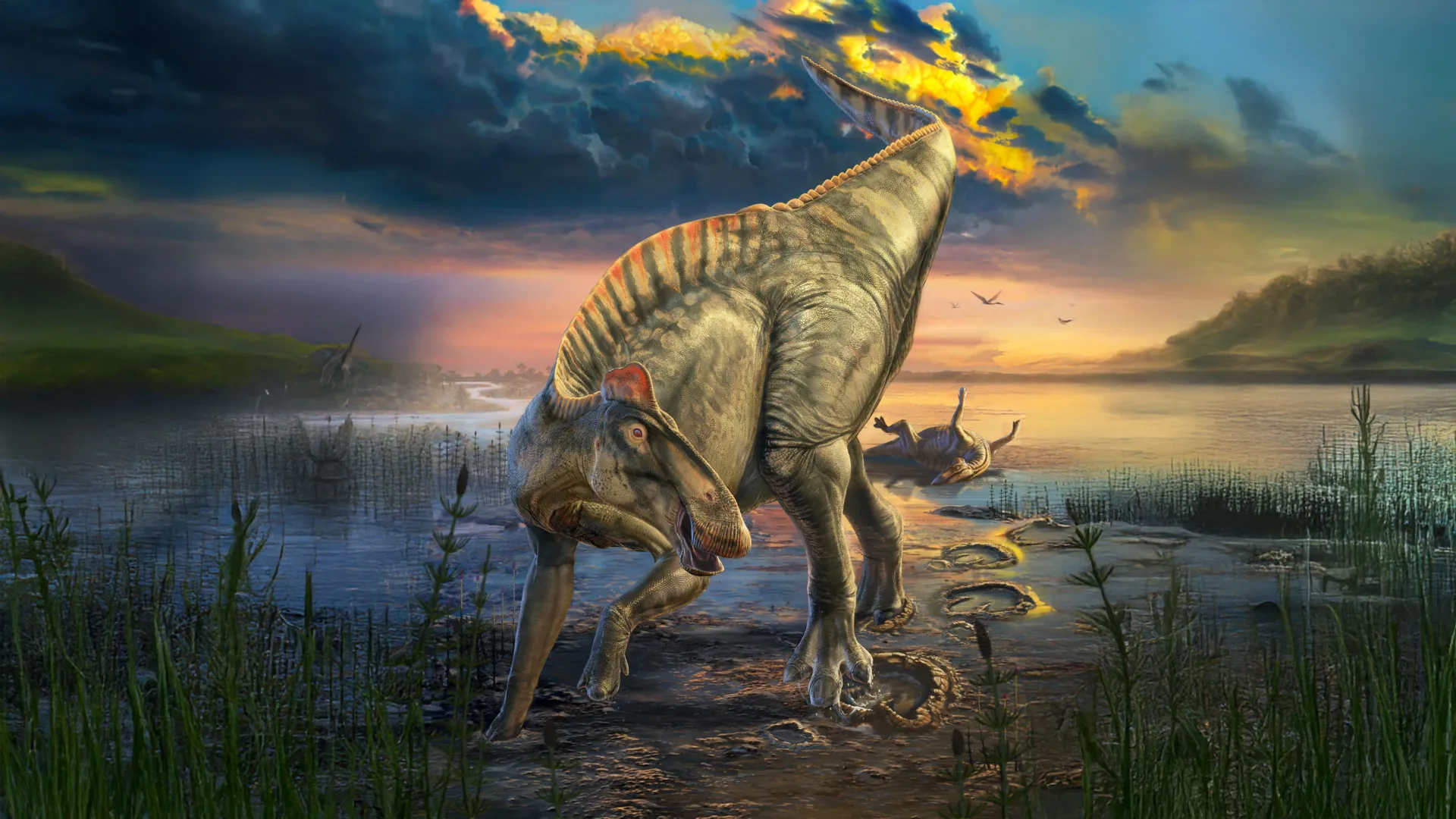
In a groundbreaking study published in the prestigious journal Science, researchers from the University of Chicago have unveiled extraordinary insights into the ancient world, describing how approximately 66 million years ago, the remains of the duck-billed dinosaur Edmontosaurus annectens underwent a unique transformation, becoming remarkably detailed "mummies" that have preserved minute features of skin, scales, and even hooves. This revolutionary process has been formally named "clay templating" by the team. This intricate geological phenomenon involved the outer soft tissues of the colossal herbivore being meticulously preserved as a delicate clay coating, a mask less than 1/100th of an inch thick, which settled over the skeletal structure shortly after burial. This discovery not only redefines our understanding of dinosaur anatomy but also offers a new paradigm for studying soft tissue preservation in the fossil record.
Unveiling Ancient Anatomy: A Glimpse into the Past
Utilizing a sophisticated suite of advanced imaging methodologies, the scientists were able to meticulously reconstruct the Edmontosaurus as it would have appeared in its prehistoric prime. Their detailed reconstruction has brought to light previously unknown anatomical features, including a prominent, fleshy crest that extended along the dinosaur’s neck and torso, a distinctive row of spikes tracing down its powerful tail, and surprisingly, hooves that encased its toes. When these unprecedented findings are integrated with data gleaned from fossilized footprints of the same species, the comprehensive appearance of this iconic duck-billed dinosaur, long a subject of paleontological speculation but never before documented with such precision, emerges with striking clarity.
Paul Sereno, PhD, Professor of Organismal Biology and Anatomy at the University of Chicago and the senior author of the study, emphasized the monumental significance of these findings. "It’s the first time we’ve had a complete, fleshed-out view of a large dinosaur that we can really feel confident about," Sereno stated, underscoring the shift from skeletal inference to a robust, evidence-based reconstruction. He further hinted at the rich potential of the discovery site, noting, "The badlands in Wyoming where the finds were made is a unique ‘mummy zone’ that has more surprises in store from fossils collected over years of visits by teams of university undergrads." This statement highlights not only the enduring dedication of the research team but also the ongoing treasure trove of paleontological data waiting to be unearthed in this specific geological locale.
The "Mummy Zone" of Wyoming: A Rare Window into Preservation
The story of these remarkable fossils stretches back over a century. Through diligent detective work, involving the careful examination of old field photographs and historical records, Professor Sereno and his colleagues successfully retraced the exact locations in east-central Wyoming where several classic dinosaur "mummies" were initially unearthed during the early 1900s. This meticulous historical sleuthing allowed them to precisely map a compact "mummy zone" within these specific rock layers, which are characterized by stacked river sands. This geological formation, part of the Lance Formation (a lateral equivalent to the more famous Hell Creek Formation), represents the very end of the Cretaceous period, just before the catastrophic asteroid impact that led to the extinction of non-avian dinosaurs. The environment would have been a dynamic landscape of rivers, floodplains, and forests, providing ample opportunities for both life and the unusual circumstances required for such exceptional preservation.
Within this historically significant area, Sereno’s team conducted new excavations, yielding two additional Edmontosaurus mummies. These specimens, one representing a younger individual and the other a somewhat older one, both preserved extensive, continuous patches of the dinosaur’s external skin surface. These newly discovered fossils proved invaluable, providing crucial, complementary pieces of the anatomical puzzle required to construct a full, fleshy profile of the animal.
It is crucial to differentiate these dinosaur mummies from the human-created mummies of ancient Egypt. Sereno meticulously clarifies that, unlike their Egyptian counterparts, none of the original organic material of the dinosaur remains. In both the newly described specimens and earlier examples labeled as mummies (including those found at the same site in the 20th century), the preserved skin, spikes, and hooves exist not as actual tissue, but as an extraordinarily thin clay coating. This coating formed on the exterior of the carcass relatively soon after burial, acting as a geological mold rather than a preserved organic remnant. "This is a mask, a template, a clay layer so thin you could blow it away," Sereno explained, emphasizing the delicate and fortuitous nature of this preservation. "It was attracted to the outside of the carcass in a fluke event of preservation." This rarity underscores the unique conditions required for such an event, making each discovery profoundly significant.
Deciphering "Clay Templating": A Novel Preservation Mechanism
To unravel the mysteries behind the formation of these extraordinary fossils, the research team employed a comprehensive array of imaging and analytical approaches. These included high-resolution hospital and micro-CT scans, which allowed for non-invasive examination of internal structures and the delicate clay layer; thin sections for microscopic analysis of the mineral composition; X-ray spectroscopy to identify elemental compositions; detailed clay mineral analyses to characterize the specific types of clay involved; and an exhaustive study of the surrounding rock layers where the fossils were situated. The convergence of evidence from these diverse scientific disciplines consistently pointed toward a precise sequence of events that culminated in this rare and remarkable style of preservation.
The researchers propose a detailed model for "clay templating." Following the death of the Edmontosaurus, their massive bodies likely underwent a period of drying under the sun, a process known as desiccation. This initial drying stage would have helped to stabilize the soft tissues to some extent. Subsequently, these desiccated carcasses were rapidly buried, most likely by sudden and voluminous flash floods—a common occurrence in the active riverine environments of the Late Cretaceous. Crucially, a microbial film then formed on the outer surface of the carcass. This biofilm, through electrostatic forces, attracted fine clay particles from the surrounding wet sediment. This electrostatic interaction facilitated the formation of a wafer-thin clay template that meticulously captured the animal’s outer shape in three dimensions, replicating the texture of its skin, scales, and other soft tissues with astonishing fidelity. Over extended geological timescales, the original soft tissues within this clay mold naturally decayed away, leaving behind the resilient clay film alongside the skeleton, which subsequently underwent its own fossilization process, primarily through permineralization. This specific set of circumstances differentiates "clay templating" from other forms of exceptional preservation, such as carbonization (where organic material is compressed into a thin carbon film) or preservation in amber, highlighting its unique contribution to taphonomy, the study of how organisms decay and become fossilized.
A Multidisciplinary Quest: From Field to Digital Reconstruction
The revelation of such a fragile boundary – the paper-thin clay layer – demanded an extraordinary level of skill and patience in the laboratory. Tyler Keillor, the Fossil Lab manager and a co-author on the study, spearheaded countless hours of meticulous preparation, carefully uncovering the crucial surfaces without inflicting any damage. This painstaking manual work was complemented by cutting-edge digital techniques.
Another key group, led by postdoctoral scholar Evan Saitta, leveraged 3D surface imaging and sophisticated CT scans. Their work involved tracing the preserved soft anatomy, meticulously examining the sediments both inside and outside the mummy, and crucially, matching the dinosaur’s hooves back into fossilized footprints found from the same geological period. This cross-referencing provided definitive validation for the anatomical reconstructions. The data was then handed over to skilled digital artists who collaborated closely with the scientists to generate lifelike reconstructions. These artistic renderings not only depicted how the Edmontosaurus would have looked but also how it might have moved, demonstrating its gait as it walked across soft mud near the very end of the dinosaur age. Sereno eloquently summarized this collaborative ethos: "I believe it’s worth taking the time to assemble a dream team in order to generate science that can be appreciated by the general public. We’ve never been able to look at the appearance of a large prehistoric reptile like this — and just in time for Halloween." This sentiment underscores the team’s commitment to both rigorous scientific inquiry and effective public engagement.
Revolutionary Insights: Hooves, Spikes, and Scales Redefined
Working from the detailed evidence provided by the two newly described mummies, the researchers were able to assemble a comprehensive and fleshy outline of Edmontosaurus annectens. "The two specimens complemented each other beautifully," Sereno remarked, highlighting how each fossil contributed unique pieces to the overall anatomical mosaic. "For the first time, we could see the whole profile rather than scattered patches."
Their investigations revealed a continuous, striking feature running along the center of the dinosaur’s back. This began as a fleshy crest over the neck and torso, a feature previously unknown for Edmontosaurus, which was typically reconstructed as having a relatively smooth, unadorned head and neck, earning it the moniker "flat-headed duckbill." Over the hips, this structure transitioned into a single row of prominent spikes, meticulously aligned along the tail, with each spike neatly positioned above a vertebra and fitting precisely with its neighbors. These crests and spikes likely served a role in social display, species recognition, or even as a deterrent against predators.
The team also meticulously documented the dinosaur’s scale patterns. They observed that the largest polygonal scales were concentrated along the lower body and tail, offering robust protection. However, the majority of the animal’s body was covered in surprisingly small, pebble-like scales, measuring only 1-4 millimeters across. This diminutive scale size is particularly noteworthy for a dinosaur that could attain impressive lengths exceeding 40 feet. Fine wrinkles preserved over the ribcage further indicated that the skin of this duckbill was relatively thin, suggesting a degree of flexibility and potentially a different physiological role than thicker, more heavily armored skin.
The most astonishing and unexpected discovery emerged from the larger mummy’s hind feet: this dinosaur possessed hooves. The tips of each of the three hind toes were enclosed in a distinctive wedge-shaped hoof, characterized by a flat underside, remarkably similar in structure to the hooves found on modern horses. This discovery profoundly alters previous conceptions of hadrosaur foot anatomy, which were often depicted with fleshy pads and blunt claws.
To conclusively confirm the appearance of these feet in life, the researchers seamlessly integrated CT scans of the mummified feet with 3D images of the best-preserved duckbill footprint from the same time period. This innovative approach allowed them to carefully align the fossilized bones and soft-tissue impressions, creating a highly accurate and detailed reconstruction of the hind foot. Unlike the forefoot, which made contact with the ground primarily through its hooves, the hind feet also featured a substantial, fleshy heel pad positioned behind the hooves, providing additional support and cushioning for the immense weight of the animal. This anatomical difference between forelimb and hindlimb posture, combined with the presence of hooves, represents a significant evolutionary adaptation for terrestrial locomotion. "There are so many amazing ‘firsts’ preserved in these duck-billed mummies," Sereno enthused, "the earliest hooves documented in a land vertebrate, the first confirmed hooved reptile, and the first hooved four-legged animal with different forelimb and hindlimb posture." These "firsts" are not merely curiosities; they offer crucial insights into the evolutionary pressures and adaptations that shaped the locomotion and terrestrial habits of these late Cretaceous giants.
Setting a New Standard: A Toolkit for Future Paleontology
Beyond the striking revelations about Edmontosaurus anatomy, this research provides a practical and comprehensive framework for future studies focusing on dinosaur soft tissue. The authors have meticulously outlined novel preparation techniques specifically tailored for such delicate fossils, established a clear and consistent set of terms for describing soft structures and various scale types, detailed a step-by-step imaging pathway from initial fossil specimen to fully fleshed-out digital model, and most importantly, presented a scientific "recipe" for how a dinosaur mummy can form under natural conditions through the "clay templating" process.
Their work transcends a mere series of isolated findings. It proposes a general, testable model for dinosaur mummification based on clay templating, which can now be applied and validated against other fossils exhibiting similar preservation styles across different geological contexts. This methodological contribution is poised to significantly impact how paleontologists approach the study of rare soft-tissue fossils.
The team has also clearly articulated the critical next steps for this burgeoning field of research. These include focused searches for additional specimens displaying this unique kind of preservation, not only within the same Wyoming rock layers but also in other potentially suitable regions globally. Furthermore, the accurate external body outlines derived from this study will enable more precise biomechanical studies, allowing scientists to model gait, weight distribution, and movement with unprecedented accuracy. Complementary analyses will also be crucial to better understand the specific environmental and taphonomic conditions under which "clay templating" is most likely to occur. "This may be the single best paper I’ve released," Sereno reflected, encapsulating the profound scope and impact of the study. "From field to lab to 3D reconstructions along with a suite of useful terms defined, it’s a tour de force, and it tells a coherent story about how these remarkable fossils come to be and what we can learn from them." This groundbreaking work sets a new benchmark for paleontological research, promising a future where our understanding of ancient life is enriched by previously unimaginable detail.
