
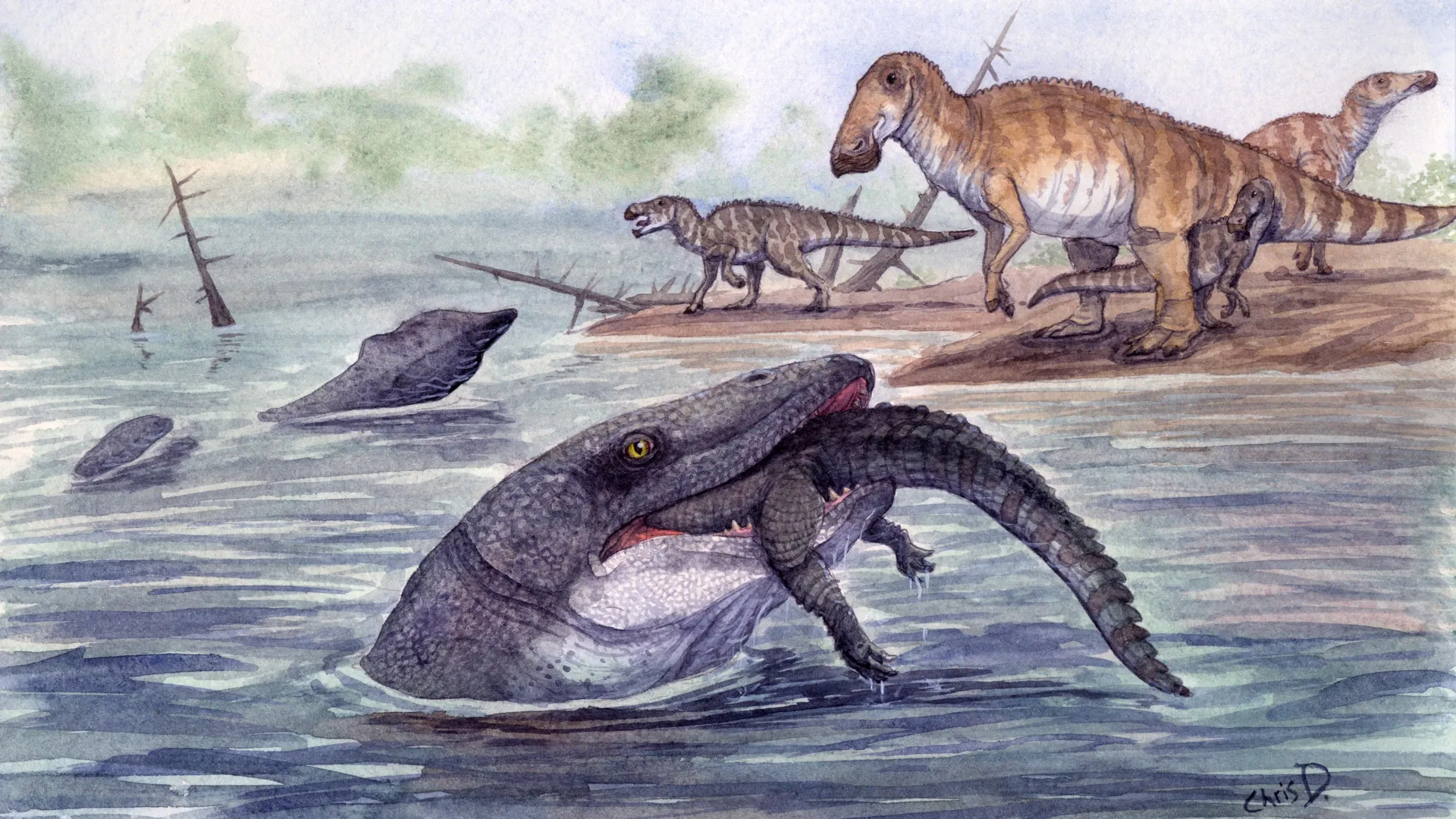
Mosasaurs, the colossal marine reptiles that dominated ancient oceans more than 66 million years ago, are now revealed to have been more ecologically versatile than previously understood. New evidence, derived from the meticulous analysis of a mosasaur tooth unearthed in North Dakota, strongly indicates that some of these formidable predators adapted to freshwater river systems during the twilight of the Cretaceous Period. This unprecedented finding challenges long-held assumptions about their strictly marine existence and offers a fascinating glimpse into the adaptability of life in a rapidly changing world on the cusp of a mass extinction event.
The fossilized tooth, likely belonging to an individual measuring up to 11 meters long – comparable in size to a city bus – provides compelling chemical signatures of a freshwater habitat. The international research team, spearheaded by scientists from Uppsala University, concluded that this adaptation to riverine environments occurred during the final million years preceding the devastating extinction event that wiped out the dinosaurs and many other life forms. This discovery fundamentally reshapes our understanding of mosasaur ecology and the complex dynamics of Late Cretaceous ecosystems.
The Unearthing of an Enigma in North Dakota
The journey to this groundbreaking revelation began in 2022, with the discovery of the mosasaur tooth in a river deposit in North Dakota. This particular region, already celebrated for its rich fossil record, including specimens of the iconic duck-billed dinosaur Edmontosaurus, presented an immediate paleontological puzzle. The mosasaur tooth was not found in isolation; it lay alongside a tooth from a Tyrannosaurus rex and a jawbone belonging to a crocodylian. This unusual assemblage of fossils – a land-dwelling apex predator, a riverine crocodile, and what was traditionally considered an exclusively marine giant reptile – instantly raised questions among researchers. How could the tooth of an ocean-dwelling mosasaur end up preserved in a freshwater riverine context, thousands of miles from the nearest marine environment of the time?
The size of the discovered tooth points to a truly enormous animal, estimated to be up to 11 meters in length. This immense scale suggests a predator capable of dominating its local ecosystem, regardless of whether that was salt or fresh water. Earlier discoveries of mosasaur bones at a nearby site corroborate this size estimate, reinforcing the image of a truly gargantuan beast. While the exact genus of the mosasaur cannot be definitively identified from a single tooth, it is believed to have belonged to the prognathodontine group. Close relatives within the genus Prognathodon were characterized by massive heads, immensely powerful jaws, and robust, conical teeth, indicative of opportunistic predators capable of tackling substantial prey, including other marine reptiles, large fish, and even ammonites. The notion of such a formidable predator lurking in a river system fundamentally alters our perception of Late Cretaceous freshwater environments.
Unlocking Ancient Secrets Through Isotope Geochemistry
To unravel the mystery of the mosasaur tooth’s unexpected location, researchers from the United States, Sweden, and the Netherlands turned to the sophisticated techniques of isotope analysis. This scientific method examines the ratios of different isotopes (atoms of the same element with varying numbers of neutrons) within a fossilized specimen. The chemical makeup of tooth enamel, being highly resistant to alteration over millions of years, provides an invaluable archive of an animal’s environment and diet throughout its lifetime.
The analysis was meticulously carried out at the Vrije Universiteit (VU) in Amsterdam. Crucially, because the mosasaur tooth, the T. rex tooth, and the crocodylian jawbone all date to approximately 66 million years ago – a critical juncture in Earth’s history – scientists could perform a direct chemical comparison. This contemporaneous context allowed for a precise understanding of the environmental conditions these animals experienced.
The research focused on the isotopes of oxygen, strontium, and carbon, each serving as a distinct environmental proxy:
-
Oxygen Isotopes (16O and 18O): Water bodies have characteristic oxygen isotope ratios. Freshwater typically contains higher proportions of the lighter oxygen isotope (16O) compared to marine water, which is enriched in the heavier isotope (18O). The analysis of the mosasaur tooth revealed unusually high levels of 16O, a signature strongly indicative of a freshwater environment rather than a marine one. This was a primary indicator that the mosasaur had spent a significant portion of its life in non-saline waters.
-
Strontium Isotopes (87Sr/86Sr): Strontium isotope ratios in water are influenced by the weathering of continental rocks, making them excellent tracers of water source. Freshwater systems, draining continental landmasses, typically have different strontium isotope ratios compared to marine environments. The strontium isotope ratios found in the mosasaur tooth also aligned with signatures characteristic of a freshwater habitat, further strengthening the case for its riverine residency.
-
Carbon Isotopes (13C and 12C): Carbon isotope ratios in an animal’s tissues, including tooth enamel, generally reflect its diet and, by extension, its position within the food web and its habitat depth. Melanie During, one of the study’s corresponding authors, explained, "Carbon isotopes in teeth generally reflect what the animal ate. Many mosasaurs have low 13C values because they dive deep." This lower 13C is typical of marine food webs where primary producers often utilize different carbon fixation pathways or where food sources are less enriched in 13C. However, the mosasaur tooth discovered with the T. rex tooth presented a striking anomaly: it possessed a higher 13C value than all previously known mosasaurs, dinosaurs, and crocodiles. This elevated 13C signature suggests a diet distinct from typical deep-diving marine mosasaurs, implying a shallower habitat and potentially even feeding on drowned terrestrial animals, such as dinosaurs, that might have been carried into the river. This specific isotopic signature provides not only environmental context but also sheds light on the dietary adaptations of this particular mosasaur.
Melanie During further emphasized the consistency of these findings: "The isotope signatures indicated that this mosasaur had inhabited this freshwater riverine environment. When we looked at two additional mosasaur teeth found at nearby, slightly older, sites in North Dakota, we saw similar freshwater signatures. These analyses show that mosasaurs lived in riverine environments in the final million years before going extinct." The corroboration from multiple specimens across a narrow chronological window underscores the robustness of the team’s conclusions, suggesting this was not an isolated incident but a more widespread, albeit localized, ecological shift.
When Seas Slowly Turned Into Rivers: The Western Interior Seaway
The findings are not just about a single mosasaur’s surprising habitat; they also offer critical insights into the dramatic environmental transformations occurring in North America during the late Cretaceous. The key to understanding how mosasaurs could adapt to freshwater lies in the fate of the Western Interior Seaway (WIS). This vast, shallow inland sea was an epic feature of North American paleogeography, stretching from the Gulf of Mexico northwards to the Arctic Ocean, effectively bisecting the continent for millions of years. It was a thriving marine ecosystem, teeming with ammonites, fish, plesiosaurs, and, of course, mosasaurs.
However, towards the very end of the Cretaceous, geological and climatic shifts led to an increasing influx of freshwater from continental runoff into the WIS. Over time, this constant freshwater input gradually altered the seaway’s salinity. It transitioned from a fully marine, salty environment to a brackish state, and in certain regions, particularly its northern reaches, it likely became predominantly freshwater. This process created conditions similar to those observed today in the Gulf of Bothnia, a northern arm of the Baltic Sea, which is heavily influenced by freshwater river input and exhibits a strong salinity gradient.
The researchers propose that this desalinization created a distinct ‘halocline’ within the seaway and its connected river systems. A halocline is a strong vertical salinity gradient, where a layer of lighter, less dense freshwater forms on the surface, overlying denser, more saline water beneath. The isotope data from the mosasaur tooth strongly supports this hypothesis.
Per Ahlberg, a coauthor of the study and Dr. During’s promotor, elaborated on this: "For comparison with the mosasaur teeth, we also measured fossils from other marine animals and found a clear difference. All gill-breathing animals had isotope signatures linking them to brackish or salty water, while all lung-breathing animals lacked such signatures." This distinction is crucial. Gill-breathing organisms, such as fish and certain invertebrates, are directly dependent on the salinity of the water they draw through their gills. Mosasaurs, being air-breathing reptiles, needed to surface regularly. Their ability to inhabit the upper freshwater layer, effectively avoiding the more saline water beneath, would have provided them with a unique ecological niche and access to new food resources in these changing environments. This adaptation would have allowed them to exploit the freshwater inputs of the Western Interior Seaway, expanding their hunting grounds into what were previously inaccessible territories.
Adapting to a Changing World: Ecological Flexibility and Modern Parallels
The discovery of freshwater-dwelling mosasaurs is a powerful testament to the remarkable ecological plasticity of life. Large predators shifting between drastically different habitats is not an unprecedented phenomenon in evolutionary history, but it’s a significant re-evaluation for a group like mosasaurs, long considered exclusively marine.
Melanie During commented on the evolutionary ease of such a transition: "Unlike the complex adaptation required to move from freshwater to marine habitats, the reverse adaptation is generally simpler." This statement reflects a broader biological principle. Adapting from a hypertonic (salty) environment to a hypotonic (freshwater) one often requires less physiological modification than the reverse, particularly concerning osmoregulation (the regulation of water and salt balance in the body). Marine animals often need to conserve water and excrete excess salt, while freshwater animals need to excrete excess water and retain salts. The transition from marine to freshwater, therefore, might be less physiologically demanding for certain lineages.
Modern animals provide compelling parallels to the mosasaur’s surprising flexibility. River dolphins, such as the Amazon river dolphin (Inia geoffrensis), are fully freshwater inhabitants, despite their ancestors being marine. These cetaceans have undergone significant evolutionary changes to thrive in complex river systems, developing excellent echolocation for murky waters and flexible necks for navigating obstacles. Similarly, the estuarine crocodile (Crocodylus porosus), famously known as the saltwater crocodile in Australia, exemplifies a predator that regularly moves between freshwater rivers and the open ocean, demonstrating impressive adaptability in hunting across varying salinities. These modern examples underscore the feasibility of a large, apex predator like a mosasaur making such a habitat shift, driven by environmental pressures and the availability of new food sources.
Reimagining the Late Cretaceous Ecosystem and Its Broader Implications
This discovery fundamentally alters our understanding of the Late Cretaceous ecosystem, particularly in the critical period leading up to the K-Pg extinction event. Mosasaur fossils are abundant in marine deposits across North America, Europe, and Africa, spanning their 32-million-year reign from approximately 98 to 66 million years ago. Their rare occurrence in regions like North Dakota, especially in freshwater contexts, makes this finding exceptionally striking.
The presence of an 11-meter-long mosasaur in a river system poses a profound question: what did these colossal predators eat in such an environment? While the elevated 13C signature suggests a diet including drowned terrestrial animals, they likely also preyed on large freshwater fish, turtles, and even smaller crocodylians. The image of a bus-sized marine reptile navigating river channels alongside Tyrannosaurus rex and Edmontosaurus on the banks paints a vivid, dynamic, and previously unimagined picture of the pre-extinction world. Per Ahlberg aptly summarized the impact: "The size means that the animal would rival the largest killer whales, making it an extraordinary predator to encounter in riverine environments not previously associated with such giant marine reptiles."
This adaptation may represent a survival strategy for mosasaurs in a world undergoing dramatic environmental change. As the Western Interior Seaway diminished and transformed, some mosasaur populations might have been forced to explore new niches. While ultimately unsuccessful in staving off extinction during the K-Pg event, this adaptability showcases their evolutionary resilience. The study also highlights the importance of localized environmental shifts in shaping ecosystems, even on the brink of global catastrophe.
The research was a collaborative effort involving scientists from Uppsala University, in conjunction with Eastern West Virginia Community and Technical College, Moorefield, West Virginia, Vrije Universiteit Amsterdam, and the North Dakota Geological Survey. The findings draw heavily on a chapter from Melanie During’s doctoral thesis, which she defended at Uppsala University in November 2024. This collaborative, interdisciplinary approach, combining paleontology, geology, and geochemistry, continues to push the boundaries of our knowledge about ancient life and the intricate ways it responded to Earth’s ever-changing conditions. Further research into other fossil sites and isotopic signatures could reveal even more about the extent and timing of this remarkable freshwater adaptation among mosasaurs, enriching our understanding of these magnificent marine predators and the dynamic world they inhabited.
