
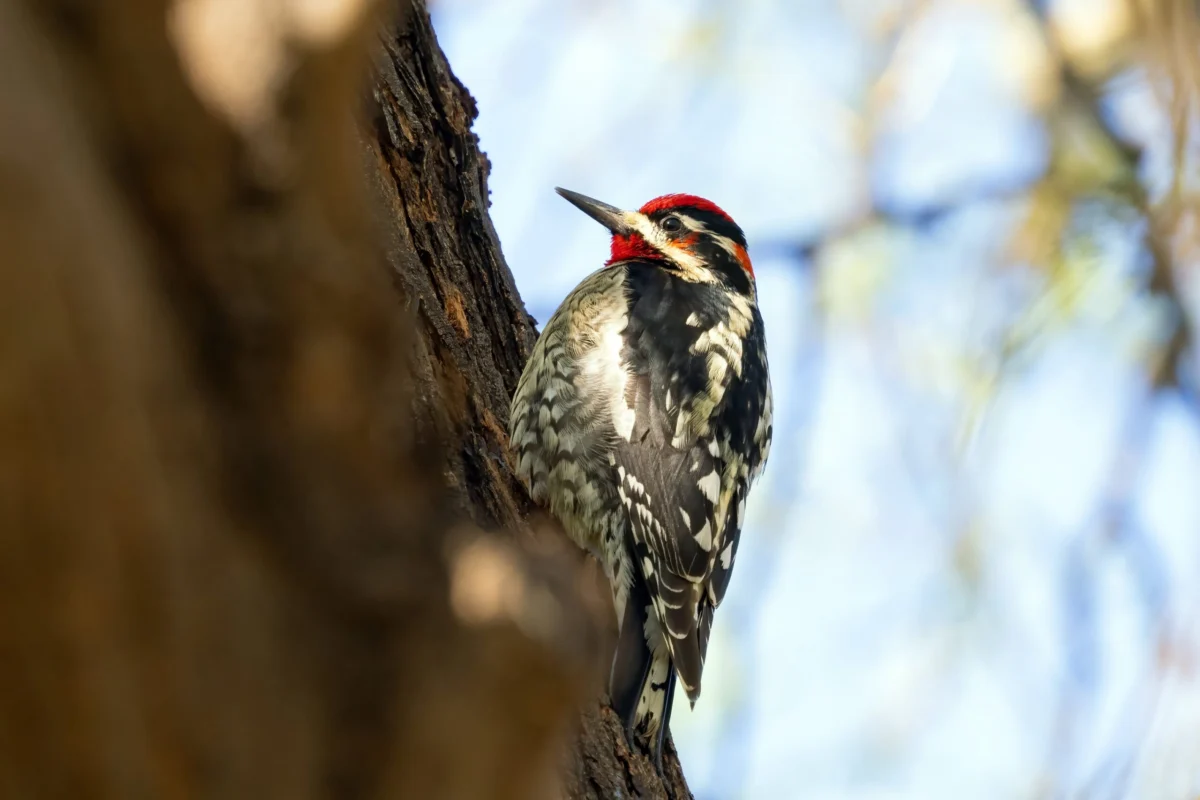
As the Northern Hemisphere tilts towards longer days and the earth awakens with fragrant blossoms, a vibrant tapestry of migratory life unfolds across the North American continent. Among the returning throngs of hummingbirds, warblers, and flycatchers that animate the Southwest, a particularly striking avian resident makes its seasonal appearance: the Red-naped Sapsucker. This handsome woodpecker, Sphyrapicus nuchalis, is named for the distinctive crimson patch adorning the back of its head, a feature that contributes to its undeniably debonair appearance and marks it as a unique member of the Picidae family.
Distinctive Plumage and Taxonomic History
The Red-naped Sapsucker is a medium-sized woodpecker, typically measuring between 8 to 9 inches (20-23 cm) in length with a wingspan of approximately 16 inches (40 cm). Its plumage is a striking mosaic of black, white, and red. Both sexes exhibit a prominent red patch on the nape, a critical field mark that differentiates it from its close relatives. Males boast an entirely red throat and crown, contrasting sharply with the white stripe running above and below the eye, and a black line extending from the eye to the back of the head. Their flanks are finely barred with black and white, and a bold white wing patch is visible in flight and at rest. Females, while sharing the characteristic red nape, present a distinctive white chin and a red throat, a detail that makes sex identification relatively straightforward for observant birders. This feature—a red marking on the head of a female woodpecker—is notable, as such vibrant coloration is often predominantly reserved for males in many avian species, particularly within the woodpecker family. Indeed, among North America’s four sapsucker species, the females of three display red head markings, an interesting deviation from typical sexual dimorphism.
For many years, the Red-naped Sapsucker was considered a subspecies of the Yellow-bellied Sapsucker (Sphyrapicus varius). This classification was based primarily on morphological similarities and instances of interbreeding in areas where their ranges overlapped. However, advanced ornithological research, including detailed studies of vocalizations, breeding behaviors, and genetic analyses, led to its reclassification as a distinct species in 1983. This taxonomic split highlighted subtle but consistent differences in their calls, drumming patterns, and preferred breeding habitats. The Yellow-bellied Sapsucker, primarily found in the eastern and central parts of North America, is characterized by a yellowish wash on its belly and often lacks the prominent red nape, or has it less distinctly. This reclassification underscores the dynamic nature of scientific understanding and the continuous refinement of avian taxonomy based on accumulating evidence.
The Ingenious Foraging Strategy: Sapsucking
The second part of the Red-naped Sapsucker’s name directly references its most iconic and evolutionarily significant feeding behavior: sapsucking. This specialized foraging method sets sapsuckers apart from most other woodpeckers, which typically focus on extracting insects from decaying wood. Red-naped Sapsuckers are arboreal engineers, meticulously drilling neat rows of shallow, rectangular holes, known as sap wells, into the bark of trees. These wells are strategically spaced to tap into the tree’s cambium layer—the thin, living tissue responsible for transporting water and nutrients—without girdling or fatally damaging the tree. Ornithologists have observed that sapsuckers instinctively understand the physiological limits of their host trees, ensuring a sustained supply of sap over time.
Once these wells are established, the sugary sap begins to flow, providing a rich source of carbohydrates. This liquid diet is supplemented by the myriad of insects—ants, wasps, beetles, and flies—that are inevitably attracted to the sweet exudate. These insects provide essential protein, fats, and other micronutrients, creating a balanced diet for the sapsucker. The effectiveness of this foraging strategy is such that several other species, including various hummingbirds, warblers, and even some small mammals, have been observed "kleptoparasitizing" sapsucker wells, feeding on the sap and insects left behind. This phenomenon highlights the sapsucker’s role as a "keystone" resource provider in its ecosystem, inadvertently supporting a diverse array of other wildlife. Studies have shown that during peak migratory periods, sapsucker wells can be critical fuel stops for hummingbirds traversing vast distances.
Sapsuckers exhibit a preference for certain tree species, favoring those with thinner bark and high sap flow, such as birch, aspen, cottonwood, larch, and even fruit trees in orchards. The choice of tree can vary regionally, but the underlying principle remains the same: efficient access to nutrient-rich sap. While the sight of numerous holes might suggest harm, the trees generally recover, thanks to the sapsucker’s careful drilling technique and the cambium’s regenerative capacity. However, in cases of severe infestation or repeated tapping on young, vulnerable trees, some damage or reduced growth can occur, though this is relatively uncommon in natural forest settings.
A Journey Across North America: Migration Patterns
The Red-naped Sapsucker is a quintessential migratory bird, undertaking significant seasonal movements across North America. Its annual cycle dictates a fascinating chronology of travel and settlement. From its wintering grounds, which stretch from southern Arizona, New Mexico, and Texas, south into the highlands of Mexico, reaching as far as Jalisco, these birds embark on their northward migration beginning in late February and intensifying through March and April.
Their breeding range extends across a vast expanse of western North America, encompassing the mountainous regions from central British Columbia and Alberta south through the Rocky Mountains to central Arizona and New Mexico, and parts of the Sierra Nevada in California. This northward journey can span thousands of miles, requiring immense physiological endurance and precise navigational skills. The timing of their arrival in breeding territories is finely tuned to the availability of suitable nesting sites and the emergence of sap flows in the deciduous trees they favor. Males typically arrive slightly before females to establish territories and begin excavating nest cavities.
The return migration to wintering grounds commences in late August and continues through September and October, as temperatures drop and food resources become scarcer in their breeding habitats. This southward journey is often less hurried than the spring migration, allowing for more leisurely foraging stops. The specific routes taken by individual sapsuckers can vary, but generally follow broad flyways associated with mountain ranges and river valleys, providing reliable stopover sites. Factors such as day length, hormonal changes, and prevailing weather conditions all play a role in triggering and guiding these remarkable journeys.
Breeding and Nesting: Raising the Next Generation
Upon arrival in their breeding territories, Red-naped Sapsuckers immediately set about the task of reproduction. These birds are cavity nesters, relying on the availability of trees with soft wood, which makes excavation easier. Preferred species include aspens, cottonwoods, birches, and larches, particularly those with heart rot or fungal infections that soften the interior while leaving the outer shell intact. Both the male and female participate in excavating the nest cavity, a process that can take one to two weeks. The entrance hole is typically round, leading to a pear-shaped chamber within the tree trunk.
Clutch sizes usually range from 4 to 7 pure white eggs. The incubation period lasts approximately 12 to 14 days, with both parents sharing incubation duties. After hatching, the altricial young remain in the nest for about 25 to 29 days, a period during which both parents are diligent in feeding them a diet primarily consisting of insects gathered from the sap wells and surrounding foliage. The high protein content of insects is crucial for the rapid growth and development of the nestlings. Fledglings are often seen following their parents for several weeks after leaving the nest, learning foraging techniques and honing their flight skills before becoming independent. Family groups typically disperse by late summer, as the young prepare for their first southward migration. The fidelity to nesting sites can be high, with pairs often returning to the same general area or even the same cavity in successive years.
Vocalizations and Drumming: The Sapsucker’s Symphony
Beyond their striking appearance, Red-naped Sapsuckers possess a distinctive vocal and percussive repertoire. Their scientific name, Sphyrapicus nuchalis, derived from the Greek "sphura" (hammer) and "pikos" (woodpecker), aptly describes their primary mode of communication. While many woodpeckers drum, the Red-naped Sapsucker’s drumming pattern is particularly unique and aids significantly in species identification. It is characterized by a short, rapid burst of pecks that gradually slows in cadence, often described as sounding like a "stuttering gas motor coming to a stop." This percussive display serves multiple functions: announcing territorial claims, attracting mates, and signaling presence to rivals.
In addition to drumming, Red-naped Sapsuckers employ a variety of vocalizations. Their calls include a distinctive nasal "mewing" or "queer" sound, often repeated, and a series of sharp, squealing notes during interactions with other sapsuckers or when agitated. These vocalizations are crucial for communication within pairs, between parents and offspring, and for warning other birds of potential threats. The combination of their unique drumming and vocalizations allows experienced birders to identify the species even when it remains out of sight within the forest canopy.
Ecological Significance and Interspecies Relationships
The ecological role of the Red-naped Sapsucker extends far beyond its individual existence. By creating sap wells, it acts as an ecosystem engineer, providing a vital food source that supports a cascade of other species. Hummingbirds are perhaps the most famous beneficiaries, with several species, including Rufous, Broad-tailed, and Black-chinned Hummingbirds, regularly visiting sapsucker wells, especially during migration when floral nectar sources might be scarce. This interspecies relationship is a classic example of commensalism, where one species benefits (hummingbirds) without significantly harming or benefiting the other (sapsucker).
Furthermore, the sap and associated insects attract a host of other avian species, including various warblers, kinglets, chickadees, and even larger birds like orioles and grosbeaks. These birds exploit the sapsucker’s efforts, utilizing the readily available energy and protein. Insects, drawn to the sugary sap, also become a food source for other insectivorous birds and even small mammals. The abandoned nest cavities of sapsuckers also provide crucial nesting and roosting sites for secondary cavity nesters such as nuthatches, chickadees, swallows, and even small owls and bats, further underscoring their profound influence on forest biodiversity. Dr. Lena Hanson, an avian ecologist specializing in interspecies dynamics, noted in a recent symposium, "The Red-naped Sapsucker is a small bird with a disproportionately large impact on its ecosystem. Its unique foraging strategy creates microhabitats and food resources that ripple through the forest community, sustaining a surprising diversity of life."
Conservation Status and Future Outlook
Currently, the Red-naped Sapsucker is classified as "Least Concern" by the International Union for Conservation of Nature (IUCN), indicating a relatively stable global population. Estimates from organizations like Partners in Flight suggest a breeding population of approximately 1.7 million individuals, with some regional variations in trends. However, like many migratory species, Red-naped Sapsuckers face ongoing challenges that warrant continuous monitoring and conservation efforts.
Primary threats include habitat degradation and loss, particularly the destruction of mature forests with soft-wooded trees crucial for nesting. Changes in forest management practices, such as clear-cutting or the removal of dead and decaying trees, can limit the availability of suitable nesting sites. Climate change poses another long-term threat, potentially altering the timing of sap flow, insect emergence, and migratory cues, leading to mismatches between resource availability and the birds’ life cycles. Increased frequency of extreme weather events, such as severe droughts or wildfires, can also impact their breeding and wintering habitats.
Conservation efforts focus on protecting and restoring suitable forest habitats across their migratory and breeding ranges. Sustainable forestry practices that ensure a continuous supply of mature, cavity-suitable trees are essential. The establishment and maintenance of protected areas, national parks, and wildlife refuges play a critical role in providing secure breeding grounds and migratory stopovers. Organizations like the National Audubon Society and various state-level wildlife agencies actively monitor sapsucker populations and advocate for policies that support avian conservation. Citizen science initiatives, such as eBird, contribute invaluable data on population trends, migration timing, and distribution, empowering researchers and conservationists with real-time information.
Observing the Red-naped Sapsucker: A Birder’s Guide
For those eager to witness this dapper avian marvel, an understanding of its habitat preferences and behaviors is key. During the spring and summer breeding season, the Red-naped Sapsucker is most readily found in mixed deciduous-coniferous forests, particularly in mountainous regions from elevations of approximately 4,000 to 10,000 feet (1,200 to 3,000 meters). Look for them in areas with abundant aspen, birch, cottonwood, and larch trees, especially near areas of heart rot. Their presence is often betrayed by their distinctive drumming or the characteristic rows of sap wells on tree trunks.
In their wintering grounds in the Southwest and Mexico, they can be found in a broader range of habitats, including riparian woodlands, juniper-oak woodlands, and even suburban areas with suitable trees. The Randall Davey Audubon Center in Santa Fe, New Mexico, for instance, serves as a known migratory stopover and potential breeding site, offering excellent opportunities for observation. A spokesperson for the Center recently highlighted, "We’ve already observed a male and female pair beginning to survey potential nesting locations this spring. Their return is always a welcome sign, reminding us of the intricate connections between our local environment and the broader migratory routes across the continent."
Birdwatchers should keep a keen eye out for their striking black, white, and red plumage, and an open ear for their unique stuttering drum. Binoculars are highly recommended for observing their detailed markings and intricate foraging behaviors. Patience and quiet observation will often be rewarded with a glimpse of this fascinating and ecologically vital member of North America’s avifauna, a true emblem of the changing seasons.
