
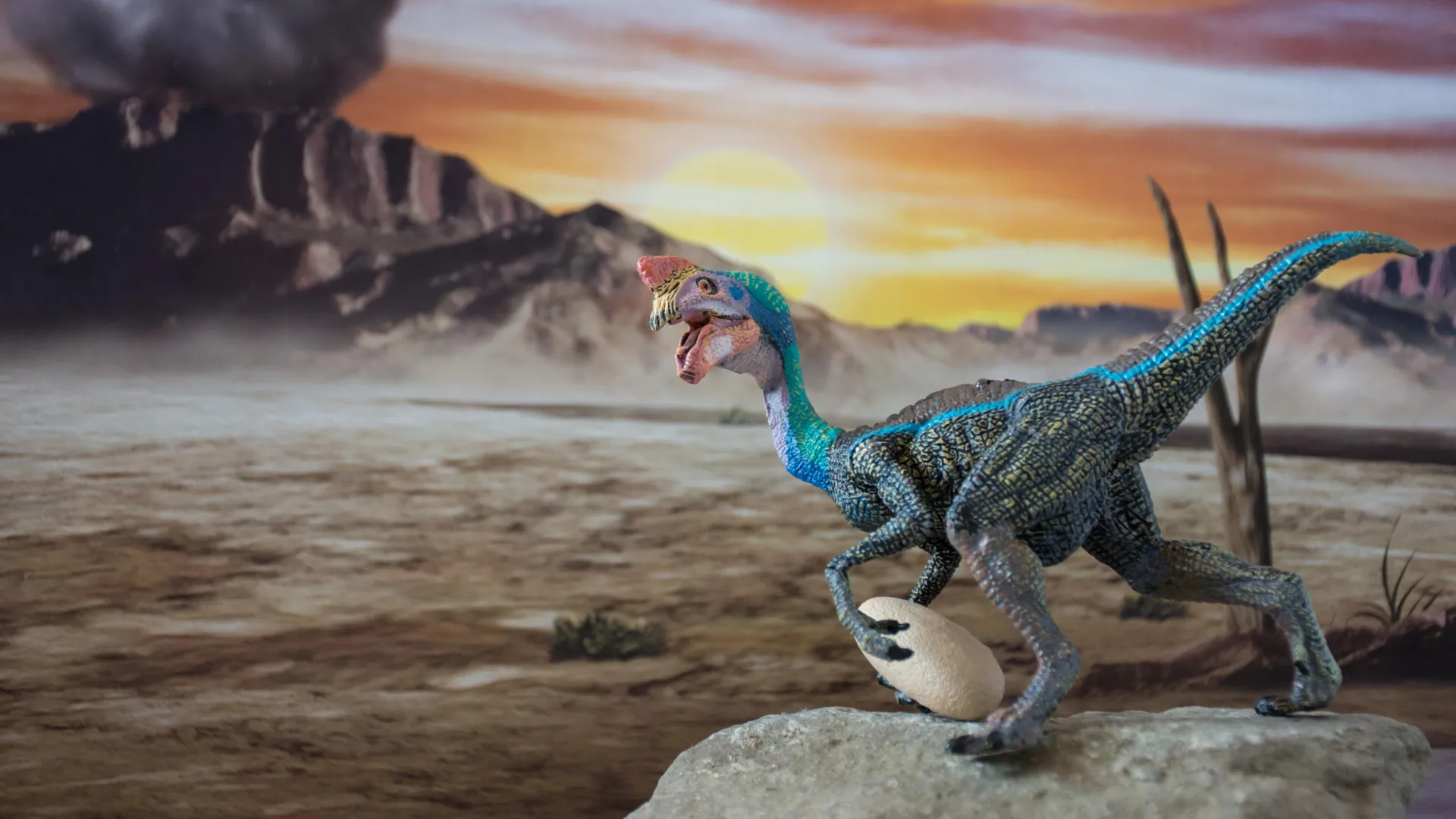
How oviraptors, the enigmatic bird-like yet flightless dinosaurs, nurtured their offspring has long presented a compelling puzzle to paleontologists. For decades, the scientific community has debated whether these Cretaceous-era creatures relied on ambient environmental heat, akin to modern crocodiles and turtles, or provided direct thermal regulation for their eggs, much like contemporary birds. A groundbreaking new study, published in Frontiers in Ecology and Evolution, has cast significant light on this enduring question by meticulously examining oviraptor nesting behavior and its resulting hatching patterns, suggesting a sophisticated "co-incubation" strategy that utilized both parental warmth and environmental conditions.
Unraveling an Ancient Parenting Mystery: The Oviraptor Incubation Enigma
The debate surrounding dinosaur incubation strategies is a cornerstone of paleontology, touching upon fundamental aspects of their physiology, behavior, and evolutionary lineage. For many large dinosaurs, the sheer scale of their bodies made direct brooding, as seen in birds, seem impractical. Early hypotheses often leaned towards reptile-like nesting, where eggs were buried or left in mounds to be warmed by decaying vegetation or solar radiation. However, the discovery of exquisitely preserved oviraptor nests in the Gobi Desert in the 1990s, particularly the iconic specimen "Big Mama" found by the American Museum of Natural History, revolutionized this understanding. These fossils depicted oviraptors in brooding postures, their bodies encircling clutches of eggs arranged in rings, strongly suggesting direct parental care. This revelation effectively debunked the species’ long-held misnomer, "egg thief," and firmly placed them as dedicated parents.
Oviraptors, theropod dinosaurs closely related to birds, became a focal point for understanding the evolution of avian reproductive strategies. Their skeletal anatomy, including pneumatic bones and a bird-like pelvis, further underscored their phylogenetic proximity to modern birds. Yet, the exact mechanics of their incubation remained elusive. Could a dinosaur weighing tens of kilograms effectively transfer heat to dozens of eggs without crushing them or overheating the inner clutch? This new research, spearheaded by a team in Taiwan, sought to answer these questions by bridging the gap between fossil evidence, advanced physics, and experimental biology.
Innovative Methodology: Bridging Paleontology and Engineering
The research team, comprising scientists from Taiwan’s National Museum of Natural Science, led by senior author Dr. Tzu-Ruei Yang, an associate curator of vertebrate paleontology, alongside first author Chun-Yu Su, who contributed to the research while attending Washington High School in Taichung, employed an innovative, interdisciplinary approach. They combined sophisticated heat transfer simulations with meticulous physical experiments to construct a comprehensive model of oviraptor incubation. This dual methodology allowed them to explore scenarios that are impossible to observe directly in the fossil record.
To achieve this, the researchers focused on Heyuannia huangi, an oviraptor species that thrived approximately 70 to 66 million years ago during the Late Cretaceous period in what is now southern China. This particular species was chosen due to the relatively abundant fossil evidence of its nesting behavior, which indicated a body length of about 1.5 meters and an estimated weight of around 20 kilograms – a manageable size for a detailed physical reconstruction. Its characteristic semi-open nests, often arranged in multiple concentric rings of eggs, provided a tangible blueprint for their experimental setup.
The physical model was a testament to the team’s ingenuity. A life-sized torso of Heyuannia huangi was meticulously constructed using a polystyrene foam core and a robust wooden frame, providing structural integrity. This was then padded with layers of cotton, bubble paper, and fabric to realistically mimic the soft tissues and insulating properties of a living dinosaur’s body. The eggs themselves posed a unique challenge, as oviraptor eggs are distinct from those of any living species in their size, shape, and shell thickness. To overcome this, the team custom-fabricated eggs from casting resin, precisely replicating the dimensions and thermal properties believed to be characteristic of real oviraptor eggs. For the experiments, two clutches were arranged in double rings, mirroring the patterns observed in fossilized nests, ensuring the setup closely approximated ancient realities.
"Part of the difficulty lies in reconstructing oviraptor incubation realistically," explained Chun-Yu Su, highlighting the challenges of working with extinct species. "For example, their eggs are unlike those of any living species, so we invented the resin eggs to approximate real oviraptor eggs as best as we could." This dedication to detail was crucial for the validity of their findings, as the thermal properties of the eggs would directly influence heat transfer dynamics.
The heat transfer simulations complemented the physical experiments by allowing the researchers to test various environmental conditions and brooding positions, providing a broader scope of data. By comparing their simulated and experimental findings with known patterns of modern bird incubation, the team could draw meaningful conclusions about the efficiency and characteristics of oviraptor parental care.
Dissecting Incubation Dynamics: Heat, Nest Design, and Hatching Synchronicity
The core of the study involved testing how both the presence of a brooding adult and varying environmental conditions influenced egg temperatures and, consequently, the potential hatching outcomes. The results revealed a complex interplay of factors, pointing towards a less uniform incubation process than typically observed in modern birds.
A significant finding concerned temperature variations within the nest. In simulated colder environmental conditions, when the brooding oviraptor model was present, temperatures in the outer ring of eggs varied by as much as 6°C. Such substantial thermal gradients within a single clutch have profound implications. They strongly suggest that oviraptor eggs would not have hatched synchronously; instead, offspring would have emerged at different times, a phenomenon known as asynchronous hatching. This staggered emergence could present unique challenges for parental care, requiring sustained attention over a longer period, but might also offer survival advantages, such as ensuring at least some offspring survive initial predator attacks or resource scarcity.
Conversely, in warmer simulated environments, the temperature variation within the outer ring of eggs dropped dramatically to approximately 0.6°C. This stark difference suggests that in climates characteristic of the Late Cretaceous, particularly during warmer periods, ambient solar radiation likely played a crucial role in stabilizing and evening out temperatures across the entire clutch. This environmental contribution would have reduced the thermal burden on the parent and could have led to more synchronous hatching patterns during optimal weather.
Dr. Tzu-Ruei Yang elaborated on this concept: "It’s unlikely that large dinosaurs sat atop their clutches. Supposedly, they used the heat of the sun or soil to hatch their eggs, like turtles. Since oviraptor clutches are open to the air, heat from the sun likely mattered much more than heat from the soil." This insight aligns with the physical evidence of oviraptor nests, which were semi-open structures rather than fully buried, exposing the eggs to direct sunlight. The specific architecture of the oviraptor nest – multiple rings of eggs with a central cavity where the parent would sit – further supports the idea of environmental heat playing a complementary role, as the outer rings would be more exposed to solar radiation.
Oviraptors vs. Modern Birds: A Tale of Two Incubation Strategies
A critical component of the study was the direct comparison between oviraptor incubation and the strategies employed by modern birds. The vast majority of avian species today rely on what is known as Thermoregulatory Contact Incubation (TCI). In TCI, the adult bird sits directly on its eggs, using its body heat and specialized brood patches (vascularized, featherless areas of skin) to transfer warmth efficiently and consistently to the entire clutch. For TCI to be effective, several conditions must be met: the adult must maintain continuous contact with all eggs, act as the primary and most consistent heat source, and actively regulate egg temperatures within a narrow optimal range.
The study concluded that oviraptors likely could not meet these stringent conditions for efficient TCI. Their large body size, combined with the distinctive ring-shaped arrangement of their egg clutches, meant that a brooding oviraptor, even in its characteristic posture, would have struggled to maintain consistent, direct contact with every single egg simultaneously. The eggs in the outermost rings, in particular, would have received significantly less direct parental heat.
"Oviraptors may not have been able to conduct TCI as modern birds do," stated Chun-Yu Su. Instead, the research team proposes that oviraptors engaged in a form of "co-incubation." This strategy involved a collaborative effort between the brooding parent, providing some direct warmth, and environmental heat sources, primarily solar radiation, contributing significantly to the overall incubation process. This blended approach represents a crucial evolutionary intermediate between the purely environmental incubation of many reptiles and the highly developed TCI of modern birds.
The researchers also quantified the efficiency of oviraptor incubation, finding it to be "much lower than that of modern birds." This lower efficiency implies a potentially longer incubation period for oviraptor eggs and a less precise control over the developmental temperature of the embryos. However, Dr. Yang was quick to contextualize this finding within an evolutionary framework. "Modern birds aren’t ‘better’ at hatching eggs. Instead, birds living today and oviraptors have a very different way of incubation or, more specifically, brooding," he pointed out. "Nothing is better or worse. It just depends on the environment." This perspective emphasizes that evolutionary success is not about achieving a singular "best" method, but rather about developing strategies optimally suited to a species’ specific ecological niche, physiological constraints, and prevailing environmental conditions. The shift from entirely buried nests, common among earlier dinosaur groups, to the semi-open nests of oviraptors represents an evolutionary trajectory towards greater parental involvement, even if not yet reaching the full TCI capacity of their avian descendants.
Broader Implications for Dinosaur Paleontology and Avian Evolution
This study offers profound insights into several key areas of paleontology and evolutionary biology. Firstly, it significantly advances our understanding of dinosaur parental care and reproductive strategies. By providing a plausible model for oviraptor incubation, the research helps to reconstruct the complex behaviors of these ancient animals, moving beyond mere anatomical description to explore their life histories. It suggests that while oviraptors were dedicated parents, their methods were distinctly different from those of their modern avian relatives, reflecting an intermediate stage in the evolution of parental care.
Secondly, the findings provide a crucial piece of the puzzle regarding the dinosaur-bird evolutionary link. Oviraptors, as advanced theropods, are widely recognized as being very close to the ancestry of birds. Understanding their incubation strategy helps to bridge the gap between purely reptilian incubation and the highly specialized TCI of birds. The co-incubation model suggests an incremental evolution of parental warmth provision, where early bird-like dinosaurs began to supplement environmental heat with their own body heat, gradually leading to the complete reliance on TCI seen in extant birds. This evolutionary trajectory would have been driven by factors such as fluctuating Cretaceous climates, predation pressures, and the energetic demands of rapidly developing embryos.
The study also underscores the growing power of interdisciplinary research in paleontology. By integrating paleontology with physics (heat transfer simulations) and engineering (model construction), the team demonstrated how innovative methodologies can unlock secrets that are otherwise inaccessible from the fossil record alone. This approach opens new possibilities for studying other aspects of dinosaur biology, from biomechanics to physiology, by creating testable, observable models.
However, the researchers also prudently caution about the limitations of their study. Their results are based on a reconstructed nest and modern environmental conditions, which undoubtedly differ from the highly dynamic climate of the Late Cretaceous period. Global temperatures, atmospheric composition, and even solar intensity could have varied significantly 70 million years ago, potentially influencing incubation outcomes. Furthermore, oviraptors likely had much longer incubation periods than modern birds, a factor that could not be fully simulated but would have impacted the overall efficiency and duration of parental investment. Future research could explore these variables through sophisticated paleoclimate modeling, offering an even more refined picture of ancient incubation.
Inspiring the Next Generation of Scientists
Beyond its significant scientific contributions, the study also carries an inspiring message for the scientific community, particularly for aspiring young researchers. Dr. Yang articulated this sentiment, noting, "It also truly is an encouragement for all students, especially in Taiwan. There are no dinosaur fossils in Taiwan, but that does not mean that we cannot do dinosaur studies." This statement highlights the universal nature of scientific inquiry and the power of innovative thinking. It demonstrates that a lack of local fossil resources does not preclude a region from making world-class contributions to paleontology, especially when researchers are willing to embrace new technologies and interdisciplinary approaches.
The collaborative spirit, exemplified by the involvement of a high school student as a first author, further underscores the inclusive and forward-looking nature of modern scientific research. This pioneering work from Taiwan not only reshapes our understanding of dinosaur parenting but also serves as a beacon for future generations, proving that curiosity, ingenuity, and a global perspective can unlock the deepest secrets of Earth’s ancient past.
