
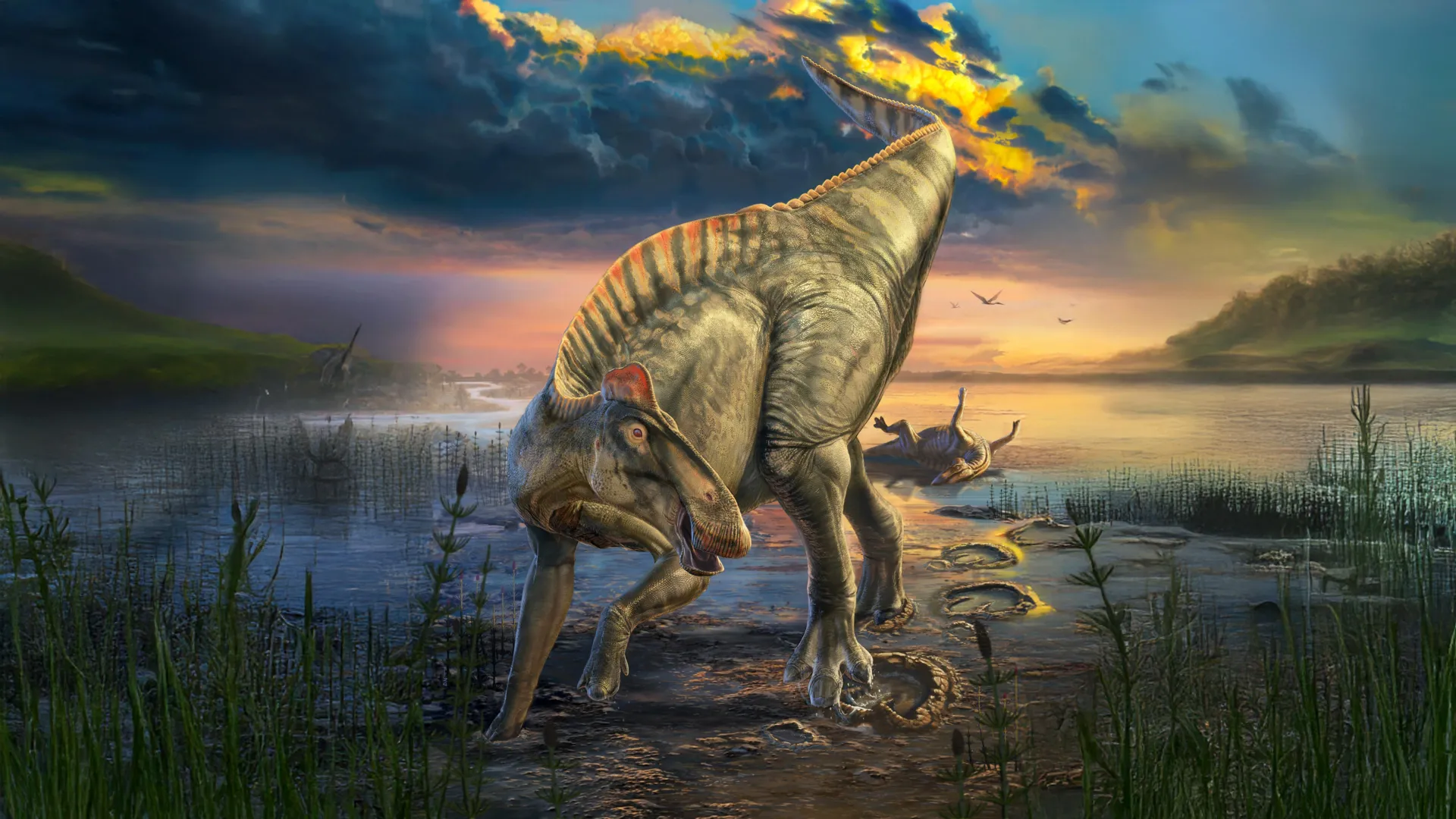
In a landmark paper published in Science, a collaborative team of researchers from the University of Chicago has unveiled the astonishing details of how the bodies of the duck-billed dinosaur Edmontosaurus annectens were transformed into remarkably preserved "mummies" approximately 66 million years ago. This groundbreaking research, which describes a novel process termed "clay templating," offers an unparalleled glimpse into the external anatomy of a large dinosaur, revealing features such as a tall crest, spiked tail, and, most surprisingly, hooves. The findings not only revolutionize our understanding of this specific species but also establish a new paradigm for studying soft tissue preservation in the fossil record.
A Window into the Late Cretaceous: The Mystery of Dinosaur Mummification
For decades, paleontologists have largely relied on skeletal remains to reconstruct the appearance and biology of extinct dinosaurs. While fossilized bones provide crucial information about size, musculature, and locomotion, the delicate soft tissues—skin, scales, crests, and specialized foot structures—rarely survive the harsh processes of decomposition and fossilization. The rare instances of soft tissue preservation, such as skin impressions or isolated fossilized organs, have often been fragmented or two-dimensional, leaving much to speculation. This new discovery, however, presents a complete, three-dimensional "fleshed-out view" of Edmontosaurus annectens, an herbivorous hadrosaurid that roamed North America during the late Maastrichtian stage of the Late Cretaceous period, just prior to the K-Pg extinction event.
The specimens at the heart of this study are not mummies in the traditional sense, like those created by ancient Egyptians with embalming techniques. Instead, they represent an extraordinary natural phenomenon where the outer soft tissues of the animal were preserved as a delicate clay coating. This ultra-thin "mask," less than 1/100th of an inch thick, settled over the skeleton after burial, faithfully capturing the contours and textures of the dinosaur’s external surface. The team’s ability to analyze and digitally reconstruct these fragile templates has allowed for an unprecedented level of precision in depicting Edmontosaurus in life.
Unveiling "Clay Templating": A Unique Preservation Mechanism
The research team, led by senior author Paul Sereno, PhD, Professor of Organismal Biology and Anatomy at UChicago, has meticulously detailed the geological and chemical processes responsible for this exceptional preservation, dubbing it "clay templating." This process diverges significantly from typical fossilization pathways, which usually involve rapid burial in anoxic (oxygen-deprived) environments to prevent decay, followed by permineralization where minerals replace organic material over millions of years.
According to the researchers’ proposed sequence of events, after the Edmontosaurus individuals died, their carcasses likely underwent a period of desiccation, drying out under the sun. This initial drying phase would have helped to stabilize the outer tissues. Subsequently, the bodies were rapidly buried, likely during sudden flash floods common in the ancient riverine environments of Wyoming. Crucially, a microbial film then formed on the outer surface of the carcass. Through electrostatic forces, this film attracted fine clay particles from the surrounding wet sediment, creating a wafer-thin, three-dimensional template that perfectly mirrored the animal’s external shape. Over extended geological timescales, the original soft tissues completely decayed away, leaving behind the clay film and the underlying skeleton, which subsequently fossilized. This clay template acted as a mold, preserving the intricate details of the skin and other external features long after the organic material had vanished.
The discovery of this mechanism is profound, as it offers a new framework for understanding and potentially identifying other instances of similar preservation in the fossil record. It suggests that specific geological and biological conditions—a unique interplay of rapid burial, microbial action, and sediment composition—are essential for the formation of these rare dinosaur "mummies."
Rediscovering Wyoming’s Ancient "Mummy Zone"
The geographical context of these discoveries is as compelling as the scientific findings themselves. The specimens were excavated from a compact "mummy zone" located in east-central Wyoming, an area historically known for rare dinosaur finds. Sereno and his colleagues undertook meticulous detective work, utilizing old field photographs and historical records, to retrace the precise locations where several classic dinosaur mummies had been uncovered in the early 1900s. These early 20th-century finds, while remarkable for their time, lacked the advanced imaging and analytical capabilities available today, meaning their full scientific potential remained untapped.
The rock layers in this region primarily consist of stacked river sands, indicating a dynamic fluvial environment 66 million years ago. Within this re-identified mummy zone, Sereno’s team successfully excavated two new Edmontosaurus mummies: a younger individual and a somewhat older one. Both specimens preserved large, continuous patches of the external skin surface, providing complementary pieces of a paleontological puzzle. These new fossils, combined with the detailed re-examination of historical finds, offered the critical evidence needed to construct a comprehensive, fleshy profile of the animal.
Paul Sereno remarked on the significance of the location, stating, "The badlands in Wyoming where the finds were made is a unique ‘mummy zone’ that has more surprises in store from fossils collected over years of visits by teams of university undergrads." This highlights the importance of sustained field research and the potential for continued discoveries in historically rich paleontological sites.
A Multidisciplinary Toolkit for Unveiling Ancient Life
Revealing the intricate details preserved within these paper-thin clay layers required an advanced, multidisciplinary approach. The research team employed a sophisticated suite of imaging and analytical techniques to investigate the formation and structure of these extraordinary fossils. These methods included hospital and micro-CT scans, which allowed for non-destructive visualization of internal structures and the delicate clay film. Thin sections provided microscopic views of the fossilized material, while X-ray spectroscopy and clay mineral analyses helped identify the chemical composition of the preserving medium. Furthermore, a close study of the surrounding rock layers provided crucial geological context, confirming the environmental conditions at the time of burial.
Fossil Lab manager Tyler Keillor, a co-author on the study, played a pivotal role, leading hours of painstaking preparation to uncover the crucial surfaces without damaging them. The fragility of the clay template meant that traditional preparation methods could easily destroy the very features they sought to reveal.
Postdoctoral scholar Evan Saitta’s group contributed significantly through 3D surface imaging, CT scans, and comparative analyses with fossil footprints from the same geological period. They meticulously traced the preserved soft anatomy, examined the sediments inside and outside the mummy, and even matched the dinosaur’s hooves back into a specific footprint. This cross-referencing between body fossils and trace fossils provided robust validation for their reconstructions. Finally, digital artists worked in close collaboration with the scientists to translate the scientific data into lifelike reconstructions, illustrating how the Edmontosaurus would have looked and moved as it traversed the muddy landscapes of the Late Cretaceous. This interdisciplinary "dream team" approach, combining paleontology, geology, chemistry, advanced imaging, and digital artistry, exemplifies the cutting edge of modern paleontological research.
Astonishing Anatomical Revelations: Crests, Spikes, and Hooves
The detailed reconstruction of Edmontosaurus annectens has yielded several astonishing anatomical discoveries, challenging long-held assumptions about hadrosaurid morphology.
One of the most striking features is a continuous structure running along the center of the dinosaur’s back. It began as a fleshy crest over the neck and torso, a feature previously hypothesized for some hadrosaurs but never definitively documented with such clarity. Over the hips, this crest seamlessly transitioned into a single row of prominent spikes along the tail, with each spike meticulously aligned above a vertebra and fitting neatly with its neighbors. The function of these crests and spikes remains a subject of scientific discussion, but they likely served roles in display (for mate attraction or species recognition), thermoregulation, or even defense against predators like Tyrannosaurus rex, which coexisted with Edmontosaurus.
The team also meticulously documented the dinosaur’s scale patterns. Contrary to some earlier, more generalized depictions, Edmontosaurus exhibited a diverse integumentary covering. The largest polygonal scales were found along the lower body and tail, providing a robust, protective layer. However, the majority of the animal’s body was covered in surprisingly small, pebble-like scales, only 1-4 millimeters across. This is remarkably tiny for a dinosaur that could reach lengths of over 40 feet (approximately 12 meters) and weigh several tons. The presence of fine wrinkles preserved over the ribcage suggests that the skin of this duckbill was relatively thin and flexible, perhaps allowing for greater mobility or aiding in heat dissipation.
The most unexpected and revolutionary discovery, however, came from the larger mummy’s hind feet: this Edmontosaurus had hooves. The tips of each of its three hind toes were enclosed in a distinct, wedge-shaped hoof with a flat underside, strikingly similar to those found on modern horses or rhinoceroses. This finding fundamentally alters our understanding of hadrosaurid locomotion and foot morphology. To confirm this, researchers combined CT scans of the mummified feet with 3D images of the best-preserved duckbill footprint from the same time period. By carefully aligning the bones and soft-tissue impressions with the footprint, they produced a detailed and highly accurate reconstruction of the hind foot. Unlike the forefoot, which made contact with the ground primarily through its hooves, the hind feet also featured a fleshy heel pad located behind the hooves, providing additional support and cushioning for this massive animal.
Sereno emphasized the profound implications of this discovery: "There are so many amazing ‘firsts’ preserved in these duck-billed mummies—the earliest hooves documented in a land vertebrate, the first confirmed hooved reptile, and the first hooved four-legged animal with different forelimb and hindlimb posture." This highlights the evolutionary significance of the finding, pushing back the known timeline for specialized hoofed structures in terrestrial vertebrates and offering new insights into the adaptive strategies of large herbivores. The presence of hooves suggests a lifestyle of sustained terrestrial locomotion, potentially across varied terrain, capable of supporting immense body weight.
Broader Impact and Future Directions for Paleontology
Beyond the specific anatomical revelations, this research provides a comprehensive and practical framework for future studies of dinosaur soft tissue. The authors have outlined new preparation techniques that are sensitive to ultra-fragile structures, established a clear set of terms for describing soft structures and scale types, and detailed a step-by-step imaging pathway from fossil specimen to fleshed-out digital model. Furthermore, they have presented a robust scientific "recipe" for how a dinosaur mummy can form under specific natural conditions.
This work offers more than just a series of isolated findings; it proposes a general model for dinosaur mummification based on clay templating. This model can now be rigorously tested on other fossils that might have undergone similar preservation pathways, potentially leading to the reinterpretation of existing specimens and the identification of new "mummy zones" in other regions. The implications extend to broader paleobiological studies. Accurate external body outlines, now possible through this method, will enable more precise biomechanical studies of dinosaur locomotion, posture, and weight distribution. Researchers can now move beyond skeletal approximations to understand how skin, muscle, and other soft tissues interacted during movement.
The team has already outlined several crucial next steps. These include focused searches for additional specimens exhibiting this rare kind of preservation, not only in the established Wyoming rock layers but also in other potentially suitable geological formations worldwide. Further complementary analyses will aim to understand the precise geochemical and environmental conditions under which clay templating is most likely to occur, refining the predictive power of this model.
Paul Sereno concluded, reflecting on the magnitude of the achievement: "This may be the single best paper I’ve released. From field to lab to 3D reconstructions along with a suite of useful terms defined, it’s a tour de force, and it tells a coherent story about how these remarkable fossils come to be and what we can learn from them." Indeed, this groundbreaking study not only enriches our understanding of a specific dinosaur species but also provides a powerful new toolkit and conceptual framework that promises to unlock further secrets from the vast and enigmatic history of life on Earth. It is a testament to the enduring power of scientific inquiry and the collaborative spirit that drives paleontological discovery.
