
In 1982, cartoonist Gary Larson introduced a famous Far Side comic called Cow Tools. The illustration showed a cow proudly standing next to a strange collection of useless objects labeled as tools. The humor relied on a widely accepted idea that cows lack the intelligence to create or use tools. For decades, this playful jab at bovine intellect resonated because it tapped into a pervasive cultural assumption: cows, as livestock, are simple creatures, primarily driven by instinct and lacking complex cognitive abilities. This perception has historically shaped everything from agricultural practices to scientific inquiry, often placing cattle in a category far removed from animals recognized for their problem-solving skills, such as primates or corvids. The very notion of a cow wielding an object with purpose seemed confined to the realm of absurd humor.
That long-held assumption is now being fundamentally questioned thanks to a real cow named Veronika, whose remarkable abilities are challenging the foundations of animal cognition research. A groundbreaking study published in the esteemed journal Current Biology reports the first documented case of flexible, multi-purpose tool use in a domestic cow, suggesting that cattle may be far more cognitively capable and adaptable than previously believed. This discovery isn’t just an anecdotal curiosity; it represents a significant shift in our understanding of a species that has largely been overlooked in the study of complex animal behaviors.
"The findings highlight how assumptions about livestock intelligence may reflect gaps in observation rather than genuine cognitive limits," explains Alice Auersperg, a cognitive biologist at the University of Veterinary Medicine, Vienna, and a lead author on the study. Her statement underscores a critical point: our understanding of animal intelligence is often constrained by the environments in which we observe animals and the questions we bother to ask. For too long, the cognitive lives of livestock have been simplified or dismissed, leading to a potential blind spot in ethological research.
Veronika: The Unconventional Bovine Companion
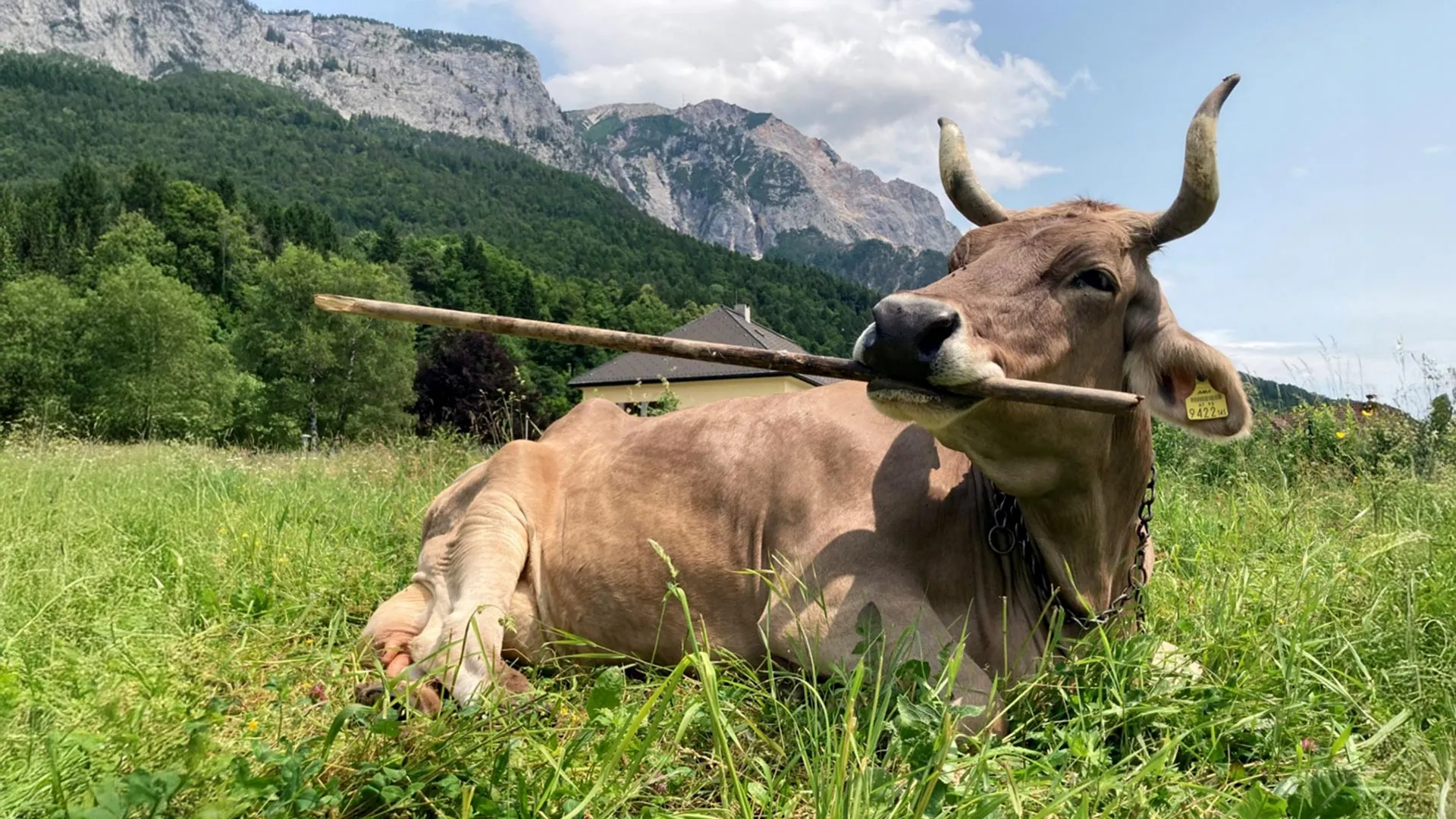
Veronika is no ordinary dairy cow. A Swiss Brown cow, she lives as a cherished companion animal rather than being raised for food production, residing on a picturesque organic farm in Austria. Her owner, Witgar Wiegele, an organic farmer and baker, considers her an integral part of his family. This unique living arrangement—one that provides a rich, stimulating, and low-stress environment—is believed to be crucial to the development and observation of her extraordinary behavior. Unlike typical farm animals whose lives are often characterized by routine, limited interaction, and early culling, Veronika has enjoyed a long, enriched life, fostering an environment ripe for exploration and individual expression.
More than a decade ago, Wiegele first noticed Veronika engaging in an unusual behavior. He observed her picking up sticks and, later, a discarded deck brush, and meticulously using them to scratch various parts of her body that she couldn’t reach with her tongue or hind leg. This wasn’t a one-off event; it was a consistent, purposeful action. Initially, Wiegele, like many, might have simply marvelled at his pet’s cleverness. However, as the behavior persisted and became more refined, he began to document it. The pivotal moment came when he recorded Veronika’s actions on video and shared the footage with researchers, including Auersperg’s team.
"When I saw the footage, it was immediately clear that this was not accidental," Auersperg recalls, her voice conveying the scientific excitement of the discovery. "This was a meaningful example of tool use in a species that is rarely considered from a cognitive perspective, let alone one expected to exhibit such complex behavior." The video evidence provided the initial spark, transforming a farmer’s observation into a subject of serious scientific inquiry.
Rigorous Scientific Validation: Testing Veronika’s Abilities
To move beyond anecdotal evidence and systematically understand Veronika’s behavior, researchers designed a series of structured experiments. Their goal was to determine if her actions truly constituted flexible tool use, rather than a mere conditioned response or random manipulation of objects. They focused on her interaction with a deck brush, an object she frequently employed.
The experimental setup involved placing the deck brush on the ground in various positions and observing how Veronika interacted with it. Across multiple trials, the results were consistent and compelling. Veronika did not simply rub against the brush indiscriminately. Instead, she consistently chose specific parts of the brush—the bristled head or the smoother handle—depending on which area of her body she intended to scratch and the specific type of sensation she desired. Her selections were not random; they precisely matched the needs of different regions of her body, demonstrating an intentional and adaptive approach to using the object.
"We show that a cow can engage in genuinely flexible tool use," states Antonio Osuna-Mascaró, another key researcher on the project. "Veronika is not just using an object to scratch herself. She uses different parts of the same tool for different purposes, and she applies different techniques depending on the function of the tool and the body region." This distinction is crucial in the scientific definition of tool use, elevating Veronika’s actions beyond simple object manipulation to a more sophisticated cognitive process.
Flexible and Multi-Purpose Tool Use: A Rare Feat
The researchers meticulously analyzed Veronika’s interactions with the brush, uncovering clear patterns that underscored the sophistication of her behavior. For larger, firmer areas of her body, such as her back, she consistently preferred the bristled side of the brush, applying robust pressure to achieve a satisfying scratch. In contrast, for more sensitive regions on her lower body or areas requiring a gentler touch, she would deliberately switch to the smoother, less abrasive handle of the brush.
Furthermore, her movements were not uniform. Scratching her upper body involved broader, stronger motions, indicative of a need to cover a larger area and apply more force. Movements directed at lower, more delicate areas were slower, more precise, and often involved careful angling of the brush to reach specific spots. This demonstrated an impressive level of motor control and an understanding of cause and effect, tailoring her actions to achieve a specific, desired outcome.
In ethology, tool use is generally defined as the use of an external object as a means to achieve a goal through physical interaction between the object and the environment or another object. Veronika’s actions clearly meet this definition. However, her behavior goes significantly beyond this basic threshold. Her ability to utilize different features of the same object for different outcomes—what scientists term "flexible, multi-purpose tool use"—places her in an elite category. This type of sophisticated behavior is extremely rare in the animal kingdom and has previously been clearly documented only in a handful of non-human species, most notably chimpanzees, among other primates, and certain bird species like New Caledonian crows. The discovery of such an ability in a cow is thus profoundly significant, expanding the known cognitive capacities of a species long underestimated.
Overcoming Physical Limitations: The Ingenuity of a Bovine
Veronika’s tool use is directed at her own body, a category known as egocentric tool use. While this form is typically considered less complex than using tools on external objects (like a chimpanzee cracking nuts with a stone), it still presents unique and substantial challenges, especially for an animal like a cow. The most apparent limitation is the absence of prehensile hands, which are critical for fine motor manipulation in many tool-using species.
Because cows lack hands, Veronika must manipulate tools using her mouth. Despite this anatomical constraint, she exhibits remarkable dexterity and control. She does not simply mouth the brush; she adjusts her grip, changes the angle, and modifies the pressure with striking precision. This suggests not only a high degree of motor learning but also an apparent ability to anticipate the effects of her actions. She seems to understand how her manipulation of the tool will translate into a specific sensation or action on her body, adjusting her technique to achieve the desired result. This level of intentionality and anticipatory control further strengthens the case for her sophisticated cognitive abilities.
Why This Behavior May Be Rare: The Role of Environment and Enrichment
The researchers believe that Veronika’s unique living conditions have played a crucial role in the development and manifestation of her tool-using behavior. Her life as a companion animal in an enriched environment stands in stark contrast to the typical existence of most cattle. Unlike livestock raised for food production, which often experience confined spaces, limited social interaction beyond their herd, and a relatively short lifespan, Veronika has lived a long, stimulating life. She enjoys daily interactions with humans, access to varied terrain, and a rich array of objects she can explore and manipulate.
These factors likely created unparalleled opportunities for exploration, innovation, and learning that are simply uncommon, if not impossible, for most cows. The absence of chronic stress, the presence of novel stimuli, and the freedom to express natural behaviors likely fostered a cognitive environment where such complex problem-solving could emerge and be refined over time. It suggests that intelligence and complex behaviors are not static traits but can be influenced and developed by environmental conditions.
As the researchers aptly note in their paper, "[Veronika] did not fashion tools like the cow in Gary Larson’s cartoon, but she selected, adjusted, and used one with notable dexterity and flexibility." This distinction is important; while she didn’t create the tool, her use of it demonstrates a level of cognitive complexity previously unimagined for her species. Their conclusion offers a profound challenge to our anthropocentric biases: "Perhaps the real absurdity lies not in imagining a tool-using cow, but in assuming such a thing could never exist."
Rethinking Animal Intelligence and Welfare: Broader Implications
This discovery represents the first confirmed case of tool use in cattle and significantly expands the range of species known to demonstrate this ability. It forces the scientific community, and indeed the public, to re-evaluate long-held assumptions about bovine intelligence and, by extension, the cognitive capabilities of many other species traditionally viewed as "simple" or "unintelligent."
The implications are far-reaching. Firstly, for animal welfare and ethics, if cows possess a higher degree of cognitive complexity and problem-solving ability than previously understood, it strengthens arguments for providing more enriched environments for livestock. The ability to use tools to alleviate an itch, for instance, speaks to a capacity for self-care and agency that should inform discussions on humane treatment and the conditions under which farm animals are kept. It raises questions about the psychological well-being of animals in highly restrictive environments where such innate problem-solving behaviors cannot be expressed.
Secondly, from an evolutionary biology perspective, Veronika’s case adds another layer to our understanding of the distribution and emergence of complex cognitive traits. Tool use is often considered a hallmark of intelligence, linked to advanced cognitive processes like planning, foresight, and understanding of causality. Finding it in a bovine suggests that the evolutionary pathways to such abilities might be more diverse and widespread than currently appreciated, potentially occurring even in species lacking highly specialized appendages like hands. It prompts scientists to look for similar behaviors in other ungulates and livestock species, which may have been overlooked due to observational biases or environmental limitations.
The research team is now actively exploring which specific environmental and social conditions allow such behaviors to develop, hoping to understand the interplay between nature and nurture in cognitive expression. They also encourage others to report similar observations, recognizing that Veronika might not be an anomaly but rather a pioneering example of a more widespread, yet undocumented, phenomenon.
"Because we suspect this ability may be more widespread than currently documented," Osuna-Mascaró states, "we invite readers who have observed cows or bulls using sticks or other handheld objects for purposeful actions to contact us." This open call is a testament to the scientific humility that this discovery inspires. It suggests that the boundaries of animal intelligence are far from settled and that many species, including those we live alongside daily, may hold cognitive secrets waiting to be unveiled, simply requiring us to observe with fresh eyes and an open mind, free from the biases of past assumptions. The saga of Veronika, the tool-using cow, is a powerful reminder that sometimes, the most profound discoveries emerge from the most unexpected places, challenging our perceptions and expanding our understanding of the intricate tapestry of life on Earth.
