
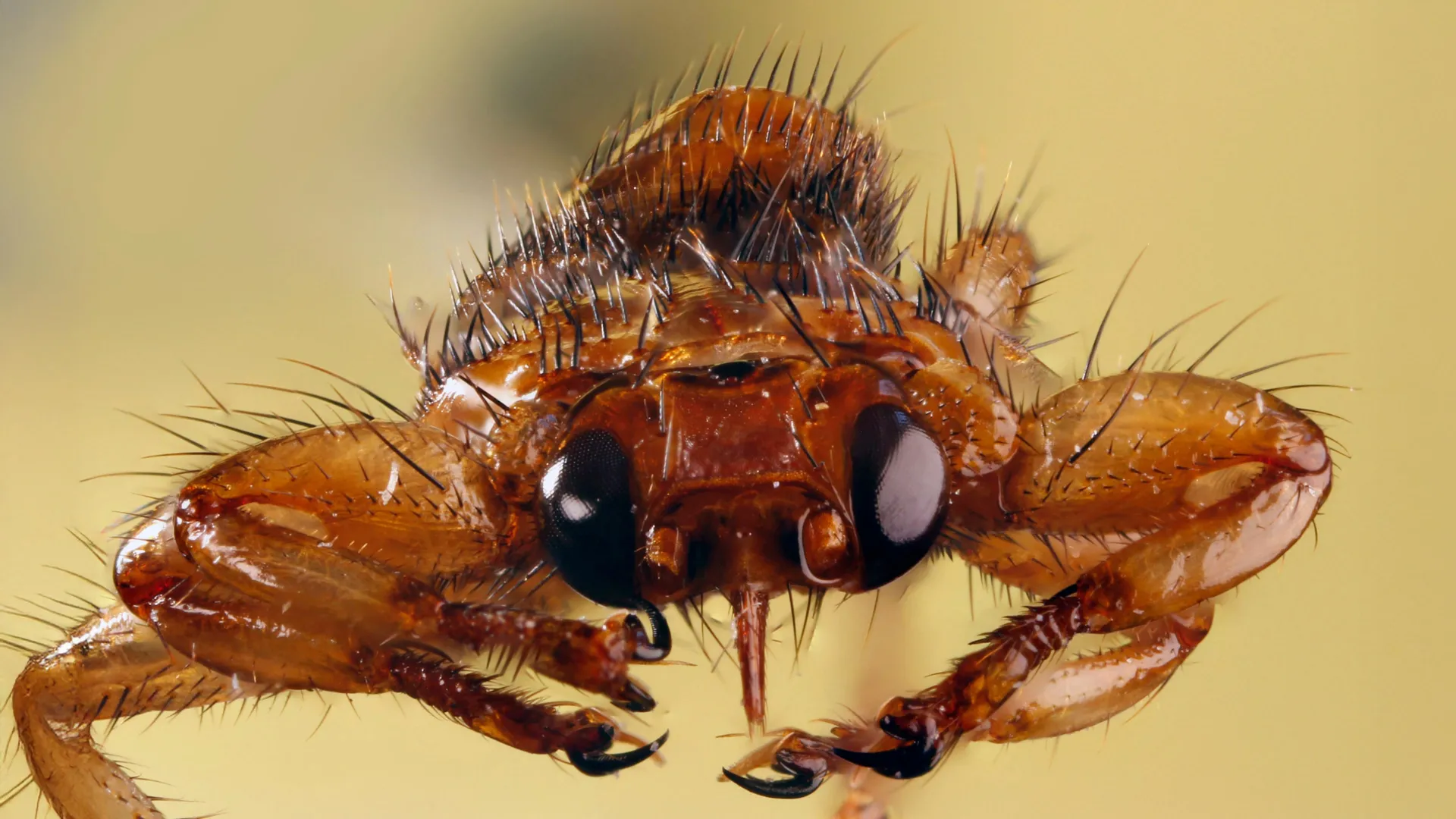
New research reveals that the deer ked, a widespread blood-feeding fly, significantly diminishes its visual sensitivity once it has successfully located and settled on a host, abandoning flight and embracing a permanently parasitic existence. This remarkable physiological adaptation underscores a fundamental principle of evolutionary biology: the efficient allocation of resources to align an organism’s sensory capabilities with its specific lifestyle. Scientists from Aberystwyth University and the University of Florence have meticulously documented this sensory transformation, providing unprecedented insight into how parasites recalibrate their biological machinery for survival.
The Enigmatic Deer Ked: A Global Presence
Deer keds, scientifically classified within the Hippoboscidae family and often referred to by species names such as Lipoptena cervi in Europe and Asia, and Lipoptena depressa in parts of North America, are distinctive biting flies with a fascinating life cycle. Their distribution spans vast geographical regions, encompassing Europe, Asia, Africa, and the Americas, indicating their adaptability to diverse ecological niches. As adults, these insects initiate their lives as winged, highly mobile creatures, employing both flight and keen vision to actively seek out a suitable mammalian host. Their primary targets are cervids, including red deer, roe deer, moose, and elk, with their flattened bodies and specialized claws making them adept at navigating dense fur. However, their host-seeking behavior is not entirely exclusive; they are known to opportunistically target humans, domestic animals such as dogs, horses, and cattle, and even birds, causing irritation and, in cases of heavy infestation, potential dermatitis or anemia.
Unlike many other insects that lay eggs, deer keds exhibit an unusual reproductive strategy known as larviposition. Instead of eggs, the female fly retains the developing larvae internally, nourishing them until they are fully grown and ready to pupate. These pre-pupae are then deposited by the female onto the ground or within leaf litter, where they quickly form a hardened puparium. This pupal stage, often lasting several weeks to months, is crucial for overwintering, particularly in temperate climates. Once environmental conditions are favorable, typically in late summer or autumn, the adult deer ked emerges from its puparium. This winged adult immediately embarks on its mission to locate a host, a period characterized by intense energy expenditure and reliance on its visual and olfactory senses.
A Radical Life Transformation: From Hunter to Permanent Resident
The moment a deer ked successfully lands on a host animal marks a dramatic and irreversible turning point in its life. Within a short period, often mere minutes to hours after attachment, the insect undergoes a profound morphological and behavioral metamorphosis: it permanently sheds its wings. This act of autotomy, the voluntary severing of a body part, is not merely a cosmetic change but signifies a complete commitment to a parasitic existence. Having found its sanctuary within the host’s fur, the deer ked relinquishes its aerial mobility entirely. From this point onward, its life is dedicated to navigating the dense hair, feeding on blood, mating, and reproducing, all while remaining firmly attached to its chosen host. This shift represents a significant energy re-prioritization, moving from the demands of flight and active hunting to the requirements of sustained feeding, digestion, and reproduction in a relatively static environment.
This unique two-phase lifestyle makes deer keds an exceptionally compelling subject for evolutionary biologists. The transition from a free-flying, visually-dependent hunter to a wingless, permanent ectoparasite necessitates a re-evaluation of physiological needs and, consequently, a reallocation of metabolic resources. Such a dramatic shift raises fundamental questions about sensory ecology: how do organisms adapt their sensory systems when their environment and behavioral repertoire change so drastically? The answer, as this latest research suggests, lies in a sophisticated process of sensory downregulation, particularly concerning vision.
Unveiling Sensory Adaptation: The Research Framework
The collaborative research, spearheaded by Dr. Roger Santer from the Department of Life Sciences at Aberystwyth University and involving colleagues from the University of Florence, set out to precisely answer these questions by investigating the changes in the deer ked’s sensory system that accompany its major behavioral shift. The central hypothesis posited that the energetic cost of maintaining a high level of visual acuity would become superfluous, and thus evolutionarily disadvantageous, once the fly had secured a host.
To rigorously test this hypothesis, the research team adopted a comparative approach, studying deer keds at distinct, critical points in their life cycle. Their methodology involved collecting two primary groups of adult flies:
- Winged adults: These were individuals actively searching for hosts, representing the mobile, visually-dependent phase of their life.
- Wingless adults: These were collected directly from deer after they had successfully adopted their permanent parasitic lifestyle, having already shed their wings.
The researchers focused their molecular investigations on a specific class of genes known as opsins. Opsins are light-sensitive proteins found in the photoreceptor cells of the eye. They are fundamental components of the visual system, responsible for converting light into electrical signals that the brain interprets as vision. The activity level of opsin genes directly correlates with the sensitivity and capacity of an animal’s visual system. By comparing the gene activity of these opsins between the free-flying and the wingless parasitic stages, the scientists aimed to quantify the physiological response of the insects’ visual systems to their sudden and profound change in lifestyle. This detailed molecular analysis provided an unprecedented window into the genetic underpinnings of adaptive sensory plasticity.
Dimming the Lights: Evidence of Visual Downregulation
The findings of the study, published in the esteemed Journal of Experimental Biology, were conclusive and shed significant light on the deer ked’s adaptive strategy. Dr. Roger Santer elaborated on the initial observations, stating, "We found that a flying deer ked’s visual system is much like that of a tsetse fly, which famously hunt out mammal hosts in Africa." This comparison is highly significant. Tsetse flies (Glossina species) are renowned for their acute vision and their reliance on visual cues, alongside olfactory signals, to locate their hosts in the complex African savanna environments. They are also notorious vectors of African trypanosomiasis (sleeping sickness in humans, nagana in animals). The implication is that, during its host-seeking phase, the deer ked possesses a sophisticated visual apparatus, optimized for detecting movement, shape, and contrast – essential for spotting a large mammal from a distance.
However, the dramatic change occurred after host attachment. Dr. Santer continued, "After a deer ked loses its wings and becomes an ectoparasite, activity of its opsin genes reduces to around half the previous level. This suggests that the flies do not lose vision entirely, but that their visual sensitivity is reduced. We think the fly might be sacrificing sight to conserve energy for functions such as digestion and reproduction." The quantified reduction in opsin gene activity, approximately 50%, is a stark indicator of a deliberate physiological adjustment. It implies that the neural and metabolic machinery required to maintain full visual processing capacity is significantly scaled back.
Crucially, the research indicates a reduction in visual sensitivity rather than complete blindness. While navigating the dense, often dark, environment of animal fur, rudimentary vision might still be beneficial for avoiding obstacles (like skin folds or matted hair) or even detecting light changes, but the high-resolution, long-range vision necessary for aerial host-seeking becomes largely redundant. The energy saved from maintaining and operating such an energetically demanding visual system can then be reallocated to other vital biological processes.
Energetic Trade-offs and Evolutionary Efficiency
The principle of energetic trade-offs is a cornerstone of evolutionary biology. Every biological function, from growth and movement to sensory perception and reproduction, incurs a metabolic cost. Organisms face constant pressure to allocate their limited energy resources in ways that maximize their survival and reproductive success in their specific environment. For the deer ked, the shift from an active, mobile hunter to a sessile, permanent parasite represents a radical change in its energetic landscape.
Flight is one of the most energetically expensive activities for insects, requiring significant metabolic investment in muscle development, neural control, and sustained physiological processes. Similarly, maintaining a highly sensitive visual system, with its complex photoreceptor cells, neural processing centers, and continuous regeneration of photopigments, also demands substantial energy. Once the deer ked sheds its wings, the energy previously devoted to flight muscles and their maintenance can be repurposed. The concomitant reduction in visual sensitivity further augments these savings.
The researchers hypothesize that this conserved energy is redirected towards functions that become paramount for its parasitic lifestyle:
- Digestion: Continuous blood feeding requires efficient digestive enzymes and metabolic pathways to process the nutrient-rich, but often challenging, blood meal.
- Reproduction: As a permanent parasite, the female deer ked’s primary role is to produce offspring. Energy allocation to oogenesis (egg development) and larviposition is critical for propagating the species.
- Immune Response: Living on a host means constant exposure to the host’s immune system and potential pathogens, necessitating a robust immune defense.
This adaptive strategy exemplifies phenotypic plasticity at a molecular level, where gene expression patterns dynamically respond to environmental and behavioral changes. It is a testament to the finely tuned nature of natural selection, which favors organisms that can efficiently match their physiological investments to their current ecological demands.
Expert Perspectives and Broader Scientific Context
Dr. Santer’s insights highlight the elegance of this evolutionary solution. The study provides a compelling example of how sensory systems are not static but are plastic and adaptable, evolving under specific environmental pressures. Beyond the immediate findings, the research resonates with broader themes in sensory ecology and evolutionary biology.
Experts in the field of insect physiology and parasitology are likely to view this study as a significant contribution to understanding convergent evolution in parasitic lifestyles. While many parasites exhibit reduced or lost sensory organs over evolutionary time (e.g., cave-dwelling organisms or endoparasites with rudimentary eyes), the deer ked offers a rare and clear example of an individual organism actively downregulating a sensory system within its own lifetime in response to a life-history switch. This demonstrates a level of adaptability that is not merely genetic over generations but also phenotypic within an individual’s existence.
The Journal of Experimental Biology, where the findings were published, is a highly respected peer-reviewed scientific journal focusing on comparative physiology and biomechanics. Its rigorous editorial process ensures that published research is of high quality and scientific merit, lending significant credibility to the deer ked study. The publication in such a prominent journal underscores the novelty and importance of this investigation for the wider scientific community.
Implications for Parasitology and Pest Management
While deer keds are primarily a nuisance parasite and not major vectors of severe human diseases, the insights gained from this study have broader implications, particularly for the fields of parasitology and pest management. Understanding how biting flies, especially those with complex life cycles, utilize and adapt their sensory systems is crucial for developing more effective monitoring and control strategies for other, more medically significant, insect vectors.
For example, many blood-feeding insects, such as mosquitoes, sandflies, and tsetse flies, rely heavily on a combination of visual, olfactory, and thermal cues to locate their hosts. If a similar energetic trade-off and sensory downregulation were found in different life stages or environmental contexts of these vector species, it could fundamentally alter how we approach their control.
- Targeted Traps: Knowing that visual sensitivity changes post-host-seeking could influence the design of traps. Traps aimed at free-flying individuals might need to optimize visual attractants (e.g., color, shape, contrast), whereas monitoring methods for already-established parasites might need to focus on different cues or mechanical capture.
- Repellents: Understanding the sensory hierarchy could inform the development of repellents that specifically target the most critical sensory modalities during the host-seeking phase.
- Monitoring Strategies: Different life stages of a pest might require different monitoring approaches. For deer keds, visual traps might be highly effective for newly emerged adults, but irrelevant for those already established on a host. This differentiation could lead to more efficient and resource-conscious pest management programs.
The study also provides a model system for exploring the genetic and molecular mechanisms underlying such rapid and profound sensory plasticity. Deciphering these mechanisms could open avenues for novel control methods that interfere with these adaptive switches, potentially disrupting the parasite’s life cycle.
The Future of Sensory Ecology Research
This pioneering research on deer keds undoubtedly opens several new avenues for future investigation. The immediate questions that arise include:
- Other Sensory Modalities: How do other sensory systems, such as olfaction (smell), mechanoreception (touch), and thermoreception (temperature sensing), adapt during this transition? Do they become enhanced to compensate for reduced vision, or do they also undergo specific reconfigurations?
- Morphological Changes: Are there any accompanying morphological changes in the eyes themselves, such as a reduction in ommatidia (individual visual units of a compound eye) or changes in retinal structure, that complement the gene expression downregulation?
- Precise Energetic Savings: Can the precise energetic savings from visual downregulation be quantified and compared to the energy demands of increased digestion and reproduction?
- Genetic Regulatory Networks: What are the specific genetic regulatory networks and signaling pathways that control the downregulation of opsin genes? Identifying these could offer deeper insights into the molecular control of phenotypic plasticity.
The deer ked, once primarily known as a peculiar biting fly, has now emerged as a significant model organism for understanding the intricate dance between an animal’s lifestyle, its sensory perception, and the evolutionary pressures that shape its biology. This study serves as a compelling reminder that adaptation is a dynamic, ongoing process, constantly optimizing life for survival in a changing world.
