

The persistent challenge of maintaining meaningful connections with beloved companions during periods of absence has been significantly addressed by innovative technological solutions, as demonstrated by the ongoing work of renowned animal cognition researcher Dr. Irene Pepperberg. In a recent reflection on her experience, Dr. Pepperberg highlights the unexpected yet profound effectiveness of video calls in sustaining her relationship with Griffin, her highly intelligent African grey parrot, during her travels. This practice, initially an experiment, has evolved into a crucial tool for mitigating the emotional impact of separation on both herself and her avian companion.
Dr. Pepperberg, a celebrated figure in the study of avian intelligence, particularly for her groundbreaking work with the late Alex the African grey parrot, has long understood the importance of consistent, interactive engagement for these highly social and cognitively complex birds. Her decision to implement video calls while away from her lab stems from a deep-seated commitment to Griffin’s well-being and a desire to prevent the perceived abandonment that can lead to behavioral changes.
The Evolution of Connectivity: From Experiment to Essential Tool
The genesis of this technological intervention can be traced back several years to Dr. Pepperberg’s initial exploration of using video conferencing platforms to connect with her parrots. While she had previously written about this intention, the full impact and consistent application of this strategy have only recently been fully realized and documented. The initial experiment has since transformed into a reliable method for preserving the unique bond she shares with Griffin.
"I realize now that I never followed up on what has turned out to be a very effective way of keeping in touch when I’m not in town," Dr. Pepperberg noted in her reflection. This sentiment underscores the organic and adaptive nature of her approach, driven by practical necessity and observed positive outcomes.
Navigating the Logistical Challenges of Global Travel
Dr. Pepperberg’s travel schedule, once characterized by frequent excursions, has seen a significant reduction following her 75th birthday. This personal milestone prompted a deliberate shift towards a more sustainable pace, with her current travel generally limited to approximately one trip per month. However, the inherent unpredictability of conference scheduling means that extended absences from her lab remain a reality.
During these periods away, Griffin is well-cared for by a dedicated team of research associates who ensure his daily needs are met. Nevertheless, Dr. Pepperberg prioritizes ensuring Griffin understands that her absence is temporary and not a form of personal abandonment. This psychological reassurance is a primary driver for her commitment to regular video contact.
The feasibility of these calls is heavily influenced by geographical location and the associated time differences. Within the United States, coordinating a call is relatively straightforward, typically involving a minor time differential of no more than three hours. This allows for ample flexibility to connect with Griffin before his 8:00 PM bedtime.
However, international travel presents considerably more complex logistical hurdles. Destinations like Dubai, with an eight-hour time difference, or Japan, with a thirteen-hour difference and the added complication of crossing the international dateline, necessitate meticulous planning. In such scenarios, very narrow windows of opportunity exist for successful communication. Dr. Pepperberg has recounted instances where she has resorted to using a colleague’s car as an internet "hot spot" to facilitate these crucial calls, illustrating the lengths to which she will go to maintain this connection. These unusual circumstances have also provided enjoyable moments for her colleagues, who have expressed delight in observing Griffin.
Decoding Griffin’s Perception of the Virtual Encounter
A central question surrounding these video calls revolves around Griffin’s actual perception and understanding of the medium. While parrots possess advanced visual capabilities, including the ability to see in the ultraviolet spectrum, the cameras on standard mobile devices are optimized for human visual perception. Dr. Pepperberg acknowledges that the visual components of human faces, unlike the vibrant colors and patterns of parrot feathers, likely possess minimal or no ultraviolet elements. This suggests that Griffin is likely viewing a reasonable, albeit not entirely identical, representation of her on the screen.
Furthermore, the auditory recognition of her voice during these calls remains a subject of scientific inquiry. It is possible that Griffin associates the sounds emanating from the device with Dr. Pepperberg, given that she is the primary individual who initiates these video interactions with him.
Despite these uncertainties, the behavioral responses observed from Griffin are overwhelmingly positive and indicative of a meaningful connection. He consistently lowers his head to the screen, a gesture interpreted as offering "kisses," and engages with the virtual representation of his caregiver. Crucially, Dr. Pepperberg has noted that Griffin has learned to refrain from requesting "tickles" from the phone, demonstrating a nascent understanding that she is not physically present and therefore unable to fulfill such requests. This cognitive development suggests a level of comprehension regarding the limitations of the virtual interaction.
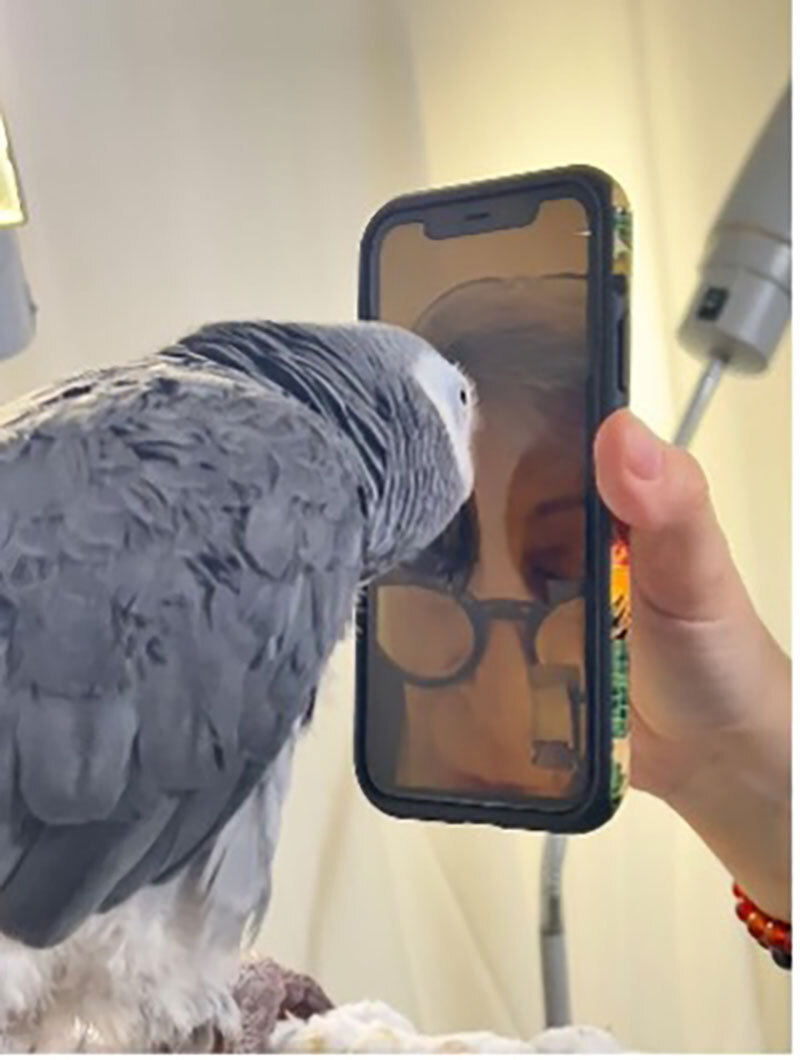
"In any case, he seems to find the experience as something positive and absolutely not aversive, and I definitely like to see how he is looking in my absence," Dr. Pepperberg stated. The ability to visually monitor Griffin’s condition and demeanor while away provides her with significant peace of mind.
Assessing the Efficacy: A Substitute, Not a Replacement
Dr. Pepperberg candidly assesses the efficacy of video calls, distinguishing between their role as a substitute and their inability to replace genuine physical presence. While a ten-minute video call cannot replicate the hours of physical contact, including tactile stimulation, preening, and shared quiet moments that Griffin experiences when she is present, it undeniably offers a significant benefit over complete disconnection.
"So, is a phone call a good substitute for my presence? Not really," she admitted. "When I am in town, Griffin will spend at least an hour a day on my hand, getting tickles and preening himself; we spend additional time together in sessions, and while he eats his afternoon birdy snacks, he likes to have me nearby, eating my human snacks (things like carrots, which he absolutely hates—so no sharing!). None of those things can be replaced by 10 minutes on a phone."
However, she emphatically concludes, "But is a video call better than nothing? For sure."
Mitigating Post-Travel Reintegration Challenges
The positive impact of these video calls is particularly evident upon Dr. Pepperberg’s return. She reports a marked reduction in the "cold wing" treatment—a behavioral response characterized by indifference or avoidance—that Griffin might otherwise exhibit after her prolonged absence. If such behavior does occur, its duration is significantly shortened. This suggests that the regular virtual contact helps to maintain a continuous sense of connection, smoothing the reintegration process.
Consequently, Dr. Pepperberg is highly motivated to incorporate these calls into her travel itinerary, often structuring her day around the limited windows of opportunity to "phone home." This prioritization reflects the deep value she places on preserving her relationship with Griffin, even amidst demanding travel schedules.
Her experience draws a parallel to the broader societal experience during the COVID-19 pandemic. Reflecting on the widespread use of platforms like Zoom for connecting with friends and family, Dr. Pepperberg acknowledges the limitations of virtual interaction in replacing physical intimacy. Yet, she also recognizes the profound comfort and emotional support derived from maintaining contact, sharing news, and seeing loved ones’ faces during periods of isolation. "Even when such scheduling is truly difficult, I remind myself how much I both appreciated and disliked ZOOM calls with friends and family during COVID: Nothing could replace a real hug, but sharing news and seeing the faces of loved ones certainly made life a bit less miserable!" she concluded.
Broader Implications for Human-Animal Bonds and Animal Welfare
Dr. Pepperberg’s pioneering use of video calls with Griffin has implications that extend beyond her individual research and personal connection. It offers a tangible, evidence-based approach for pet owners and animal caregivers who face similar challenges due to travel, work commitments, or other forms of separation. The success of this method underscores the cognitive and emotional capacities of animals, particularly highly intelligent species like parrots, and highlights their need for ongoing social and psychological stimulation.
This practice can be seen as a significant advancement in animal welfare strategies, particularly for companion animals. As our understanding of animal sentience grows, so too does the imperative to develop innovative methods for ensuring their emotional well-being even when physical presence is not possible. The technology, readily available to a large segment of the population, offers a scalable solution for maintaining bonds and reducing the stress associated with separation.
The research also subtly contributes to the ongoing scientific discourse surrounding animal cognition. By observing Griffin’s responses and learning, Dr. Pepperberg continues to gather data on how these animals perceive and interact with technology. While the exact mechanisms of Griffin’s understanding are still being explored, the consistently positive outcomes suggest that these virtual interactions are perceived as beneficial, reinforcing the idea that animals can adapt and form meaningful connections through mediated communication.
Further research could explore the long-term effects of such consistent virtual interaction on animal behavior, cognitive development, and overall welfare. Investigating the specific visual and auditory cues that are most effective for different species could also lead to more refined and targeted applications. As technology continues to evolve, the potential for even richer and more nuanced forms of mediated communication with our animal companions remains an exciting frontier in both scientific inquiry and the strengthening of human-animal bonds.
