
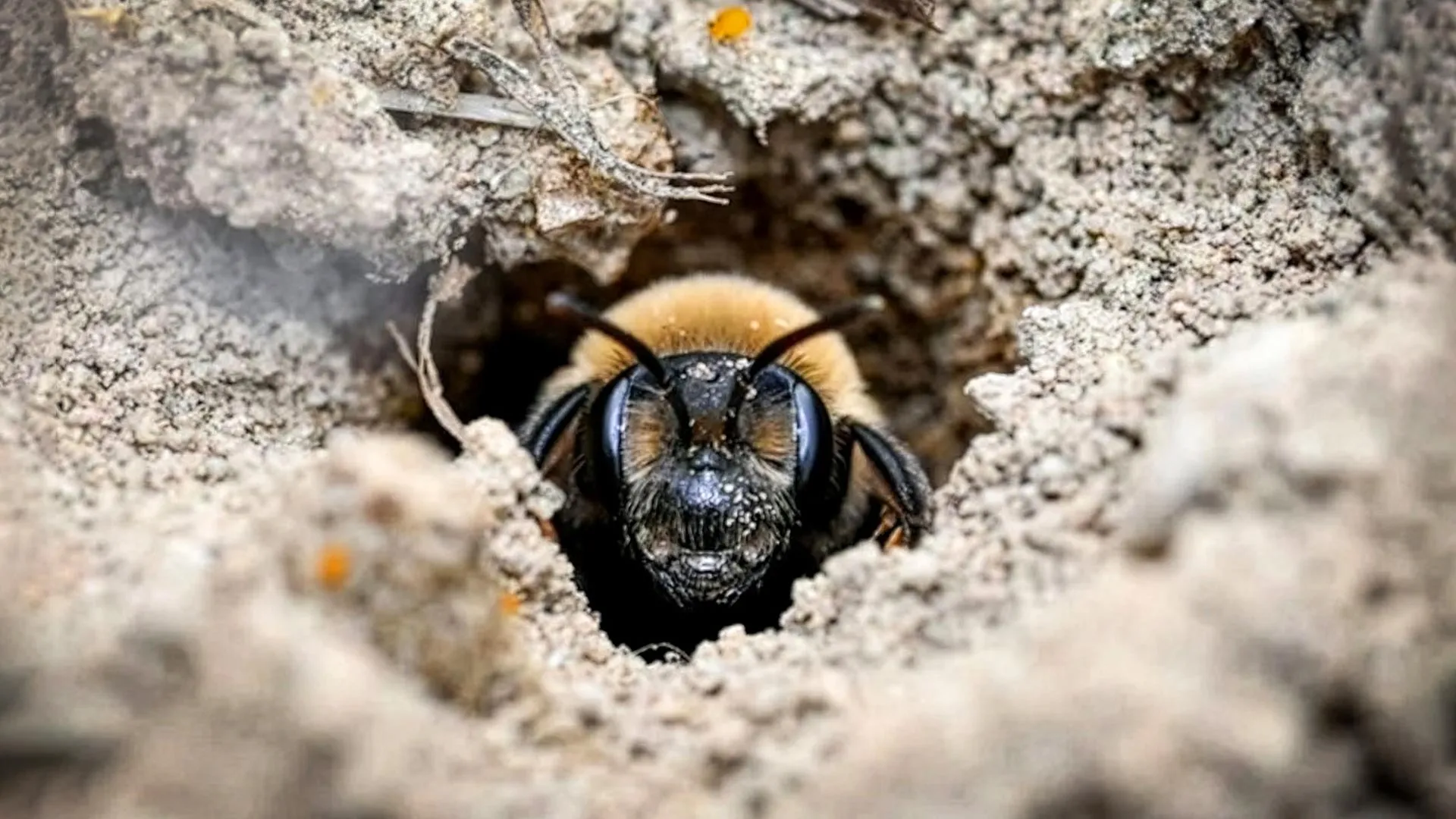
Ithaca, NY – What began as a casual observation during a daily commute has culminated in the extraordinary discovery of one of the largest and oldest known aggregations of ground-nesting bees ever documented. Rachel Fordyce, then a lab technician at a Cornell University entomology lab, regularly traversed East Lawn Cemetery on her walk to work in the spring of 2022. It was during one of these routine passages that she noticed an unusual abundance of bees across the cemetery grounds. Her curiosity, coupled with scientific rigor, ultimately led to the uncovering of a vast, subterranean bee metropolis, housing an estimated 5.5 million individual "regular mining bees" (Andrena regularis) within a mere 1.5-acre area. This staggering figure is comparable to over 200 honeybee hives and far surpasses the human population of Manhattan by more than threefold, highlighting a remarkable example of urban biodiversity thriving in an unexpected sanctuary.
The initial encounter took place in the verdant, peaceful setting of East Lawn Cemetery, a historic site dating back to 1878. Fordyce, a keen observer, collected several specimens in a jar and promptly brought them to her supervisor, Bryan Danforth, a distinguished professor of entomology in Cornell’s College of Agriculture and Life Sciences. "These are all over the cemetery," she reported, underscoring the sheer density of the insects. Subsequent identification confirmed the species as Andrena regularis, a solitary wild bee known for nesting underground and playing a crucial role in the pollination of both agricultural crops and wild plants. This seemingly simple observation served as the catalyst for a comprehensive research endeavor, shedding light on the biology of these often-overlooked pollinators and the unique ecological value of urban green spaces.
A Deep Dive into the Discovery’s Chronology and Methodology
Following Fordyce’s initial sighting in the spring of 2022, the scientific inquiry quickly escalated. Professor Danforth recognized the potential significance of the observation, leading to the involvement of undergraduate researcher Steve Hoge ’24, who would later become the lead author of the study. Hoge undertook the challenging task of researching Andrena regularis, a species for which surprisingly little scientific information was readily available, with many detailed references dating back to 1978. This presented the Cornell team with a unique opportunity to significantly enhance the scientific understanding of this particular bee’s biology, behavior, and ecological role.
To accurately estimate the immense bee population and study their emergence patterns, the research team developed and deployed an innovative monitoring method utilizing specialized emergence traps. These small, mesh tents, each covering less than a square meter of ground, are designed to funnel emerging insects into glass jars, allowing for precise collection and counting. Bryan Danforth elaborated on the efficacy of this approach, stating, "You capture a whole community of animals coming out of the ground with this approach."
Between March 30 and May 16, 2023, the researchers strategically placed 10 such traps throughout the designated 1.5-acre section of the cemetery. Over this period, they meticulously collected 3,251 insects, representing 16 distinct species of bees, beetles, and flies. Critically, Andrena regularis overwhelmingly dominated these samples, confirming the species’ extraordinary prevalence within the site. Based on the number of bees captured in each trap, the team calculated the average bee density across the cemetery’s approximately 6,000 square meters. These calculations yielded an estimated total population ranging from about 3 million to 8 million bees, with an average, conservative estimate settling at a staggering 5.5 million. The findings were subsequently published on April 13, 2024, in the esteemed scientific journal Apidologie, bringing this remarkable discovery to the global scientific community.
The traps also offered fascinating insights into the emergence timing of the bees, revealing a distinct sexual dimorphism. Male Andrena regularis were observed emerging first during warmer periods in April, preceding the females by several days. Steve Hoge explained the evolutionary advantage of this pattern: "The males come out first and wait for the females, so that they have the best opportunities to mate and pass on their genes." This pre-emergence of males ensures prime mating opportunities, a common reproductive strategy among many insect species.
The East Lawn Cemetery: An Unlikely Biodiversity Hotspot
The study extends beyond a mere population count; it delves into the critical question of why East Lawn Cemetery has become such an extraordinary haven for Andrena regularis. Historical records indicate that A. regularis has maintained a presence at the cemetery since at least the early 1900s, suggesting a long-standing ecological relationship with the site. The cemetery itself, established in 1878, offers a unique combination of environmental factors conducive to supporting such a massive aggregation of ground-nesting bees.
Professor Danforth highlighted the broader implications of the findings, emphasizing that the research "elevates the value of solitary ground-nesting bees and shows just how abundant these bees are, how important they are as crop pollinators, and that we need to be aware of these nest sites and preserve them." This statement underscores the often-underestimated ecological importance of solitary bee species, which, despite receiving less public attention than their social counterparts like honeybees, constitute the vast majority of bee diversity.
Scientists contend that the discovery at East Lawn Cemetery strengthens the growing body of evidence that cemeteries, particularly older ones located in urban or suburban environments, can serve as vital refuges for biodiversity. These green spaces are typically characterized by minimal human disturbance, a relative lack of pesticides, and stable ground conditions—all factors that create ideal nesting habitats for ground-nesting insects. Unlike actively managed agricultural lands or residential areas, cemeteries often maintain large tracts of undisturbed soil, providing the necessary substrate for bees to excavate their underground nests.
Keven Morse, the superintendent of East Lawn Cemetery, whose family has managed the nonprofit cemetery for 46 years, corroborated the site’s rich biodiversity. He reported observing a wide array of wildlife, including deer, geese, hawks, foxes, and coyotes, alongside countless bees. Morse also shared a personal anecdote regarding the bees, stating, "And of course, bees, which he said have never stung him." This observation is significant, as Andrena regularis, like many solitary bees, is non-aggressive and poses little threat to humans, a point often misunderstood by the public who associate all bees with stinging behavior. Morse further acknowledged the bees’ substantial presence, noting, "I just felt bad having to mow in certain areas. There’s probably three or four sections where they really migrate heavy, there’s a lot of them." This informal observation from the groundskeeper aligns perfectly with the scientific findings of high-density aggregation.
Beyond the general characteristics of cemeteries, specific environmental factors at East Lawn likely contribute to its suitability for A. regularis. The bees prefer sandy soil, which the cemetery contains in large amounts. This soil type is ideal for excavation and provides good drainage, preventing waterlogging of underground nests. Furthermore, the proximity of Cornell Orchards, located approximately one-third of a mile from the cemetery, provides an abundant and consistent food source in the form of spring flowers, particularly apple blossoms. Andrena regularis overwinters as adults, a relatively rare trait among bees, and emerges early in the spring, precisely timed with the apple bloom in New York, typically in April when daytime temperatures consistently reach around 70 degrees Fahrenheit. This synchronized emergence with a major agricultural crop highlights their immense value as pollinators.
The Unsung Heroes of Pollination: Solitary Ground-Nesting Bees
While honeybees (Apis mellifera) often dominate public discourse and conservation efforts surrounding pollinators, they represent only a tiny fraction of global bee diversity. Approximately 75% of all bee species are solitary ground-nesters, much like Andrena regularis. As Professor Danforth succinctly put it, "It’s the most common lifestyle for bees." These solitary bees do not live in colonies with queens and workers; instead, each female constructs her own nest, typically an underground burrow, where she lays eggs in individual cells provisioned with pollen and nectar. The larvae then develop beneath the surface, undergoing metamorphosis before emerging as adults.
The ecological and economic importance of these wild pollinators cannot be overstated. Globally, insect pollination contributes an estimated $217 billion to the economy annually, with wild bees accounting for a significant portion of this value. In New York State, the apple industry alone is a multi-million dollar enterprise, heavily reliant on effective pollination. Andrena regularis plays a critical role in this agricultural ecosystem, ensuring the successful setting of fruit. The discovery at East Lawn Cemetery underscores the vast, often unseen, network of biodiversity that supports our food systems and natural environments. It serves as a powerful reminder that conservation efforts must extend beyond charismatic megafauna and well-known species to encompass the intricate web of lesser-known, yet equally vital, organisms.
Challenges and the Path Forward for Conservation
The study also documented instances of brood parasitism by nomad (or "cuckoo") bees (Nomada imbricata) within the Andrena regularis aggregation. These parasitic bees exhibit a cunning strategy: they wait until A. regularis females have meticulously prepared their underground brood cells, then surreptitiously lay their own eggs inside. Once the nomad larvae hatch, they mercilessly kill the host bee larvae and consume the stored pollen and nectar, hijacking the resources intended for the mining bees. This natural challenge highlights the complex ecological dynamics at play within even seemingly stable populations and underscores the constant pressures faced by wild bee species.
The implications of this discovery are profound, particularly in the context of global pollinator decline. Habitat loss, pesticide use, and climate change pose significant threats to bee populations worldwide. The identification of such a massive and long-standing aggregation of Andrena regularis at East Lawn Cemetery offers a beacon of hope and a crucial lesson in conservation. It demonstrates that seemingly ordinary urban green spaces can harbor extraordinary biodiversity and serve as critical refuges.
Recognizing the urgent need to identify and protect similar nesting sites, Professor Danforth and his colleagues have launched a global citizen science initiative. This program encourages individuals worldwide to report any ground-nesting bee aggregations they encounter, leveraging public participation to expand the scope of ecological monitoring and conservation efforts. "These populations are huge, and they need protection," Danforth emphasized. "If we don’t preserve nest sites, and someone paves over them, we could lose in an instant 5.5 million bees that are important pollinators." This stark warning underscores the fragility of these ecological treasures and the critical importance of informed land management decisions.
The research conducted by the Cornell team was made possible through the generous support of several key funding bodies, including the Cornell Atkinson Center for Sustainability, the National Science Foundation, and the Federal Capacity Funds program. The collaborative effort involved not only Rachel Fordyce and Bryan Danforth but also postdoctoral researchers Jordan Kueneman and Katherine Odanaka, undergraduate students Steve Hoge ’24 and Cassidy Dobler ’26, further exemplifying Cornell’s commitment to cutting-edge ecological research and the training of future scientists.
The discovery at East Lawn Cemetery stands as a testament to the hidden wonders of the natural world, often thriving in plain sight. It challenges conventional notions of urban landscapes as ecological deserts and instead reveals their potential as vital havens for biodiversity. As we grapple with the ongoing challenges of environmental degradation, findings like these offer invaluable insights into the resilience of nature and provide a clear roadmap for targeted conservation strategies, emphasizing the protection of critical habitats, even in the most unexpected of places. The bustling underground city of Andrena regularis in an Ithaca cemetery serves as a powerful symbol of the intricate balance of ecosystems and the enduring importance of every single species, no matter how small or overlooked.
