
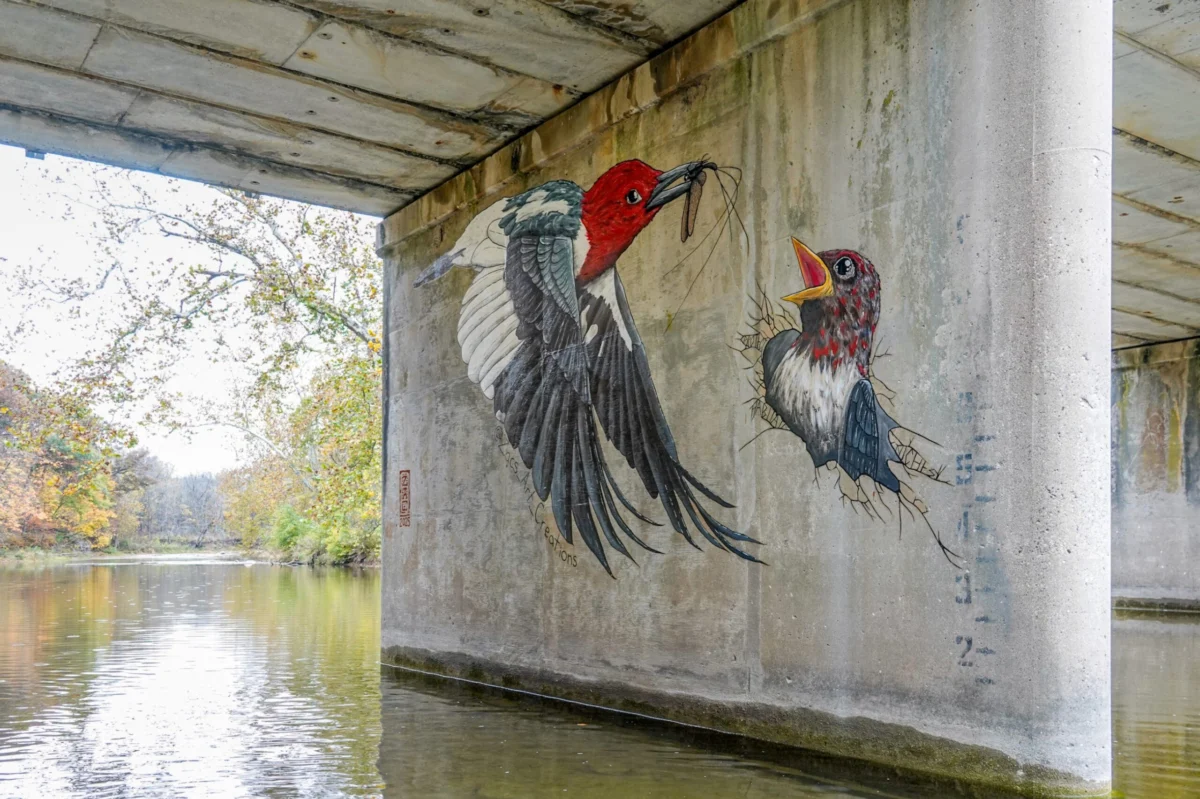
The concrete pillars supporting the Twin Bridges over Big Pine Creek in Warren County, Indiana, have been transformed into a living gallery of local ecology. On October 7, 2025, the unveiling of a striking, high-contrast mural depicting a Red-headed Woodpecker signaled a new chapter for the Wabash River corridor. This installation, created by artist Zac Cody as part of the Audubon Mural Project, serves as more than just a public art piece; it is a visual manifesto for land conservation, community engagement, and the resilience of both nature and the human spirit.
A Visual Dialogue with Nature
The mural utilizes the unique textures of the bridge’s concrete pylons to ground its subject matter. The artwork features a Red-headed Woodpecker captured in a moment of intense parental labor: swooping toward its nestling with a mayfly held firmly in its beak. The design is deliberately immersive, with the baby bird depicted as if it is emerging from the very surface of the wall. Surrounding the nestling are the words "Protect," "Habitat," and "Niches"—a triad of concepts that define the modern struggle for biodiversity in the Midwest.
The choice of the Red-headed Woodpecker is intentional. Once a ubiquitous sight in the eastern United States, the species has become an indicator of environmental health. By placing the mural in a remote, water-adjacent location, the Warren County Community Foundation aims to draw the public into a deeper, slower interaction with the environment.
The Genesis of a Commission
The project was facilitated by the Warren County Community Foundation in partnership with the Wabash River Blueway. Michele Stucky, the executive director of the foundation, views the mural as a catalyst for environmental tourism. "Because the mural is so detailed, it will make them want to get closer, whether that be taking off their shoes and wading over or bringing a kayak to get right next to it," Stucky stated.
The strategy is rooted in the "Blueway Art" initiative, which seeks to integrate public art into the infrastructure along the river and its tributaries. By placing art in locations that require physical effort to access—such as the banks of the Big Pine Creek—the foundation hopes to cultivate a sense of ownership and stewardship among local residents and visitors alike. This is a departure from urban mural programs, where art is often passively consumed by commuters; here, the art is a destination that demands presence and silence.
Ecological Context and the Survival of the Species
The Red-headed Woodpecker (Melanerpes erythrocephalus) is characterized by its bold, tri-color plumage and its penchant for open woodland habitats, orchards, and forest edges. However, the species faces significant survival pressures. Population surveys conducted over the last several decades have indicated a consistent decline.
The primary drivers of this decline are multi-faceted:
- Habitat Loss: The removal of dead or decaying trees—often referred to as "snags"—deprives the birds of critical nesting sites.
- Invasive Competition: The European Starling has emerged as a major competitor for these nesting cavities, often displacing the native woodpeckers.
- Anthropogenic Threats: As these birds frequently forage for insects along roadsides, they are highly susceptible to vehicle collisions.
The long-term outlook for the species is particularly concerning under the lens of climate change. According to Audubon’s "Survival by Degrees" report, the Red-headed Woodpecker could lose up to 94 percent of its current summer range if global temperature increases are not curtailed. This projection underscores the urgency behind the mural’s message of "protecting habitats." The presence of the birds during the painting process was a point of optimism for the artist; he reported sighting three individuals, suggesting that the Big Pine Creek area remains a critical, if fragile, sanctuary.
Zac Cody: From Crisis to Canvas
The artist behind the mural, Zac Cody, brings a unique narrative to the project. For years, Cody balanced his artistic aspirations with a career in photography. The turning point in his professional trajectory was a personal tragedy: the loss of his home in a 2023 fire. In the aftermath, the only items he was able to salvage were his watercolor paints.
This period of instability served as a catalyst for a permanent shift in his life’s work. He committed to painting full-time, focusing on wildlife as a means of connecting with the natural world. For Cody, the transition from photography to large-scale muralism was an opportunity to translate the intimacy of his previous work into the public sphere. "I like to do wildlife up close because it’s a perspective that, if you’re not a photographer or sitting in the woods watching animals, you don’t always see," Cody remarked.
His research-heavy approach to muralism involves studying avian anatomy and behavioral patterns to ensure scientific accuracy. His social media presence, under the handle "Zac’s Art Creations," mirrors this commitment to education, where he pairs his visual output with biological facts to foster a deeper understanding of the local ecosystem.
Implications for Public Art and Land Stewardship
The installation of the Red-headed Woodpecker mural represents a growing trend in rural community development: the intersection of environmental education and cultural tourism. By commissioning art that reflects the local flora and fauna, the Warren County Community Foundation is effectively rebranding the region as a hub for ecological appreciation.
The implications of this initiative are several-fold:
- Direct Environmental Monitoring: By encouraging people to visit these specific sites, the community foundation is effectively increasing the "eyes on the ground," which can lead to better informal monitoring of bird populations.
- Infrastructure Revaluation: The project demonstrates that functional infrastructure, such as bridge pylons, can serve as a canvas for cultural expression, effectively turning mundane transit routes into educational corridors.
- Community Pride: For local residents, the mural serves as a reminder of the unique biodiversity that characterizes their immediate surroundings, reinforcing the value of the land they inhabit.
A Chronology of the Project
- 2023: Zac Cody experiences a total loss of his home due to fire, leading to his decision to pursue art as a full-time profession.
- Early 2025: The Warren County Community Foundation identifies the Twin Bridges over Big Pine Creek as a prime location for a new mural under the Wabash River Blueway initiative.
- Mid-2025: Cody is commissioned for the project, beginning a period of intensive research into the Red-headed Woodpecker’s behavior and habitat requirements.
- October 7, 2025: The mural is officially completed, drawing attention to the species’ conservation needs and the importance of land stewardship.
Moving Forward: The Role of Public Art in Conservation
The success of the mural in Warren County highlights the power of art to bridge the gap between scientific concern and public engagement. While the data regarding the decline of the Red-headed Woodpecker is sobering, projects like this serve as a call to action. By framing the bird as a "nod to good land stewardship," stakeholders like Stucky and Cody are shifting the conversation from one of hopelessness to one of active participation.
As the Wabash River Blueway continues to expand, the hope is that these artistic installations will continue to serve as beacons for the local population. The mural on the Twin Bridges is not merely a static image; it is a living reminder that the health of the land is inextricably linked to the species that reside there. Through the combination of rigorous research, artistic skill, and community foresight, Warren County has demonstrated that even the most overlooked corners of the landscape can become centers for environmental awareness.
The final product stands as a testament to the idea that conservation begins with observation. By asking the public to pause, look closely at the "splintering design," and contemplate the "unseen things" of the natural world, the project invites a necessary dialogue about what it means to coexist with, and protect, the wildlife that remains in our backyards. As climate change continues to put pressure on local ecosystems, such initiatives may prove vital in building the public consensus necessary to support larger-scale conservation efforts.
