
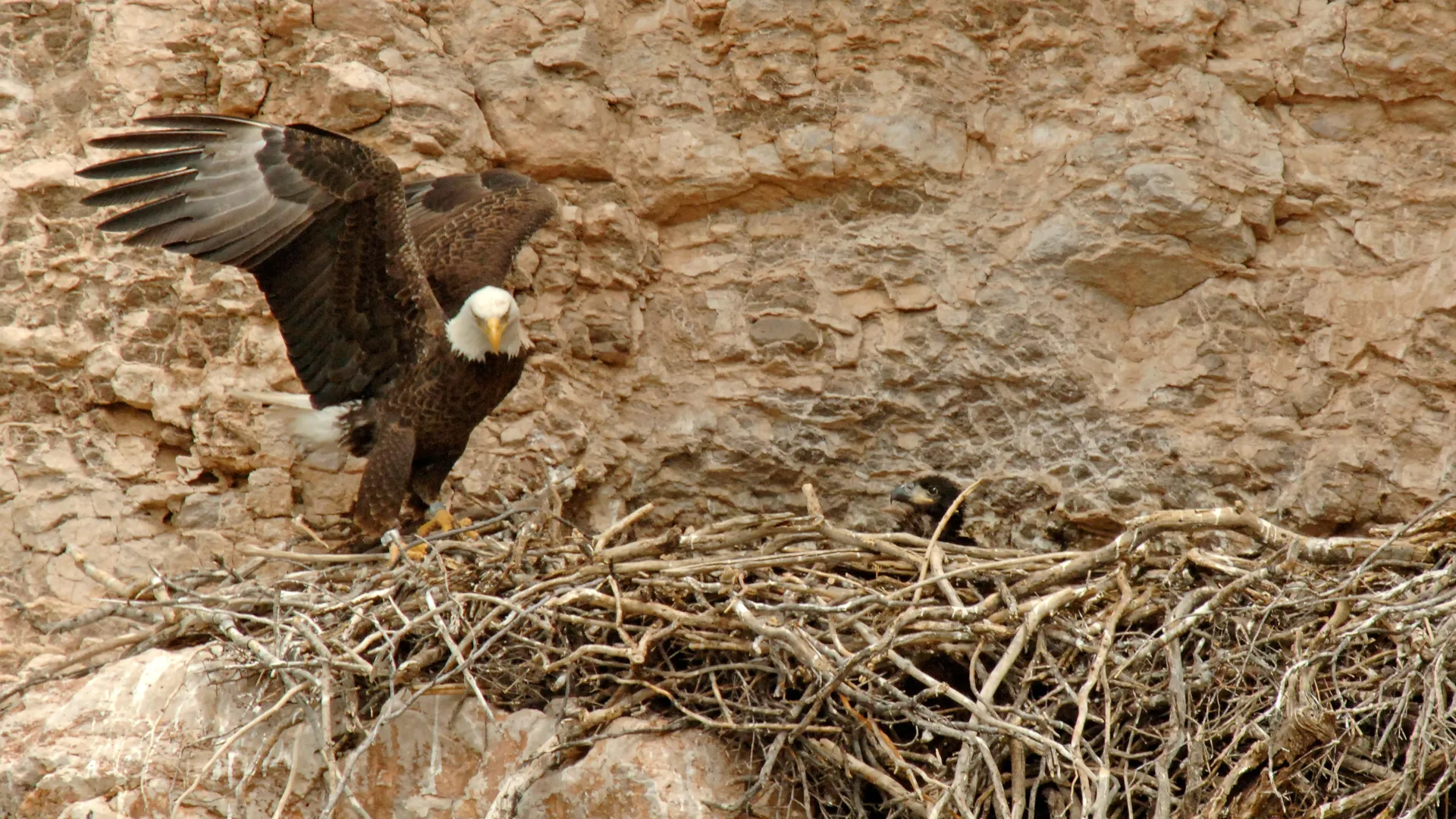
Birds of a feather do not always flock together, despite the adage, and a recent study published in the Journal of Raptor Research highlights a compelling divergence from traditional avian migration patterns. Bald Eagles (Haliaeetus leucocephalus) originating from Arizona are undertaking unusual journeys, flying north instead of south, a stark contrast to the migratory behaviors observed in most temperate region bird species. The paper, titled "Northward Migrations of Nonbreeding Bald Eagles from Arizona, USA," not only details these unexpected northbound movements but also reports on a singular eagle that embarked on an extensive journey, ultimately settling in California. This individual’s decision challenges earlier assumptions regarding the frequency with which these majestic birds emigrate from their natal populations. Researchers conclude that southwestern Bald Eagles exhibit a high degree of exploratory behavior, a trait likely honed to enable them to locate ephemeral and spatially unpredictable food sources. In an era marked by accelerating climate change and dynamic landscape transformations, research meticulously documenting how wildlife adjusts its movements is paramount for formulating effective conservation strategies and safeguarding critical travel corridors for vulnerable species.
The Unconventional Migration Revealed: Challenging Avian Norms
Between 2017 and 2023, a dedicated Arizona-based research team initiated a comprehensive study utilizing advanced satellite telemetry to track the movements of 24 newly fledged Bald Eagles and two nonbreeding adults. The objective was to precisely map their movements both within and beyond the geographical boundaries of Arizona. While breeding Bald Eagles in Arizona have historically been understood to remain in close proximity to their nesting territories for the majority of the year, a significant knowledge gap persisted concerning the activities and dispersal patterns of their nonbreeding counterparts. Understanding the full life cycle of a species, including the often-overlooked nonbreeding stages, is critical. Given that survival rates can vary significantly across different life stages, a comparative analysis of movement patterns and survival rates between nonbreeding eagles and established breeders offers scientists a far more holistic perspective on the species’ overall health across its expansive range and provides crucial insights into the population-level processes that shape its dynamics.
The research team meticulously followed individual eagles for the operational lifespan of their tracking devices, with some birds providing data for up to four years within the seven-year study period. For many, including seasoned ornithologists, the conventional understanding of North American migratory birds involves a southward trajectory during the nonbreeding season, typically coinciding with the colder winter months, in pursuit of milder climates and more dependable food sources. However, Arizona’s Bald Eagles present a unique ecological anomaly. Their nesting season commences in winter, meaning their non-breeding period naturally falls during the summer and autumn months. Dr. Caroline D. Cappello, the lead author of the study, expressed particular intrigue regarding this distinct timing of seasonal movement. She notes that this "northward migratory behavior raises interesting questions about the recent and historical pressures that shape these movement strategies," hinting at deep evolutionary adaptations at play. This finding alone prompts a re-evaluation of generalized migration models, suggesting that local ecological pressures can dramatically alter species-specific behaviors.
Echoes of the Past: Enduring Stopover Sites and Habitat Fidelity
A particularly significant finding reported by the authors is the remarkable overlap between the stopover sites utilized by the tracked eagles and those identified as crucial gathering points for Bald Eagles in a pioneering study conducted in the 1980s. This compelling continuity provides robust evidence that these specific lakes and rivers have retained their ecological importance, serving as vital waypoints and resource hubs for multiple generations of eagles over decades. This habitat fidelity underscores the enduring quality and strategic location of these sites within the broader landscape.
Beyond merely confirming a strong reliance on the Intermountain Flyway — a significant migratory corridor spanning western North America — and a clear dependence on the numerous lakes and rivers dotting their routes, the study illuminated that eagles of varying ages were migrating extensively into the northern U.S. and even into southern Canada. Dr. Javan M. Bauder, a coauthor of the paper, a USGS researcher, Assistant Unit Leader at the Arizona Cooperative Fish and Wildlife Research Unit, and Assistant Professor at the University of Arizona, underscored the profound significance of this observation. He emphasized that "managing and conserving wildlife populations requires that we understand the movement patterns of individuals of all age classes within those populations." This highlights the need for a granular approach to conservation, acknowledging that juvenile and adult birds may have distinct requirements and vulnerabilities.
The research team also observed a fascinating developmental progression in the eagles’ migratory patterns: as the birds matured, their migration pathways became notably more precise and refined. A majority of the birds tracked for a minimum of two years consistently returned to Arizona in the autumn of their hatch year after spending their summer months roaming farther north. The researchers posit that these young, exploratory eagles might be strategically leveraging seasonal food bonanzas found in northern climes, such as the concentrated availability of spawning salmon, abundant nesting waterfowl, or the carcasses of large mammals that become more accessible during certain times of the year. While this hypothesis is compelling, the authors acknowledge that further dedicated research will be necessary to conclusively determine the precise drivers behind these seasonal northern excursions and the specific ecological benefits reaped by the eagles.
The Perils of Exploration: Long Journeys and Lethal Threats to Young Raptors
Bald Eagles, like many other large raptor species, must navigate an increasingly complex and hazardous world dominated by human activity. The study tragically brought this reality into sharp focus through the journey of one particular eagle. This individual traversed an astonishing ten U.S. states and four Canadian provinces during her formative years before appearing to settle in northern California, where she seemed poised to establish her own breeding territory. At just four years old, a critical age for reproductive maturity, she was killed by electrocution – an all too common and devastating cause of death for large birds of prey across North America.
Her loss was particularly distressing for the research team, as Dr. Cappello explained, because it "underscored the ongoing risks these birds face." Furthermore, the incident highlighted the inherent difficulty in accurately measuring emigration as a component of population dynamics. The eagle’s apparent decision to establish a life and potentially breed in California would have provided rare and invaluable insight into the frequency and patterns of dispersal among Bald Eagles hatched in Arizona to other regional populations. Understanding emigration rates is crucial for population models, as birds dispersing out of a study area are often simply considered "lost," leading to potential underestimation of survival and overestimation of local mortality.
Electrocution remains a significant threat to raptors globally. Large birds with expansive wingspans can bridge the gap between energized conductors and grounded equipment on power poles, leading to fatal electrical shock. Utility companies, often in collaboration with wildlife agencies, have implemented various mitigation strategies, including installing raptor-safe perches, insulating exposed conductors, and modifying pole configurations to increase spacing. However, the sheer scale of electrical infrastructure means that risks persist, particularly in remote areas or where older designs remain.
Beyond electrocution, young raptors confront a spectrum of other anthropogenic threats. These include poisoning from lead, often ingested indirectly through carrion or prey contaminated by lead ammunition fragments, and secondary poisoning from rodenticides, which accumulate in the food chain. Collisions with wind turbines, a growing concern as renewable energy infrastructure expands, pose another significant hazard, particularly during migratory periods or in areas of high raptor activity. Habitat loss and fragmentation, driven by urbanization, agriculture, and resource extraction, continue to erode essential nesting, foraging, and roosting areas. Compounding these existing pressures is the overarching uncertainty related to a rapidly changing climate, which can alter prey availability, shift breeding grounds, and impact migration corridors, creating novel challenges for raptor survival.
By meticulously studying raptors at every stage of their lives, from their exploratory juvenile journeys to their established breeding phases, scientists can generate evidence-based recommendations that directly inform conservation actions. Such recommendations might include identifying which specific stopover sites are most critical for protection, advocating for modifications to various types of human infrastructure – particularly electrical systems – to enhance survival rates for eagles and other large raptors, and guiding land-use planning to minimize human-wildlife conflict.
Broader Conservation Imperatives: Adapting to a Changing Climate
The findings from this Arizona Bald Eagle study carry significant implications for broader conservation strategies, particularly in the context of global climate change. The observed exploratory behavior and northward migration could be interpreted as an adaptive strategy, allowing these eagles to track shifting resource availability. As temperatures rise and precipitation patterns change, traditional food sources may become less reliable or shift geographically. The ability of a species to adapt its movement patterns, as demonstrated by these eagles, becomes a critical survival mechanism. This flexibility suggests that conservation efforts must also be adaptable and dynamic, moving beyond static protected areas to focus on maintaining connectivity across landscapes and protecting a network of potential resource hotspots.
The Bald Eagle’s journey from the brink of extinction to a remarkable recovery, largely due to the banning of DDT and habitat protection, serves as a testament to successful conservation. However, its delisting from the Endangered Species Act in 2007 did not signify an end to conservation challenges. Rather, it marked a transition to ongoing management and monitoring. Studies like this one underscore that even "recovered" species face new and evolving threats, necessitating continuous research and adaptive management. The U.S. Fish and Wildlife Service, along with state wildlife agencies, consistently emphasize the importance of understanding population dynamics and habitat use for long-term species health. This research will undoubtedly inform their ongoing management plans for the species.
Future Trajectories: Research and Policy Recommendations
Looking ahead, the research team strongly advocates for future investigations into route fidelity among these northward-migrating eagles. As Dr. Cappello noted, "if consistent patterns exist it could help focus conservation efforts on specific, high-use areas along their migratory route." Identifying these predictable corridors would allow conservationists to prioritize land acquisition, implement targeted habitat enhancements, and influence development planning to minimize negative impacts. This approach would be far more efficient and effective than a generalized, less-informed strategy.
Furthermore, the team highlights the crucial importance of conducting comparative studies, contrasting these Arizona Bald Eagles with other wildlife populations that exhibit northward migration from the southern edge of their respective ranges. Such comparative analyses would provide invaluable insights into the commonalities and divergences in ecological pressures, evolutionary adaptations, and the ultimate tradeoffs, costs, and benefits associated with this specific northward migration strategy. Understanding the physiological costs, energy expenditures, and survival advantages of such movements can further refine our understanding of avian ecology.
Ultimately, the insights gleaned from this groundbreaking study are expected to inform policy recommendations for various stakeholders. Utility companies, for instance, could be encouraged to accelerate the retrofitting of power infrastructure to mitigate electrocution risks, particularly in areas identified as high-use corridors for raptors. Land management agencies, both federal and state, could prioritize the protection and restoration of critical stopover sites and foraging areas, ensuring their long-term ecological viability. Urban planners and developers might be guided to consider raptor movement patterns when designing new infrastructure or expanding human settlements, thereby minimizing habitat fragmentation and collision risks.
This research into Arizona’s Bald Eagles offers a compelling narrative of adaptation and resilience in the face of environmental change. It underscores that even well-studied species can harbor surprising behaviors that defy long-held assumptions. As our planet continues its unprecedented transformation, such detailed, evidence-based understanding of wildlife movement and survival strategies is not merely academic; it is an indispensable foundation for crafting robust conservation measures that will safeguard biodiversity for future generations.
