
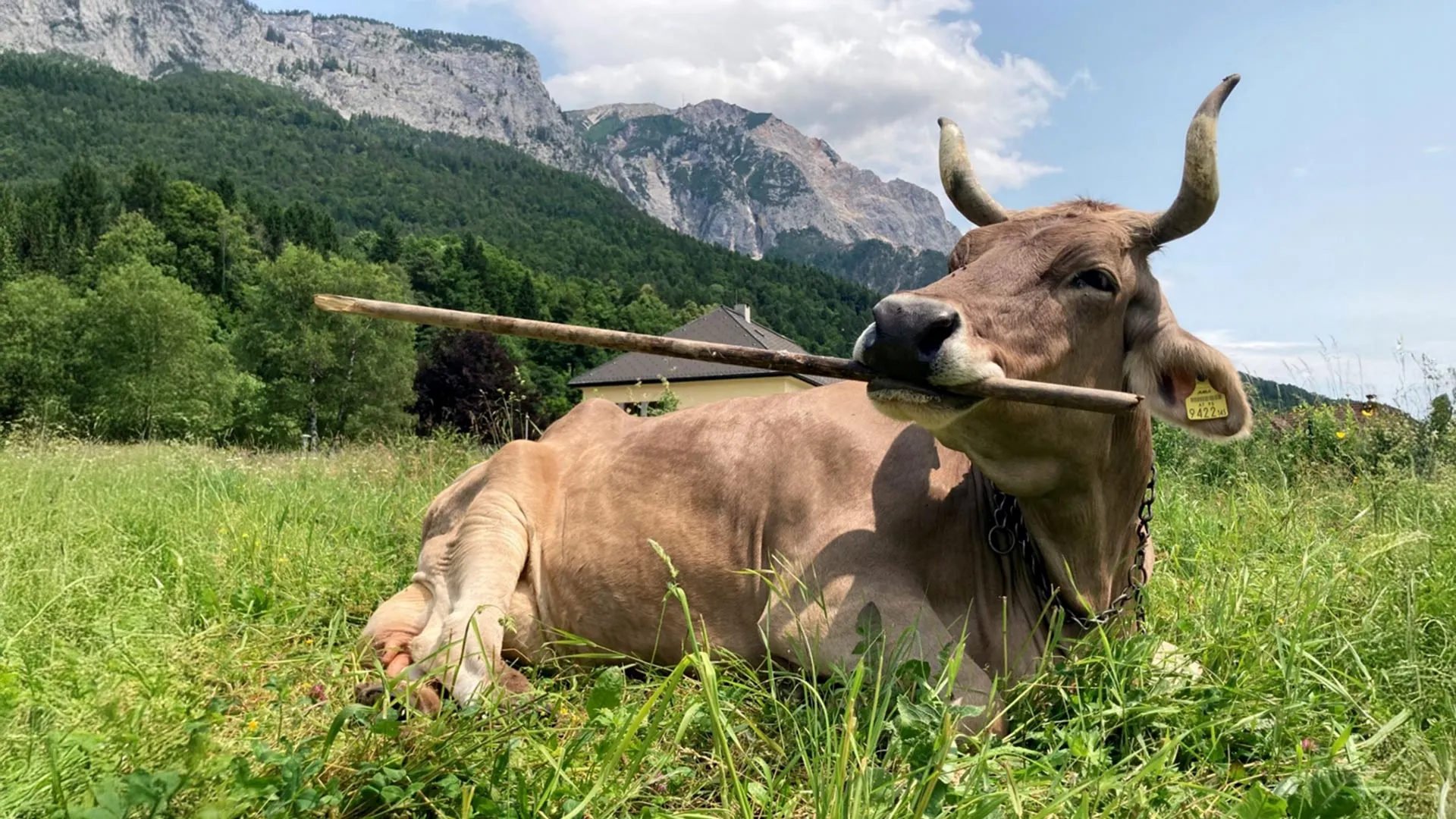
For decades, the image of a cow struggling with rudimentary implements has been a cornerstone of popular humor, epitomized by Gary Larson’s iconic 1982 Far Side comic, "Cow Tools." This widely beloved illustration depicted a bovine protagonist standing proudly beside a bizarre assortment of seemingly useless objects labeled as tools, deriving its comedic impact from the widely held assumption that cows inherently lack the cognitive capacity for such complex behaviors. However, this ingrained perception of bovine intellect is now being fundamentally challenged by groundbreaking scientific research, ignited by the remarkable actions of a real-life Swiss Brown cow named Veronika, whose documented use of tools suggests a far more sophisticated cognitive landscape within cattle than previously imagined.
The pivotal findings, recently published in the esteemed journal Current Biology, detail the first scientifically confirmed instance of tool use in a pet cow. This revelation not only expands the known repertoire of intelligent behaviors in domesticated animals but also prompts a critical re-evaluation of how human assumptions may have historically underestimated the cognitive capabilities of livestock species. Alice Auersperg, a distinguished cognitive biologist at the University of Veterinary Medicine, Vienna, whose expertise lies in animal problem-solving and innovation, succinctly summarized the significance of the discovery, stating, "The findings highlight how assumptions about livestock intelligence may reflect gaps in observation rather than genuine cognitive limits." Her comment underscores a growing sentiment within the scientific community that many species, particularly those extensively managed by humans for agricultural purposes, may possess latent cognitive skills that remain unobserved due to environmental constraints or a lack of focused scientific inquiry.
Veronika: A Companion Animal Redefining Bovine Cognition
Veronika, the cow at the center of this scientific paradigm shift, lives an existence far removed from the typical commercial dairy or beef operation. She is a Swiss Brown cow residing as a cherished companion animal with Witgar Wiegele, an organic farmer and baker, in the tranquil Swiss countryside. Wiegele views Veronika not merely as livestock but as an integral member of his family, a bond that likely fostered the observational opportunities crucial to this discovery. This unique living arrangement, characterized by extensive human interaction and an enriched environment, stands in stark contrast to the often-impoverished sensory and social landscapes of industrial farming, a factor researchers believe to be instrumental in the manifestation of Veronika’s advanced behaviors.
It was more than a decade ago that Wiegele first began to notice Veronika exhibiting an unusual and intriguing behavior. Periodically, she would deliberately pick up sticks or other suitable objects and meticulously use them to scratch various parts of her body that she could not otherwise reach. Initially, such observations might be dismissed as anecdotal or coincidental, but Wiegele’s consistent attention allowed him to recognize the purposeful nature of these actions. Eventually, this compelling behavior was captured on video and subsequently shared with researchers, sparking the scientific investigation that would ultimately lead to its formal documentation.
Upon reviewing the footage, Auersperg and her colleagues immediately recognized the profound implications. "When I saw the footage, it was immediately clear that this was not accidental," Auersperg recounted. "This was a meaningful example of tool use in a species that is rarely considered from a cognitive perspective." The clarity of Veronika’s intentions and the repeatability of her actions provided the initial impetus for a structured scientific study, designed to rigorously test and confirm the observations.
Rigorous Testing: Unveiling Flexible and Multi-Purpose Tool Use
To transition from anecdotal observation to robust scientific evidence, researchers embarked on a series of controlled experiments with Veronika. Their primary objective was to determine if her stick-scratching was indeed deliberate, flexible, and indicative of genuine tool use rather than mere accidental interaction with objects. For these trials, a standard deck brush was chosen as the tool, offering different textures and shapes, and was strategically placed on the ground in various positions around Veronika. Researchers then meticulously observed and recorded her interactions.
Across numerous trials, Veronika demonstrated remarkable consistency and precision in her approach. She did not simply nudge the brush randomly; instead, she consistently selected specific parts of the brush, adjusting her grip and manipulation based on the particular area of her body she intended to scratch. Her choices were far from arbitrary; they precisely matched the varying needs of different body regions, revealing a nuanced understanding of the tool’s properties and their application.
Antonio Osuna-Mascaró, a co-author of the study, emphasized the sophistication of Veronika’s actions: "We show that a cow can engage in genuinely flexible tool use. Veronika is not just using an object to scratch herself. She uses different parts of the same tool for different purposes, and she applies different techniques depending on the function of the tool and the body region." This observation is critical because it elevates Veronika’s behavior beyond simple object manipulation to a more advanced form of cognitive ability.
The research team identified clear patterns in Veronika’s brush usage. For instance, when targeting larger, firmer areas of her body, such as her back or flanks, she invariably opted for the bristled side of the brush, applying more pressure and broader movements. Conversely, for more sensitive or delicate regions, particularly on her lower body or legs, she demonstrated a distinct preference for the smoother, gentler handle of the brush, employing slower, more precise motions. This differential application of the tool, adapting technique and part of the tool to the specific need, is a hallmark of sophisticated cognition.
Defining Tool Use: A High Bar Met and Exceeded
In ethology, the scientific study of animal behavior, tool use is generally defined as the employment of an external object to achieve a goal through physical interaction. Veronika’s actions not only meet this fundamental definition but significantly transcend it. Her behavior qualifies as flexible, multi-purpose tool use, a much rarer and more complex form of intelligence where an individual utilizes different features or orientations of the same object to achieve distinct outcomes or address varying needs.
Historically, this advanced type of flexible, multi-purpose tool use has been clearly documented in a very limited number of non-human species, with chimpanzees often cited as the preeminent example due to their diverse use of sticks, stones, and leaves for tasks ranging from foraging to defense. Isolated instances have been observed in other species like New Caledonian crows, otters, and elephants, but the inclusion of a cow in this elite group marks a significant expansion of our understanding of animal cognition. The implication is profound: species once relegated to a lower tier of cognitive capability may, under the right circumstances, exhibit problem-solving skills on par with some of the most intelligent animals on the planet.
Overcoming Physical Limitations: The Challenge of Lacking Hands
Veronika’s tool use is directed at her own body, a category known as egocentric tool use. While this form is typically considered less complex than allocentric tool use (using tools on external objects or other individuals), it still presents significant challenges, especially for a species with Veronika’s physical anatomy. Cows, lacking dexterous hands or prehensile tails, must manipulate objects primarily with their mouths. This anatomical limitation might initially suggest a constraint on complex tool use, yet Veronika demonstrates remarkable proficiency.
Despite the inherent difficulties of oral manipulation, Veronika consistently displays careful control and a seeming anticipation of the effects of her actions. She skillfully adjusts her grip on the brush and modifies her movements – from broad sweeps to subtle nudges – to achieve the precise desired result. This level of fine motor control and adaptive strategy, executed without the benefit of hands, further underscores her cognitive sophistication and problem-solving abilities. It suggests an internal model of how the tool interacts with her body, allowing her to predict and adjust her actions effectively.
The Role of Environment: Why Veronika is Unique
The researchers believe that Veronika’s unique living conditions have been a critical factor in the development and manifestation of her tool-using behavior. Unlike the vast majority of cattle globally, she has lived a remarkably long life (cattle typically live 18-22 years if not slaughtered for food, but often much shorter in industrial settings) in an exceptionally complex and stimulating environment. Her daily interactions with humans are extensive and positive, fostering a bond of trust and providing consistent opportunities for observation. Crucially, she has continuous access to a variety of objects within her environment that she can manipulate and explore.
These factors — longevity, environmental enrichment, and sustained human interaction — likely created an unparalleled opportunity for exploration, learning, and behavioral innovation that is simply uncommon for most cows. In typical agricultural settings, cattle often experience environments designed for efficiency rather than cognitive stimulation, with limited opportunities for complex social interactions or the manipulation of novel objects. The researchers postulate that such restricted environments might suppress the expression of innate cognitive abilities, leading to an underestimation of what these animals are truly capable of.
As the study authors eloquently conclude, "[Veronika] did not fashion tools like the cow in Gary Larson’s cartoon, but she selected, adjusted, and used one with notable dexterity and flexibility. Perhaps the real absurdity lies not in imagining a tool-using cow, but in assuming such a thing could never exist." This statement serves as a powerful call to reconsider the anthropocentric biases that have long shaped our understanding of animal intelligence.
Broader Implications: Rethinking Animal Intelligence and Welfare
This groundbreaking discovery represents more than just an interesting anecdote; it is the first scientifically confirmed case of tool use in cattle and significantly expands the known range of species capable of demonstrating this complex cognitive ability. Its implications are far-reaching, particularly for the fields of animal cognition, ethology, and animal welfare.
Firstly, it strongly suggests that similar sophisticated behaviors may exist in other species, or even in other cattle, but have simply gone unnoticed due to a lack of detailed observation, preconceived notions, or environmentally impoverished living conditions. The prevailing scientific and public perception of cattle has often been that of animals driven primarily by instinct, lacking the individual problem-solving skills seen in primates, cetaceans, or even some birds. Veronika’s case challenges this fundamental assumption, demanding a more open-minded and rigorous approach to studying bovine intelligence.
Secondly, the findings have significant implications for animal welfare and ethical considerations in agriculture. If cows are indeed capable of such flexible cognition, it raises serious questions about the adequacy of current housing, enrichment, and management practices in industrial farming. Providing environments that allow for exploration, problem-solving, and the expression of natural behaviors might not just be a moral imperative but also a necessary condition for understanding the full cognitive potential of these animals. A cow capable of flexible tool use likely experiences a richer inner life, with greater capacities for learning, memory, and even emotional complexity, than previously assumed. This newfound understanding could inform future regulations and best practices aimed at enhancing the psychological well-being of livestock.
The research team is not resting on its laurels. They are now actively exploring the specific environmental and social conditions that enable such complex behaviors to develop and manifest. This ongoing work seeks to identify the key ingredients – be it specific types of social interaction, access to certain objects, or opportunities for sustained exploration – that unlock these latent cognitive abilities. Furthermore, they are actively encouraging farmers, animal caregivers, and the general public to report any similar observations of cattle using sticks or other objects for purposeful actions.
"Because we suspect this ability may be more widespread than currently documented," Osuna-Mascaró stated, "we invite readers who have observed cows or bulls using sticks or other handheld objects for purposeful actions to contact us." This open call for citizen science highlights the potential for countless undocumented instances of animal intelligence to exist within our midst, waiting to be recognized and understood. The story of Veronika, the tool-using cow, is not just about one remarkable animal; it’s a profound invitation to look closer, question assumptions, and redefine the boundaries of animal intelligence.
