
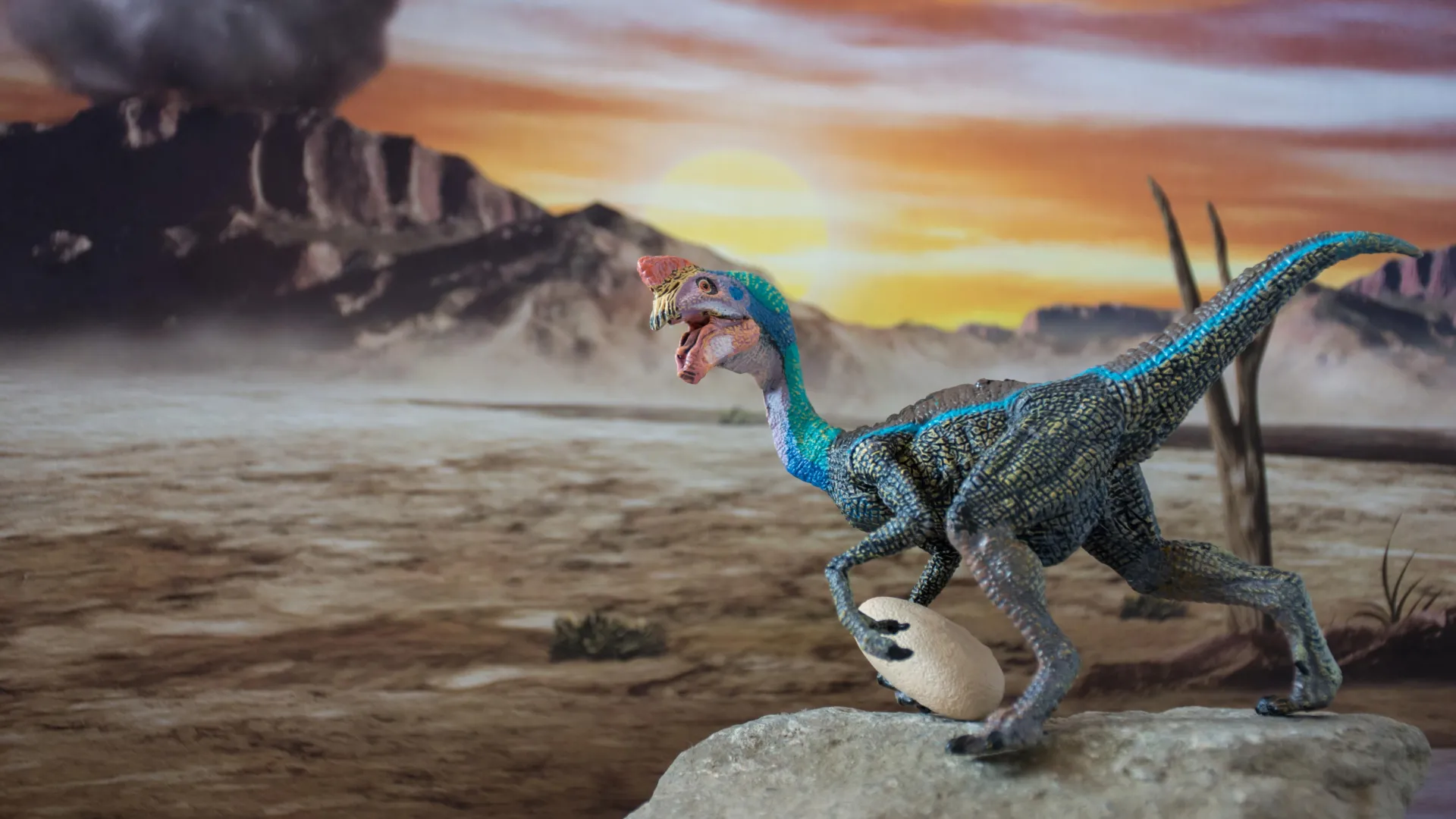
The long-standing enigma of how oviraptors, those intriguing bird-like but flightless dinosaurs, hatched their eggs has taken a significant step towards resolution with a new study published in Frontiers in Ecology and Evolution. For decades, paleontologists have debated whether these creatures relied on ambient environmental heat, akin to modern crocodiles and turtles, or if they directly warmed their eggs with their bodies, a behavior characteristic of birds. The groundbreaking research, led by scientists in Taiwan, delves deep into oviraptor nesting behavior and hatching patterns, offering compelling evidence that these dinosaurs employed a sophisticated, albeit less efficient, form of "co-incubation" that combined parental brooding with environmental warmth.
The Enduring Mystery of Dinosaur Nurturing
The question of dinosaur parental care, particularly egg incubation, has captivated scientists and the public alike since the first dinosaur fossils were unearthed. Early perceptions often depicted dinosaurs as colossal, reptilian beasts with little to no parental instinct, simply laying their eggs and abandoning them. However, a series of remarkable fossil discoveries, particularly in the Gobi Desert since the 1920s, began to challenge this simplistic view. The discovery of oviraptor fossils nestled atop clutches of eggs, famously nicknamed "Big Mama" specimens, dramatically shifted this understanding. These fossils, depicting adults in a brooding posture strikingly similar to modern birds, strongly suggested direct parental care. Yet, the sheer size of many dinosaurs, coupled with the prevailing understanding of reptilian incubation, left the precise mechanism unclear. Could a large dinosaur truly sit on a clutch of eggs without crushing them, and if so, how effectively could it transfer heat? This new study addresses these complexities directly.
Innovative Reconstruction: Bridging the Past and Present
To tackle this paleontological puzzle, the research team employed a novel, interdisciplinary approach that combined advanced heat transfer simulations with meticulous physical experiments. Their objective was to reconstruct the conditions within an oviraptor nest and compare their findings with the well-understood incubation strategies of modern birds. The focal species for their investigation was Heyuannia huangi, an oviraptorid that roamed the Earth between 70 and 66 million years ago during the Late Cretaceous period in what is now southern China. This particular species, approximately 1.5 meters (5 feet) long and weighing around 20 kilograms (44 pounds), was known to construct semi-open nests characterized by multiple rings of eggs.
The ingenuity of the research design lay in its tangible reconstruction. Researchers built a life-sized model of Heyuannia huangi, carefully crafting its torso using polystyrene foam and a sturdy wooden frame. To accurately mimic the soft tissues and provide realistic thermal properties, layers of cotton, bubble paper, and fabric were meticulously applied. The eggs themselves presented a unique challenge. Unlike the eggs of any living species, oviraptor eggs possess distinct shapes and shell thicknesses. To overcome this, the team developed specialized resin eggs, designed to approximate the thermal conductivity and dimensions of authentic oviraptor eggs as closely as possible. For the experiments, two clutches, each arranged in double rings, were meticulously placed within the reconstructed nest, mirroring patterns observed in fossil evidence.
"Part of the difficulty lies in reconstructing oviraptor incubation realistically," explained Chun-Yu Su, the first author of the study, who was a high school student at Washington High School in Taichung when much of the research was conducted, highlighting the impressive collaborative nature of the project. "For example, their eggs are unlike those of any living species, so we invented the resin eggs to approximate real oviraptor eggs as best as we could." This meticulous attention to detail allowed for unprecedented realism in simulating ancient incubation conditions.
Thermal Dynamics of an Ancient Nest
The core of the experimental phase involved testing how both the presence of an incubating adult and prevailing environmental conditions influenced egg temperatures and, consequently, potential hatching outcomes. The results unveiled a nuanced picture of oviraptor incubation efficiency and thermal management.
In simulated colder environmental conditions, when the brooding adult model was positioned over the nest, significant temperature variations were observed, particularly within the outer ring of eggs. These variations could be as substantial as 6 degrees Celsius (approximately 10.8 degrees Fahrenheit) across different eggs in the same clutch. Such a pronounced thermal gradient would inevitably lead to asynchronous hatching, where eggs within the same nest would not hatch simultaneously but rather over an extended period. This contrasts sharply with the tightly synchronized hatching often seen in many modern bird species, where consistent temperatures across the clutch promote simultaneous emergence.
Conversely, when the experiments were conducted under warmer environmental conditions, the temperature variation within the outer ring of eggs dramatically decreased, dropping to a mere 0.6 degrees Celsius (about 1 degree Fahrenheit). This striking reduction strongly suggests that in warmer climates, direct sunlight played a crucial role in helping to equalize temperatures across the egg clutch, thereby influencing hatching patterns to be more synchronous.
Dr. Tzu-Ruei Yang, senior author of the study and an associate curator of vertebrate paleontology at Taiwan’s National Museum of Natural Science, elaborated on this aspect: "It’s unlikely that large dinosaurs sat atop their clutches. Supposedly, they used the heat of the sun or soil to hatch their eggs, like turtles. Since oviraptor clutches are open to the air, heat from the sun likely mattered much more than heat from the soil." This statement underscores the importance of considering the ambient environment as a significant contributor to the incubation process for these large, semi-brooding dinosaurs.
Oviraptors vs. Modern Birds: A Question of Efficiency, Not Superiority
A critical component of the study involved a direct comparison between oviraptor incubation strategies and those employed by modern birds. Most avian species rely on a highly evolved method known as Thermoregulatory Contact Incubation (TCI). In TCI, the adult bird maintains direct, continuous physical contact with all its eggs, serving as the primary, and often sole, heat source. For TCI to be effective, the adult must be able to touch every egg, provide a consistent and sufficient amount of heat, and actively regulate the temperature to minimize fluctuations.
The research findings indicate that oviraptors likely could not meet these stringent conditions for efficient TCI. Their distinctive ring-shaped egg arrangements, coupled with their body size, meant that a brooding adult would have been physically incapable of maintaining consistent contact with every egg in the clutch simultaneously. The sheer circumference of the egg rings, especially in larger clutches, would have left significant portions of the outer eggs beyond the direct thermal reach of the parent.
"Oviraptors may not have been able to conduct TCI as modern birds do," noted Su. Instead, the study proposes that oviraptors functioned as "co-incubators," where parental heat contribution worked in conjunction with environmental heat. This dual-source approach, while less efficient in terms of maintaining uniform temperatures across the clutch compared to the dedicated TCI of modern birds, appears to have been perfectly suited to their unique nesting style. The evolutionary trajectory of oviraptor nesting, which seems to have transitioned from potentially buried nests to these semi-open, ring-shaped structures, would have naturally favored such a co-incubation strategy.
Dr. Yang thoughtfully clarified the comparative aspect, stating, "Modern birds aren’t ‘better’ at hatching eggs. Instead, birds living today and oviraptors have a very different way of incubation or, more specifically, brooding. Nothing is better or worse. It just depends on the environment." This perspective is crucial, emphasizing that evolutionary success is about adaptation to specific ecological niches and environmental pressures, rather than a linear progression towards a "better" state. Oviraptors developed a functional strategy optimized for their body plan, nest design, and the Late Cretaceous climate, even if it diverged significantly from the highly specialized methods of their modern avian relatives.
Paleontological Context and Evolutionary Implications
The Late Cretaceous period, roughly 100 to 66 million years ago, was a time of significant global warmth, though regional climates could vary. The environment in what is now China, where Heyuannia huangi lived, would have presented opportunities for solar incubation, especially in more arid or open landscapes. Understanding this climatic backdrop is essential for interpreting the co-incubation model. The study’s findings suggest a sophisticated, intermediate form of parental care, bridging the gap between the purely environmental incubation of many reptiles and the highly active brooding of modern birds.
This research significantly enriches our understanding of dinosaur parenting behaviors, moving beyond simplistic assumptions. It highlights that the evolution of parental care was likely diverse and complex, with different dinosaur lineages adopting various strategies tailored to their specific anatomy, physiology, and environmental conditions. For instance, sauropods are thought to have buried their eggs in mounds, relying solely on geothermal or decompositional heat, while some hadrosaurs might have used similar mound-nesting strategies. Oviraptors, with their bird-like posture and semi-open nests, represent a distinct evolutionary pathway towards more direct parental involvement.
The study also provides valuable insights into the broader evolutionary transition from dinosaurs to birds. While oviraptors are not direct ancestors of modern birds, they belong to a group of dinosaurs (Maniraptorans) that are closely related. Their incubation strategy offers a glimpse into the diverse array of behaviors that might have existed in the dinosaur-avian evolutionary continuum. The shift from buried nests to semi-open ones, combined with partial brooding, represents an important step in the evolution of avian-like parental care.
Limitations and Future Directions
The researchers acknowledge certain limitations inherent in their study. Their results are based on a reconstructed nest and the prevailing environmental conditions of today, which undoubtedly differ from the specific climatic nuances of the Late Cretaceous. Factors such as atmospheric composition, solar intensity, and average temperatures 70 million years ago could have influenced the actual incubation dynamics. These differences could introduce some variability into the findings. Furthermore, the study notes that oviraptors likely had considerably longer incubation periods than most modern birds, a factor that could also influence the overall efficiency and thermal management requirements over the entire developmental cycle.
Despite these limitations, the study represents a monumental leap forward in our understanding of oviraptor reproductive biology and, by extension, dinosaur behavior. By ingeniously combining physical models with sophisticated simulations, the work establishes a robust methodological framework that opens up exciting new possibilities for future research into dinosaur reproduction. This interdisciplinary approach, merging paleontology with engineering and biology, is becoming increasingly vital for deciphering the mysteries of extinct life.
Dr. Yang concluded with an inspiring message, particularly for the scientific community in Taiwan: "It also truly is an encouragement for all students, especially in Taiwan. There are no dinosaur fossils in Taiwan, but that does not mean that we cannot do dinosaur studies." This statement powerfully underscores that scientific inquiry is not bound by geographical proximity to fossil sites, but by intellectual curiosity, innovative methodologies, and a collaborative spirit. The study stands as a testament to the fact that groundbreaking paleontological research can be conducted anywhere, fostering global scientific collaboration and inspiring the next generation of researchers.
In conclusion, this pioneering research from Taiwan has illuminated the complex and adaptive incubation strategies of oviraptors, revealing them as sophisticated "co-incubators" who skillfully blended their own body heat with environmental warmth. This finding not only resolves a long-standing paleontological debate but also enriches our appreciation for the diverse and often surprisingly complex parental behaviors that characterized the age of dinosaurs, further blurring the lines between these ancient reptiles and their modern avian descendants. The ongoing pursuit of such interdisciplinary studies promises to continually redefine our understanding of life’s deep past.
