
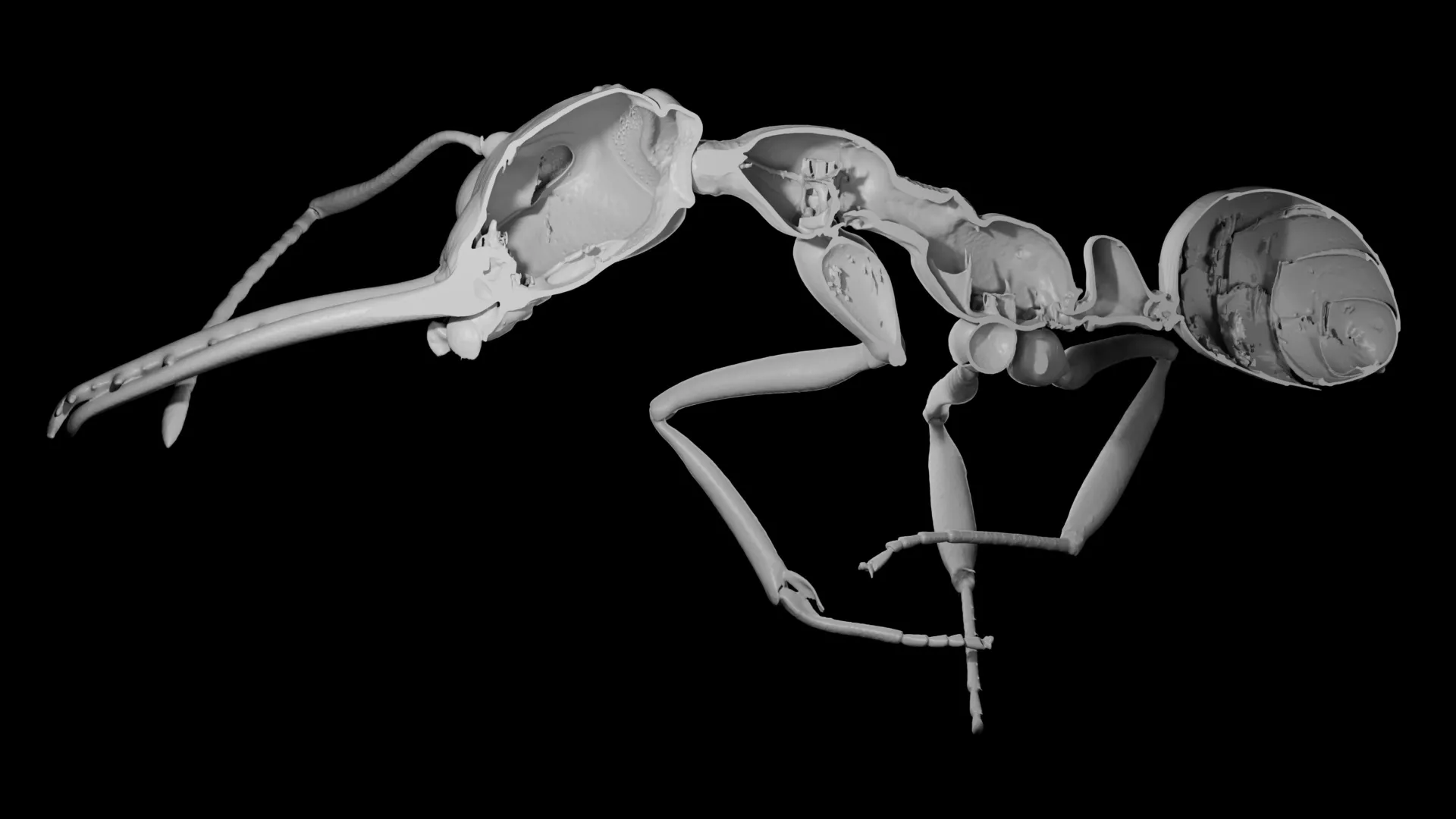
The age-old philosophical debate contrasting quantity with quality has found a profound new echo in the intricate world of ants, where groundbreaking research reveals that a strategic shift from individual robustness to collective numerical strength has been a cornerstone of their evolutionary triumph. This counterintuitive strategy, prioritizing the production of many "cheaper" individuals over fewer "heavily armored" ones, has propelled ants to build vast, complex societies and diversify into an astonishing array of species across the globe.
The Evolutionary Dilemma: Quantity Versus Quality
Published on December 19, 2025, in the esteemed journal Science Advances, a study led by researchers from the University of Maryland and the University of Cambridge presents compelling evidence for this evolutionary bargain. The core finding posits that certain ant species have optimized their colonial organization by investing less in the individual physical protection of their workers. Specifically, they reduce the allocation of vital nutrients and resources towards the cuticle—the hard, protective outer layer of the exoskeleton. This resource reallocation allows for the production of a significantly greater number of workers, fundamentally altering the dynamics of their societies.
This finding addresses a long-standing question in biology regarding the fate of individuals within increasingly complex social structures. Senior author Evan Economo, chair of the Department of Entomology at the University of Maryland and the James B. Gahan and Margaret H. Gahan Professorship at UMD, elucidated this concept: "There’s this question in biology of what happens to individuals as societies they are in get more complex. For example, the individuals may themselves become simpler because tasks that a solitary organism would need to complete can be handled by a collective." In this context, individuals effectively become "cheaper" – requiring fewer resources to construct and thus enabling larger populations, even if each member possesses reduced physical resilience. Economo emphasized the novelty of the study, stating, "That idea hasn’t been explicitly tested with large-scale analyses of social insects until now."
Ants: A Model for Social Evolution
Ants, belonging to the family Formicidae, are an unparalleled model system for exploring the intricate mechanisms of social evolution. Their social structures span an immense spectrum, from rudimentary colonies comprising a mere few dozen individuals to supercolonies numbering in the tens of millions, sometimes even billions. This extraordinary variation in social complexity, coupled with their global distribution and ecological dominance—ants constitute an estimated 15-25% of terrestrial animal biomass—makes them ideal subjects for studying the evolutionary drivers of sociality.
Lead author Arthur Matte, a Ph.D. student in zoology at the University of Cambridge, highlighted the enduring mystery surrounding their success: "Ants are everywhere. Yet the fundamental biological strategies which enabled their massive colonies and extraordinary diversification remain unclear." The research team hypothesized that a crucial, yet overlooked, factor might be the level of investment a colony makes in the individual worker’s physical "body armor"—specifically, the cuticle.
Deciphering the Cuticle’s Cost
The cuticle is far more than just an outer shell; it is a multi-functional marvel of biological engineering. Composed primarily of chitin (a tough polysaccharide), proteins, lipids, and sometimes minerals like calcium carbonate, it provides essential protection against a myriad of environmental threats. This includes acting as a formidable barrier against predators, preventing desiccation (drying out) in various climates, and offering a first line of defense against pathogens and diseases. Beyond protection, the cuticle also serves as a crucial external skeleton, providing structural support for muscles and anchoring points for movement.
However, this sophisticated biological armor comes at a significant metabolic cost. The synthesis of chitin and the associated proteins and lipids demands a substantial investment of limited nutrients, particularly nitrogen and various minerals. Producing a thicker, more robust cuticle for each individual worker consumes a larger proportion of these finite resources, thereby directly limiting the total number of individuals a colony can sustain. This inherent trade-off between individual strength and population size forms the crux of the researchers’ investigation.
Methodology: A Glimpse into Ant Anatomy
To empirically test their hypothesis, the research team embarked on an ambitious undertaking, analyzing an extensive dataset derived from 3D X-ray micro-computed tomography (micro-CT) scans. This cutting-edge imaging technique allowed for non-invasive, high-resolution visualization of internal and external structures of more than 500 distinct ant species. For each scanned specimen, researchers meticulously measured two critical parameters: total body volume and cuticle volume.
The analysis revealed a remarkable variability in cuticle investment across species, ranging from a lean 6% to a substantial 35% of an ant’s total body volume. This wide range underscored the evolutionary flexibility in this trait. These detailed anatomical measurements were then integrated into sophisticated evolutionary models. The models were designed to trace phylogenetic relationships and identify statistical correlations between cuticle investment, colony size, and diversification rates, accounting for shared ancestry and evolutionary history. A clear and compelling trend emerged from this rigorous analysis: species that exhibited a lower proportional investment in their cuticle consistently tended to form larger, more populous colonies.
Key Findings: The Numbers Game
The direct correlation between reduced individual cuticle investment and increased colony size suggests a powerful evolutionary advantage. While a thinner cuticle undeniably renders individual ants more vulnerable to direct threats—making them, as Economo playfully put it, "more squishable"—this apparent weakness is paradoxically transformed into a collective strength. The authors propose that this trade-off actively encourages the development and refinement of sophisticated social traits.
Reduced individual armor appears to go hand-in-hand with an intensified reliance on cooperative behaviors. These include highly organized cooperative foraging strategies, where multiple individuals work together to locate and transport resources; robust shared nest defense mechanisms, where the collective actively repels intruders; and a highly specialized division of labor, where different castes of ants perform specific roles (e.g., queens reproduce, workers forage, soldiers defend). All these traits become progressively more pronounced and effective as colony sizes expand.
Matte eloquently summarized this shift: "Ants reduce per-worker investment in one of the most nutritionally expensive tissues for the good of the collective. They’re shifting from self-investment toward a distributed workforce, resulting in more complex societies." He drew a compelling parallel to a fundamental transition in the history of life itself: "It’s a pattern that echoes the evolution of multicellularity, where cooperative units can be individually simpler than a solitary cell, yet collectively capable of far greater complexity." Just as individual cells sacrificed some autonomy for the benefits of a multicellular organism, individual ants appear to have traded individual robustness for the unparalleled advantages of a vast, cooperative society.
Accelerated Diversification: A Marker of Success
Perhaps one of the most striking findings of the study was the revelation that lower investment in the cuticle was not only linked to larger societies but also to significantly higher diversification rates. In evolutionary biology, diversification—which quantifies the frequency at which new species arise within a lineage—is considered a robust indicator of evolutionary success. Economo noted the rarity of such a direct link, stating that "very few traits have been connected to diversification in ants, making this result especially striking." This suggests that the "quantity over quality" strategy has not merely allowed ants to thrive in existing niches but has actively facilitated their expansion into new environments and the formation of novel species.
Unraveling the Mechanisms of Speciation
The precise mechanisms by which reduced cuticle investment promotes speciation remain an area for further investigation, but the researchers propose several compelling hypotheses. One leading idea centers on resource acquisition and adaptability. Ants with lower nutritional demands for individual worker construction are inherently more versatile. This reduced requirement, particularly for nitrogen—a critical and often limiting nutrient—could allow them to colonize and thrive in environments where resources are scarce or marginal, environments that more "expensive" ant species might find inhospitable.
Matte, who initiated this foundational work during his master’s program while interning in Economo’s lab at the Okinawa Institute of Science and Technology in Japan, explained, "Requiring less nitrogen could make them more versatile and able to conquer new environments." This enhanced ecological flexibility provides opportunities for geographic isolation and subsequent genetic divergence, key drivers of speciation.
Furthermore, the authors suggest a powerful reinforcing cycle. As ant societies become more complex and their collective defense mechanisms—such as coordinated nest protection, sophisticated alarm systems, and even group-level disease control (e.g., social immunity behaviors like allogrooming or waste disposal outside the nest)—grow more effective, the selective pressure for heavily armored individual workers diminishes. This reduction in individual armor then allows colonies to grow even larger, further enhancing collective defenses and perpetuating the cycle. Economo’s humorous remark, "I think of this as the evolution of squishability," encapsulates the essence of this evolutionary trade-off.
Broader Ecological and Evolutionary Context
The implications of this research extend beyond the fascinating world of ants. The researchers speculate that other highly social organisms, such as termites, which also form vast, complex colonies, may have followed similar evolutionary trajectories. While this possibility awaits further rigorous testing, the underlying principle of trading individual robustness for collective strength and numerical superiority likely holds broad applicability across diverse social taxa. The study encourages a re-evaluation of how evolutionary pressures shape individual traits within the context of group living, highlighting that what might appear as a decrement at the individual level can be a profound advantage at the collective or species level.
Echoes in Human History and Society
Perhaps the most thought-provoking aspect of this research lies in its potential parallels to human societies and historical events. The researchers explicitly draw connections to human military history, offering a vivid analogy: the eventual replacement of heavily armored, individually formidable knights by specialized, less-protected soldiers like archers and crossbowmen, who, when deployed in large, coordinated units, could overwhelm superior individual combatants. This shift represents a tactical embrace of quantity and specialized roles over individual, all-encompassing protection.
Economo also referenced Lanchester’s Laws, a set of mathematical equations developed during World War I to model combat outcomes. These laws famously demonstrate scenarios where a larger force of individually weaker fighters can, under certain conditions, decisively overpower a smaller force of stronger, more robust opponents, particularly in concentrated engagements. This mathematical framework provides a quantitative underpinning for the "quantity over quality" principle observed in ant evolution.
Matte eloquently summarized the universal nature of this trade-off: "The tradeoff between quantity and quality is all around. It’s in the food you eat, the books you read, the offspring you want to raise." He concluded, "It was fascinating to retrace how ants handled it through their long evolution. We could see lineages taking different directions, being shaped by different constraints and environments, and ultimately giving rise to the extraordinary diversity we observe today." The study underscores that this fundamental dilemma is not merely an abstract concept but a tangible force shaping life’s myriad forms and strategies.
Looking Ahead: Future Research and Implications
This seminal study, "The evolution of cheaper workers facilitated larger societies and accelerated diversification in ants," published in Science Advances on December 19, 2025, opens numerous avenues for future research. Scientists will undoubtedly delve deeper into the genetic and molecular mechanisms underlying cuticle development and its regulation in different ant species. Further comparative studies across other social insect orders, such as termites and social bees, will be crucial to ascertain the generality of these findings. Understanding how this quantity-over-quality strategy interacts with other evolutionary pressures, such as predator-prey dynamics, climate change, and resource availability, will provide a more comprehensive picture of social evolution.
The research also holds implications for fields beyond fundamental biology, potentially informing our understanding of resilience in complex systems, whether biological, technological, or social. By dissecting the evolutionary blueprints of nature’s most successful social engineers, humanity gains invaluable insights into the enduring power of collective action and the strategic compromises that underpin life’s incredible diversity.
This research was made possible through the generous support of the Okinawa Institute of Science and Technology, the Japan Society for the Promotion of Science KAKENHI (24K01785), the University of Cambridge, and the General Research Fund 2022/2023 (17121922) from the Research Grant Council of Hong Kong. It is important to note that the views expressed in this article do not necessarily reflect the official positions of these funding organizations.
