
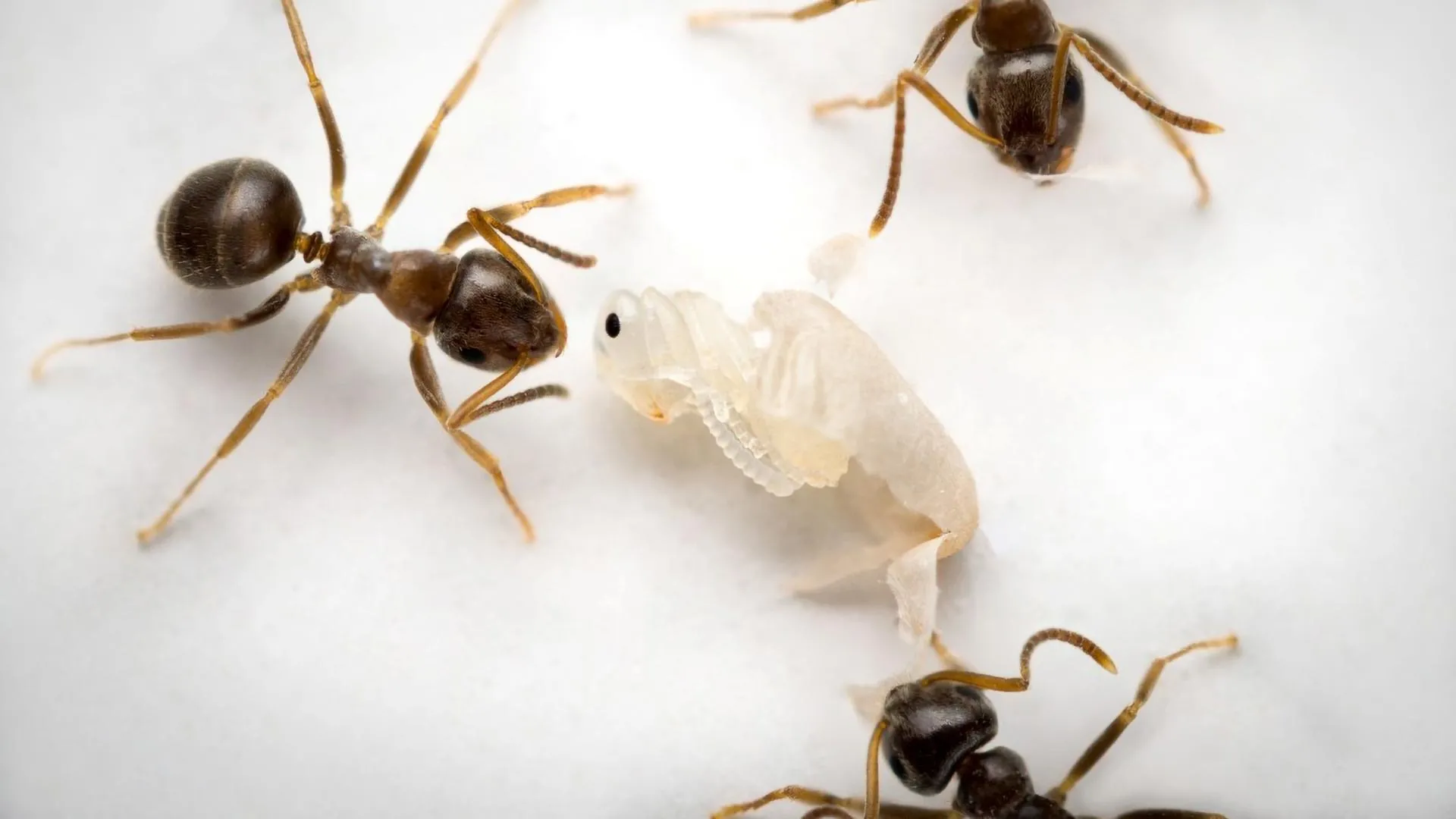
A groundbreaking study from the Institute of Science and Technology Austria (ISTA) has revealed a remarkable mechanism of collective defense in ant societies: terminally ill ant brood release a distinctive chemical odor, functioning as an early warning system to safeguard the entire colony from pathogen spread. This intricate form of self-sacrifice, detailed in Nature Communications, underscores the "superorganism" paradigm, where thousands of individual ants operate with the coordinated precision akin to cells within a single body, employing sophisticated social immunity strategies to ensure group survival.
The Chemical SOS: A Colony’s First Line of Defense
In the dense, interconnected world of an ant colony, the rapid detection and containment of disease are paramount. Unlike many social animals where individuals might conceal illness to avoid ostracization, ant pupae facing an incurable infection adopt a radically different strategy. They actively produce a unique chemical alarm, broadcasting their perilous state to their nestmates. This "distress signal" is not merely a passive byproduct of infection but an evolved, intentional communication.
Upon detecting this critical signal, worker ants initiate a swift and decisive intervention. They meticulously open the infected pupa’s cocoon, create small incisions on its outer surface, and apply formic acid. This potent natural antimicrobial compound, produced by the workers themselves, is lethal to the pathogens festering within the pupa. While effectively neutralizing the threat, this treatment inevitably leads to the pupa’s demise.
Erika Dawson, the study’s first author and a former postdoc in the Social Immunity research group led by Sylvia Cremer at ISTA, explains the paradox of this seemingly brutal act: "What appears to be self-sacrifice at first glance is, in fact, also beneficial to the signaler: it safeguards its nestmates, with whom it shares many genes. By warning the colony of their deadly infection, terminally ill ants help the colony remain healthy and produce daughter colonies, which indirectly pass on the signaler’s genes to the next generation." This statement highlights the profound evolutionary underpinnings of kin selection, where individual sacrifice contributes to the greater genetic success of the collective.
This research, conducted in collaboration with chemical ecologist Thomas Schmitt from the University of Würzburg in Germany, marks the first documented instance of such altruistic disease signaling in social insects. Without this sophisticated early warning system, a dying ant could transform into a highly infectious reservoir, posing an existential threat to the entire colony. The early signaling by the incurably ill enables the colony to preemptively neutralize the danger before it can escalate into a widespread epidemic.
The Superorganism Concept: Beyond Individual Ants
The concept of an ant colony as a "superorganism" is central to understanding these complex behaviors. Pioneered by figures like the late E.O. Wilson, this paradigm posits that a highly integrated social insect colony functions as a single biological entity, much like a multicellular organism. In this framework, individual ants are analogous to cells or specialized organs, each performing specific roles vital for the survival and reproduction of the collective.
In a typical ant colony, a queen or queens are dedicated to reproduction, akin to the germline cells in a vertebrate body. The vast numbers of worker ants, often sterile females, undertake all other "somatic" tasks: foraging, nest construction and maintenance, defense, and crucially, healthcare. This division of labor mirrors the cellular specialization seen in higher organisms, where reproductive cells generate offspring while other cells manage daily biological functions, grow, and maintain the body.
The health of this superorganism depends profoundly on the seamless cooperation between its reproductive and non-reproductive components. In ants, this cooperation extends to extreme behaviors, including the sacrifice of fatally infected brood. This level of integration is not just about efficiency but about collective survival, demonstrating how natural selection can operate at a level above the individual, favoring traits that benefit the group’s fitness.
Why an Early Warning is Indispensable for Immobile Brood
A natural question arises: why have ants evolved such an intricate alarm system when sick individuals might simply isolate themselves? Cremer clarifies this distinction, explaining that "Adult ants that approach death leave the nest to die outside the colony. Similarly, workers that have been exposed to fungal spores practice social distancing." This self-removal or behavioral immunity is a common strategy in many social species to minimize disease transmission.
However, this option is unavailable to ant brood – the eggs, larvae, and pupae – which are immobile and utterly dependent on worker care. Much like infected cells within a complex body, these developing individuals cannot remove themselves and require external intervention. The chemical signal they emit is thus a critical adaptation, analogous to the "find-me and eat-me signal" recognized by immunologists. In multicellular organisms, dying or infected cells release chemical cues (like ATP or phosphatidylserine) that attract immune cells, prompting their removal and preventing further damage or infection spread. The ant pupae’s signal performs an identical function within the superorganism.
"The signal must be both sensitive and specific," Cremer emphasizes. "It should help to identify all terminally-sick ant pupae but be precise enough to avoid triggering the unpacking of healthy pupae or those capable of overcoming the infection with their own immune system." This precision is vital to prevent the unnecessary loss of viable individuals, a delicate balance essential for colony fitness.
Unraveling the Chemical Signature of Doom
Thomas Schmitt, a leading expert in chemical communication in social insects, shed light on the nature of this precise signal. He observed that worker ants can pinpoint a single sick pupa amidst a multitude of healthy ones. "This means the scent cannot simply diffuse through the nest chamber but must be directly associated with the diseased pupa. Accordingly, the signal does not consist of volatile compounds but instead is made up of non-volatile compounds on the pupal body surface."
The research identified that two specific components of the ants’ natural scent profile intensify when a pupa becomes fatally infected. To rigorously test if this altered odor alone was the trigger for the disinfection response, the researchers conducted a crucial experiment: they extracted the scent from signaling pupae and applied it to healthy pupae, then observed the workers’ reactions.
"We extracted the smell from the signaling pupae and applied it to healthy brood," Cremer recounted. The results were conclusive: the artificial application of the altered scent was sufficient to prompt workers to unpack and treat the healthy pupae as if they were infected. This elegantly demonstrated that the distinctive odor of terminally infected brood functions as a direct chemical command, mirroring the "find-me and eat-me" signals observed at the cellular level in individual organisms.
Specificity and Strength: Only the Truly Lost Signal for Help
Further investigation revealed that not all infected brood emit this critical alarm signal. Dawson explains, "Queen pupae, which have stronger immune defenses than worker pupae and can limit the infection on their own, were not observed to emit this warning signal to the colony." This crucial distinction highlights the signal’s specificity. Queen pupae, destined to become the reproductive core of future colonies, possess enhanced immunity, allowing them to combat infections independently without burdening the colony with a false alarm or unnecessary sacrifice. Worker pupae, lacking this superior immune capacity, are the ones that signal for intervention.
By signaling only when an infection is truly beyond their individual control, the brood ensures that the colony’s drastic response is reserved for genuine, insurmountable threats. This prevents the wasteful loss of individuals that could otherwise recover and contribute to the colony. Cremer concludes, "This precise coordination between the individual and colony level is what makes this altruistic disease signaling so effective." It’s a testament to the evolutionary fine-tuning of collective intelligence and disease management within these complex social structures.
Broader Implications and Future Horizons
This groundbreaking discovery has profound implications across several scientific disciplines.
Evolutionary Biology and Altruism: The study provides compelling empirical evidence for the mechanisms driving extreme altruism in social insects, reinforcing the theory of kin selection. It illustrates how the genetic relatedness within a colony can favor behaviors that are detrimental to an individual but highly beneficial for the propagation of shared genes in the wider group. This deepens our understanding of the evolutionary pressures that shape complex social structures.
Disease Ecology and Epidemiology: Understanding how ant colonies detect and manage disease offers a novel perspective on epidemiology in densely populated systems. The strategy of early detection, signaling, and rapid, localized eradication could inspire new approaches to disease control in other contexts, perhaps even informing strategies for managing pathogens in agricultural settings or urban environments where social insects interact with human infrastructure.
Bio-inspiration and Robotics: The sophisticated, decentralized warning and response system observed in ants could serve as a powerful model for bio-inspired engineering. Imagine swarm robotics where individual units, upon detecting a critical failure or threat, can emit a precise, non-volatile signal that triggers a coordinated, localized response from other units. This could have applications in autonomous exploration, environmental monitoring, or disaster response, where collective intelligence and distributed sensing are paramount.
Comparative Immunology: The striking parallel between the ant pupae’s signal and the "find-me and eat-me" signals of infected or apoptotic cells in multicellular organisms invites further comparative immunological research. It suggests convergent evolution of fundamental disease management strategies across vastly different biological scales and organizational levels, from single-celled organisms to complex superorganisms. This highlights universal principles of maintaining health and integrity in biological systems.
Social Immunity Research: This study significantly advances the field of social immunity, which explores how social groups collectively fight disease. It adds a crucial layer to existing knowledge about hygienic behaviors, nest disinfection, and the use of antimicrobials. Future research may explore the genetic basis of this signaling, the specific chemical pathways involved in producing the signal, and how different ant species might have evolved variations of this defense mechanism.
The research conducted at ISTA, including experiments involving animals, adheres to strict legal and ethical guidelines. These studies are essential for unraveling fundamental biological processes in fields like behavioral biology, immunology, and genetics, as no alternative methods, including in silico approaches, can fully replicate the complexity of living systems.
The intricate dance between individual sacrifice and collective survival in ant colonies continues to astound scientists. This latest discovery from ISTA not only sheds light on the remarkable intelligence embedded within these "superorganisms" but also opens new avenues for understanding the fundamental principles of life, cooperation, and defense against disease across the biological spectrum. The humble ant, once again, proves to be a master class in survival strategy.
