
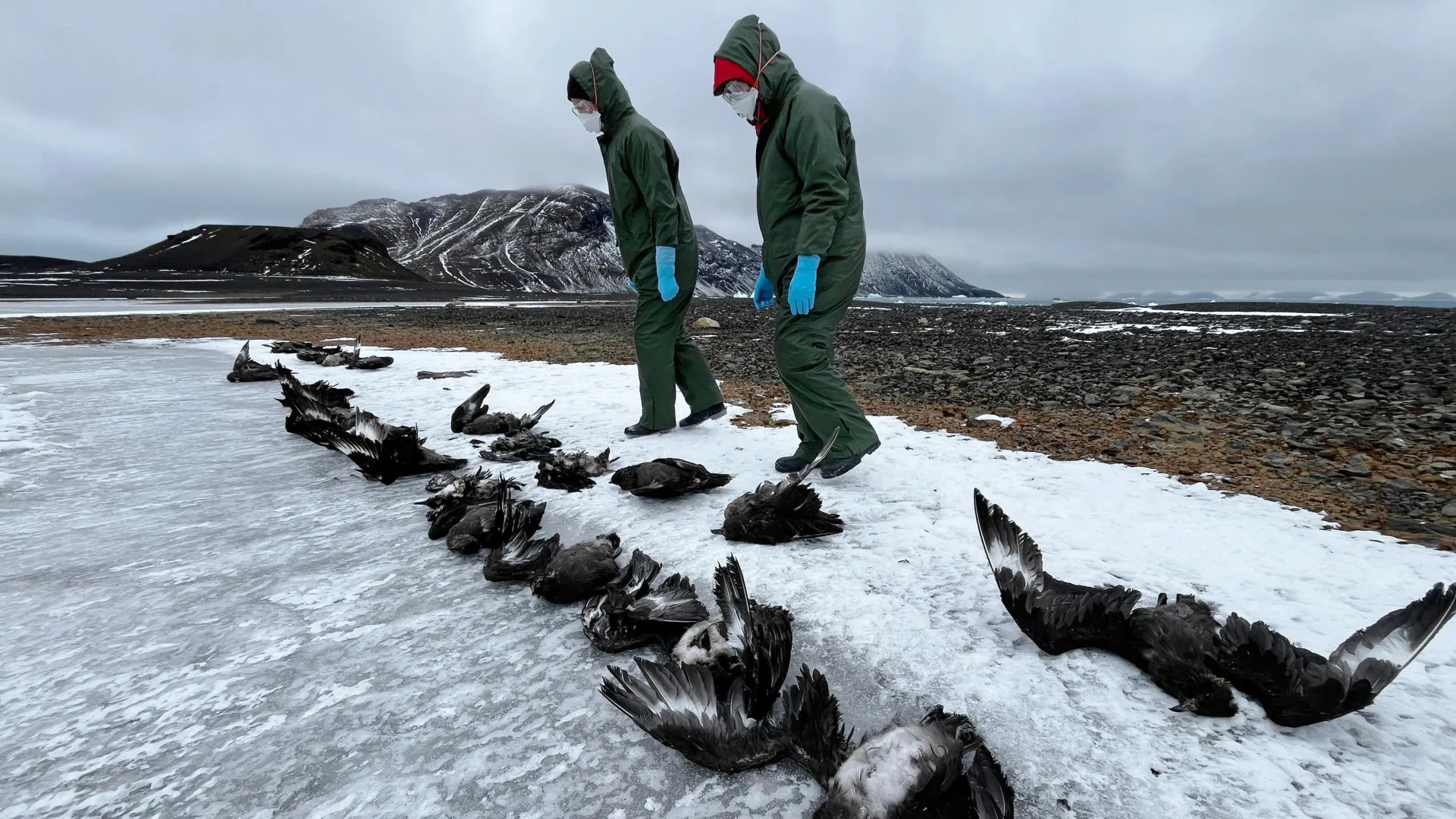
More than 50 skuas, robust seabirds native to the Earth’s polar regions, succumbed to the highly pathogenic avian influenza (HPAI) virus H5N1 during the austral summers of 2023 and 2024, marking the first confirmed mass wildlife die-off from the virus on the Antarctic continent. This alarming discovery, detailed in a study led by researchers from Erasmus MC in The Netherlands and the University of California, Davis, and recently published in the esteemed journal Scientific Reports, represents a critical turning point in the global spread of this virulent pathogen, underscoring the profound vulnerability of Antarctica’s pristine and unique ecosystem. The findings not only confirm the presence of the virus but definitively link it to the deaths of these significant avian predators, raising urgent concerns about the potential for wider ecological devastation across the continent.
Skuas are distinctive large brown seabirds, closely related to gulls, yet possessing the predatory prowess and scavenging habits often associated with birds of prey. Thriving predominantly in the challenging environments of polar and subpolar regions, they occupy a vital niche within the Antarctic food web. As both predators and scavengers, skuas play an indispensable role in maintaining the health of their ecosystem, notably by cleaning up carcasses and preventing the spread of other diseases. Ironically, this very scavenging behavior, which is essential for ecosystem sanitation, has been identified by researchers as a significant factor increasing their risk of exposure to, and subsequent spread of, the H5N1 virus across the vast Antarctic landscape. Their foraging habits, which involve close contact with dead or ailing animals, create a direct pathway for viral transmission, making them particularly susceptible to an infectious agent like H5N1.
A Confirmation of Mortality: From Detection to Definitive Cause
The journey to definitively link H5N1 to the skua deaths has been a rapid and concerning one. Earlier in 2024, the scientific community had already registered a chilling precursor when H5N1 was detected in a kelp gull and two skuas found deceased in January and February. While these initial findings confirmed the virus’s presence on the continent, the crucial step of proving H5N1 as the direct cause of death remained elusive until the publication of this latest study. The distinction is not merely academic; it fundamentally alters the perception of the threat, transitioning from a mere presence to an active, lethal agent capable of causing significant mortality events.
Dr. Ralph Vanstreels, a co-senior author of the study and a wildlife veterinarian with the UC Davis One Health Institute within the Weill School of Veterinary Medicine, emphasized the significance of this confirmation. "We knew there were animals with the infection, but this is the first study to show they died of the viral infection," Vanstreels stated, highlighting the critical nature of the distinction. "It’s an important distinction in the early days of an outbreak, moving from detection to confirmed impact." This scientific rigor in establishing causality is paramount for guiding subsequent conservation strategies and understanding the potential trajectory of the disease.
The Antarctic Expedition: Unraveling the Die-Off
The comprehensive investigation into the H5N1 outbreak was spearheaded by a dedicated research team that embarked on an expedition to Antarctica in March 2024. This timing, strategically chosen shortly after the peak breeding season for both skuas and penguins, allowed researchers to assess the immediate aftermath of potential disease outbreaks when populations were still relatively aggregated. The expedition spanned 10 critical sites across the South Shetland Islands, the northern Weddell Sea, and the Antarctic Peninsula, covering a substantial geographical area known for its rich wildlife populations.
During their meticulous fieldwork, the scientists adopted a rigorous protocol: whenever sick or deceased animals were encountered, they meticulously collected tissue and environmental samples. Necropsies, post-mortem examinations crucial for determining the cause of death, were conducted on-site. The team examined the remains of various iconic Antarctic species, including gentoo penguins, Adélie penguins, and Antarctic fur seals. Significantly, despite these investigations, H5N1 was not identified as the primary cause of death in these other species, suggesting a more localized or species-specific initial impact, at least as observed during this expedition.
However, as the expedition progressed, a clear pattern began to emerge. "As the expedition progressed, it became obvious quickly that skuas were a major victim," Dr. Vanstreels recounted, reflecting on the unfolding crisis. The H5N1 virus was specifically detected in skuas across three distinct locations: Hope Bay, Devil Island, and most notably, Beak Island. It was at Beak Island where the team documented a particularly large and distressing die-off of south polar skuas, providing stark visual evidence of the virus’s devastating effects.
Matteo Iervolino, the first author of the study and a Ph.D. candidate at Erasmus MC in Rotterdam, The Netherlands, described the grim reality on the ground. "We diagnosed high pathogenicity avian influenza as the cause of death for nearly all of the dead skuas we found at Beak Island," Iervolino explained. "There, I could really see with my eyes the impact this virus can have on these populations." His firsthand account underscores the severity of the outbreak and the palpable threat it poses to these ecologically vital birds.
The symptoms observed in the infected skuas painted a horrifying picture of suffering. Dr. Vanstreels described the situation as a "crisis in animal suffering," detailing how H5N1 relentlessly attacks the brain, leading to severe neurological symptoms. Infected birds exhibited twisted necks, unusual body stretching, disorientation, and impaired motor skills, often observed walking or swimming in circles, crashing into objects, or even tragically falling out of the air. These overt signs of neurological damage highlight the aggressive nature of the H5N1 strain affecting Antarctic wildlife. The researchers also stressed a critical underlying point: human activity played an undeniable role in the initial emergence of the virus and remains key to both understanding and limiting its further global spread.
H5N1’s Global Trajectory: A Path of Unchecked Proliferation
The current Antarctic crisis is but the latest chapter in the relentless global spread of the H5N1 virus, a pathogen with a concerning history of unchecked proliferation. Its origins trace back to 1996, when it was first identified on a domestic goose farm in Southeast China. For several years, the virus circulated predominantly within poultry populations, largely unnoticed or contained, undergoing mutations that increased its transmissibility and virulence. Eventually, it breached the species barrier, spilling over from confined poultry operations into wild bird populations. This spillover event marked a catastrophic turning point, as migratory wild birds became unwitting vectors, carrying the virus across continents.
From its initial foothold in Asia, H5N1 embarked on a relentless global march, establishing itself across Europe, the Middle East, and Africa. By 2021-2022, a particularly virulent clade (2.3.4.4b) of H5N1 underwent a significant evolutionary shift, leading to unprecedented outbreaks. This variant then made its way across the Atlantic, reaching North and South America, causing widespread mortality in wild bird populations and significant economic losses in the poultry industry. By early 2024, its arrival in Antarctica completed a devastating global circuit, leaving no major continental landmass untouched.
The same strain of H5N1 now impacting Antarctic skuas has already wrought havoc in other parts of the Southern Hemisphere. In Argentina, for instance, it caused massive die-offs among elephant seals and sea lions, demonstrating its capacity to jump to marine mammals and cause severe disease. Globally, the toll on domestic poultry has been staggering, with estimates exceeding 400 million birds culled or lost to the disease, leading to substantial economic repercussions for agricultural sectors worldwide. Beyond birds, the virus has shown a concerning propensity for infecting a wide array of mammalian species, including dairy cows, mink, foxes, bears, otters, and various other wild mammals, underscoring its broad host range and zoonotic potential.
The threat extends to human health as well. While human-to-human transmission remains rare and inefficient, H5N1 is a zoonotic pathogen. Of the approximately 1,000 reported human cases globally, a chilling statistic emerges: about half have been fatal. This high mortality rate, coupled with the virus’s continuous evolution, underscores the critical public health implications and the need for constant vigilance.
Dr. Thijs Kuiken, a corresponding senior author and professor at Erasmus MC, offered a sobering reflection on the global trajectory of H5N1. "We let the virus slip out through our fingers when it first emerged in the poultry industry," he lamented, pointing to a critical failure in early containment. "Once it got into wild bird populations, we lost ability to control this virus. Now it’s established in wild bird populations in all the continental regions of the world except Oceania." This assessment highlights the profound challenge posed by a virus that has become entrenched in wild reservoirs, making eradication virtually impossible and long-term management a global imperative.
Antarctica’s Fragile Ecosystem Under Renewed Threat
The arrival and establishment of H5N1 in Antarctica represent an additional, formidable pressure on an ecosystem already grappling with a multitude of existential threats. Antarctic wildlife faces a complex array of challenges, including the accelerating impacts of climate change, which manifest as melting glaciers, altered sea ice dynamics, and changes in prey availability. Growing tourism, while providing economic benefits and raising awareness, also carries risks of disturbance and the potential for introducing non-native species or pathogens. Invasive species, overfishing, and widespread pollution further exacerbate the fragility of this unique biome. The introduction of a highly pathogenic and rapidly spreading virus like H5N1 could trigger cascading ecological effects, potentially destabilizing food webs and threatening populations that have evolved in relative isolation.
The study underscores the urgent need for enhanced surveillance and monitoring efforts across the continent to accurately track the virus’s spread and mitigate its impact. A significant complication in assessing the true extent of the current skua die-off, and predicting future trends, is the lamentable lack of up-to-date population data for these birds. The last comprehensive census of Antarctic skuas was conducted in the 1980s, an era when researchers estimated a population of approximately 800 breeding pairs. Without more recent, robust population numbers, it becomes exceedingly difficult to gauge the true significance of the loss of 50 or more birds, let alone anticipate the long-term demographic consequences for the species.
"Everything points toward this virus spreading further," Dr. Kuiken warned, emphasizing the probable trajectory of the disease within the continent. "If nobody is watching, we won’t know what is happening." This stark warning serves as a clarion call for international collaboration, increased funding, and a renewed commitment to ecological monitoring in Antarctica. The continent’s vastness and logistical challenges make comprehensive surveillance difficult, but the stakes for global biodiversity and ecosystem health are immeasurably high.
The Path Forward: Enhanced Surveillance and a One Health Approach
The confirmed H5N1 die-off in Antarctica necessitates a robust and coordinated global response. Conservation organizations and scientific bodies are likely to amplify calls for immediate and sustained action. This includes strengthening biosecurity protocols for all human activities in Antarctica, from scientific expeditions to tourist operations, to minimize the risk of human-mediated viral transmission. Furthermore, the incident underscores the critical importance of a "One Health" approach, recognizing the interconnectedness of human, animal, and environmental health. This holistic perspective is essential for tackling complex zoonotic diseases like H5N1, which emerge from the animal-human interface and are profoundly influenced by ecological factors.
The HPAI Australis Expedition, which yielded these crucial findings, received vital funding from the International Association of Antarctica Tour Operators (IAATO) and Ocean Expeditions. Further support for the study was provided by the European Union, Consejo Superior de Investigaciones Científicas (CSIC), and PTI Global Health. This collaborative funding model highlights the recognition by various stakeholders, including the tourism industry, of the profound risks posed by such pathogens and the shared responsibility in protecting Antarctica’s unique biodiversity. Moving forward, sustained investment in scientific research, long-term ecological monitoring programs, and international collaboration will be indispensable to understand, track, and ultimately mitigate the devastating impacts of H5N1 on the planet’s last pristine wilderness. The Antarctic skuas serve as a stark reminder of the global interconnectedness of disease and the urgent need for collective action to safeguard both wildlife and human health.
