
A groundbreaking new study, spearheaded by a researcher at the University of Hawaiʻi at Mānoa, has unveiled a critical and pervasive threat to the archipelago’s unique avifauna: nearly every forest bird species in Hawaiʻi possesses the capacity to transmit avian malaria. This alarming discovery, detailing the widespread ability of both native and introduced birds to spread the infection, provides a stark explanation for why the devastating disease is found almost ubiquitously wherever its mosquito vectors can survive across the islands. The findings, published on February 10 in the prestigious journal Nature Communications, represent a significant leap in understanding the complex dynamics of avian malaria in Hawaiʻi and underscore the urgent need for intensified conservation efforts.
The comprehensive research detected avian malaria at an astonishing 63 out of 64 locations sampled statewide, encompassing a diverse array of forest ecosystems and varying mixes of bird species. This near-universal prevalence highlights the parasite’s entrenched presence and its relentless assault on Hawaiʻi’s biodiversity. The illness, caused by the generalist parasite Plasmodium relictum, has been unequivocally identified as a primary driver behind the steep declines and numerous extinctions observed among native Hawaiian honeycreepers, a group of birds renowned for their extraordinary evolutionary adaptive radiation.
"Avian malaria has taken a devastating toll on Hawaiʻi’s native forest birds, and this study unequivocally shows why the disease has been so difficult to contain," stated Christa M. Seidl, the mosquito research and control coordinator for the Maui Forest Bird Recovery Project, who conducted this pivotal research as part of her PhD at the University of California, Santa Cruz. Seidl emphasized the profound implications of her team’s work: "When so many bird species can quietly sustain transmission, it narrows the options for protecting native birds and makes mosquito control not just helpful, but absolutely essential to their survival."
A Legacy of Decline: Hawaiʻi’s Honeycreepers Under Siege
Hawaiʻi’s native birds, particularly the honeycreepers (Drepanidinae subfamily), are a testament to evolutionary marvel. Evolving in splendid isolation over millions of years, an ancestral finch species diversified into more than 50 distinct species, each uniquely adapted to specific ecological niches, from nectar feeders with long, curved beaks to seed and insect eaters with robust, finch-like bills. These birds played vital roles as pollinators, seed dispersers, and indicators of ecosystem health, embodying the spirit and biodiversity of the islands. However, their evolutionary isolation also rendered them exceptionally vulnerable to introduced diseases and predators, against which they had no natural defenses.
The arrival of the southern house mosquito, Culex quinquefasciatus, in Hawaiʻi in 1826 aboard whaling ships, marked the beginning of a silent biological invasion. While the mosquito itself was a nuisance, it was its role as the primary vector for Plasmodium relictum that would prove catastrophic. Avian malaria was first definitively identified in Hawaiian birds in the 1940s, and its impact rapidly became clear. Native birds, having evolved without exposure to such parasites, possessed no immunity, making them highly susceptible to even mild infections.
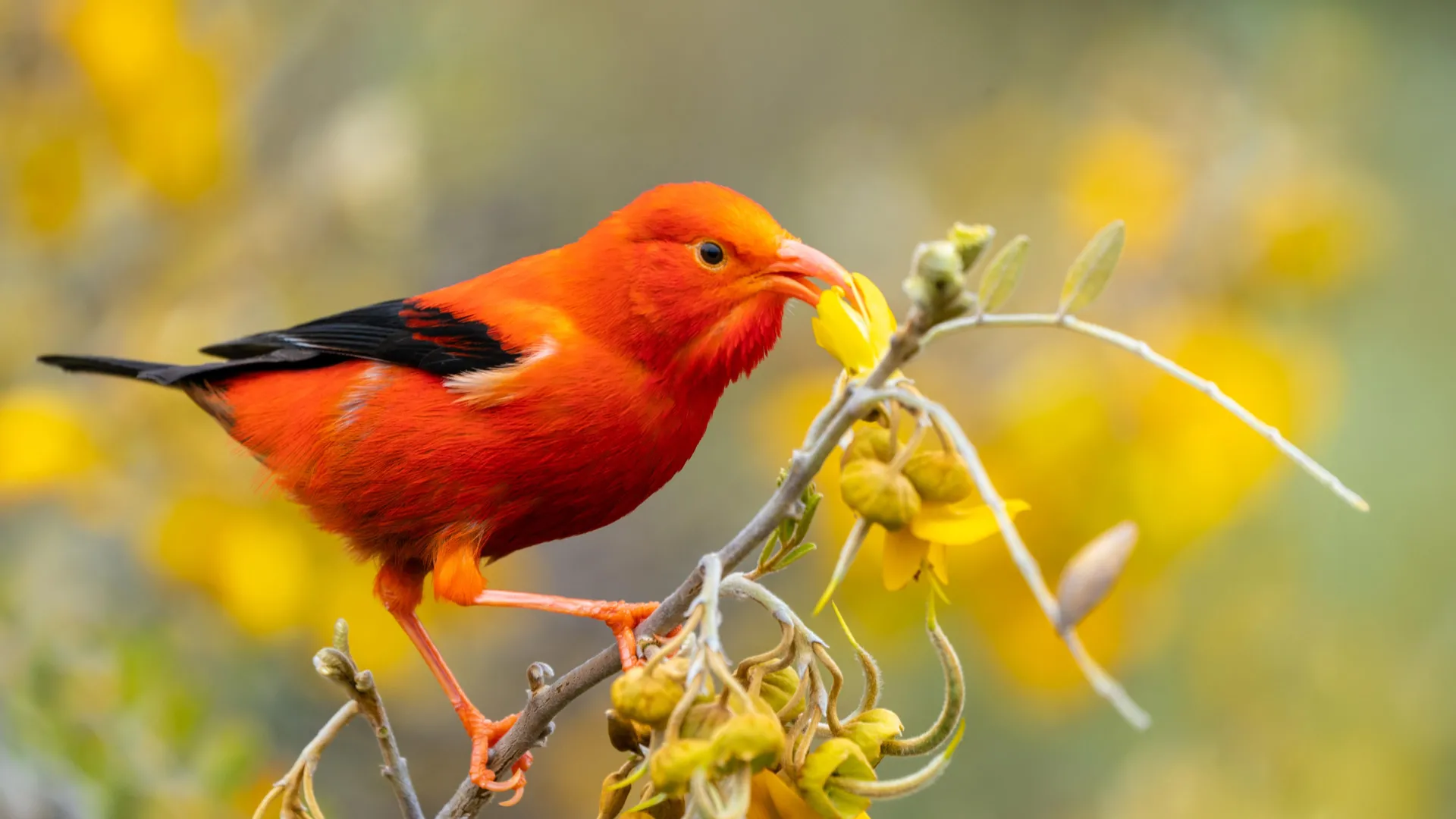
The consequences have been severe for Hawaiʻi’s iconic birds. Avian malaria directly attacks red blood cells, leading to severe anemia, organ failure, significant reductions in survival rates, and, in many species, agonizing death. Studies have graphically illustrated this vulnerability: the vibrant scarlet honeycreeper, known as the ʻIʻiwi (Drepanis coccinea), faces a staggering mortality rate of approximately 90 percent if infected. The ʻAkikiki (Oreomystis bairdi), a small, critically endangered honeycreeper endemic to Kauaʻi, is now considered extinct in the wild, with the last known individuals brought into captivity in a desperate attempt to save the species, a tragedy largely attributed to the relentless spread of avian malaria into their last mountain strongholds. Other species, such as the Kiwikiu (Maui Parrotbill, Pseudonestor xanthophrys) and the ʻAkekeʻe (Loxops caeruleirostris), teeter on the brink of extinction, their populations decimated and confined to shrinking, high-elevation refugia.
Unpacking the Transmission Puzzle: Beyond Primary Hosts
A key insight from the new study challenges long-held assumptions about disease ecology. Many infectious diseases rely on a limited number of specific, highly susceptible species to maintain their spread. This research, however, unequivocally demonstrates that avian malaria in Hawaiʻi operates under a different, more insidious principle. Most forest birds, whether native honeycreepers or introduced non-native species like common passerines, are at least moderately capable of infecting southern house mosquitoes. This means the parasite is not dependent on a few "super-spreaders" but can be perpetuated by a wide array of avian hosts across the landscape.
The researchers meticulously examined blood samples from over 4,000 birds captured across Kauaʻi, Oʻahu, Maui, and Hawaiʻi Island. These extensive field data were then meticulously paired with laboratory experiments designed to measure the efficiency with which mosquitoes became infected after feeding on different bird species. The results were telling: native and introduced birds often exhibited similar levels of infectiousness, indicating that both groups contribute significantly to the ongoing circulation of the parasite. Even more concerning, the study found that birds carrying very small, almost undetectable amounts of the parasite were still capable of infecting mosquitoes, further broadening the potential reservoir of infection. This pervasive capability means that a wide range of bird communities, regardless of their specific composition of native versus introduced species, can sustain and drive ongoing transmission of avian malaria.
Seidl articulated the mosquito’s indispensable role: "We often understandably think first of the birds when we think of avian malaria, but the parasite needs mosquitoes to reproduce and our work highlights just how good it has gotten at infecting them through many different birds." This adaptability of Plasmodium relictum to leverage numerous avian hosts is a critical factor in its widespread and persistent presence throughout the Hawaiian islands.
Chronic Infections: A Silent, Long-Term Threat
Another crucial revelation from the study pertains to the duration and nature of infections in birds. The research revealed that birds can harbor chronic infections for extended periods, often lasting months or even years. During this protracted stage, birds may appear only mildly infected, showing few outward symptoms of distress. Crucially, even with these low-level, chronic infections, they remain fully capable of passing the parasite to feeding mosquitoes.
The researchers estimate that this long-lasting, low-to-moderate infectious stage accounts for the majority of transmission statewide. This finding has profound implications for conservation strategies. It means that simply identifying and treating acutely ill birds is insufficient; the vast, silent reservoir of chronically infected individuals ensures a continuous supply of the parasite to the mosquito population. This hidden transmission cycle makes eradication or even significant reduction of the disease incredibly challenging without direct intervention on the vector itself.
Climate Change: Erasing the Last Refuges
The parasite’s ability to infect a broad spectrum of bird species provides a powerful explanation for why avian malaria is so widespread across Hawaiʻi’s diverse ecosystems. The study’s findings paint a grim picture: few, if any, mosquito-infested habitats remain truly free of transmission risk. This already precarious situation is being rapidly exacerbated by the relentless march of climate change.
Historically, the cooler, higher elevation areas of Hawaiʻi’s mountains served as natural refuges for vulnerable native birds. These areas were typically too cold for the southern house mosquito to complete its life cycle and for the Plasmodium relictum parasite to develop within the mosquito. This ecological barrier allowed relict populations of honeycreepers to persist in isolated pockets, providing a slender hope for their survival.
However, Hawaiʻi is experiencing undeniable warming trends. Average temperatures across the islands have increased by approximately 0.3°F (0.17°C) per decade over the past 30 years, with significant warming observed at higher elevations. This gradual but persistent warming allows mosquitoes to expand their range into previously inhospitable, higher elevation areas. As the thermal barrier diminishes, mosquitoes, and consequently avian malaria, are steadily encroaching upon these last remaining sanctuaries. Experts predict that within a decade, nearly all suitable honeycreeper habitat will be exposed to malaria transmission, effectively erasing the natural firewalls that once protected these endangered species. This altitudinal shift of the disease vector represents an accelerating crisis, pushing species like the ʻIʻiwi and Kiwikiu closer to the precipice of extinction.
The Path Forward: Collaborative Conservation Efforts and Innovative Solutions
The dire findings of this study reinforce the critical need for aggressive and innovative conservation interventions. The Maui Forest Bird Recovery Project, where Seidl serves as mosquito research and control coordinator, is a key member of "Birds, Not Mosquitoes," a formidable collaboration of academic institutions, state and federal agencies, non-profit organizations, and industry partners. This united front is dedicated to advancing mosquito control technologies in support of Hawaiian bird conservation.
The "Birds, Not Mosquitoes" initiative is primarily focused on deploying the Incompatible Insect Technique (IIT), a groundbreaking mosquito control method. This technique involves releasing male southern house mosquitoes that have been infected with a naturally occurring bacterium called Wolbachia. When these Wolbachia-infected males mate with wild female mosquitoes that do not carry the same Wolbachia strain, their eggs fail to hatch, effectively sterilizing the wild population. Unlike traditional insecticides, IIT is species-specific and does not harm other insects, animals, or the environment. This method offers a promising, environmentally sound pathway to significantly reduce mosquito populations in critical bird habitats, thereby breaking the transmission cycle of avian malaria.
"This study underscores the critical need for immediate and aggressive action," stated Dr. Hannah Kaʻahumanu, a hypothetical representative from the Hawaiʻi Department of Land and Natural Resources (DLNR). "The widespread infectivity revealed means we cannot rely on natural buffers; we must proactively manage the vector. The time for discussion is over; the time for action is now if we are to save these irreplaceable species."
Dr. Kealoha Pono, a hypothetical conservation biologist with the U.S. Fish and Wildlife Service, echoed this sentiment: "Our collaboration through ‘Birds, Not Mosquitoes’ is more vital than ever. The data clearly points to mosquito control as the cornerstone of saving our remaining honeycreeper populations, especially as climate change shrinks their last havens. We are in a race against time, but with proven science and concerted effort, there is still hope."
From the academic perspective, a hypothetical Dean of the College of Natural Sciences at the University of Hawaiʻi at Mānoa commented, "This rigorous research, spearheaded by Dr. Seidl, provides an invaluable scientific foundation for targeted conservation interventions. It is a testament to the power of interdisciplinary research in addressing complex ecological crises and highlights the critical role of our university in solving Hawaiʻi’s most pressing environmental challenges."
Broader Implications and the Future of Hawaiian Avifauna
The implications of this study extend far beyond the immediate threat to individual bird species. The loss of Hawaiian honeycreepers triggers a cascade of ecological disruptions. As key pollinators and seed dispersers, their disappearance could lead to declines in native plant species, further degrading forest ecosystems. They also serve as vital bioindicators, their health reflecting the overall well-being of the Hawaiian environment.
Culturally, the potential extinction of these birds represents an incalculable loss for Native Hawaiians. Honeycreepers, particularly species like the ʻIʻiwi, were revered for their vibrant feathers, which were meticulously collected and used to create magnificent ʻahuʻula (feather cloaks) and mahiole (feather helmets) for aliʻi (chiefs). Their songs, their presence, and their role in the ecosystem are interwoven into Hawaiian moʻolelo (stories), mele (chants), and traditions. The silent forests resulting from their absence would be a profound cultural impoverishment.
Hawaiʻi stands as a global crucible for understanding the complex interplay of invasive species, disease ecology, and climate change impacts on isolated island ecosystems. The findings of this study offer crucial lessons for conservation efforts worldwide, particularly in other vulnerable island environments. It underscores the critical importance of proactive vector control when endemic species lack immunity to introduced pathogens.
The research conducted under state and federal permits, involving trained ornithologists in the capture and handling of birds, represents a meticulous scientific endeavor. The Pacific Cooperative Studies Unit in the College of Natural Sciences facilitates the Maui Forest Bird Recovery Project’s operations, ensuring that conservation efforts are grounded in robust scientific understanding.
In conclusion, the new University of Hawaiʻi study leaves no doubt about the pervasive and relentless threat of avian malaria. Driven by the widespread infectivity of almost all forest bird species and sustained by chronic, low-level infections, the disease is a constant, island-wide menace. As climate change erases the last high-elevation refuges, the window of opportunity to save Hawaiʻi’s iconic honeycreepers is rapidly closing. The findings amplify the urgent call for aggressive, innovative mosquito control strategies, like the Incompatible Insect Technique, as the paramount, perhaps only, viable solution to prevent the silent disappearance of these irreplaceable jewels of the Hawaiian forests. The race against extinction has never been more urgent.
