
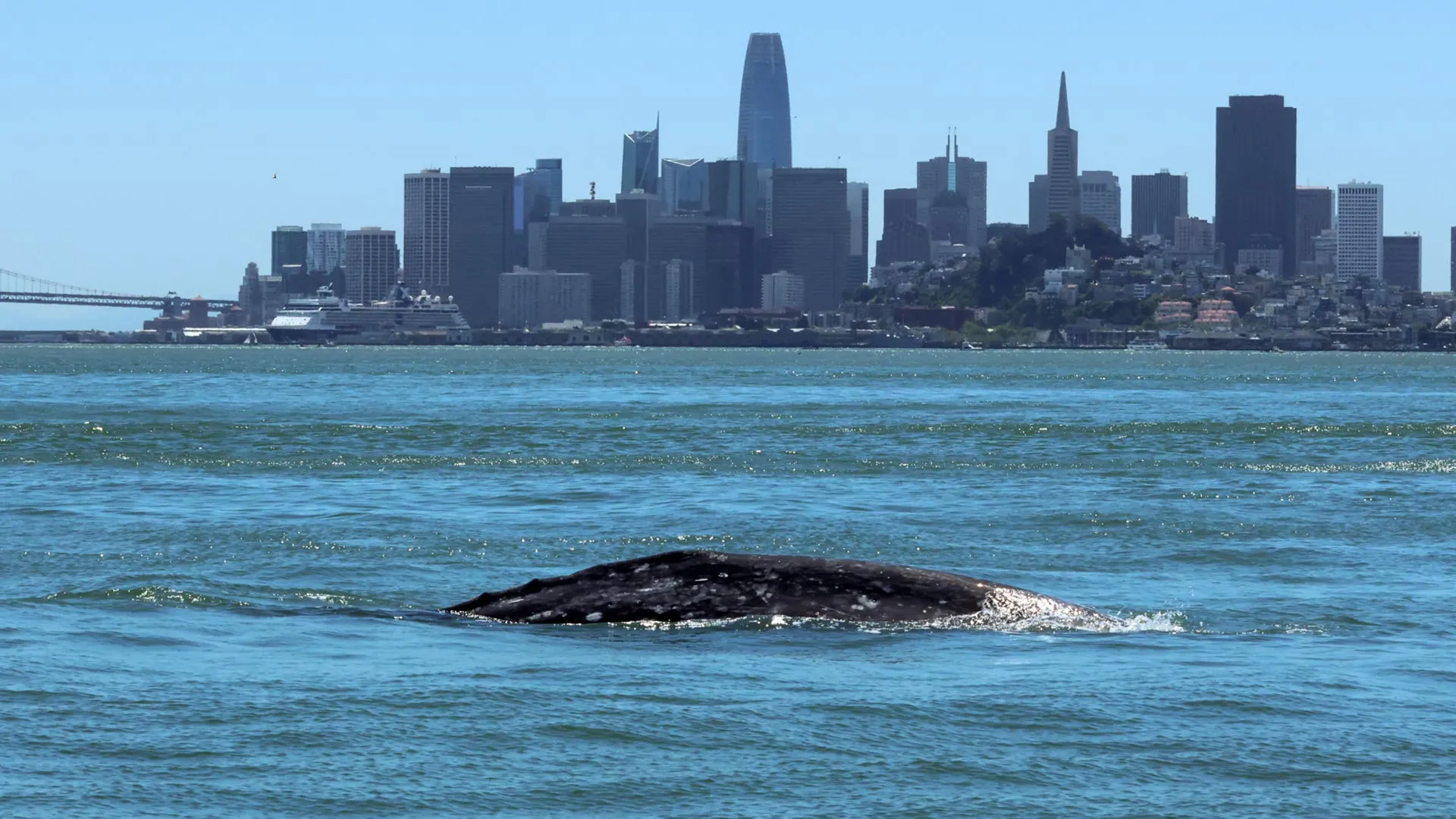
Gray whales, celebrated for undertaking one of the longest mammalian migrations on Earth, are exhibiting increasingly erratic behaviors driven by the profound impacts of climate change, with a recent study highlighting a particularly alarming trend: a significant number of these majestic cetaceans are now entering the highly urbanized and perilous waters of San Francisco Bay, often with fatal consequences. Traditionally, these magnificent travelers journey between their food-rich Arctic feeding grounds and the warm, sheltered lagoons of Baja California, Mexico, where they breed and calve. However, as global warming fundamentally alters ocean conditions and disrupts their primary food sources in the Arctic, a growing number of whales are venturing into unfamiliar and dangerous territories in a desperate search for sustenance, inadvertently placing themselves in direct conflict with human activity.
The San Francisco Bay, a bustling hub of maritime traffic, has emerged as one such unexpected and deadly detour. Researchers investigating an unusually high number of gray whale deaths along the Pacific coast have documented that nearly 20% of the individual gray whales observed entering the Bay did not survive, with a tragically high proportion succumbing to collisions with vessels. This finding underscores a critical and escalating conservation crisis for a species already under immense pressure.
The Unprecedented Incursion into San Francisco Bay
Historically, San Francisco Bay was not considered a regular stop on the gray whale’s epic migratory route. These robust baleen whales are known for their fasting periods during migration, relying instead on the massive energy reserves built up during their intensive summer feeding in the Arctic. However, this established pattern began to unravel around 2018, coinciding with a broader ecological shift and an increase in unusual whale mortality events across the Pacific. That year marked a noticeable uptick in gray whale sightings within the Bay, a phenomenon that has only intensified since, bringing with it a corresponding rise in local deaths.
"Gray whales have a low profile to the water when they surface, and this makes them difficult to see in conditions like fog which are common to San Francisco Bay," explained Josephine Slaathaug of Sonoma State University, lead author of a groundbreaking article published in Frontiers in Marine Science. "Additionally, San Francisco Bay is a highly trafficked waterway, and the Golden Gate Strait serves as a bottleneck through which all traffic and whales must enter and exit." This unique combination of environmental factors and intense human activity creates a gauntlet of hazards for any marine mammal, let alone one already potentially weakened and disoriented. The Golden Gate, a majestic natural landmark, transforms into a perilous choke point, forcing both immense cargo ships, ferries, and recreational boats into close proximity with surfacing whales.
Climate Change: The Root Cause of Shifting Behaviors
The primary driver behind this behavioral anomaly is the accelerating climate crisis and its cascading effects on marine ecosystems. Gray whales primarily feed on amphipods, small crustaceans that thrive in the cold, ice-covered waters of the Arctic. Warming ocean temperatures are drastically altering these delicate habitats, impacting the availability and distribution of their crucial prey. The loss of sea ice, changes in ocean currents, and increased competition from other species are contributing to a decline in the whales’ primary food sources, forcing them to seek alternative foraging grounds.
According to the National Oceanic and Atmospheric Administration (NOAA), the Eastern North Pacific gray whale population has suffered a devastating decline, plummeting by more than half since 2016. What was once a population estimated at around 27,000 individuals has now dwindled to approximately 13,000 as of 2023. This dramatic reduction prompted NOAA to declare an "Unusual Mortality Event" (UME) for the entire Pacific gray whale population in 2019, a designation that triggers an intensive scientific investigation into the causes of elevated mortality. A key indicator of this crisis is the increasingly rare sightings of calves, signaling severe reproductive stress within the population and raising profound concerns about its long-term viability. The whales entering San Francisco Bay are often observed to be unusually thin, a stark visual testament to the scarcity of food in their traditional feeding areas and a likely motivator for their risky foray into unfamiliar waters.
Unraveling the Mystery of the "Bay Grays": Research Methodology
To better understand these "Bay Grays" – whether they were repeat visitors or desperate one-time arrivals – scientists launched a comprehensive research effort. Between 2018 and 2023, researchers built a meticulously compiled catalog of individual whales. This catalog relied heavily on opportunistic sightings and photographs generously contributed by the public, demonstrating the invaluable role of citizen science in modern conservation efforts. Complementing these public submissions, more structured surveys were conducted from 2023 to 2025, providing a more systematic data collection approach.
Identification of individual whales was achieved by analyzing unique markings on their skin – distinct patterns, scars, and pigmentation that serve as natural fingerprints. These photographic records were then cross-referenced with necropsy data obtained from stranded whales found deceased in the surrounding region. While this method proved effective, researchers acknowledged a limitation: these unique markings can sometimes fade or be obscured after death, meaning that some potential matches between live sightings and deceased individuals might have been inadvertently missed. This meticulous work provided a critical baseline for understanding the frequency of visits and the ultimate fate of these venturing whales.
Alarming Findings: High Mortality and Non-Returning Visitors
The study’s findings painted a grim picture. In total, 114 individual gray whales were documented within San Francisco Bay during the entire study period. A key observation was the low rate of return: only four of these individuals were observed in more than one year, suggesting that the vast majority of whales entering the Bay do not make it back for subsequent visits. This low return rate strongly implies that the Bay may serve as an emergency feeding stop for whales in poor physiological condition, a last resort in their desperate search for nourishment. The observation of unusually thin individuals foraging not only in the Bay but also in other nontraditional habitats further supports this hypothesis.
The mortality statistics were particularly stark. Between 2018 and 2025, a devastating total of 70 gray whales were found dead in the broader San Francisco Bay region. Of these, a shocking 30 were definitively confirmed to have died from vessel strikes, their bodies bearing the unmistakable blunt force trauma associated with collisions. For the remaining whales where a cause of death could be determined, many displayed clear signs of severe malnutrition, reinforcing the link between their weakened state and their risky deviation into the Bay. Researchers were able to match 21 of 45 identifiable dead whales to individuals previously documented in their living catalog, providing direct evidence of the perilous nature of their Bay excursions.
"At least 18% of the individuals identified in San Francisco Bay later died in the area," stated Bekah Lane of the Center for Coastal Studies, a co-author of the study. "Our broader analysis of local strandings both inside and outside San Francisco Bay found that over 40% of these whales died of trauma from vessels." These figures highlight the dual threat faced by these whales: starvation weakening them and making them more susceptible, and the relentless, often invisible, danger posed by the Bay’s heavy vessel traffic.
The Silent Killers: Vessel Strikes and Starvation
The high incidence of vessel strikes in San Francisco Bay can be attributed to several compounding factors beyond just the sheer volume of traffic. Gray whales, unlike some other whale species, often swim and surface with a relatively low profile, making them difficult for even vigilant vessel operators to spot, especially in conditions of reduced visibility such as the frequent fog characteristic of the Bay. The narrow confines of the Golden Gate Strait exacerbate this problem, creating inevitable choke points where whales and ships are funneled into close proximity.
Furthermore, whales that are already weakened by malnutrition may be less agile and slower to react to oncoming vessels, further increasing their vulnerability. The energetic demands of migration are immense, and a whale struggling to find food is less likely to have the reserves needed for evasive maneuvers. This creates a tragic feedback loop where climate-induced food scarcity drives whales into dangerous waters, and their compromised health makes them more susceptible to the primary threat within those waters.
Urgent Calls for Conservation and Mitigation
The study’s findings underscore an urgent need for proactive conservation measures to protect these imperiled whales. The increasing frequency of Bay incursions, with 36 whales entering the area in 2025 alone, and groups sometimes exceeding 10 individuals, signals that this is not an isolated phenomenon but a growing crisis. Scientists emphasize that more research is critically needed to better understand the day-to-day movements and behaviors of whales within the Bay. Detailed tracking, potentially through satellite tagging, combined with additional necropsies, could provide crucial insights into whether the low number of returning whales is primarily due to high mortality rates, and whether deaths are predominantly caused by starvation, vessel strikes, or, most likely, a complex interaction of both.
Preventive steps are already being discussed and include a range of potential interventions. These could involve comprehensive educational programs for commercial vessel operators, raising awareness of whale presence and identification. Adjusting ferry routes to avoid known whale hotspots or critical foraging areas could significantly reduce encounters. Perhaps most critically, implementing mandatory or voluntary speed restrictions in high-risk zones, particularly within the Golden Gate Strait and key areas of the Bay, has been shown in other regions to dramatically reduce vessel strike mortality for large whales. For example, similar measures implemented in shipping lanes off the coast of Southern California and the East Coast have demonstrated success in protecting endangered right whales and other species.
"In San Francisco Bay, the biggest threat to these whales is vessel traffic," reiterated Bekah Lane. "Continued monitoring will help illuminate their distribution patterns and behaviors while within the Bay, which can impact risk. Route changes and speed restrictions have been found to significantly reduce vessel strike mortality to large whales, and an assessment of risk can help identify the most effective strategies to protect these animals." This assessment will involve collaboration between scientific researchers, port authorities, shipping companies, ferry operators, and environmental agencies to develop and implement effective, feasible solutions.
NOAA’s Role and Broader Context of the UME
NOAA’s declaration of an Unusual Mortality Event (UME) for the gray whale population is a critical piece of the larger puzzle. A UME is defined as a significant, unexpected, and atypical die-off of any marine mammal population, requiring an immediate and intensive response. The gray whale UME, ongoing since 2019, has seen thousands of whales strand along the Pacific coast from Mexico to Alaska, many showing signs of emaciation. This widespread mortality event, coupled with the Bay incursions, highlights the systemic stress on the entire population. NOAA, in collaboration with numerous partners, continues to monitor the population, investigate strandings, and analyze data to understand the full scope and causes of the UME, with climate change emerging as a dominant factor. The findings from the San Francisco Bay study provide crucial regional data points for this larger national and international effort.
The Larger Puzzle: Gray Whales as Climate Sentinels
Researchers caution that while this study provides invaluable data, there are still gaps in understanding the minute-by-minute movements and day-to-day behaviors of these whales. However, the findings offer a critical snapshot of how gray whales are reacting in real-time to rapidly changing environmental conditions across their vast range. The plight of the gray whale in San Francisco Bay serves as a powerful, visceral indicator of the broader ecological crisis unfolding globally.
"This study is our best analysis of the data we collected, but it’s important to consider that we do not have the full picture of each whale’s movements on a daily timescale," acknowledged Josephine Slaathaug. "These results are an important piece of the larger puzzle of what is going on in the overall population as they attempt to adapt to climate change in real time." The gray whale, a species that has survived millennia of environmental fluctuations, is now struggling to cope with the unprecedented speed and scale of human-induced climate change. Their desperation to find food in unexpected places, leading them into dangerous, human-dominated environments, is a stark warning. Protecting these magnificent migrants in places like San Francisco Bay is not just about saving individual whales; it’s about acknowledging the profound and accelerating impact of climate change on our planet’s most iconic species and the urgent need for global action to mitigate its devastating effects.
Looking Ahead: Collaborative Efforts for Survival
The challenges facing gray whales require a multi-faceted and collaborative approach. Beyond the immediate mitigation measures in San Francisco Bay, there is a pressing need for international cooperation to address the root causes of climate change. Locally, continued investment in scientific research, including advanced tagging technologies and genetic studies, will refine our understanding of whale health, migration patterns, and the effectiveness of protective measures. Public awareness campaigns can also play a vital role, encouraging recreational boaters and commercial operators alike to be vigilant and adhere to recommended guidelines. The tragic events unfolding in San Francisco Bay serve as a poignant reminder that human activity and a changing climate are pushing even the most resilient species to their limits, demanding immediate and sustained efforts to ensure their survival.
