
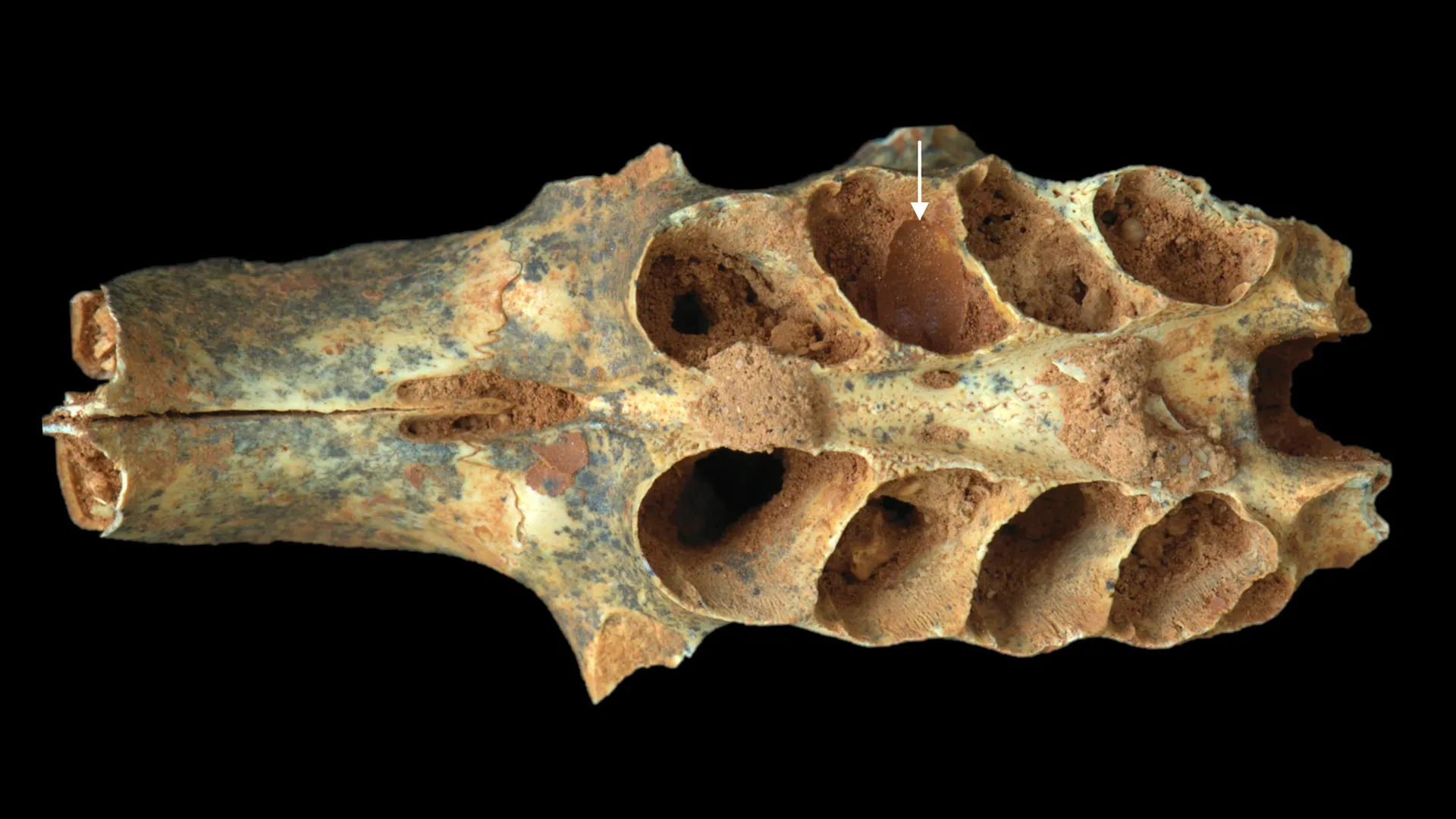
An extraordinary paleontological discovery has revealed that approximately 20,000 years ago, during the late Pleistocene epoch, generations of ancient bees utilized a highly unusual nesting strategy: they laid their eggs within the empty tooth sockets of fossilized bones. These bones, remnants of prey regurgitated by owls inhabiting a cave on the Caribbean island of Hispaniola, offered an unexpected nursery for the bees’ offspring. This groundbreaking finding, detailed in a new study published in Royal Society Open Science, marks the first known evidence of bees employing animal bones as sites for their nests, shedding light on a previously undocumented facet of ancient insect behavior and paleoecology.
The Unprecedented Discovery: A Microcosm of Ancient Life
The revelation stems from meticulous examination of fossil deposits within a limestone cave on Hispaniola, an island now shared by Haiti and the Dominican Republic. Researchers stumbled upon distinctive, smooth, concave structures nestled within the alveolar sockets of ancient mammal jawbones. These peculiar formations, initially mistaken for unusual sediment infill, were later identified as fossilized mud nests constructed by solitary bees. The discovery not only broadens our understanding of the adaptive capabilities of ancient insects but also underscores the intricate interdependencies within ancient ecosystems, where the refuse of one species became a vital resource for another.
Hispaniola’s Rich Paleontological Tapestry
The Caribbean island of Hispaniola is renowned for its extensive karst topography, a landscape characterized by soluble bedrock like limestone, which over millennia has been sculpted into a labyrinth of sinkholes and thousands of caves. These geological formations are natural traps and excellent preservers of prehistoric life. Lazaro Viñola López, a postdoctoral researcher at the Field Museum in Chicago and the lead author of the study, highlights the prevalence of these features: "In some areas, you’ll find a different sinkhole every 100 meters," he notes, emphasizing the island’s unique geological canvas for paleontological exploration.
The specific cave central to this study had long been recognized by Juan Almonte Milan, curator of paleobiology at the Dominican Republic’s Museo Nacional de Historia Natural, as an exceptionally rich fossil deposit. Almonte Milan’s decades of dedicated research in the region laid the groundwork for subsequent expeditions. Viñola López and his colleagues embarked on their detailed exploration of the site during his PhD research at the University of Florida and the Florida Museum of Natural History, a collaboration that combined international expertise with local knowledge.
Accessing the site was an adventure in itself. Viñola López recounts the initial descent: "The initial descent into the cave isn’t too deep — we would tie a rope to the side and then rappel down. If you go in at night, you see the eyes of the tarantulas that live inside. But once you walk down a ten-meter-long tunnel underground, you start finding the fossils." This vivid description paints a picture of the challenging yet rewarding environment faced by paleontologists working in such remote and biologically active locations. The cave’s internal structure, with multiple fossil layers separated by carbonate deposits formed during ancient rainy periods, provided a chronological archive of life over thousands of years.
A Predator’s Legacy: The Owl’s Role in Fossil Accumulation
The vast majority of the fossil remains recovered from the cave belonged to small rodents, but researchers also unearthed bones from sloths, various birds, reptiles, and numerous other animals, collectively representing more than 50 distinct species. This diverse assemblage of fauna offered a comprehensive snapshot of the cave’s long-term ecological role.
"We think that this was a cave where owls lived for many generations, maybe for hundreds or thousands of years," explains Viñola López. Owls are well-known for their habit of regurgitating indigestible parts of their prey, such as bones, fur, and feathers, in compact pellets. These owl pellets, often deposited at roosting or nesting sites, accumulate over time, creating concentrated bone beds that are invaluable to paleontologists. In this Hispaniolan cave, the continuous deposition of these pellets by successive generations of owls created a unique taphonomic environment, an abundance of disarticulated bones that would eventually become the substrate for the ancient bees’ unusual nesting strategy. The presence of owl fossils themselves, alongside bones of animals like turtles and crocodiles—likely accidental cave inhabitants—further solidified the narrative of the cave as a vibrant, albeit sometimes perilous, ancient ecosystem.
The Genesis of an Unusual Observation
Viñola López’s primary focus during his research was the mammal bones accumulated by the owls. It was during the meticulous process of cleaning these fossils that he first noticed something peculiar. Several jawbones contained smooth, unusual deposits within their empty tooth sockets. These structures differed significantly from typical sediment infill, which usually presents a more irregular, granular texture.
"It was a smooth surface, and almost concave. That’s not how sediment normally fills in, and I kept seeing it in multiple specimens. I was like, ‘Okay, there’s something weird here,’" he recalls. The repeated occurrence of these distinctive formations across multiple specimens piqued his scientific curiosity. Critically, the observation triggered a memory from an earlier undergraduate fossil excavation in Montana, where another paleontologist had shown him fossilized wasp cocoons – small, mud-built chambers where larvae developed. The striking resemblance between those wasp cocoons and the structures he was now observing inside the fossil jaws provided the crucial conceptual link, suggesting an entomological origin for the mysterious deposits.
Unveiling the Architects: Solitary Bees and Their Ingenious Nests
While popular perception often associates bees with large, communal hives, the vast majority of bee species are, in fact, solitary. These solitary bees do not form colonies or produce honey; instead, a single female constructs and provisions individual nests for her offspring. "Most bees are solitary. They lay their eggs in small cavities, and they leave pollen for the larvae to eat," Viñola López clarifies. Their nesting habits are incredibly diverse, ranging from burrowing into soil or wood to utilizing existing hollow structures. Some European and African species, for instance, are known to build their nests inside empty snail shells, demonstrating the remarkable adaptability of these insects in finding suitable microhabitats.
To conclusively investigate the nature of the deposits within the fossilized jawbones, the research team employed advanced imaging techniques, specifically CT scanning. This non-destructive method allowed them to generate detailed three-dimensional images of the compacted material inside the tooth sockets without causing any damage to the invaluable fossils. The scans provided irrefutable evidence: the internal structures precisely matched the mud nests constructed by certain modern solitary bees. Even more compelling, some nests preserved grains of ancient pollen, remnants of the food stores meticulously collected by the mother bees to nourish their developing larvae. This presence of pollen served as a definitive biological signature, confirming the identity of the nest builders.
The researchers hypothesize that the ancient bees crafted these tiny nests, each measuring less than the size of a pencil eraser, by mixing dirt with saliva. The choice of hollow bones, particularly the robust tooth sockets of larger animals, likely offered a significant evolutionary advantage. Nesting within these protected cavities would have provided a degree of insulation and, crucially, a shield against predators, such as parasitic wasps, which often target vulnerable insect larvae. This ingenious adaptation highlights a sophisticated behavioral response to specific environmental pressures.
A New Taxonomic Chapter: Osnidum almontei
Despite the clear evidence of bee activity, the nests themselves contained no fossilized bee bodies. This is not uncommon, as the warm, humid conditions prevalent in tropical cave environments are generally poor for preserving delicate insect exoskeletons. Without the physical remains of the bees, scientists could not definitively determine the exact species responsible for building the nests. However, the unique and distinct structure of the nests themselves provided sufficient grounds for their own taxonomic classification.
The fossil nests were formally named Osnidum almontei. The genus name, Osnidum, is a combination of "Os" (Latin for bone) and "nidum" (Latin for nest), aptly describing their unusual location. The species epithet, almontei, was chosen to honor Juan Almonte Milan, in recognition of his pioneering work in identifying the cave as a significant paleontological site and his enduring contributions as one of Hispaniola’s leading paleontologists. This act of naming not only formalizes the discovery but also pays tribute to the collaborative spirit of scientific research.
The question of whether the ancient bee species is still extant remains open. "Since we didn’t find any of the bees’ bodies, it’s possible that they belonged to a species that’s still alive today — there’s very little known about the ecology of many of the bees on these islands," notes Viñola López. However, given that many of the vertebrate species whose bones are preserved in the cave are now extinct, it is equally plausible that the bee species responsible for these unique nests has also vanished, a casualty of the profound ecological shifts that have occurred since the late Pleistocene.
Ecological Drivers of a Unique Adaptation
According to the researchers, this finding represents the first documented instance of bees utilizing animal bones as nesting sites. This unprecedented behavior was likely driven by a confluence of specific environmental factors unique to Hispaniola during that epoch. The karst landscape, while rich in caves, generally has very little topsoil. This scarcity of suitable substrate would have made traditional underground nesting sites, favored by many solitary bee species, a limited resource.
Concurrently, the consistent presence of generations of owls within the cave provided an abundant and readily available alternative. The continuous deposition of bone-rich pellets created an ever-replenishing supply of hollow tooth sockets – perfect, pre-fabricated micro-cavities for solitary bees. This remarkable example of resourcefulness highlights the intense selective pressures that can drive organisms to develop highly specialized and seemingly unconventional adaptations. It underscores the concept of ecological opportunism, where available resources are exploited in novel ways to ensure reproductive success.
Broader Implications for Paleoecology and Entomology
This discovery holds significant implications for several scientific disciplines. For paleoecology, it offers a deeper understanding of ancient food webs and resource utilization within a specific ecosystem. It illustrates how the remains of large vertebrates, often studied in isolation, can provide crucial context for the lives of much smaller, invertebrate organisms. For entomology, it expands the known repertoire of nesting behaviors for bees, challenging existing assumptions about their ecological flexibility and adaptability. It suggests that the evolutionary history of bees might harbor even more surprising adaptations awaiting discovery, particularly in understudied regions like the Caribbean.
The study also serves as a powerful reminder of the importance of meticulous observation in paleontological research. Viñola López emphasizes this point: "This discovery shows how weird bees can be — they can surprise you. But it also shows that when you’re looking at fossils, you have to be very careful." He reflects that without his prior experience recognizing fossilized wasp nests, he might have inadvertently cleaned away the unusual sediment, forever losing this invaluable piece of behavioral evidence.
The Future of Discovery: A Call for Meticulous Observation
The broader message from this research extends beyond the specifics of ancient bees. It underscores the critical role of trace fossils – evidence of past life activity rather than the organisms themselves – in reconstructing ancient ecosystems. "Even if you’re looking primarily for fossils of larger, vertebrate animals, you should keep an eye out for trace fossils that can tell you about invertebrates like insects. Knowing about insects can tell you a lot about a whole ecosystem, so you have to pay attention to that part of the story," Viñola López advises. This interdisciplinary approach, integrating vertebrate paleontology with entomology and taphonomy, is crucial for developing a holistic picture of life on Earth through deep time.
The Osnidum almontei discovery from Hispaniola stands as a testament to the ongoing revelations hidden within the fossil record. It champions the value of persistent exploration, sharp observation, and cross-disciplinary thinking in unraveling the complex and often surprising narratives of ancient life, reminding us that even the smallest traces can tell the grandest stories of adaptation and survival.
