
Thousands of years ago on the Caribbean island of Hispaniola, a dramatic yet commonplace scene unfolded: a giant barn owl, a formidable predator of the ancient Antillean landscape, returned to its roost within a sprawling cave system, a freshly caught hutia – a large, native rodent – clutched in its talons. The owl’s young were fed, and the remnants of the unlucky prey were scattered across the cave floor, destined to become part of the geological record. What no creature could have predicted, however, was that these very remains, after millennia of fossilization, would provide an ingenious solution for an entirely different inhabitant: a burrowing bee seeking a place to call home. This extraordinary intersection of predator, prey, and pollinator, preserved in stone, has now been meticulously uncovered by paleontologists, offering a rare and unprecedented glimpse into ancient ecological ingenuity.
The discovery, detailed in the Proceedings of the Royal Society B, highlights a unique instance where burrowing bees utilized the fossilized remains of extinct megafauna, specifically the empty tooth sockets (alveoli), vertebral canals, and even pulp cavities of sloth teeth, as ready-made nesting sites. This behavior represents a novel adaptation to the challenging karst environment of Hispaniola, where suitable soil for digging nests is scarce. Far from a mere curiosity, this finding redefines our understanding of ancient insect behavior, taphonomy – the study of how organisms decay and become fossilized – and the intricate, often surprising, interconnections within prehistoric ecosystems.
A Glimpse into the Past: Hispaniola’s Prehistoric Landscape
To fully appreciate the significance of this discovery, one must first envision the ancient Caribbean. Thousands of years ago, Hispaniola, now shared by Haiti and the Dominican Republic, was a vibrant tapestry of life, distinct from its modern iteration. Its ecosystems supported a rich diversity of endemic species, many of which have since vanished. Among the dominant predators was the Hispaniolan giant barn owl (likely Tyto noevae Hispaniolae), a magnificent bird significantly larger than its modern mainland counterparts, capable of preying on substantial game. These owls, much like many raptors today, utilized caves as long-term roosts and feeding stations, accumulating vast quantities of skeletal remains from their prey over generations.
One of their primary food sources was the Hispaniolan hutia (Plagiodontia ipnae), a robust, guinea pig-like rodent, endemic to the island. These hutias, along with various species of ground sloths, monkeys, and other unique fauna, formed the prey base for the island’s apex predators. The Cueva de Mono, or "Monkey Cave," in the southern Dominican Republic, served as precisely such a long-term feeding site for these giant barn owls. Over countless generations, the owls would bring their catches back to the cave, consume them, and leave the bones to accumulate, eventually becoming buried under layers of sediment. This continuous deposition created a veritable treasure trove of fossilized remains, providing a detailed record of the island’s ancient biodiversity.
The geological context of Hispaniola, particularly its prevalence of karst topography, is crucial to understanding the bee’s subsequent adaptation. Karst landscapes, formed by the dissolution of soluble rocks like limestone, are characterized by sharp, irregular surfaces, sinkholes, and a scarcity of stable, deep soil. While caves are abundant, the external environment often presents a challenging terrain for burrowing creatures, including many insect species that rely on soft earth for nesting. Any soil that does accumulate on the surface is frequently washed into these caves by rainfall, settling in sheltered pockets and creating localized deposits of fine, clay-rich silt – precisely the kind of material that would later become critical for the bees.
The Accidental Architects: How Bees Reimagined a Home
Fast forward through millennia. The giant barn owls and their hutia prey had long since passed into extinction, their bones entombed and fossilized within the cave’s sediment. The island’s climate had shifted, and new forms of life had emerged. Among them were burrowing bees, likely a species endemic to Hispaniola, facing the perennial challenge of finding suitable nesting sites in the island’s rocky, soil-deficient environment.
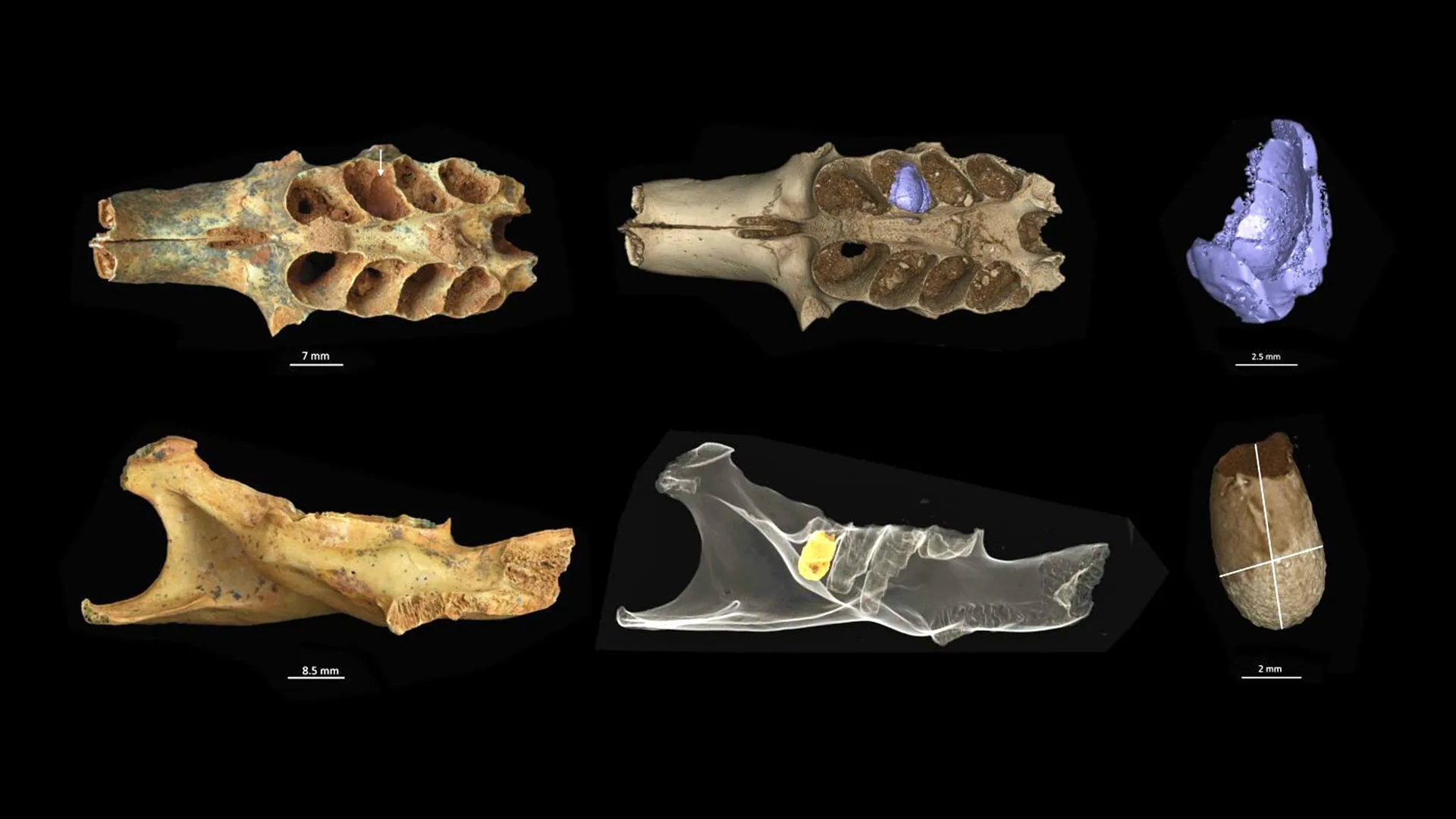
The ingenious solution they found lay within the very fossil record left by their ancient predecessors. As a bee began to dig into the cave’s fine, clay-rich silt, it encountered the fossilized remains of hutias and other extinct creatures. Instead of an impediment, these bones presented an opportunity. The hutia’s jawbones, for instance, contained numerous small, hollow sockets known as alveoli, where teeth had once been rooted. Though the teeth themselves were long gone, these empty spaces remained intact, perfectly sized and shaped for a bee’s nest. Similarly, the pulp cavities of sloth teeth and even the central canal of a hutia vertebra – the space that once housed the spinal cord – offered comparable, pre-formed chambers.
This wasn’t just a matter of convenience; it was a matter of survival. Burrowing bees typically dig their own tunnels, but in the absence of suitable soil, these fossilized cavities offered a ready-made, protected environment. What’s more, burrowing bees are known to line their nests with a waxy, waterproof secretion, creating a smooth, polished interior to protect their eggs and larvae from moisture and pathogens. The naturally smooth, hard walls of the fossilized bone cavities, once lined with this waxy substance, would have provided an ideal, secure nursery. Over time, more bees followed, establishing generations of nests within these ancient, skeletal structures, leaving behind a testament to their remarkable adaptability.
The Discovery Unveiled: Meticulous Excavation and Scientific Insight
The uncovering of this extraordinary behavior began with meticulous archaeological work by Lazaro Viñola Lopez, then a doctoral student at the Florida Museum of Natural History. His primary focus was on the Hispaniolan hutia, a species rarely found elsewhere on the island, making the thousands of fossils he unearthed at Cueva de Mono particularly significant. The cave’s role as a long-term feeding site meant a rich density of specimens, but it was Viñola Lopez’s keen eye and willingness to deviate from standard paleontological protocols that led to the breakthrough.
"Usually, when collecting fossils, you get all the sediment out of the alveoli while cleaning the specimen," Viñola Lopez explained, highlighting a common practice that could have easily obliterated the evidence. However, his interest in the specific hutia species prompted a more cautious approach. Instead of immediately cleaning the fossils, he inspected them closely. One particular cavity stood out: its inner surface was smooth, not rough like typical bone.
This observation triggered a memory. Viñola Lopez recalled a similar experience in Montana in 2014, where he and colleagues found wasp cocoons mixed with dinosaur fossils. He initially assumed the same explanation applied here, thinking, "it would be nice to write a short paper reporting the occurrence of these wasp nests in the mandibles." He shared this idea with his colleague, Mitchell Riegler, another doctoral student at the museum. Riegler, initially skeptical due to a heavy workload, eventually took on the challenge as part of a friendly competition to write a scientific paper within a week.
Their initial hypothesis, however, soon faced scrutiny. As they delved deeper into the research on ichnofossils – trace fossils that provide evidence of past life activity, such as nests – they encountered a critical discrepancy. Wasp nests are typically constructed from chewed plant material mixed with saliva, resulting in a rough, fibrous texture. The structures within the Hispaniolan fossils, crucially, were smooth and polished. This detail, seemingly minor, proved to be the linchpin. Bees, unlike wasps, often coat their nests with a waxy, resinous secretion that creates a waterproof, smooth interior. This distinction unequivocally revealed the true identity of the nest builders: they had been studying bees, not wasps. This correction elevated the discovery from an interesting anecdote to a finding of profound scientific significance.
Unprecedented Behavior: A Unique Chapter in Paleontology
The identification of the nests as belonging to bees, rather than wasps, made the discovery far more remarkable. There is only one other known case of burrowing bees nesting inside a cave, and critically, none where bees used pre-existing fossil structures without altering them. Previous reports included bees drilling into human bones, but never simply occupying natural cavities within fossilized remains in such an unaltered state. This distinction underscores the unprecedented nature of the Hispaniolan finding.
Realizing the immense importance of their findings, the researchers slowed their pace, expanding the scope of their study. They engaged with experts in modern bee entomology, thoroughly reviewed existing scientific literature, and Viñola Lopez returned to the Cueva de Mono for further geological analysis of its layers, seeking to establish a precise chronology of the events.
The study revealed the incredible diversity of fossilized structures utilized by these ancient bees. While hutia jawbones were common, nests were also found within the pulp cavity of a sloth tooth – a poignant reminder of the island’s lost megafauna, as tree sloths disappeared from the Caribbean after human arrival. Another nest was discovered inside a hutia vertebra, ingeniously exploiting the space that once housed the spinal cord. Furthermore, advanced imaging techniques, specifically CT scans, unveiled even more intricate details. Some cavities contained multiple layers of nests, suggesting that instead of expending energy to dig new tunnels, certain bees reused existing ones if they were empty. In one astonishing example, six nests were stacked within a single alveolus, arranged concentrically like a set of Russian dolls, showcasing an incredible economy of space and resources.
Challenges and Triumphs: Preserving a Priceless Record
The journey of discovery was not without its challenges. At one point, the Cueva de Mono faced a direct threat when a development plan emerged to convert the ancient cave into a septic tank. Such a conversion would have irrevocably destroyed a priceless paleontological record. Recognizing the imminent danger, the research team acted swiftly, launching a "rescue mission" to recover as many fossils as possible before potential destruction. "We had to go on a rescue mission and get as many fossils out as possible, and we got a lot of them," Viñola Lopez recounted, emphasizing the urgency and dedication that often accompanies scientific endeavors in the face of modern development pressures.
This episode highlights the broader conservation implications of such paleontological sites. Caves, often perceived as mere geological formations, are frequently time capsules, preserving unique records of past life, climate, and ecological interactions. Their destruction represents an irreplaceable loss of scientific data and cultural heritage. The collaborative efforts of paleontologists, entomologists, and conservationists are crucial in protecting these invaluable natural archives for future study and understanding.
Broader Implications: Rewriting Ecological Narratives
The Hispaniolan bee nest discovery offers a wealth of implications across multiple scientific disciplines:
- Paleoecological Insights: This finding provides a rare glimpse into the intricate ecological dynamics of ancient Caribbean ecosystems. It details not just predator-prey relationships, but also the subsequent exploitation of those remains by a completely different guild of organisms. It underscores the resourcefulness of island biota, often facing unique evolutionary pressures due to limited resources and isolation. The bees’ adaptation speaks volumes about the scarcity of suitable nesting habitats in karst regions, driving them to utilize even the most unconventional spaces.
- Taphonomic Significance: The discovery significantly expands our understanding of taphonomy. It demonstrates a novel form of biological modification of fossil remains, where post-mortem processes (fossilization) are followed by a secondary biological interaction (nesting). This interaction itself then becomes part of the fossil record, creating a complex, multi-layered narrative within the same specimen. It emphasizes the importance of meticulous observation during excavation, as subtle clues like a smooth internal cavity could easily be overlooked or dismissed.
- Evolutionary Adaptation: The behavior of these ancient bees is a powerful testament to evolutionary adaptation. Faced with a challenging environment lacking conventional nesting substrate, they evolved to exploit an entirely new, stable resource: the fossilized bones of extinct animals. This demonstrates the remarkable plasticity of life and its capacity to find niches in the most unexpected places. It also offers a compelling case study for understanding how environmental pressures drive unique behavioral and ecological innovations, particularly relevant in the context of island biogeography where endemic species often exhibit highly specialized adaptations.
- Conservation Lessons: The vulnerability of sites like Cueva de Mono to human development serves as a stark reminder of the urgent need for conservation. These paleontological sites are not just repositories of bones; they are detailed historical records that inform our understanding of biodiversity, extinction events, and long-term ecological change. Protecting them is crucial for deciphering the past and informing future conservation strategies in the face of ongoing environmental challenges.
Continuing the Exploration: More Stories from Cueva de Mono
The researchers are far from finished with their work. The Cueva de Mono continues to yield new secrets, and additional findings from other fossils recovered from the cave are anticipated in future publications. Each new discovery further enriches the narrative of ancient Hispaniola, illuminating the lives of its extinct inhabitants and the remarkable ways in which ecosystems adapt and evolve over geological timescales.
The work of Viñola Lopez, Riegler, and their team is a powerful reminder that the past is constantly revealing itself in unexpected ways. A giant barn owl’s meal, a rodent’s remains, and a burrowing bee’s search for a home—these seemingly disparate events, spanning millennia, converged in a remote Caribbean cave to tell a story of unparalleled ecological ingenuity and adaptation. It is a testament to the enduring power of nature to innovate and to the relentless dedication of scientists who painstakingly piece together the fragments of ancient life, ensuring that the cave, full of untold stories, continues to speak across the ages.
