
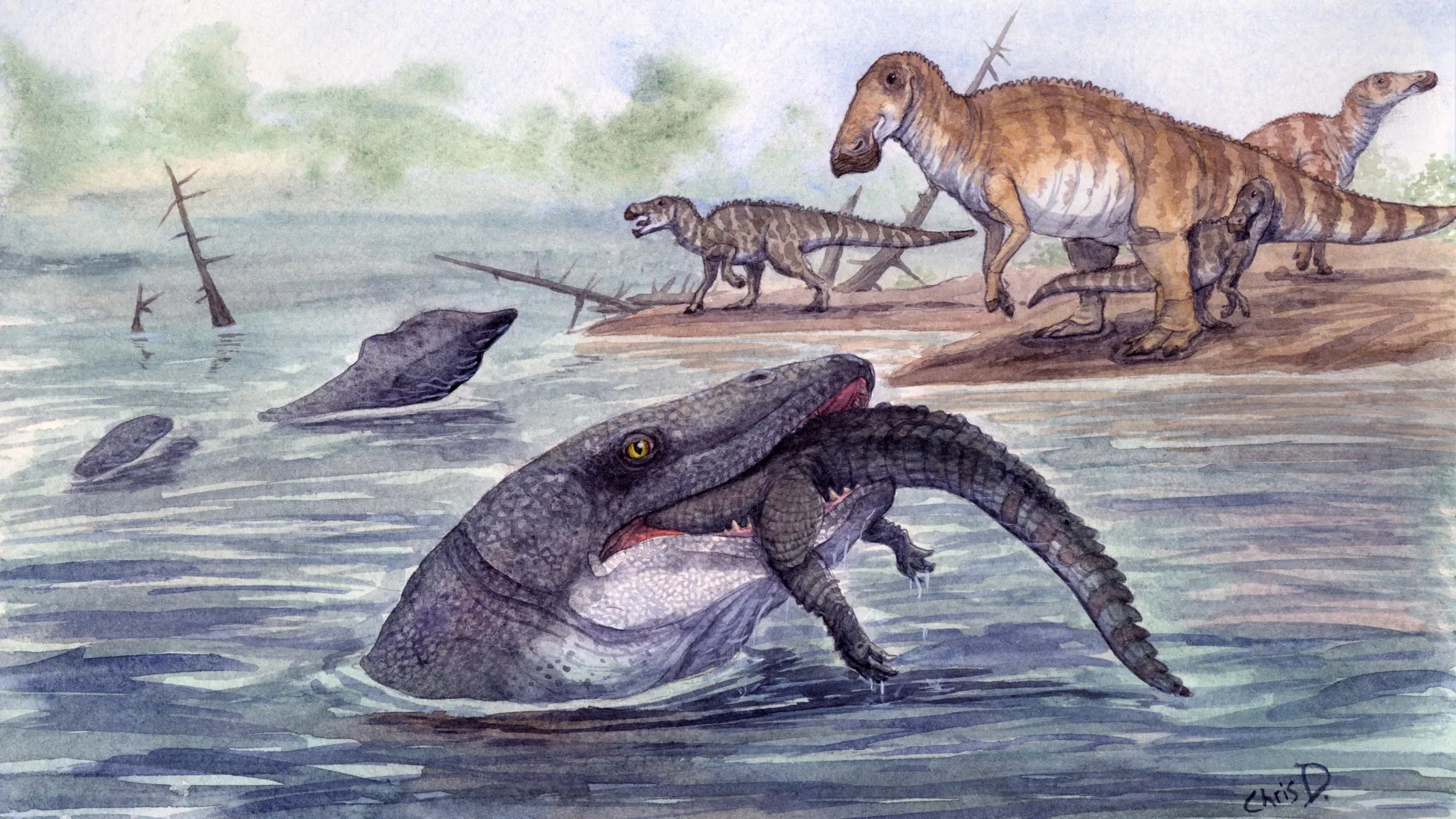
Mosasaurs, the formidable marine reptiles that dominated ancient oceans for millions of years, were long believed to be exclusively ocean-dwelling creatures. However, groundbreaking new evidence stemming from a remarkable fossil discovery in North Dakota has forced scientists to rethink this long-held assumption. Researchers, spearheaded by scientists at Uppsala University, have uncovered strong indicators that some mosasaur species adapted to and actively inhabited freshwater river systems during the final million years leading up to their extinction approximately 66 million years ago. This revelation, based on the meticulous analysis of a mosasaur tooth, paints a more complex picture of these colossal predators, suggesting a surprising ecological flexibility that allowed them to venture far beyond their traditional saltwater domains. The tooth itself, a substantial relic, likely belonged to an individual measuring up to 11 meters long, a size comparable to a modern-day bus or even the largest killer whales, making its presence in an ancient riverbed an extraordinary find.
The Unearthing of a Freshwater Enigma
The journey to this paradigm-shifting discovery began in 2022 when the mosasaur tooth was unearthed from a river deposit in North Dakota. This particular locale, rich in palaeontological treasures, offered an immediate puzzle to the excavators. The mosasaur tooth was not found in isolation; it lay amidst a captivating assemblage of fossils that seemed to defy conventional ecological understanding. Alongside it, researchers discovered a tooth from a formidable terrestrial predator, a Tyrannosaurus rex, and a robust jawbone from a crocodylian, an animal known for its freshwater and estuarine habitats. The region itself is renowned for yielding fossils of the duck-billed dinosaur Edmontosaurus, a common inhabitant of the Late Cretaceous North American landscape.
The unusual juxtaposition of these fossils — a giant marine reptile, land-dwelling dinosaurs, and river-dwelling crocodiles — immediately raised questions. If mosasaurs were strictly ocean animals, how could one of their teeth, particularly one from such a large individual, end up perfectly preserved within a riverine sediment alongside terrestrial and freshwater fauna? This perplexing mix suggested a scenario far removed from the established narrative of mosasaur life, compelling the international research team, comprising experts from the United States, Sweden, and the Netherlands, to delve deeper into the tooth’s secrets.
Unlocking Ancient Secrets: The Power of Isotope Analysis
To unravel this palaeontological mystery, the researchers turned to a powerful analytical tool: isotope analysis. This technique involves examining the precise chemical makeup of fossilized tissues, specifically the ratios of different isotopes (atoms of the same element with varying numbers of neutrons) within the mosasaur tooth enamel. The enamel, being the hardest and most resistant part of the tooth, acts as a durable archive of an animal’s life, preserving chemical signatures from the water it drank and the food it consumed.
Crucially, all the fossils found at the North Dakota site – the mosasaur tooth, the T. rex tooth, and the crocodylian jawbone – date back to approximately the same geological epoch, around 66 million years ago. This synchronicity allowed for direct chemical comparisons, providing a unique snapshot of the environment and ecological interactions during the very end of the Cretaceous Period, just before the catastrophic K-Pg extinction event. The detailed analytical work was primarily carried out at the Vrije Universiteit (VU) in Amsterdam, focusing on isotopes of oxygen, strontium, and carbon, each offering distinct clues about the ancient environment and the animal’s physiology.
Chemical Fingerprints: Evidence of a Riverine Life
The results of the isotope analysis were nothing short of revelatory. The mosasaur tooth contained unusually high levels of the lighter oxygen isotope (¹⁶O) compared to its heavier counterpart (¹⁸O). In geological and biological contexts, the ratio of ¹⁶O to ¹⁸O is a well-established proxy for water salinity. Freshwater environments typically exhibit higher concentrations of ¹⁶O because the lighter isotope evaporates more readily from oceans and is subsequently deposited as rain and snow over land, eventually flowing into rivers and lakes. Marine environments, conversely, tend to have higher ¹⁸O ratios. The observed oxygen isotope signature in the mosasaur tooth was strikingly consistent with freshwater conditions, starkly contrasting with typical marine signatures.
Further corroboration came from strontium isotope ratios. Strontium, a trace element found in water, is incorporated into tooth enamel. The specific ratio of strontium isotopes (e.g., ⁸⁷Sr/⁸⁶Sr) in an animal’s tissues reflects the strontium composition of the water in its environment, which in turn is influenced by the geology of the surrounding landmass. The strontium isotope ratios in the mosasaur tooth similarly pointed unequivocally to a freshwater habitat, reinforcing the conclusion drawn from the oxygen isotopes.
Perhaps one of the most intriguing findings emerged from the carbon isotope analysis. "Carbon isotopes in teeth generally reflect what the animal ate. Many mosasaurs have low ¹³C values because they dive deep," explained Melanie During, one of the study’s corresponding authors, highlighting a common pattern in marine predators that forage in deeper, darker waters where carbon cycling differs. "The mosasaur tooth found with the T. rex tooth, on the other hand, has a higher ¹³C value than all known mosasaurs, dinosaurs and crocodiles, suggesting that it did not dive deep and may sometimes have fed on drowned dinosaurs," During elaborated. This exceptionally high ¹³C signature is unprecedented among known mosasaurs and even terrestrial contemporaries, suggesting a unique dietary niche within this freshwater ecosystem, possibly involving scavenging on large carcasses from land that washed into the rivers.
The significance of these findings was further amplified by examining additional mosasaur teeth from nearby, slightly older sites in North Dakota. "The isotope signatures indicated that this mosasaur had inhabited this freshwater riverine environment. When we looked at two additional mosasaur teeth found at nearby, slightly older, sites in North Dakota, we saw similar freshwater signatures. These analyses show that mosasaurs lived in riverine environments in the final million years before going extinct," During affirmed, cementing the conclusion that this was not an isolated incident but rather an established ecological pattern for some mosasaur populations.
A Shifting World: The Western Interior Seaway’s Transformation
The findings also provide critical insights into how this remarkable lifestyle shift became possible. During the Late Cretaceous, central North America was bisected by the Western Interior Seaway (WIS), a vast, shallow inland sea that stretched from the Gulf of Mexico to the Arctic Ocean. This epicontinental sea was a vibrant marine ecosystem, teeming with diverse life, including numerous mosasaur species. However, geological and climatic forces were at play that gradually altered this enormous waterway during the Maastrichtian age, the final stage of the Cretaceous.
As the continent underwent tectonic uplift, particularly in the Laramide Orogeny that was forming the Rocky Mountains, and as global climate patterns shifted, increasing amounts of freshwater flowed into the Western Interior Seaway from newly formed river systems. Over millions of years, this continuous influx of freshwater progressively diluted the seaway’s salinity. It transitioned from a fully marine environment to a brackish one, and eventually, in its northern reaches, to a state that was predominantly freshwater, akin to conditions observed today in semi-enclosed basins like the Gulf of Bothnia between Sweden and Finland.
The researchers propose that this process created a distinct ‘halocline’ within the seaway’s water column. A halocline is a strong vertical gradient in salinity, where lighter freshwater forms a distinct surface layer above denser, more saline water below. This stratification would have created a unique ecological opportunity. Isotope data from other marine fossils collected for comparison supported this hypothesis. "For comparison with the mosasaur teeth, we also measured fossils from other marine animals and found a clear difference. All gill-breathing animals had isotope signatures linking them to brackish or salty water, while all lung-breathing animals lacked such signatures," stated Per Ahlberg, coauthor of the study and Dr. During’s promotor. "This shows that mosasaurs, which needed to come to the surface to breathe, inhabited the upper freshwater layer and not the lower layer where the water was more saline." This adaptation would have allowed these air-breathing reptiles to exploit a vast, previously inaccessible freshwater niche, effectively bypassing the physiological challenges of living in saline environments by simply staying within the freshwater layer.
Evolutionary Adaptability: Parallels in Prehistory and Today
The researchers contend that the studied teeth unequivocally belonged to mosasaurs that had actively adjusted to these evolving environmental conditions. The ability of large predators to shift between different habitats, or exhibit euryhalinity (tolerance to a wide range of salinities), is not an unheard-of phenomenon in evolutionary history, though the scale of this mosasaur adaptation is remarkable.
"Unlike the complex adaptation required to move from freshwater to marine habitats, the reverse adaptation is generally simpler," During noted. Moving from freshwater to marine environments presents significant osmoregulatory challenges, as organisms must actively prevent dehydration in a hypertonic (saltier) environment. Conversely, adapting from marine to freshwater (hypotonic) generally involves less physiological stress, as the primary challenge is preventing excessive water uptake and salt loss, mechanisms that many marine animals already possess to some degree.
Modern animals offer compelling parallels to this ancient adaptability. River dolphins, for instance, are entirely freshwater dwellers, despite their evolutionary lineage tracing back to marine ancestors. The estuarine crocodile (Crocodylus porosus), famously known in Australia as the saltwater crocodile, exemplifies this flexibility, regularly navigating between freshwater rivers, brackish estuaries, and the open ocean, strategically hunting wherever prey is most abundant. Even bull sharks (Carcharhinus leucas), notorious for their aggressive nature, are well-documented for their ability to venture hundreds of miles up freshwater rivers, a testament to the physiological plasticity of certain apex predators. These modern examples underscore the plausibility and ecological advantage of such adaptations, especially in environments undergoing significant changes.
An Apex Predator in Unexpected Waters
Mosasaur fossils are typically abundant in marine deposits across vast geographical ranges, including North America, Europe, and Africa, spanning their reign from approximately 98 to 66 million years ago. In stark contrast, their fossils are exceedingly rare in North Dakota, making this specific discovery particularly striking and significant. The sheer size of the tooth, indicating an animal up to 11 meters long, provides a vivid image of a truly colossal predator. Earlier discoveries of mosasaur bones at a nearby site in North Dakota lend further credence to this impressive size estimate.
While the exact genus of this mosasaur cannot be definitively identified from a single tooth, its characteristics suggest it likely belonged to a prognathodontine mosasaur. Close relatives within the genus Prognathodon were renowned for their massive heads, incredibly powerful jaws, and robust, often blunt, teeth. These features indicate that they were opportunistic and versatile predators, capable of crushing shells, bones, and tackling large, formidable prey. Imagining such a creature, rivaling the largest killer whales in size and power, patrolling ancient North American rivers adds an entirely new dimension to our understanding of Late Cretaceous freshwater ecosystems.
"The size means that the animal would rival the largest killer whales, making it an extraordinary predator to encounter in riverine environments not previously associated with such giant marine reptiles," Ahlberg emphasized. This revelation not only expands the known ecological range of mosasaurs but also forces palaeontologists to consider the full complexity of food webs and predatory dynamics in these ancient freshwater systems, where such an apex predator would have had a profound impact.
Broader Scientific Implications and Future Research
This groundbreaking research fundamentally alters our understanding of mosasaur ecology and the palaeoenvironments of the Late Cretaceous. It challenges the long-held assumption of mosasaurs as exclusively marine animals, revealing a remarkable capacity for adaptation to changing environments. The discovery suggests a more complex, adaptable picture of life right before the catastrophic K-Pg extinction event, where some species might have sought refuge or new ecological niches in freshwater systems as their traditional marine habitats underwent profound changes.
The findings highlight the critical importance of multidisciplinary approaches in palaeontology, combining detailed fossil analysis with advanced geochemical techniques. It opens new avenues for future research, prompting scientists to re-examine other mosasaur fossils from marginal marine or potentially freshwater deposits to look for similar isotopic signatures. Understanding such ecological shifts can provide valuable insights into how ancient ecosystems responded to significant environmental pressures, offering potential lessons for understanding biodiversity and species resilience in the face of ongoing global change.
While the freshwater adaptation ultimately did not save mosasaurs from the K-Pg extinction, which wiped out 75% of plant and animal species, including all non-avian dinosaurs, it showcases their evolutionary flexibility during their final moments on Earth. This discovery serves as a powerful reminder that the ancient world was far more dynamic and surprising than we often imagine.
The research was a collaborative effort, carried out by scientists from Uppsala University, in conjunction with Eastern West Virginia Community and Technical College, Moorefield, West Virginia, Vrije Universiteit Amsterdam, and the North Dakota Geological Survey. The pivotal article draws on a chapter from Melanie During’s doctoral thesis, which she successfully defended at Uppsala University in November 2024, marking a significant contribution to the field of palaeontology.
