
Deep within a labyrinth of limestone caves on the Caribbean island of Hispaniola, scientists have uncovered an extraordinary and previously undocumented chapter of ancient ecological history. Dating back approximately 20,000 years, a subterranean chamber that once served as a multi-generational roost for predatory owls has yielded physical evidence of an entirely unique biological interaction: ancient solitary bees utilizing the hollow tooth sockets of fossilized mammalian jaws as micro-nurseries for their offspring.
Published in the journal Royal Society Open Science, the new study details how prehistoric insects adapted to harsh environmental constraints by repurposing the discarded remnants of the food chain. This discovery marks the first known documentation in the fossil record of bees using vertebrate skeletal remains as nesting sites. By combining high-resolution computed tomography (CT) scanning with paleontological fieldwork, researchers have opened a rare window into Late Pleistocene ecosystem dynamics, shedding light on the resourcefulness of solitary insect species operating in isolated island habitats.
The Genesis of a Fossil-Rich Subterranean Archive
The discovery unfolded across the rugged karst topography of Hispaniola, the Caribbean landmass shared by the nations of Haiti and the Dominican Republic. Characterized by dense networks of limestone caves and frequent sinkholes—where a distinct depression can emerge every 100 meters—the island’s subterranean landscape has long been recognized as a treasure trove for paleontologists.
The specific site at the center of the recent study was initially flagged by Juan Almonte Milan, curator of paleobiology at the Museo Nacional de Historia Natural in the Dominican Republic, who identified it as an exceptionally dense concentration of fossilized remains. A research expedition later probed the cave during fieldwork led by Lazaro Viñola López, then a PhD researcher at the University of Florida and the Florida Museum of Natural History, now a postdoctoral researcher at the Field Museum in Chicago.
Accessing the fossil bed required navigating a precarious descent. Researchers secured ropes to the cave entrance, rappelling past resident tarantulas before traversing a ten-meter-long underground tunnel. At the end of this passage lay a stratified record of ancient life. The cave floor preserved multiple geological layers separated by carbonate crusts—mineral deposits formed during ancient periods of heavy rainfall.
Within these strata, scientists recovered an abundance of vertebrate remains representing more than 50 species. While the vast majority belonged to extinct rodents, the assemblage also included fossils of ancient sloths, birds, reptiles, and occasional amphibians or larger fauna that had accidentally fallen into the vertical shafts.
Chronology of the Cave: From Owl Roost to Insect Nursery
To understand how the bones became available to the bees, researchers had to reconstruct the chronological sequence of the cave’s usage. The primary architects of the bone deposit were barn owls and related raptor species that utilized the sheltered darkness of the cave for generations, likely spanning hundreds or thousands of years.
Operating as apex predators of the night, these raptors hunted across the surrounding Hispaniolan landscape, returning to the cave to digest their meals and regurgitate indigestible material in the form of pellets. Over millennia, accumulating piles of pellets disintegrated, leaving behind massive quantities of skeletal remains, particularly the sturdy skulls and jawbones of small mammals.
Interspersed among these vertebrate remains, later physical processes introduced mineral-rich waters that deposited carbonate layers, effectively sealing distinct temporal epochs within the cave floor. It was within this matrix of owl-accumulated rodent jaws that the prehistoric bees made their intervention, carving out a niche in the debris long after the original owners of the bones had perished.
Unlocking the Secret Within the Jawbones
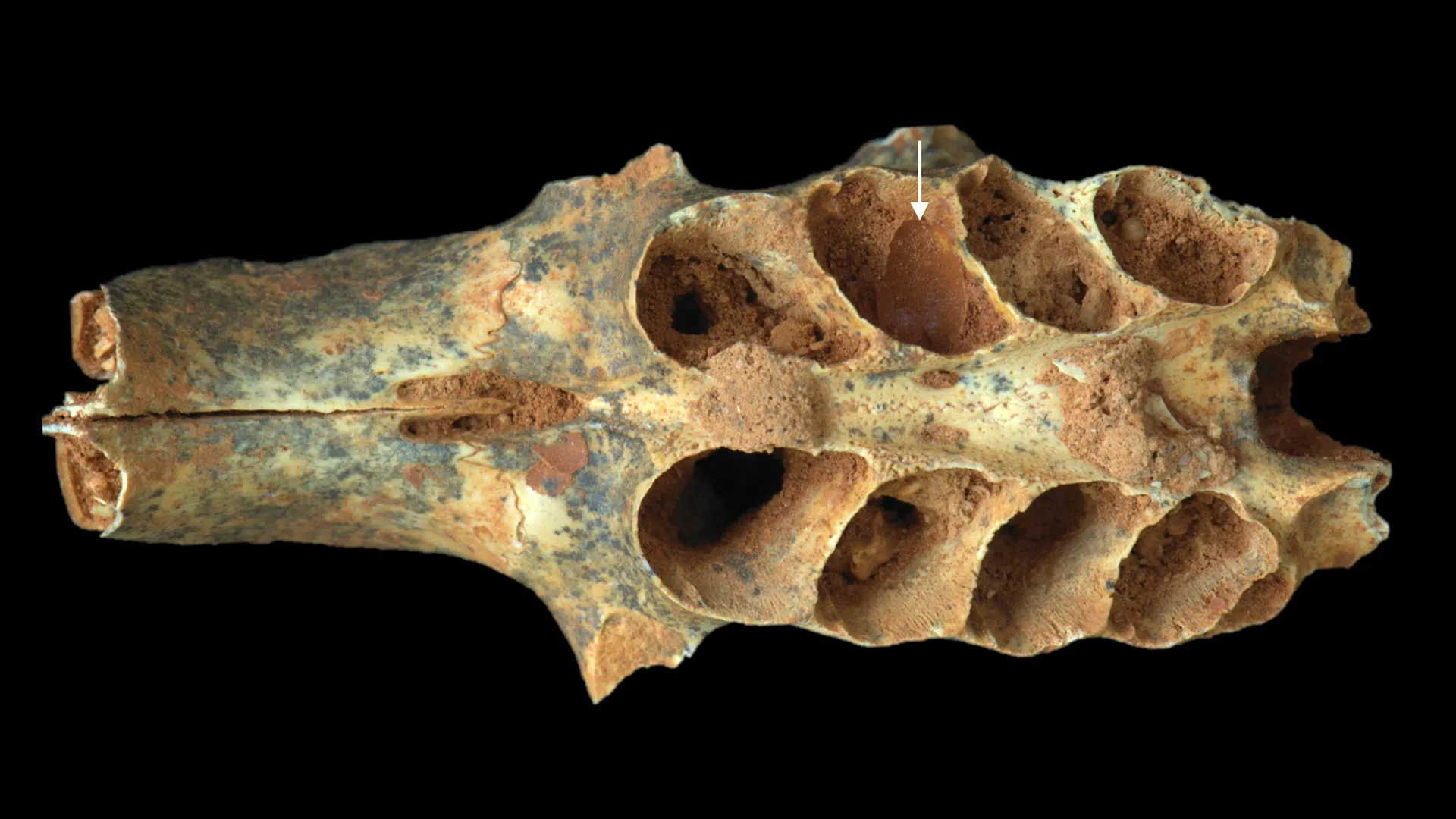
The breakthrough discovery began as an anomaly during routine laboratory preparation. While cleaning and examining mammalian jawbones collected from the cave, Viñola López noticed structural irregularities inside the empty tooth sockets.
Unlike natural sediment, which typically filters into empty cavities as random, unstructured particulate matter, the material lining the tooth sockets exhibited a distinct, smooth, concave morphology. Multiple specimens displayed the exact same geometric consistency, prompting a deeper investigation.
The visual cue instantly triggered a memory from Viñola López’s undergraduate days in Montana, where a fellow paleontologist had demonstrated fossilized wasp cocoons—hardened mud structures where larval wasps mature. Suspecting an invertebrate origin, the research team subjected the fossilized jaws to non-destructive CT scanning. This advanced imaging technology generated high-resolution three-dimensional models of the interior of the tooth sockets without compromising the integrity of the delicate bone specimens or the material inside them.
The scans confirmed that the structures were precision-built mud nests crafted by solitary bees. Measuring smaller than the eraser at the end of a standard pencil, the chambers bore the microscopic hallmarks of a mixture of fine sediment and insect saliva. Crucially, the CT scans also revealed preserved grains of ancient pollen trapped inside the tiny compartments, proving that mother bees had provisioned the nests with food resources for their larvae before sealing them.
Taxonomy and the Question of Extinction
Because the warm, humid climate of Hispaniola’s limestone caves actively destroys delicate organic tissues, no fossilized adult bees were recovered from the nests. Consequently, researchers cannot definitively identify the exact species responsible for the architectural feat.
To formally document the find within the scientific literature, the research team established a new ichnotaxon—a classification based on the organism’s behavioral trace rather than its body fossil. The structures were officially named Osnidum almontei, honoring Juan Almonte Milan for his decades of pioneering paleobiological research in the Dominican Republic.
The absence of physical insect specimens leaves open two distinct evolutionary possibilities. Given the poor state of ecological data regarding modern endemic insect populations on Caribbean islands, the architects of Osnidum almontei may belong to a living species whose nesting habits have simply gone unobserved. Alternatively, because many of the vertebrate species whose bones line the cave are now extinct, the bees themselves may represent a vanished lineage that failed to survive environmental shifts or habitat loss following the Pleistocene epoch.
Environmental Drivers and Behavioral Adaptations
The behavior documented in the study—utilizing animal bone cavities as rearing chambers—stands without precedent in the scientific literature. Ethmological and paleontological records extensively document solitary bees nesting in wood, soil burrows, plant stems, and occasionally empty snail shells in regions like Europe and Africa. However, vertebrate bone exploitation has never before been recorded.
Researchers attribute this unique evolutionary adaptation to a combination of environmental pressures unique to Hispaniola’s Pleistocene geography. The island’s extensive limestone bedrock features very little deep soil cover, severely limiting the availability of traditional subterranean nesting sites for ground-dwelling solitary bees.
Simultaneously, the persistent presence of generations of owls provided a reliable, abundant supply of prefabricated cavities. The hollow tooth sockets of rodent jaws offered ideal dimensions, shielding the developing bee larvae from environmental fluctuations and protecting them from common predators, such as parasitic wasps.
Broader Implications for Paleontology and Ecology
The documentation of Osnidum almontei carries broad methodological and ecological implications for the scientific community. Primarily, it serves as a cautionary tale for paleontologists processing vertebrate fossil deposits. Researchers note that without prior exposure to trace fossils of insects, workers cleaning mammalian jaws might easily have dismissed the hardened mud as extraneous sediment and scraped it away, permanently destroying valuable micro-ecological data.
Furthermore, the discovery emphasizes the value of interdisciplinary awareness in paleontology. While vertebrate paleontologists traditionally focus on large skeletal remains, integrating invertebrate trace fossils provides a holistic view of ancient ecosystems, revealing how different species interacted across trophic levels during periods of environmental stress.
As researchers continue to analyze the rich fossil strata of Hispaniola, the tiny nests hidden within ancient jaws stand as a testament to nature’s adaptability. Even amidst the detritus of predators in the darkest recesses of a Pleistocene cave, life found a way to secure its future, one microscopic, mud-lined tooth socket at a time.
