
For much of evolutionary history, the dominant reproductive strategy across the animal kingdom was straightforward and detached: animals produced offspring and immediately left them to fend for themselves. Yet, over millions of years, complex caregiving behaviors emerged independently across widely separated lineages, from birds tending elaborate nests to mammals nourishing their young with milk. A groundbreaking study published in the journal Nature now offers a compelling explanation for this major evolutionary transition, revealing how nature repurposed ancient neural pathways originally dedicated to hunger and feeding to establish the foundations of parental care.
By examining the neurobiology of clonal raider ants, researchers at The Rockefeller University discovered that evolution rarely invents complex behavioral systems entirely from scratch. Instead, it frequently adapts pre-existing biological machinery, shifting the functional role of ancient brain signaling systems to accommodate new social demands. The findings not only illuminate a fundamental mechanism of evolutionary adaptation but also offer a simplified model that could eventually help scientists understand parallel neurochemical processes in mammals, including humans.
Decoding the Evolutionary Origins of Caregiving
For decades, evolutionary biologists and neuroscientists have puzzled over the origins of parental care. Ancestral species offered little to no investment in their progeny, making the evolution of resource-intensive behaviors—such as brooding, guarding, and feeding offspring—an evolutionary puzzle. A long-standing hypothesis suggested that nature must have hijacked and repurposed biological systems that already existed within the ancestral organism.
Earlier investigations in mammals pointed toward specific neuropeptides—small protein-like molecules utilized by neurons to communicate across synapses—as prime candidates for this evolutionary shift. Researchers theorized that molecules initially tasked with regulating metabolic states, such as hunger and satiety, might have undergone functional evolution to encourage nurturing behaviors toward dependent offspring.
However, proving this direct connection has historically proven exceptionally difficult. Traditional neuroscience model organisms present distinct limitations. Fruit flies (Drosophila melanogaster) and roundworms (Caenorhabditis elegans), while invaluable for genetic and neural mapping, do not exhibit parental care. Conversely, mice provide extensive and complex parental care, and scientists have successfully identified several neuropeptides involved in these interactions. Yet, the sheer complexity of the mammalian brain—housing roughly 100 million neurons in a mouse—presents a formidable barrier to mapping precise cellular circuits at a granular level.
The Clonal Raider Ant as a Neurological Model
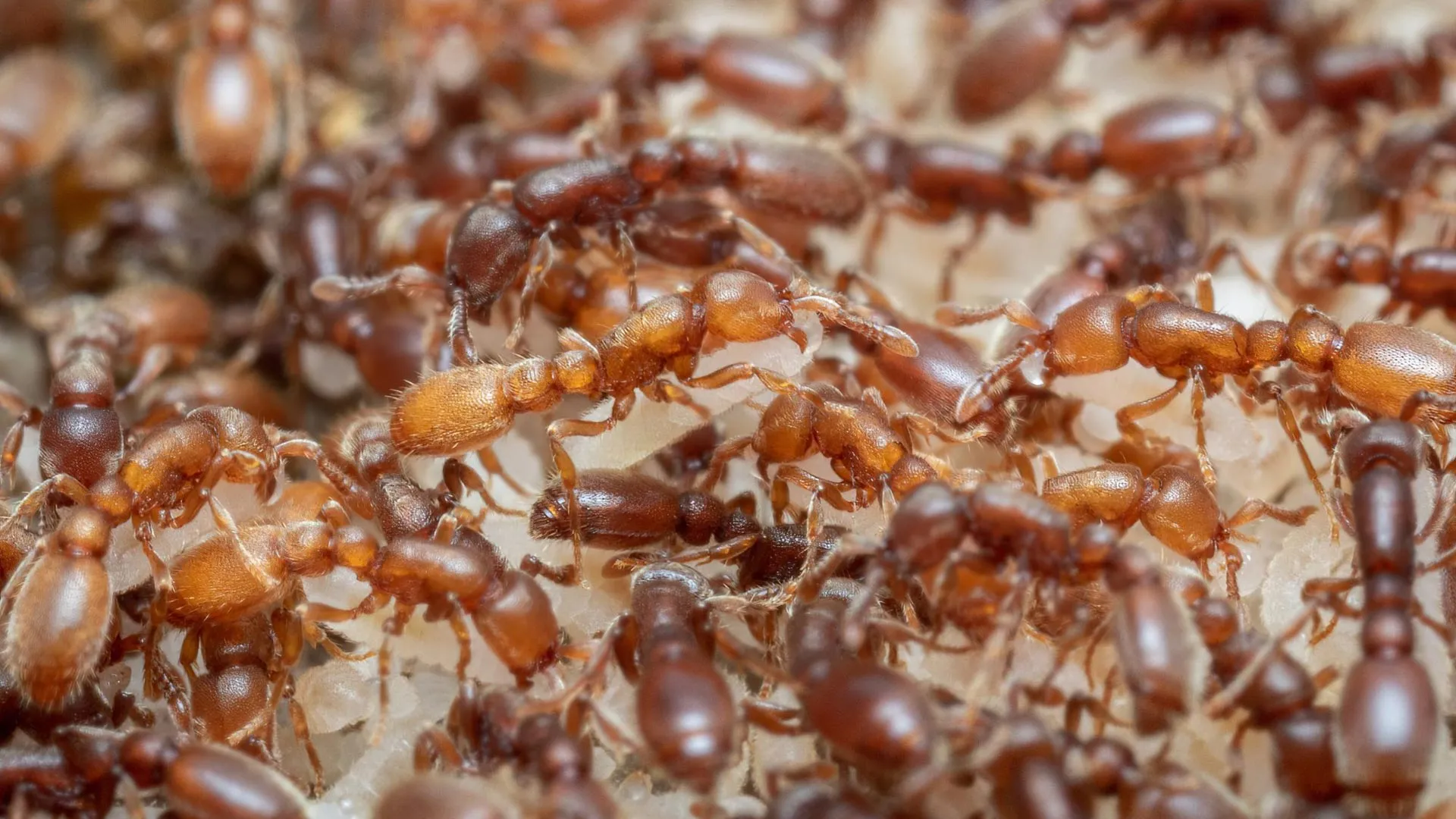
To bypass the experimental hurdles of mammalian neurobiology, the research team turned to the clonal raider ant (Oerapheidole or clonal raider ants, Ooceraea biroi). These social insects present a unique convergence of traits that make them ideal for studying the evolution of behavior and the aging brain. Unlike many other ant species that feature distinct physical castes, clonal raider ants reproduce asexually through cloning, resulting in genetically identical colonies that offer unprecedented experimental uniformity.
Furthermore, an individual ant brain contains approximately 60,000 cells—a fraction of a mammalian brain, yet complex enough to support sophisticated social structures, division of labor, and distinct age-dependent behavioral shifts. Ant colonies operate on a predictable chronological schedule determined by age. Younger ants remain sequestered within the safety of the nest, where their primary responsibility is nursing and tending to developing larvae. As the insects grow older, they undergo a behavioral transition, leaving the interior of the nest to forage for food in the external environment.
This predictable aging trajectory allowed the researchers to study how brain chemistry systematically reshapes social roles and behavioral proclivities over time. By leveraging this natural model, the team hoped to track the precise biochemical levers that dictate whether an ant acts as a dedicated caregiver or an industrious forager.
Chronology of Discovery: Mapping the Ant Neuropeptidome
The research initiative required the development of novel technological and analytical frameworks to monitor complex social interactions at scale. To achieve this, the team engineered an automated behavioral monitoring system capable of housing individual ants with individual larvae. This high-throughput setup allowed the scientists to meticulously track and record hundreds of distinct caregiving interactions simultaneously.
Following the establishment of the behavioral tracking platform, the researchers undertook the painstaking task of identifying and synthesizing the complete chemical catalog of the ant brain. Working systematically, the team annotated the neuropeptidome of the clonal raider ant, successfully cataloging 70 distinct neuropeptides.
Each identified molecule was subsequently synthesized in a laboratory environment and tested directly on the insects to determine whether its administration altered caregiving or foraging behavior. By mapping where these promising molecules were produced, tracking fluctuations in their concentration across the ant’s lifespan, and experimentally manipulating their activity levels, the team began to assemble a comprehensive picture of neurochemical governance in social insects.
To test the hypothesis that these caregiving pathways remained intrinsically linked to ancestral feeding circuits, the researchers conducted comparative trials. They evaluated colonies of well-fed ants against cohorts that had been subjected to food deprivation. This comparative design allowed the team to directly observe whether the physiological signals governing parental care were modulated by the organism’s metabolic state and nutritional needs.
Two Brain Molecules Dictate Social Roles
The experimental results revealed that caregiving behavior in ants is inextricably tied to the ancient neural circuitry that regulates hunger and food consumption. Specifically, the data highlighted two primary signaling molecules that exert opposing influences on ant behavior, acting as a biochemical pendulum that shifts an individual’s focus depending on its age and internal physiological condition.
The first molecule, Neuropeptide F (NPF), was found to strongly promote caregiving behavior. When NPF activity was heightened, ants increased their interactions with larvae, dedicating more time and energy to nursing and maintenance within the nest. In stark contrast, the second molecule, Allatostatin A (AstA), drove the opposite behavioral response, encouraging ants to abandon the brood, exit the nest, and initiate foraging tasks.
These neurochemical profiles aligned perfectly with the natural aging progression of the insects. Young ants naturally exhibited high concentrations of NPF and low concentrations of AstA in critical brain regions, locking them into their role as nest-bound nurses. As the ants aged, their neurochemical balance inverted: NPF levels declined while AstA levels rose, matching the insects’ transition from caregivers to external foragers.
When the researchers artificially manipulated the activity of either molecule using pharmacological interventions, the ants altered their behavior in real-time. This confirmed that NPF and AstA were not merely correlative markers of age or social status, but active causal agents capable of directing whether an ant nurtured developing larvae or searched for sustenance.
The Metabolic Bridge: From Hunger to Nurturing
One of the study’s most significant discoveries was the observation that these same neurochemical systems respond dynamically to metabolic stress. When ants were deprived of food, their neurochemical profile shifted significantly: their internal levels of NPF increased, while AstA levels dropped.
This metabolic state effectively reprogrammed the starving ants to behave like caregivers, increasing their interactions with larvae despite their own lack of nourishment. Once the ants were fed, the chemical balance abruptly reversed, dampening their focus on the brood and redirecting their energy toward food collection.
"We learned that parental behaviors build on the neural circuitry for feeding, and that makes some sense," noted Daniel Kronauer, head of the Laboratory of Social Evolution and Behavior at Rockefeller University and senior author of the study. "Parental behavior is a lot about feeding—not just yourself, but your offspring."
This physiological crossover provides strong empirical support for the theory that parental care evolved by co-opting pre-existing neural pathways dedicated to locating, acquiring, and consuming food. Rather than inventing an entirely new behavioral repertoire from nothing, evolution appears to have expanded existing metabolic motivation systems, redirecting an animal’s drive to nourish itself toward the equally vital task of nourishing its offspring.
Broader Implications and Comparative Neurobiology
The implications of the Rockefeller University study extend far beyond the biology of social insects. By establishing a direct link between metabolic signaling and social caregiving in an organism with a tractable nervous system, the research provides a foundational blueprint that neuroscientists can use to investigate similar processes in more complex organisms.
Mammals—including humans—utilize homologous neuropeptide systems that play critical roles in maternal care, bonding, and social attachment. The discovery that ants and mice share overlapping neuromodulatory mechanisms suggests that the evolutionary routes leading to complex social behaviors are far more constrained and conserved than previously assumed.
"It amazes me that similar parenting behaviors have evolved so many times in so many distinct animal lineages," remarked Taylor A. Kay, a lead researcher on the project. "Our paper suggests that the evolutionary routes to these sorts of behaviors are far more constrained than we may have naively imagined. That’s very exciting, because it may eventually lead to a blueprint of how these complex social behaviors evolve."
Looking ahead, the research team plans to map the precise downstream neural circuits targeted by NPF and AstA within the ant brain. Uncovering how these chemical signals translate into physical actions will allow scientists to trace the exact wiring diagrams that govern social care across species boundaries.
Insights into Healthy Brain Aging
In addition to shedding light on the evolutionary origins of parenting, the clonal raider ant model offers a novel window into the study of neurobiology and aging. Contemporary neuroscience research heavily prioritizes late-stage neurodegenerative conditions, such as Alzheimer’s disease and other forms of dementia. Consequently, science maintains a significant knowledge gap regarding the subtle, progressive neurological changes that occur in a healthy brain across a normal lifespan.
Because the age-dependent behavioral transitions observed in clonal raider ants are essential to the survival and organization of the colony, these insects provide a natural, highly accessible system for studying how normative brain aging reshapes behavior. The researchers hypothesize that the same neuromodulatory mechanisms driving age-related behavioral shifts in ants may operate across the animal kingdom, influencing how brains adapt as they age in mammals and humans alike.
"There’s a lot of research and funding invested in studying late-stage neurodegenerative diseases, but we actually know very little about how the brain changes throughout the normal healthspan of an individual," Kronauer emphasized. "In ant colonies, these dynamics are central to the organization of the society. Our discovery provides a striking demonstration that neuromodulators can produce age-dependent changes in behavioral proclivities in ants, and I suspect that that’s the case in other animals as well, including in humans."
By demonstrating how ancient, hunger-regulating neural pathways were repurposed to foster social care, this research bridges a critical divide between metabolism, evolution, and neurobiology. As scientists continue to map these shared biochemical pathways, the humble ant may ultimately provide the key to understanding both the origins of nurturing behavior and the fundamental mechanisms of the aging mammalian brain.
