
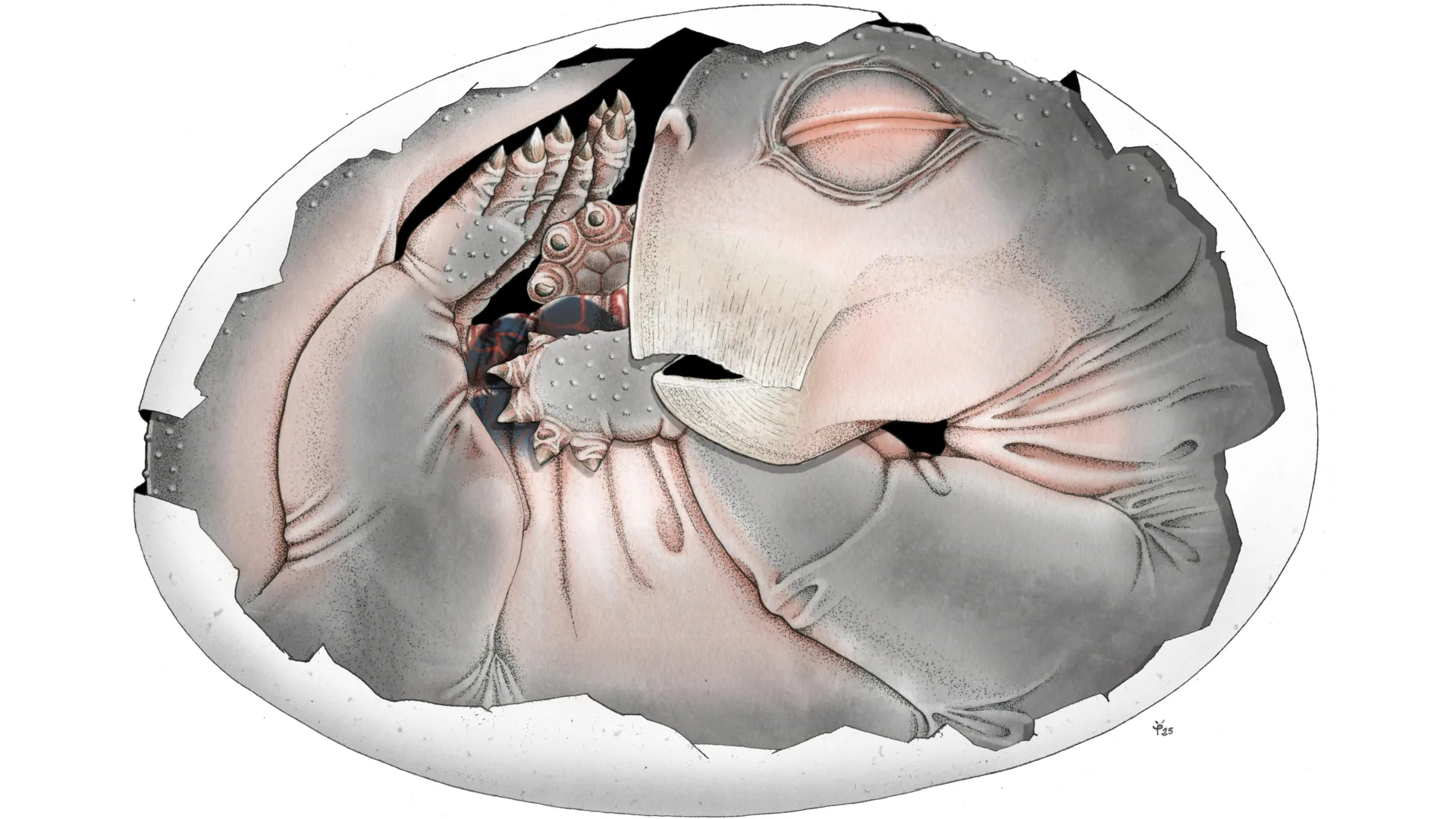
A groundbreaking fossil discovery is reshaping our understanding of early mammalian evolution and providing unprecedented insight into one of Earth’s most astonishing survival tales. Researchers have identified the first confirmed egg from a mammal ancestor, a 250-million-year-old fossil containing an embryo of Lystrosaurus, a resilient, plant-eating creature that dominated the planet after the devastating End-Permian Mass Extinction. This pivotal find not only answers a scientific enigma that has perplexed paleontologists for decades but also sheds light on the reproductive strategies that allowed life to rebound in the aftermath of the greatest ecological catastrophe in Earth’s history.
The End-Permian Mass Extinction, occurring approximately 252 million years ago, was an event of cataclysmic proportions, often dubbed "The Great Dying." It wiped out an estimated 96% of all marine species and 70% of terrestrial vertebrate species, fundamentally restructuring the tree of life. The causes are believed to be linked to massive volcanic eruptions in the Siberian Traps, which released vast quantities of greenhouse gases, triggering runaway global warming, widespread ocean anoxia, and severe acid rain. The planet became a hostile furnace, characterized by extreme heat, volatile atmospheric conditions, and prolonged droughts, creating an environment utterly inimical to complex life. Amidst this desolation, a stout, pig-like creature named Lystrosaurus, a dicynodont therapsid and a distant ancestor to modern mammals, not only endured but remarkably flourished, becoming one of the most widespread and numerous land vertebrates for millions of years. Its extraordinary resilience has long been a subject of scientific fascination.
The Unveiling of an Ancient Secret
New research, meticulously detailed in the journal PLOS ONE, describes the fossil that is now fundamentally altering our understanding of this ancient animal. An international research consortium, spearheaded by Professor Julien Benoit and Professor Jennifer Botha from the Evolutionary Studies Institute at the University of the Witwatersrand, South Africa, alongside Dr. Vincent Fernandez of ESRF – The European Synchrotron in France, meticulously analyzed a fossil containing a Lystrosaurus embryo. The age of this fossil places it squarely in the Early Triassic period, just after the End-Permian extinction event.
This discovery holds immense significance because it represents the first unequivocally confirmed egg from a therapsid, the group of synapsids that includes mammals and their closest extinct relatives. For generations, paleontologists have grappled with a fundamental question regarding the reproductive biology of early mammal ancestors: did they lay eggs? While it was widely hypothesized, concrete fossil evidence remained elusive. This find provides the definitive "yes" that scientists have sought for so long, bridging a critical gap in the evolutionary narrative leading to modern mammals.
A Decades-Old Paleontological Enigma
The scarcity of fossilized eggs from this crucial period of mammalian evolution has been a persistent puzzle. Unlike the robust, mineralized shells of many dinosaur eggs, which are relatively common in the fossil record due to their durable calcium carbonate composition, the eggs of Lystrosaurus and its kin are now believed to have been soft-shelled. This characteristic offers a compelling explanation for their rarity. Soft-shelled eggs, similar to those laid by many modern reptiles and the platypus, are far more susceptible to decay and degradation before they can undergo the lengthy and specific conditions required for fossilization. Their delicate structure means they typically decompose rapidly, leaving little to no trace behind. This inherent fragility makes the discovery of a soft-shelled egg with an intact embryo an extraordinarily rare event, underscoring the exceptional nature of this particular find.
Professor Botha recounts the initial discovery, highlighting the serendipitous nature of paleontological fieldwork and the long road to scientific confirmation. "This fossil was discovered during a field excursion I led in 2008, nearly 17 years ago. My preparator and exceptional fossil finder, John Nyaphuli, identified a small nodule that at first revealed only tiny flecks of bone. As he carefully prepared the specimen, it became clear that it was a perfectly curled-up Lystrosaurus hatchling. I suspected even then that it had died within the egg, but at the time, we simply didn’t have the technology to confirm it." This anecdote underscores the profound impact of technological advancements in resolving long-standing scientific questions.
From Field to Synchrotron: The Journey of Discovery
The journey from a promising field discovery to a confirmed scientific breakthrough spanned nearly two decades, a testament to the meticulous pace of paleontological research and the exponential growth in analytical capabilities. The initial identification of the embryo in 2008 by John Nyaphuli, a renowned fossil finder, was a crucial first step. However, proving that the embryo was still within an egg, rather than simply a post-hatching individual, required techniques far beyond what was available at the time.
The breakthrough came with the application of advanced imaging technologies, specifically synchrotron X-ray computed tomography (CT) scanning. Researchers utilized the powerful X-rays and high-resolution capabilities available at the European Synchrotron Radiation Facility (ESRF) in Grenoble, France. Synchrotron radiation is a type of electromagnetic radiation generated by electrons accelerating in powerful magnetic fields. This technology allows scientists to non-destructively peer inside opaque objects with incredibly high spatial resolution and sensitivity, revealing internal structures that would otherwise remain hidden. For delicate fossils like this Lystrosaurus embryo, it meant the ability to construct detailed 3D models of the internal anatomy without damaging the specimen.
Dr. Fernandez, intimately involved in the scanning process, described the moment of revelation as particularly exhilarating. "Understanding reproduction in mammal ancestors has been a long-lasting enigma and this fossil provides a key piece to this puzzle. It was essential that we scanned the fossil just right to capture the level of detail needed to resolve such tiny, delicate bones." The precision afforded by synchrotron scanning was paramount, enabling the team to discern the faint outlines of the soft eggshell and the intricate skeletal features of the developing embryo, definitively confirming its pre-hatching state.
Unlocking Developmental Clues
The high-resolution scans did more than just confirm the presence of an egg; they provided invaluable insights into the developmental stage of the Lystrosaurus embryo. One critical clue emerged from the structure of the lower jaw. "When I saw the incomplete mandibular symphysis, I was genuinely excited," says Professor Benoit. The mandible, or lower jaw, of most vertebrates, including Lystrosaurus and its descendants, begins as two separate halves during embryonic development. These halves typically fuse together before or shortly after birth, forming a single, strong jawbone essential for feeding. The observation that the mandibular symphysis in the fossilized Lystrosaurus embryo was still unfused indicated that the individual had not yet reached a stage where it could independently feed itself. This strongly suggests it was still developing within the egg when it perished, providing direct evidence of its embryonic status.
This finding also hinted at the nature of parental care, or lack thereof, in Lystrosaurus. In modern mammals, the young are typically born with fused mandibles and are capable of suckling milk or consuming solid food. The unfused jaw of the Lystrosaurus embryo, coupled with other evidence, suggests a different strategy.
The Lystrosaurus Survival Strategy: Large Eggs and Fast-Developing Young
Further analysis of the fossil and comparisons with modern analogues revealed key aspects of Lystrosaurus‘s reproductive strategy. The study indicates that Lystrosaurus produced relatively large eggs in proportion to its body size. In contemporary animal biology, larger eggs typically contain a greater volume of yolk. This nutrient-rich yolk serves as a vital food source for the developing embryo, providing sufficient energy and building blocks for growth without requiring external feeding or extensive parental care immediately after hatching. This suggests that, unlike modern mammals which nourish their young with milk, Lystrosaurus relied on a substantial internal nutrient reserve within the egg.
The large size of these eggs also conferred another significant advantage in the harsh, arid environment of the Early Triassic: enhanced resistance to desiccation. In a world ravaged by prolonged droughts and unstable conditions following the mass extinction, eggs that could better withstand drying out would have had a substantially higher chance of successful incubation and hatching. This adaptation would have been crucial for survival in a climate vastly different from the lush, humid conditions that characterized much of the Permian.
These findings collectively indicate that Lystrosaurus hatchlings were likely "precocial." Precocial animals are born at an advanced stage of development, often possessing well-developed sensory and motor skills, and are capable of independent movement, feeding, and predator avoidance shortly after birth. This contrasts sharply with "altricial" species, whose young are born helpless and require extensive parental care for an extended period. For Lystrosaurus, being precocial meant that its young could quickly become self-sufficient, forage for themselves, evade dangers, and reach sexual maturity at an accelerated pace. In essence, Lystrosaurus maximized its chances of survival and propagation in a deeply unstable world by growing fast and reproducing early, an efficient strategy for populating a recovering ecosystem.
Evolutionary Echoes: Lessons from Ancient Reproductive Strategies
The discovery of soft-shelled, yolk-rich eggs and precocial young in Lystrosaurus offers a fascinating parallel with modern monotremes, such as the platypus and echidna. These unique mammals, found exclusively in Australia and New Guinea, are the only living mammals that lay eggs. Their eggs are also soft-shelled and contain a significant yolk sac, providing nourishment for the developing embryo. While monotremes do eventually feed their young with milk (secreted through pores rather than nipples), their egg-laying biology provides a tangible link to the ancient reproductive strategies of mammal ancestors like Lystrosaurus. This fossil further reinforces the understanding that egg-laying was the ancestral condition for mammals, with live birth (viviparity) evolving later in the synapsid lineage.
Reactions and Reflections from the Research Team
The profound implications of this discovery are keenly felt by the research team. Professor Julien Benoit articulates the dual significance of the findings: "This research is important because it provides the first direct evidence that mammal ancestors, such as Lystrosaurus, laid eggs, resolving a long-standing question about the origins of mammalian reproduction. Beyond this fundamental insight, it reveals how reproductive strategies can shape survival in extreme environments: by producing large, yolk-rich eggs and precocial young, Lystrosaurus was able to thrive in the harsh, unpredictable conditions following the End-Permian mass extinction." He also shared his excitement about the collaborative scientific process: "The opportunity to work at the European Synchrotron Radiation Facility alongside beamline scientists was also an unforgettable part of the journey. The cutting-edge data we generated there allowed us to ‘see’ inside the fossil in extraordinary detail, ultimately revealing that the embryo was still at a pre-hatching stage. That moment, when the pieces all came together, was incredibly rewarding."
Professor Jennifer Botha emphasizes the long-term journey of the discovery: "What makes this work especially exciting is that we were able to quite literally follow in John Nyaphuli’s footsteps, returning to a specimen he discovered nearly two decades ago and finally solve the puzzle he uncovered. At the time, all we had was a beautifully curled embryo, but no preserved eggshell to prove it had died within an egg. Using modern imaging techniques, we were able to answer that question definitively." She also highlights the historical context of the find within South African paleontology: "It is also thrilling because this discovery breaks entirely new ground. For over 150 years of South African paleontology, no fossil had ever been conclusively identified as a therapsid egg. This is the first time we can say, with confidence, that mammal ancestors like Lystrosaurus laid eggs, making it a true milestone in the field."
Broader Implications: Resilience in the Face of Global Change
The Lystrosaurus discovery transcends its paleontological significance, offering crucial insights into resilience and adaptability in the face of rapid climate change and ecological crises—issues that resonate deeply in the modern world. The End-Permian Mass Extinction serves as a stark reminder of Earth’s capacity for extreme environmental shifts and the devastating consequences for biodiversity. Lystrosaurus‘s story illustrates that survival during such global upheavals is not merely a matter of brute strength but often hinges on a finely tuned combination of physiological adaptability, ecological flexibility, and, critically, an effective reproductive strategy.
The ability of Lystrosaurus to produce large, robust eggs and rapidly developing, independent young was a "winning strategy" in a severely disrupted ecosystem. This approach allowed for quick population recovery and expansion into new niches left vacant by the extinction. In a modern context, understanding how past organisms navigated global upheaval provides scientists with a deep-time perspective on how contemporary species might respond to ongoing environmental stress, habitat loss, and climate change. The lessons from Lystrosaurus suggest that species with high reproductive rates, adaptable life histories, and robust offspring may possess a greater capacity to weather environmental perturbations.
As scientists continue to unravel the mysteries of ancient life, a consistent pattern emerges: survival in the face of existential threats is intrinsically linked to a species’ ability to adapt, demonstrate resilience, and employ reproductive strategies optimized for prevailing conditions. Lystrosaurus stands as a prime example of an organism that masterfully combined all three, securing its lineage through Earth’s most challenging chapter and providing a powerful narrative for how life perseveres. This discovery is not just a breakthrough in paleontology; it is a profound commentary on the enduring power of evolution in shaping life’s trajectory, offering valuable insights for understanding and addressing the biodiversity and climate challenges of today.
