
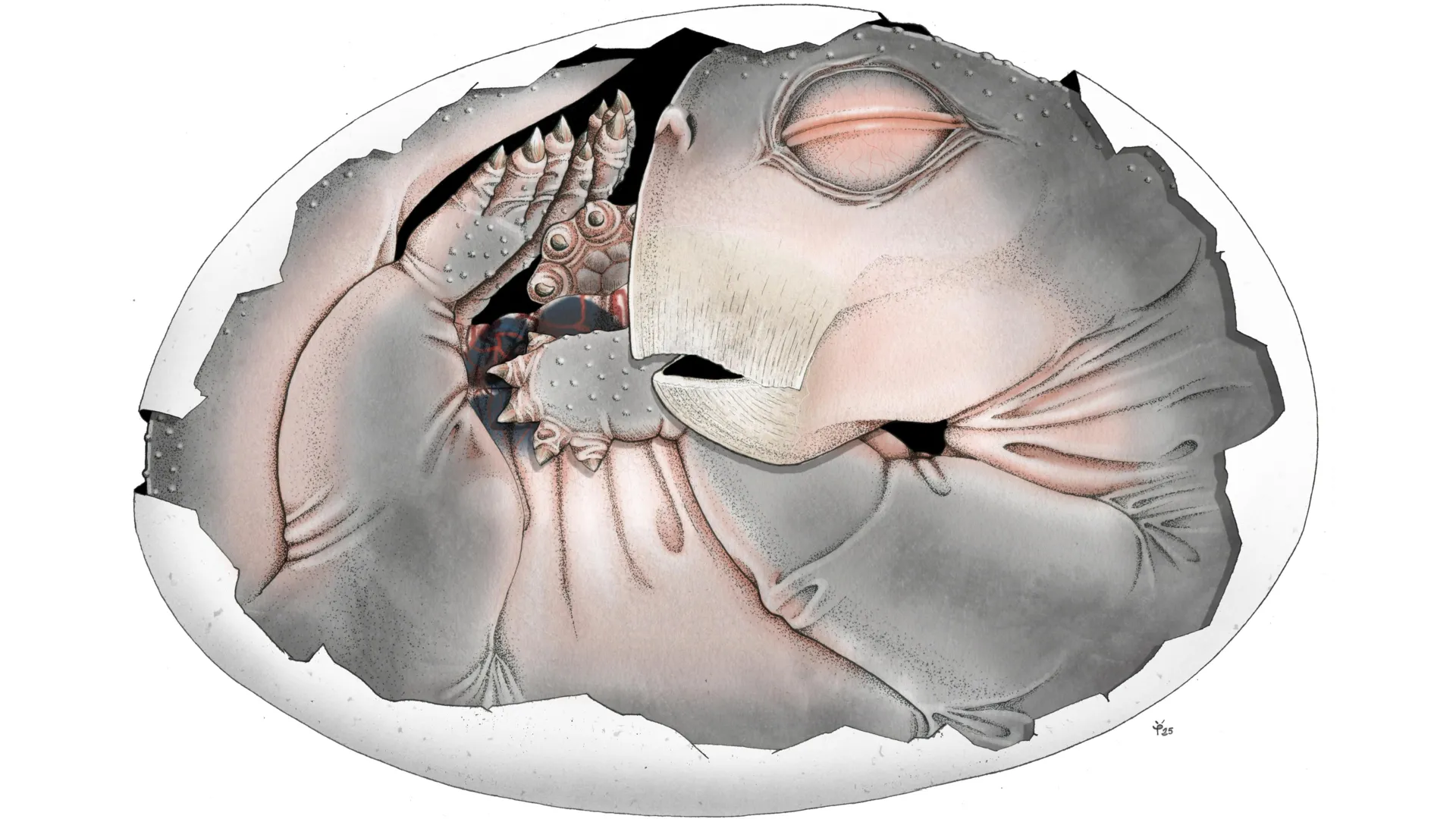
A groundbreaking fossil discovery is providing unprecedented insight into one of the most remarkable survival stories in Earth’s history, simultaneously resolving a scientific mystery that has perplexed researchers for decades. The discovery centers on Lystrosaurus, a resilient, plant-eating ancestor of mammals that rose to dominance following the End-Permian Mass Extinction approximately 252 million years ago. This cataclysmic event, often dubbed "The Great Dying," eradicated the vast majority of life on the planet. Yet, amidst extreme heat, pervasive environmental instability, and prolonged droughts, Lystrosaurus not only persisted but thrived, becoming a ubiquitous presence across the desolate post-extinction landscapes.
The Unprecedented Discovery: A 250-Million-Year-Old Embryo
New research, meticulously detailed in the scientific journal PLOS ONE, describes a finding that fundamentally alters how scientists understand this ancient animal and the evolutionary path of mammals. An international research consortium, spearheaded by Professor Julien Benoit and Professor Jennifer Botha from the Evolutionary Studies Institute at the University of the Witwatersrand in South Africa, alongside Dr. Vincent Fernandez from ESRF – The European Synchrotron in France, has identified an extraordinarily well-preserved fossil: an egg containing a Lystrosaurus embryo, dating back some 250 million years.
This exceptional fossil represents the first definitively confirmed egg ever found from a synapsid, the lineage that includes mammals and their direct ancestors. Its identification finally provides a conclusive answer to a long-standing and pivotal question concerning early mammal evolution: did the ancestors of mammals lay eggs? The unequivocal answer, affirmed by this discovery, is yes. This revelation provides a critical piece of the puzzle in understanding the reproductive strategies that characterized the earliest stages of mammalian evolution, bridging the gap between reptilian egg-laying and the live-bearing strategies of most modern mammals.
A Paleontological Puzzle: The Elusive Eggs of Therapsids
The scarcity of fossilized eggs from early mammal ancestors, specifically therapsids like Lystrosaurus, has long been a confounding factor for paleontologists. The researchers now believe the primary reason for this absence lies in the nature of these ancient eggs themselves: they were soft-shelled. Unlike the hard, mineralized, calcium carbonate-rich eggs laid by many dinosaurs and modern birds, which possess robust shells that readily resist decay and are prone to fossilization, soft-shelled eggs are highly perishable. Their delicate, leathery composition means they tend to decompose rapidly before the complex geological processes required for fossilization can occur. This inherent fragility makes the preservation of such an egg, complete with an embryo, an incredibly rare stroke of paleontological luck, elevating this particular find to a status of immense scientific significance. It highlights the often-random and serendipitous nature of fossil discoveries, where the confluence of specific environmental conditions and geological timing is essential for the preservation of such ephemeral biological structures.
From Field to Synchrotron: A Journey of Scientific Revelation
The journey of this remarkable fossil began nearly two decades ago. Professor Jennifer Botha recounts the initial stages of the discovery: "This fossil was discovered during a field excursion I led in 2008, nearly 17 years ago. My preparator and exceptional fossil finder, John Nyaphuli, identified a small nodule that at first revealed only tiny flecks of bone. As he carefully prepared the specimen, it became clear that it was a perfectly curled-up Lystrosaurus hatchling. I suspected even then that it had died within the egg, but at the time, we simply didn’t have the technology to confirm it." This anecdote underscores the patience and persistence often required in paleontology, where initial hunches can take years, even decades, to verify as scientific technology advances.
The ultimate confirmation of Professor Botha’s suspicion came with the application of cutting-edge imaging techniques. The fossil was subjected to modern synchrotron X-ray CT scanning, utilizing the immensely powerful X-rays available at the ESRF, one of the world’s most advanced synchrotron radiation facilities located in Grenoble, France. These state-of-the-art tools enabled researchers to peer inside the specimen with unparalleled resolution and clarity, revealing intricate details that were previously invisible. This technological leap finally allowed them to confirm what had long been suspected: the Lystrosaurus embryo was indeed encased within an egg.
Dr. Fernandez described the moment of revelation as particularly exhilarating: "Understanding reproduction in mammal ancestors has been a long-lasting enigma, and this fossil provides a key piece to this puzzle. It was essential that we scanned the fossil just right to capture the level of detail needed to resolve such tiny, delicate bones." Synchrotron radiation, generated by accelerating electrons to near the speed of light, produces X-rays far more intense and focused than conventional laboratory sources. This capability is crucial for paleontological studies, allowing scientists to non-destructively examine the internal structures of fossils, distinguish between bone and surrounding matrix, and reconstruct three-dimensional models of ancient organisms with exquisite detail, even within fragile and densely packed specimens.
Unveiling the Embryo’s Secrets: Insights into Early Development
The high-resolution scans not only confirmed the presence of the egg but also uncovered an important clue about the embryo’s developmental stage and its implications for the animal’s life history. Professor Benoit’s analysis of the detailed scans yielded a critical observation: "When I saw the incomplete mandibular symphysis, I was genuinely excited. The mandible, the lower jaw, is made up of two halves that must fuse before the animal can feed. The fact that this fusion had not yet occurred shows that the individual would have been incapable of feeding itself." This anatomical detail indicates that the embryo was still in a pre-hatching stage of development, confirming its death within the egg rather than shortly after hatching. This finding provides direct evidence of the developmental progress within the egg, offering a rare glimpse into the early life stages of a crucial mammalian ancestor.
The End-Permian Mass Extinction: A World Reshaped
To fully appreciate the significance of Lystrosaurus‘s reproductive strategy, it is essential to understand the apocalyptic backdrop against which it evolved: the End-Permian Mass Extinction. Occurring approximately 252 million years ago, this event represents the most severe biotic crisis in Earth’s history, dwarfing even the extinction event that claimed the dinosaurs. The primary driver of this catastrophe is widely attributed to massive volcanic eruptions in the Siberian Traps, a large igneous province in modern-day Russia. Over a period of hundreds of thousands of years, these eruptions released colossal quantities of greenhouse gases, including carbon dioxide and methane, into the atmosphere.
This influx of gases triggered runaway global warming, with average temperatures rising by as much as 8-10 degrees Celsius. The warming led to widespread ocean anoxia (lack of oxygen) and acidification, devastating marine ecosystems. On land, the effects were equally catastrophic: vast areas experienced extreme heat, prolonged droughts, wildfires, and acid rain. Ecosystems collapsed, food chains disintegrated, and biodiversity plummeted. Estimates suggest that up to 96% of all marine species and approximately 70% of terrestrial vertebrate species perished. The planet became a largely barren and inhospitable wasteland, characterized by unstable conditions and a severely diminished biosphere.
Lystrosaurus: A Survivor Against All Odds
It was into this ravaged world that Lystrosaurus emerged as an unlikely champion. A dicynodont therapsid, Lystrosaurus was a squat, pig-like creature, typically ranging from roughly 0.6 to 2.5 meters in length, with a distinctive tusks and a powerful beak. Its robust build, burrowing capabilities (inferred from its limb structure), and generalist herbivorous diet likely contributed to its remarkable resilience. Following the "Great Dying," Lystrosaurus underwent an extraordinary ecological radiation, dominating terrestrial ecosystems across the supercontinent Pangea for millions of years. Its fossils are found in vast numbers across southern Africa, India, China, and Antarctica, a testament to its widespread success and adaptability in a world largely devoid of other large vertebrates. This period, often referred to as the "Lystrosaurus Assemblage Zone," highlights its unprecedented ecological dominance in the immediate aftermath of the extinction, serving as a key indicator fossil for the Permian-Triassic boundary.
Reproductive Strategy: The Key to Lystrosaurus’s Success
The PLOS ONE study reveals that Lystrosaurus employed a reproductive strategy that was perfectly tailored for survival in such an unforgiving environment. The analysis of the fossilized embryo indicates that Lystrosaurus produced relatively large eggs compared to its body size. In modern egg-laying animals, larger eggs typically contain a greater amount of yolk. This yolk serves as a rich, self-contained nutrient source, providing sufficient sustenance for embryos to develop significantly before hatching, often eliminating the need for extensive parental care after the young emerge. This suggests that, unlike modern mammals that nourish their young with milk, Lystrosaurus hatchlings were not dependent on parental feeding.
This strategy has parallels with modern monotremes (e.g., echidnas and platypuses), which are the only extant mammals that lay eggs. While monotremes are not direct ancestors of Lystrosaurus, their existence demonstrates that egg-laying is a viable, albeit evolutionarily distinct, reproductive strategy within the broader mammalian lineage. The large, yolk-rich eggs of Lystrosaurus would have provided a significant evolutionary advantage, ensuring that the young were well-nourished and developed even in conditions where food resources might have been scarce or unpredictable.
Furthermore, large eggs offered another crucial benefit in the arid, post-extinction world: they were more resistant to desiccation. The greater volume-to-surface-area ratio of larger eggs, combined with the probable presence of a leathery, protective shell, would have helped to retain moisture, making them more resilient to the long-lasting droughts and dry climates that characterized the Early Triassic period.
The findings also strongly indicate that Lystrosaurus hatchlings were likely precocial. Precociality means that the young are born at an advanced stage of development, possessing a high degree of independence from birth. These well-developed young would have been capable of feeding themselves almost immediately, avoiding predators, and reaching sexual maturity relatively quickly. In the context of a rapidly fluctuating and dangerous environment, the ability to rapidly grow and reproduce early would have been an immense advantage. It allowed Lystrosaurus populations to bounce back quickly from environmental stressors and establish themselves rapidly across new territories. In essence, Lystrosaurus thrived by combining a robust, self-sufficient egg stage with fast-developing, independent young.
A Winning Strategy in a Harsh World
In the exceptionally challenging and unstable conditions that followed the End-Permian Mass Extinction, this integrated reproductive approach proved to be highly effective. The discovery provides the first direct fossil evidence that mammal ancestors laid eggs, a fundamental insight into our own evolutionary past. Moreover, it offers a compelling explanation for why Lystrosaurus became such an extraordinary ecological success story in the ravaged post-extinction ecosystems. Its ability to produce numerous, self-sufficient offspring capable of rapid development was a winning formula for survival and dominance in a world reeling from global catastrophe.
As scientists continue to unravel the complexities of ancient life, a broader, overarching pattern is consistently emerging from studies of mass extinction events. Survival during extreme global crises is not merely a matter of brute strength or sheer numbers, but critically depends on a complex interplay of adaptability, physiological resilience, and effective reproductive strategies. Lystrosaurus, with its unique combination of tough physiology, environmental adaptability, and a highly efficient reproductive system, appears to have embodied all three of these crucial traits.
Broader Implications and Modern Relevance
The implications of this discovery extend far beyond merely confirming an ancient reproductive mode. Professor Julien Benoit elaborates on the profound significance: "This research is important because it provides the first direct evidence that mammal ancestors, such as Lystrosaurus, laid eggs, resolving a long-standing question about the origins of mammalian reproduction. Beyond this fundamental insight, it reveals how reproductive strategies can shape survival in extreme environments: by producing large, yolk-rich eggs and precocial young, Lystrosaurus was able to thrive in the harsh, unpredictable conditions following the end-Permian mass extinction. In a modern context, this work is highly impactful because it offers a deep-time perspective on resilience and adaptability in the face of rapid climate change and ecological crisis. Understanding how past organisms survived global upheaval helps scientists better predict how species today might respond to ongoing environmental stress, making this discovery not just a breakthrough in paleontology, but also highly relevant to current biodiversity and climate challenges." He also highlights the collaborative scientific process: "The opportunity to work at the European Synchrotron Radiation Facility alongside beamline scientists was also an unforgettable part of the journey. The cutting-edge data we generated there allowed us to ‘see’ inside the fossil in extraordinary detail, ultimately revealing that the embryo was still at a pre-hatching stage. That moment, when the pieces all came together, was incredibly rewarding."
Professor Jennifer Botha adds her perspective on the historical and personal significance: "What makes this work especially exciting is that we were able to quite literally follow in John Nyaphuli’s footsteps, returning to a specimen he discovered nearly two decades ago and finally solve the puzzle he uncovered. At the time, all we had was a beautifully curled embryo, but no preserved eggshell to prove it had died within an egg. Using modern imaging techniques, we were able to answer that question definitively." She further emphasizes the pioneering nature of the find: "It is also thrilling because this discovery breaks entirely new ground. For over 150 years of South African paleontology, no fossil had ever been conclusively identified as a therapsid egg. This is the first time we can say, with confidence, that mammal ancestors like Lystrosaurus laid eggs, making it a true milestone in the field."
This research not only illuminates a critical chapter in the evolutionary history of mammals but also offers valuable lessons for contemporary ecological challenges. By studying the adaptive strategies of organisms like Lystrosaurus that successfully navigated past global crises, scientists can gain crucial insights into the mechanisms of resilience and the potential responses of modern species to ongoing environmental degradation and climate change. The Lystrosaurus egg is more than just an ancient relic; it is a profound testament to life’s enduring capacity for adaptation and a beacon for understanding survival in a rapidly changing world.
