
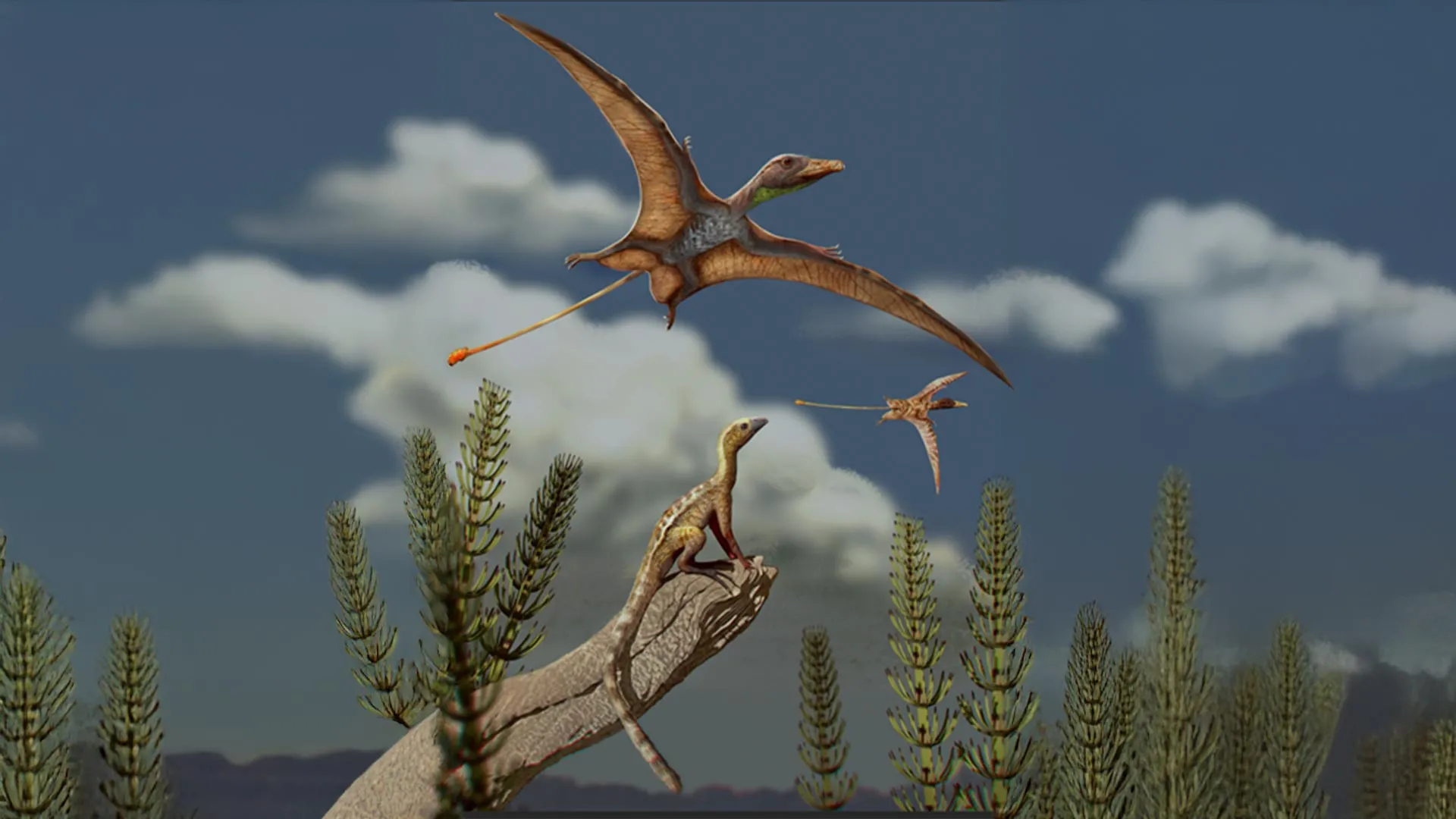
A groundbreaking study led by an evolutionary biologist at Johns Hopkins Medicine reveals that giant reptiles known as pterosaurs likely developed the complex ability of powered flight remarkably early in their evolutionary timeline, as far back as 220 million years ago. This discovery, published on November 26 in Current Biology, posits a stark contrast to the evolutionary trajectory of modern birds, whose ancestors are widely understood to have achieved powered flight through a more gradual process, characterized by the development of larger, more intricate brains. The findings offer profound insights into the diverse pathways life has taken to conquer the skies, challenging long-held assumptions about the prerequisites for such a sophisticated biological innovation.
The research, which received partial support from the National Science Foundation, delved into the internal brain cavities of pterosaur fossils using advanced imaging methods. Dr. Matteo Fabbri, an assistant professor of functional anatomy and evolution at the Johns Hopkins University School of Medicine, spearheaded the investigation. His team’s meticulous analysis suggests that the enlarged brains commonly associated with birds and their dinosaurian ancestors were not a prerequisite for pterosaurs to become airborne. "Our study shows that pterosaurs evolved flight early on in their existence and that they did so with a smaller brain similar to true non-flying dinosaurs," Fabbri explained, underscoring the unique evolutionary strategy employed by these ancient flying reptiles.
Pterosaurs: Pioneers of Vertebrate Flight
Pterosaurs were the earliest of the three major vertebrate lineages—predating birds and bats—to independently achieve powered flight. Emerging during the Late Triassic period, approximately 228 million years ago, they dominated the skies for over 160 million years, a testament to their evolutionary success, before their extinction alongside non-avian dinosaurs at the end of the Cretaceous period. These formidable creatures were far from uniform; their diversity ranged from sparrow-sized forms to colossal species like Quetzalcoatlus northropi, which boasted wingspans exceeding 30 feet and could weigh up to 500 pounds. As powerful airborne predators, they occupied a wide array of ecological niches, from coastal fish-eaters to terrestrial insectivores and even large apex predators. Their skeletal adaptations for flight were extraordinary, featuring hollow bones, a keeled sternum for flight muscle attachment, and an elongated fourth finger supporting a membranous wing.
The central question driving Fabbri’s team was how pterosaurs acquired this remarkable ability and whether their evolutionary path diverged significantly from that of birds and bats. To address this, the researchers embarked on a comprehensive examination of the pterosaur evolutionary history, meticulously tracking shifts in the shape and size of their brains over millions of years. A particular focus was placed on the optic lobe, a critical region of the brain involved in vision, which previous studies have strongly linked to advanced flight capabilities and spatial processing.
Unveiling Ancient Brains Through Advanced Imaging
Studying the brains of extinct animals presents a formidable challenge, as soft tissues rarely fossilize. However, the internal contours of the skull—the endocranial cavity—often preserve an imprint of the brain’s general shape and size. Modern paleontological techniques, particularly high-resolution computed tomography (CT) imaging, have revolutionized the ability to non-destructively peer inside these fossilized skulls. The researchers utilized CT imaging and specialized software to create digital, three-dimensional models of the nervous system structures of pterosaurs and their closest known relatives. These "virtual endocasts" provide invaluable proxy data for understanding brain morphology.
The investigation centered on the lagerpetid, a flightless, tree-climbing archosaur first identified by scientists in 2016. Lagerpetids lived during the Triassic period, between 242 and 212 million years ago, placing them firmly within the timeframe relevant to pterosaur origins. Their close evolutionary connection to pterosaurs was further confirmed by another research team in 2020, solidifying their status as a crucial missing link in understanding the ancestry of flying reptiles.
"The lagerpetid’s brain already showed features linked to improved vision, including an enlarged optic lobe, an adaptation that may have later helped their pterosaur relatives take to the skies," noted Dr. Mario Bronzati, a corresponding author on the study and a researcher at the University of Tübingen, Germany. This finding is critical because it suggests that some of the neurological groundwork for enhanced visual processing, essential for navigating complex aerial environments, was already present in the flightless ancestors of pterosaurs. While pterosaurs also possessed enlarged optic lobes, Fabbri pointed out that their overall brain shape and size differed considerably from those of the lagerpetid. This rapid divergence in brain morphology, with only a few shared similarities, suggests an accelerated acquisition of flight-related neural architecture. "The few similarities suggest that flying pterosaurs, which appeared very soon after the lagerpetid, likely acquired flight in a burst at their origin," Fabbri elaborated. "Essentially, pterosaur brains quickly transformed acquiring all they needed to take flight from the beginning." This concept of a "burst" evolution for flight stands in stark contrast to the prevailing understanding of avian flight origins.
Contrasting Evolutionary Pathways: Pterosaurs vs. Birds
The evolutionary journey of modern birds to powered flight is widely considered a more gradual, stepwise process. Birds are thought to have inherited a suite of key neurosensory and anatomical traits from their non-avian dinosaur ancestors, particularly theropods, before further adapting these regions for sustained aerial locomotion. Key neurological expansions in birds include the cerebrum, which governs higher cognitive functions like learning and memory; the cerebellum, crucial for motor control, balance, and coordination; and the optic lobes, responsible for processing visual information.
Support for this gradual model comes from extensive paleontological evidence and anatomical studies, including recent research from the laboratory of Dr. Amy Balanoff, an assistant professor of functional anatomy and evolution at Johns Hopkins Medicine. Balanoff’s 2024 research specifically highlighted the importance of cerebellum expansion in the origins of bird flight, underscoring its role in fine-tuning muscle coordination—an indispensable function for controlled flight. The cerebellum, located at the back of the brain, is a region that shows significant development in modern birds, reflecting the complex motor skills required for avian flight.
The earliest known bird, Archaeopteryx lithographica, which lived during the Late Jurassic period (approximately 150 million years ago), provides a crucial snapshot of this transitional phase. While possessing feathers and skeletal features indicative of flight, its brain structure, as inferred from fossilized endocasts, was more akin to its non-avian dinosaur relatives than to modern birds. Its brain cavities were only moderately enlarged, particularly in regions like the cerebrum, compared to the dramatic expansions seen in contemporary avian species. This intermediate stage in Archaeopteryx further buttresses the hypothesis of a prolonged evolutionary refinement towards the highly specialized avian brain.
"Any information that can fill in the gaps of what we don’t know about dinosaur and bird brains is important in understanding flight and neurosensory evolution within pterosaur and bird lineages," Balanoff emphasized, highlighting the critical role such comparative studies play in piecing together the complex puzzle of evolutionary biology.
A Wider Comparative Lens: Crocodilians and Other Dinosaurs
To provide a robust comparative framework, Fabbri’s team extended their analysis to include brain cavities from crocodilians—the closest living relatives of dinosaurs and pterosaurs—as well as early, extinct birds and other dinosaur groups. Crocodilians, as archosaurs that never developed flight, offer a baseline for ancestral brain structures within this broad reptilian lineage.
Their detailed analysis revealed that pterosaurs possessed moderately enlarged brain hemispheres, a feature comparable to other dinosaur groups, including the two-legged, bird-like troodontids. Troodontids, which thrived between the Late Jurassic and Late Cretaceous periods (163 to 66 million years ago), were known for their relatively large brains among non-avian dinosaurs, suggesting a degree of cognitive complexity. This comparative data reinforced the conclusion that while pterosaurs developed sophisticated flight, their general brain size did not undergo the dramatic, overall expansion seen in the lineage leading to modern birds. The key difference appears to be where the neurological adaptations occurred – localized visual processing in pterosaurs versus a more generalized expansion encompassing motor control and higher cognition in birds.
This distinction is crucial: while both groups achieved powered flight, they did so via different neurological architectures. The pterosaur brain, while efficient for flight, maintained a more conservative overall size, diverging from the path taken by the ancestors of modern birds, which show significantly larger brain cavities as a hallmark of their flight evolution. This phenomenon, known as convergent evolution, illustrates how different species can independently evolve similar traits (like flight) but achieve them through distinct underlying biological mechanisms.
Implications for Understanding Brain Evolution and Complex Behaviors
The findings from Fabbri’s study carry significant implications for our understanding of brain evolution and the relationship between brain morphology and complex behaviors. It suggests that highly complex behaviors like powered flight do not necessarily require a universally large or complex brain. Instead, specific, targeted neural adaptations—such as the enlarged optic lobes in pterosaurs—can be sufficient, especially if coupled with rapid morphological changes in other body systems. This challenges a simplistic view that correlates intelligence or behavioral complexity solely with overall brain size.
The Triassic period, when pterosaurs first emerged, was a time of immense evolutionary innovation among archosaurs. This study adds another layer to our understanding of how these ancient reptiles diversified and adapted, pioneering entirely new ecological roles. The rapid acquisition of flight by pterosaurs, with a brain structure optimized for visual acuity rather than overall size, highlights the plasticity of evolution and the multitude of solutions available for tackling environmental challenges. It underscores that evolutionary success is not dictated by a single pathway but by opportunistic adaptations to specific selective pressures.
Future Directions in Paleoneurology
Looking ahead, Fabbri emphasized that future progress in this field will hinge on understanding not just the size and shape of the brain, but also its internal structure and neural circuitry. While current techniques provide excellent external morphology, probing the finer details of neural organization in fossilized remains remains a significant challenge. Advanced computational models, combined with even higher-resolution imaging and comparative studies with living relatives, could potentially shed light on these intricate internal architectures.
Fabbri states that uncovering these deeper structural insights will be essential for identifying the broader biological principles that govern the evolution of flight across different vertebrate lineages. Such research promises to not only deepen our understanding of ancient life but also to inform our comprehension of the fundamental mechanisms of neurological adaptation and the origins of complex behaviors throughout the tree of life. The ongoing collaboration among international researchers, utilizing cutting-edge technology, continues to unveil the hidden complexities of prehistoric existence, pushing the boundaries of what we thought possible to learn from fossilized remains.
This collaborative research was supported by a consortium of international bodies, including the Alexander von Humboldt Foundation, the Brazilian Federal Government, The Paleontological Society, Agencia Nacional de Promoción Científica y Técnica, Conselho Nacional de Desenvolvimento Científico e Tecnológico, the European Union NextGeneration EU/PRTR, the National Science Foundation (NSF DEB 1754596, NSF IOB-0517257, IOS-1050154, IOS-1456503), and the Swedish Research Council. The extensive list of contributing scientists includes Akinobu Watanabe from New York Institute of Technology, Roger Benson from the American Museum of Natural History, Rodrigo Müller from Federal University of Santa Maria, Brazil, Lawrence Witmer from the University of Ohio, Martín Ezcurra and M. Belén von Baczko from Bernardino Rivadavia Museum of Natural Science, Felipe Montefeltro from São Paulo State University; Bhart-Anjan Bhullar from Yale University; Julia Desojo from Universidad Nacional de La Plata, Argentina; Fabien Knoll from Museo Nacional de Ciencias Naturales, Spain; Max Langer from Universidade de São Paulo, Brazil; Stephan Lautenschlager from University of Birmingham; Michelle Stocker and Sterling Nesbitt from Virginia Tech; Alan Turner from Stony Brook University; and Ingmar Werneburg from Eberhard Karls University of Tübingen.
