
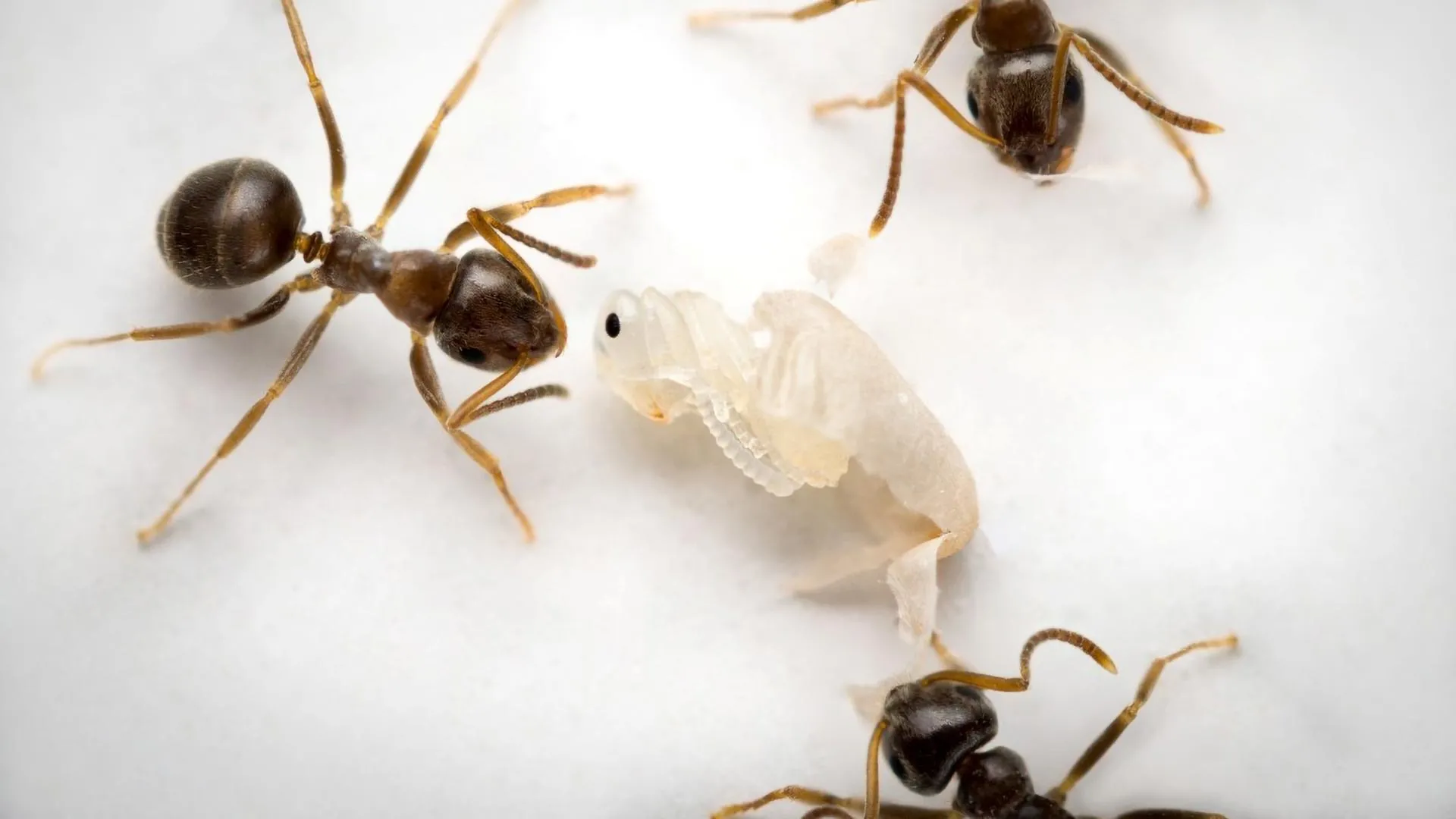
Ant societies, intricate architects of nature, operate as tightly integrated "superorganisms," where thousands of individual ants collectively orchestrate a symphony of survival that strikingly mirrors the cellular coordination within a complex body. A groundbreaking study by researchers at the Institute of Science and Technology Austria (ISTA) has unveiled a sophisticated, altruistic defense mechanism: terminally ill ant brood release a distinctive chemical odor, akin to distress signals emitted by infected body cells. This potent scent acts as an early warning system, enabling the colony to swiftly detect and neutralize infections before they escalate into widespread epidemics. The seminal findings, published in the esteemed journal Nature Communications, redefine our understanding of social immunity and the profound depths of cooperation within insect societies.
The Unveiling of an Altruistic Alarm System
Unlike many social animals where individuals instinctively conceal signs of illness to avoid ostracization or predation, ant pupae facing an insurmountable infection adopt a drastically different strategy. When confronted with a pathogen that their nascent immune systems cannot overcome, these developing ants actively produce a specific chemical alarm. This signal, a desperate plea and a vital warning, alerts their nestmates to the imminent danger they pose to the collective health of the colony. This discovery challenges conventional views of individual survival, highlighting a profound evolutionary adaptation where self-sacrifice serves the greater good of the superorganism.
The research team, led by Professor Sylvia Cremer, head of the Social Immunity research group at ISTA, and featuring first author Erika Dawson, meticulously documented this phenomenon in the laboratory. Through a series of controlled experiments, they observed how infected pupae, otherwise indistinguishable to the human eye, began to emit a unique chemical signature. This signature was not a random byproduct of disease but an evolved, intentional signal designed to communicate a critical threat. The precision of this communication system is paramount, ensuring that only truly terminally ill individuals trigger the colony’s drastic intervention, thereby preventing unnecessary losses of viable brood. This level of biological sophistication underscores the intense evolutionary pressures exerted by pathogens on social insect colonies, which are highly vulnerable to disease due to their dense populations and shared living spaces.
Worker Ants: The Colony’s Rapid Response Unit
Upon detecting this urgent chemical distress signal, worker ants, the diligent caretakers of the colony, initiate an immediate and decisive response. Their actions are swift and methodical, reflecting a highly evolved protocol for disease containment. They meticulously locate the infected pupa, often encased within a protective cocoon, and proceed to open it. Subsequently, they create minute incisions on the pupa’s outer surface, a precise intervention designed to expose the internal pathogen. Following this, the workers apply formic acid, a potent natural antimicrobial compound that they themselves produce from specialized glands. This formic acid acts as a powerful disinfectant, effectively eradicating the pathogens proliferating within the pupa, thereby preventing their spread throughout the colony.
However, this life-saving intervention for the colony comes at a dire cost to the individual. While it successfully neutralizes the infectious agent, the treatment inevitably leads to the pupa’s death. This stark outcome underscores the extreme level of cooperation and the utilitarian calculus governing the survival of the ant superorganism. The individual’s life is sacrificed to ensure the health and continuity of the entire collective, a testament to the powerful evolutionary pressures that favor colony-level fitness over individual longevity.
"What appears to be self-sacrifice at first glance is, in fact, also profoundly beneficial to the signaler," explains Erika Dawson, first author of the study and a former postdoc in Sylvia Cremer’s Social Immunity research group at ISTA. "By safeguarding its nestmates, with whom it shares a significant proportion of its genes, the terminally ill ant indirectly ensures the propagation of its own genetic lineage. By warning the colony of their deadly infection, these altruistic ants help the colony remain healthy, thrive, and ultimately produce daughter colonies, which then carry forward a portion of the signaler’s genes to subsequent generations." This concept, often termed kin selection, is a cornerstone of sociobiology, explaining how behaviors that appear detrimental to an individual can be evolutionarily advantageous when they benefit close relatives who share many of the same genes. This mechanism is particularly pronounced in eusocial insects like ants, where high relatedness within the colony creates strong selective pressures for altruistic behaviors.
This groundbreaking research, conducted in collaboration with chemical ecologist Thomas Schmitt from the University of Würzburg in Germany, marks the first documented instance of such an altruistic disease signaling system in social insects. The implications are profound: without such an sophisticated early warning mechanism, a single dying ant, harboring a virulent infection, could rapidly transform into a biological time bomb, unleashing an epidemic that threatens the very existence of an entire colony, which can number from a few dozen to hundreds of thousands of individuals in species like the common black garden ant (Lasius niger). By proactively signaling their compromised condition, the incurably ill make it possible for the colony’s collective immune system to neutralize the threat before it can metastasize.
The Superorganism Paradigm: Ants as a Collective Body
The concept of an ant colony functioning as a "superorganism" is central to understanding these extreme cooperative behaviors. Pioneered by figures like William Morton Wheeler in the early 20th century, this paradigm posits that a highly integrated colony of social insects exhibits characteristics analogous to a single biological organism. At this scale, individual ants cease to be mere individuals in the human sense but rather specialized "cells" or "organs" contributing to the homeostasis and survival of the larger entity. This holistic view helps explain why individual ants might engage in behaviors that seem self-destructive from a purely individualistic perspective.
In a superorganism, a strict division of labor prevails, mirroring the specialized cell types within a multicellular body. Queens are the reproductive cells, dedicated solely to generating offspring, ensuring the continuity of the genetic lineage. Worker ants, conversely, embody the somatic cells, performing the myriad daily tasks essential for the group’s survival: foraging for food, maintaining the nest’s structural integrity, defending against predators, and, crucially, providing healthcare. This parallel to the human body, where reproductive cells (gametes) are distinct from somatic cells that perform biological functions, is striking and provides a powerful framework for interpreting ant social dynamics.
Both individual organisms and superorganisms are fundamentally reliant on the intimate and often self-sacrificial cooperation between their reproductive and non-reproductive components. In ant societies, this cooperation reaches extraordinary levels, encompassing behaviors that demonstrably benefit the colony, even at the ultimate expense of the individual. The sacrifice of fatally infected brood is a prime example, demonstrating that the health of the collective outweighs the survival of a single member when the latter poses an existential threat. This collective health maintenance system is often referred to as "social immunity," a broader concept encompassing all behaviors that reduce disease transmission and improve resistance to pathogens within a social group. This can range from hygienic behaviors like allogrooming (mutual grooming) and waste removal to more complex collective responses like the one observed in this study, forming a multi-layered defense against ubiquitous microbial threats.
Why an Early Warning Signal is Indispensable
A pertinent question arises: if ants possess such advanced collective intelligence, why has evolution favored such a sophisticated, chemically mediated alarm system when sick individuals could simply isolate themselves? Cremer elucidates this point, drawing parallels to established ant behaviors. "Adult ants that approach death frequently exhibit a form of self-isolation, leaving the nest to die outside the colony, thereby preventing the spread of pathogens within the communal living space. Similarly, workers that have been exposed to virulent fungal spores often practice ‘social distancing,’ reducing their contact with nestmates." This behavioral immunity is a well-documented strategy in social insects.
However, this option of self-removal is simply unavailable to the ant brood. Developing pupae are sessile; they cannot move independently and are utterly reliant on the care of adult workers. Consequently, like infected cells within a multicellular organism, they require external assistance to mitigate their threat. This vulnerability necessitates an external signaling mechanism. The parallels to cellular biology are profound: developing pupae and infected body cells face analogous challenges and have evolved strikingly similar strategies to address them. Both release specific chemical cues that attract either specialized immune cells (in the case of a body) or worker ants (in the case of a colony), enabling these helpers to swiftly identify and eliminate potential sources of infection. Immunologists aptly refer to this crucial cellular communication as the "find-me and eat-me signal," a direct call for phagocytic cells to engulf and destroy compromised cells.
"The efficacy of such a signal hinges on two critical attributes: sensitivity and specificity," Cremer emphasizes. "It must be sensitive enough to reliably identify all terminally sick ant pupae, ensuring no critical threat is overlooked. Simultaneously, it must be precise enough to avoid triggering the drastic and irreversible response – the unpacking and disinfection – of healthy pupae or those capable of naturally overcoming the infection with their own immune systems." This dual requirement for sensitivity and specificity raises a significant scientific challenge: how does the ant colony achieve such an exquisite level of precision in its collective immune response?
Deciphering the Scent of Sickness: A Chemical Ecological Perspective
The answer lies in the subtle yet profound alterations to the pupal scent profile, a domain expertly investigated by chemical ecologist Thomas Schmitt. Schmitt, whose research career is dedicated to unraveling the intricacies of chemical communication in social insects, notes the remarkable ability of worker ants to precisely target a single sick pupa amidst a multitude of healthy ones. "This highly localized targeting implies that the critical scent signal cannot merely diffuse indiscriminately throughout the nest chamber," Schmitt explains. "Instead, it must be directly and intrinsically associated with the diseased pupa itself. Accordingly, the signal is not composed of highly volatile airborne compounds but rather consists of non-volatile compounds present on the pupal body surface." This distinction is crucial, allowing for targeted intervention rather than a generalized, potentially wasteful, colony-wide response.
Through sophisticated chemical analysis, the researchers identified that two specific components of the ants’ natural cuticular hydrocarbon profile – the complex waxy layer covering their exoskeleton, which also serves as a chemical ID card and communication medium – become significantly more pronounced and altered when a pupa is fatally infected. This shift in the scent signature acts as the unmistakable "death knell" that workers recognize.
To conclusively validate whether this specific odor shift alone was sufficient to trigger the colony’s disinfection response, the researchers devised an ingenious experiment. They carefully extracted the altered scent compounds from signaling pupae and then meticulously applied them to the surface of healthy, uninfected pupae. The subsequent behavior of the worker ants was then rigorously monitored. "We essentially ‘painted’ the smell of death onto healthy brood," Cremer recounts. The results were unequivocal: the mere presence of the altered scent profile on healthy pupae was enough to induce the worker ants to unpack and commence the disinfection protocol on the treated individuals. This elegant experiment definitively demonstrated that the distinctive, altered odor of terminally infected brood functions precisely as a "find-me and eat-me" signal, mirroring the sophisticated cellular communication mechanisms observed in infected body cells.
Strategic Signaling: Why Only Certain Pupae Warn
The study further revealed a crucial layer of sophistication in this altruistic signaling system: not all brood emit this critical alarm signal. According to Dawson, a significant distinction was observed between different castes of developing ants. "Queen pupae, destined to become the reproductive matriarchs of future colonies, possess inherently stronger immune defenses than their worker pupa counterparts," Dawson explains. "They demonstrated an ability to more effectively limit the progression of infections on their own and, notably, were not observed to emit this warning signal to the colony." This suggests a built-in efficiency, where valuable queen brood are not sacrificed if they possess the capacity to recover. Worker pupae, however, lacking this robust autonomous immune capability, consistently signaled for help when terminally ill.
This selective signaling mechanism ensures that the colony’s drastic and costly response – the sacrifice of an individual – is reserved only for genuine, uncontrollable threats. By signaling solely when an infection has progressed beyond their individual capacity for recovery, the brood collectively prevent the unnecessary loss of individuals that might otherwise be capable of overcoming the infection through their own internal immune systems. This precise coordination between the individual and the superorganismal level is precisely what renders this altruistic disease signaling system exceptionally effective and resource-efficient. It’s a finely tuned balance between individual survival and collective resilience, optimized through millennia of evolutionary refinement.
Broader Implications and Future Avenues of Research
The discovery of this sophisticated altruistic disease signaling system in ant colonies carries significant implications extending far beyond the realm of entomology. It offers profound insights into the evolution of social behavior, collective intelligence, and the intricate mechanisms of disease control in dense populations.
From a fundamental biological perspective, this study reinforces the validity of the "superorganism" concept, providing compelling empirical evidence for its application in understanding social insect societies. It highlights how natural selection can operate not just at the individual level, but also at the group level, favoring traits that enhance the fitness and survival of the entire colony, even at the cost of individual lives. This work enriches our understanding of social immunity, a rapidly growing field that explores how social interactions and behaviors contribute to disease resistance within groups.
Furthermore, the precise chemical communication identified in this research opens new avenues for inquiry in chemical ecology. Understanding the exact molecular structure of these "distress signals" could potentially inspire novel strategies for pest control, perhaps by developing synthetic compounds that disrupt ant colony communication or trigger specific defensive behaviors. It also offers a bio-inspired model for designing early warning systems in other contexts, particularly where rapid detection and containment of threats in dense populations are critical, such as in agriculture or even human epidemiology.
The research also underscores the enduring value of studying diverse life forms to unlock fundamental biological principles. The elegant solutions evolved by ant colonies for problems like disease management offer profound lessons for human endeavors, from designing resilient systems to understanding the dynamics of collective decision-making. Future research will likely delve deeper into the neurobiological mechanisms within worker ants that enable such rapid and precise detection of the subtle chemical shifts, as well as exploring if similar altruistic signaling mechanisms exist in other highly social insect species. The exact genetic pathways that govern the production of these signals in infected pupae also present a fascinating area for future investigation, potentially revealing conserved molecular mechanisms across disparate biological systems.
Ethical Considerations in Animal Studies
It is important to reiterate that all research involving animals, particularly in behavioral biology, immunology, or genetics, is conducted under stringent ethical guidelines. Studies like this one are indispensable for advancing our fundamental understanding of complex biological processes that cannot be fully replicated through in silico modeling or other non-animal methods. The researchers at ISTA and their collaborators adhere to strict legal regulations governing the collection, rearing, and handling of all ant colonies used in their experiments, ensuring animal welfare remains a paramount concern throughout the scientific process. This commitment to ethical research ensures that valuable scientific insights are gained responsibly.
The pioneering work from ISTA not only sheds light on the hidden complexities of ant life but also serves as a powerful reminder of nature’s ingenuity in forging sophisticated solutions to the universal challenge of disease, demonstrating that even in the smallest creatures, the echoes of grand biological principles resonate profoundly.
