
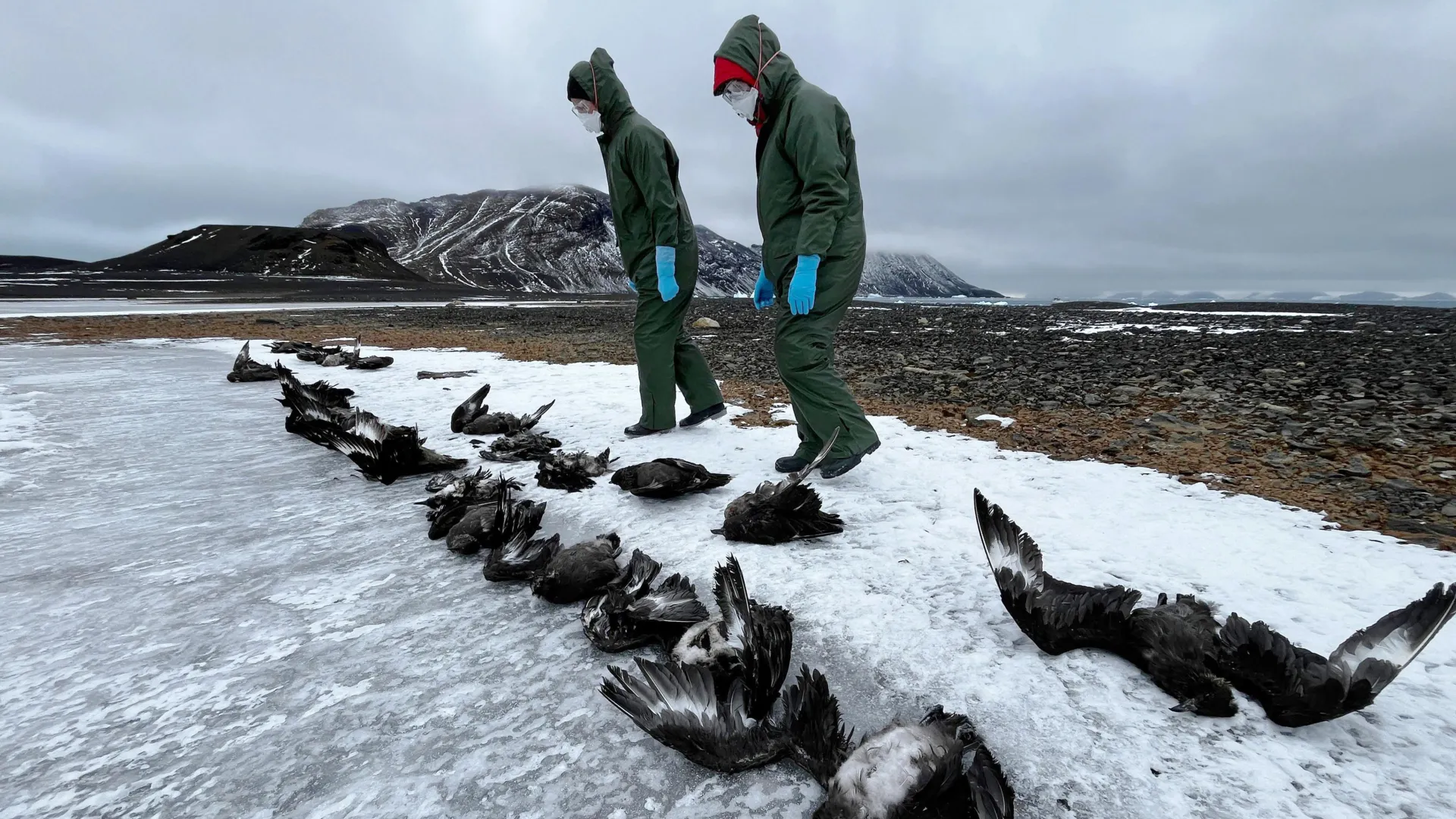
More than 50 skuas perished in Antarctica during the austral summers of 2023 and 2024, succumbing to infections caused by the highly pathogenic avian influenza (HPAI) virus H5N1. This grim discovery marks a pivotal moment, as researchers have now confirmed this to be the first documented wildlife die-off attributable to the H5N1 virus on the Antarctic continent. The groundbreaking findings emerged from a collaborative study spearheaded by Erasmus MC in The Netherlands and the University of California, Davis, with the results recently published in the esteemed scientific journal Scientific Reports.
A Global Pathogen Reaches Earth’s Last Wilderness
The H5N1 virus, a formidable and rapidly evolving pathogen, first emerged in 1996 on a domestic goose farm in Southeast China. For several years, it circulated largely unchecked within poultry populations, leading to devastating outbreaks in commercial and backyard farms across Asia. Its trajectory shifted dramatically when it successfully spilled over into wild bird populations, leveraging their migratory routes to disseminate across continents. This critical transition marked the beginning of its global expansion, spreading relentlessly across Europe, the Middle East, and Africa, before making its way to North and South America. By early 2024, H5N1’s inexorable march had reached Antarctica, a continent previously considered largely isolated from such widespread epizootics. The strain now confirmed in Antarctic skuas is genetically linked to the variants that have wrought havoc across South America, causing massive mortality events in pinniped populations and millions of poultry.
Skuas, large brown seabirds closely related to gulls, are quintessential inhabitants of polar and subpolar regions. They are apex predators and highly opportunistic scavengers, occupying a crucial ecological niche akin to birds of prey. Their role in the Antarctic ecosystem extends to cleaning up carcasses, thereby contributing to nutrient cycling and overall ecosystem health. However, this very scavenging behavior, while vital for the ecosystem, inherently elevates their risk of both contracting and disseminating the H5N1 virus across the vast Antarctic landscape. Their nomadic tendencies and interaction with other bird species further compound this risk, potentially turning them into vectors within the fragile polar food web.
The Unprecedented Antarctic Die-Off: Confirming the Cause
Prior to this definitive study, early 2024 had seen scientists detect H5N1 in a kelp gull and two skuas found dead in January and February. While these initial detections signaled the virus’s unwelcome presence, a direct causal link between the infection and the observed mortality remained unproven. The recent study, however, meticulously established this critical connection, providing irrefutable evidence that H5N1 was indeed the proximate cause of death for the affected skuas.
Dr. Ralph Vanstreels, a wildlife veterinarian with the UC Davis One Health Institute within the Weill School of Veterinary Medicine and a co-senior author of the study, underscored the significance of this distinction. "We knew there were animals with the infection, but this is the first study to show they died of the viral infection," Dr. Vanstreels stated, emphasizing the crucial difference in the nascent stages of an outbreak. This confirmation shifts the narrative from mere presence to active, lethal impact, demanding a more urgent and coordinated response.
Investigating the Crisis: The HPAI Australis Expedition
In a rapid and decisive response to the emerging threat, a dedicated research team embarked on an expedition to Antarctica in March 2024, immediately following the breeding season for skuas and penguins. The HPAI Australis Expedition, as it was known, spanned 10 critical sites across the South Shetland Islands, the northern Weddell Sea, and the Antarctic Peninsula – regions known for their dense wildlife populations.
The expedition’s methodology was rigorous and comprehensive. Upon encountering sick or deceased animals, the scientists diligently collected tissue and environmental samples. Crucially, they conducted thorough necropsies – post-mortem examinations – to ascertain the precise cause of death. While the remains of various species, including gentoo penguins, Adélie penguins, and Antarctic fur seals, were examined, H5N1 was not identified as the primary cause of death in these specific instances during this expedition. However, the focus quickly narrowed. "As the expedition progressed, it became obvious quickly that skuas were a major victim," Dr. Vanstreels recounted, highlighting the disproportionate impact on these seabirds.
The virus was definitively detected in skuas across three distinct locations: Hope Bay, Devil Island, and, most notably, Beak Island. Beak Island became the epicenter of a significant die-off event, primarily affecting south polar skuas. Dr. Matteo Iervolino, a Ph.D. candidate at Erasmus MC in Rotterdam, The Netherlands, and the first author of the study, vividly described the grim scene. "We diagnosed high pathogenicity avian influenza as the cause of death for nearly all of the dead skuas we found at Beak Island," he stated. "There, I could really see with my eyes the impact this virus can have on these populations."
The clinical presentation of H5N1 in infected birds is often severe and distressing. Dr. Vanstreels characterized the situation as a "crisis in animal suffering." The H5N1 virus targets the central nervous system, leading to profound neurological symptoms. Infected birds often display twisted necks, unusual body stretching, disorientation, and impaired motor skills. They may be observed walking or swimming in circles, crashing into objects, or even exhibiting erratic flight patterns, including falling out of the air. These symptoms not only cause immense suffering but also render the birds highly vulnerable to predation or environmental hazards, accelerating their demise.
A Broader Ecological Threat and the Human Connection
The global trajectory of H5N1 underscores a critical point made by the researchers: human activity has played an undeniable role in the virus’s emergence and, subsequently, its relentless global spread. The initial unchecked circulation within industrial poultry farming created an ideal environment for the virus to mutate and gain virulence, eventually spilling over into wild bird populations. From that point, controlling its dissemination became an insurmountable challenge.
The same virulent strain of H5N1 now impacting Antarctic skuas has already left a trail of devastation across other parts of the world. In South America, particularly in Argentina, Peru, and Chile, it has caused unprecedented mass mortality events among marine mammals, including tens of thousands of elephant seals and sea lions. Globally, the economic toll on the poultry industry has been staggering, with over 400 million domestic birds culled or lost to the disease. Beyond avian species, H5N1 has demonstrated a disturbing capacity to infect a wide array of mammals, including dairy cows, mink, foxes, bears, otters, and various other terrestrial and marine carnivores, signaling its broad host range and zoonotic potential.
The threat extends to human health as well. While human infections remain relatively rare, the severity of the disease is a grave concern. Of the approximately 1,000 reported human cases worldwide, roughly half have proven fatal, highlighting the virus’s inherent lethality when it does cross the species barrier to humans.
Professor Thijs Kuiken, a corresponding senior author from Erasmus MC, offered a stark assessment of the situation: "We let the virus slip out through our fingers when it first emerged in the poultry industry." He continued, lamenting, "Once it got into wild bird populations, we lost ability to control this virus. Now it’s established in wild bird populations in all the continental regions of the world except Oceania." This statement serves as a powerful reminder of the global interconnectedness of health – animal, human, and environmental – a core tenet of the One Health approach.
The Imperative for Enhanced Antarctic Surveillance
The arrival of HPAI H5N1 adds a perilous new dimension to the already formidable array of challenges confronting Antarctic wildlife. This includes the accelerating impacts of climate change, the growing footprint of tourism, the introduction of invasive species, the pressures of overfishing, and widespread pollution. The continent’s isolated ecosystems and the immunological naivety of its native species make them particularly vulnerable to novel pathogens.
The study unequivocally emphasizes the urgent need for significantly strengthened surveillance and monitoring efforts across Antarctica to mitigate the risk of further spread and to understand the full ecological ramifications. A critical complication in assessing the true impact of this outbreak is the alarming lack of contemporary population data for many Antarctic species. For instance, the last comprehensive census of Antarctic skuas dates back to the 1980s, when researchers estimated approximately 800 breeding pairs. Without updated, robust population figures, accurately quantifying the significance of the loss of 50 or more birds becomes incredibly challenging, hindering effective conservation planning.
"Everything points toward this virus spreading further," Professor Kuiken warned, underscoring the dynamic nature of the pathogen. He added a sobering thought: "If nobody is watching, we won’t know what is happening." This sentiment underscores the critical role of scientific expeditions and continuous monitoring in detecting, understanding, and potentially mitigating emerging threats in one of the planet’s most pristine yet vulnerable environments.
Global Implications and the Future of H5N1
The H5N1 outbreak in Antarctica serves as a stark global indicator of the pervasive reach of anthropogenically-influenced pathogens. It highlights the profound interconnectedness of global ecosystems and the cascading effects of human activities, from agricultural practices to international travel and trade. The virus’s ability to thrive in diverse hosts and environments, coupled with its high pathogenicity, makes it a persistent and evolving threat.
Beyond the immediate wildlife impact, the establishment of H5N1 in Antarctic wild bird populations raises concerns about the potential for the virus to persist seasonally, undergo further mutations, or even facilitate novel reassortment events with other influenza strains. This could potentially generate new variants with altered transmissibility or pathogenicity, posing renewed risks to wildlife, livestock, and potentially human health.
The funding for the HPAI Australis Expedition, provided by the International Association of Antarctica Tour Operators (IAATO) and Ocean Expeditions, along with support from the European Union, Consejo Superior de Investigaciones Científicas (CSIC), and PTI Global Health, reflects a growing recognition among diverse stakeholders of the need for collaborative action. This multi-sectoral approach, encompassing scientific research, conservation, and even responsible tourism, is crucial for addressing such complex global health challenges. As the scientific community continues its vigilant watch, the lessons learned from Antarctica will be vital in informing future strategies to protect global biodiversity and public health from the relentless march of emerging infectious diseases. The confirmation of a H5N1 die-off in Antarctica is not merely a regional crisis; it is a global alarm bell, echoing the urgent need for intensified surveillance, robust international cooperation, and a renewed commitment to a holistic One Health paradigm.
