
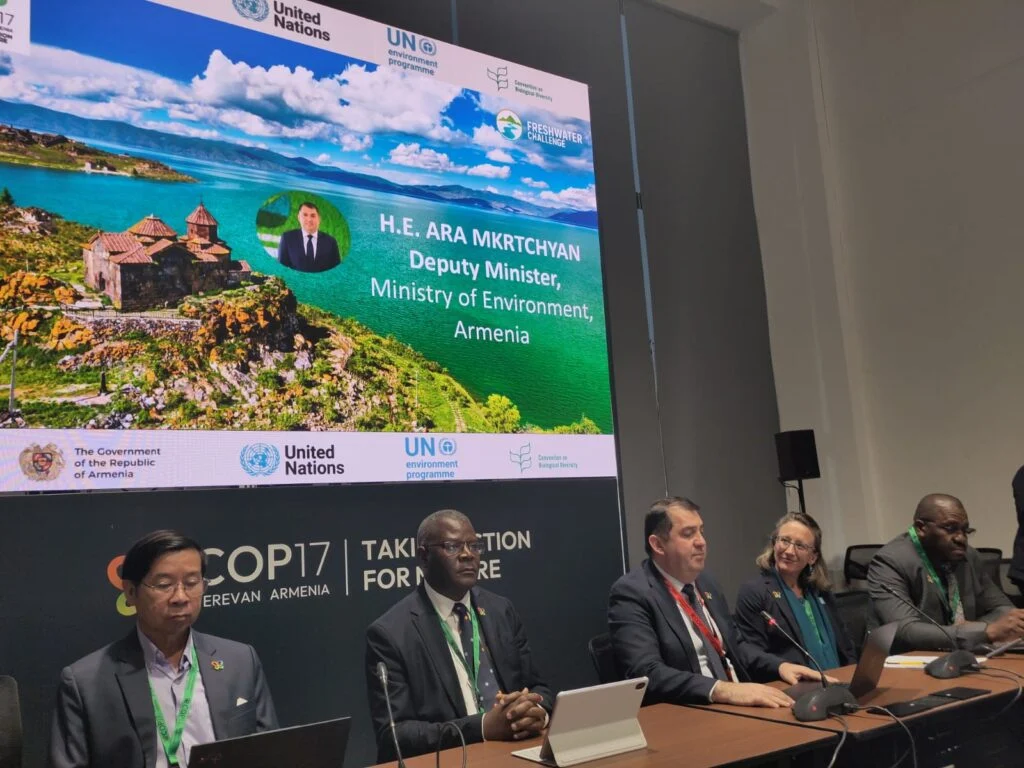
Armenia has officially solidified its commitment to global environmental protection by becoming the 55th member state to join the Freshwater Challenge. H.E. Ara Mkrtchyan, Armenia’s Deputy Minister of the Environment, made the landmark announcement during the United Nations Convention on Biological Diversity (CBD) Conference of the Parties (COP17). By signing onto this ambitious international initiative alongside the European Union, Yerevan has signaled a robust domestic and international focus on reversing the degradation of global water bodies, safeguarding vital aquatic ecosystems, and embedding water security into broader climate change mitigation frameworks.
The announcement was delivered during a high-level official side event titled "Mobilizing Resources for Freshwater Biodiversity from Water Towers to Wetlands: Scaling Up the Freshwater Challenge." The session brought together international policymakers, environmental scientists, and non-governmental organizations to discuss innovative finance mechanisms, resource mobilization, and policy alignment needed to rescue the world’s rapidly declining rivers, lakes, and wetlands.
Background Context of the Freshwater Challenge
The Freshwater Challenge is recognized as the world’s largest-scale initiative dedicated to the recovery and restoration of freshwater ecosystems. Designed to address the accelerating crisis of biodiversity loss in inland waters—where populations of freshwater species have plummeted at rates far exceeding those in terrestrial or marine environments—the initiative unites governments, civil society, and international organizations behind shared targets.
Freshwater ecosystems, spanning rivers, lakes, subterranean aquifers, and peatlands, cover less than one percent of the Earth’s surface yet harbor roughly ten percent of all known species. Despite their disproportionate ecological value, these systems face severe anthropogenic pressures, including over-extraction, pollution, damming, and climate change. The Freshwater Challenge aims to reverse these trajectories by catalyzing commitments to protect and restore millions of hectares of wetlands and thousands of kilometers of free-flowing rivers globally.
With Armenia and the European Union stepping forward at CBD COP17, the political momentum behind the initiative has reached a critical threshold, uniting diverse geographies from high-altitude mountainous water towers to expansive downstream river basins under a single cooperative umbrella.
Armenia’s Domestic Priorities and the Significance of Lake Sevan
Addressing the high-level audience at COP17, Deputy Minister Mkrtchyan framed Armenia’s accession to the Freshwater Challenge not merely as a symbolic diplomatic gesture, but as an extension of ongoing, rigorous domestic reforms.
"The Government of the Republic of Armenia is committed to protecting nature, biodiversity, and natural resources," Mkrtchyan stated during his opening address. "We aim to use our natural resources wisely, reduce harm to the environment, and ensure a healthy and safe environment for present and future generations."
At the heart of Armenia’s freshwater strategy is Lake Sevan, the largest body of water in the Caucasus region and a crucial national asset. Situated at an altitude of approximately 1,900 meters above sea level, Lake Sevan functions as the economic, ecological, and cultural lifeblood of the country. It provides vital irrigation for Armenia’s agricultural sector, supports regional fisheries, generates hydroelectric power, and serves as a major hub for endemic biodiversity, including the endangered Sevan trout (Salmo ischchan).
However, Lake Sevan and Armenia’s broader hydrological network have faced profound ecological stress over the decades, driven by historical over-abstraction, nutrient runoff, industrial pollution, and shifting climatic patterns that alter seasonal water flows. Recognizing these vulnerabilities, Deputy Minister Mkrtchyan emphasized that water resource management has been elevated to a top national priority.
"Our work focuses on protecting water resources, using modern technologies to save water, improving water systems, and making sure that water is used responsibly," Mkrtchyan explained. He detailed ongoing practical interventions, including the modernization of irrigation infrastructure, comprehensive river basin clean-up operations, forest and degraded land restoration projects, and stringent ecological safeguards designed to protect the fragile equilibrium of Lake Sevan.
Policy Integration and International Climate Strategy
Armenia’s integration into the Freshwater Challenge aligns directly with its broader commitments under the Kunming-Montreal Global Biodiversity Framework (GBF) and the Paris Agreement. By aligning national water governance with international standards, Yerevan aims to unlock new avenues for technical assistance, capacity building, and climate finance.

During the COP17 side event, the Deputy Minister underscored the necessity of bridging the persistent financing gap that hampers biodiversity conservation in the developing world. Mobilizing resources from "water towers to wetlands" requires innovative blended finance models, increased public-private partnerships, and the mainstreaming of nature-based solutions (NbS) into national budgeting.
"We welcome and support initiatives that help Armenia carry out its national plans and strategies to restore and protect freshwater ecosystems," Mkrtchyan noted. "This includes increasing investments, supporting nature conservation, and giving more attention to freshwater protection in international discussions on climate change."
The linkage between freshwater management and climate resilience is particularly acute in the South Caucasus. As a mountainous, landlocked nation, Armenia is exceptionally vulnerable to climate change-induced temperature increases, altered precipitation regimes, and accelerated glacier melt. Healthy watersheds and functional wetlands act as natural buffers against extreme weather events—mitigating the impacts of severe floods, stabilizing riverbanks against erosion, and recharging groundwater reserves during extended droughts.
Broader Implications and Global Reactions
The inclusion of Armenia as the 55th member of the Freshwater Challenge has drawn positive reactions from the international environmental community. Conservation organizations and multilateral bodies attending CBD COP17 praised Yerevan’s proactive stance, noting that regional leadership in mountainous headwater countries is essential for downstream water security.
Environmental policy analysts point out that landlocked developing countries often face unique structural challenges in environmental governance, balancing immediate socio-economic demands with long-term ecological preservation. By embedding its domestic water reforms within a global coalition like the Freshwater Challenge, Armenia gains access to a global knowledge-sharing network, peer-to-peer technical exchanges, and heightened visibility on the international climate and biodiversity stage.
Furthermore, experts emphasize that freshwater conservation cannot be siloed from broader land-use planning. Armenia’s simultaneous focus on forest restoration, soil conservation, and river basin management reflects an integrated ecosystem approach. Healthy forests capture precipitation, regulate runoff velocity, reduce sedimentation in reservoirs, and maintain the steady base flows that rivers require to sustain aquatic life during dry summer months.
Chronology of Armenia’s Environmental Milestones
To understand the trajectory that led to Armenia’s historic announcement at CBD COP17, it is instructive to examine the nation’s recent environmental governance timeline:
- Early 2000s: The Armenian government enacts the Republic of Armenia Law on Lake Sevan, establishing special legal protections and a dedicated commission to regulate water extraction and ecological rehabilitation following decades of severe lake level drops.
- 2015: Armenia submits its Nationally Determined Contribution (NDC) under the Paris Agreement, increasingly incorporating ecosystem-based adaptation and water resource management into its national climate strategy.
- 2022 (COP15): The historic Kunming-Montreal Global Biodiversity Framework is adopted at CBD COP15, setting global targets to restore 30% of degraded terrestrial, inland water, and coastal marine ecosystems by 2030, laying the groundwork for initiatives like the Freshwater Challenge.
- 2024–2025: Armenia accelerates domestic water infrastructure modernizations, deploying modern irrigation efficiency technologies and stepping up enforcement against illegal industrial discharges into major river basins such as the Araks and Hrazdan.
- October 2026 (CBD COP17): Deputy Minister Ara Mkrtchyan officially announces Armenia’s accession to the Freshwater Challenge as the 55th Member State during a high-level resource mobilization event, committing the nation to scaled-up international cooperation and freshwater protection.
Looking Ahead: Implementation and Accountability
As the dust settles on the high-level announcements at CBD COP17, attention will inevitably shift from diplomatic pledges to on-the-ground implementation. For Armenia, the challenge lies in translating the high-level objectives of the Freshwater Challenge into measurable, verifiable ecological recovery across its watersheds.
The Ministry of Environment faces the task of operationalizing enhanced monitoring systems for water quality and quantity, ensuring transparent allocation of environmental funds, and engaging local municipal authorities and rural communities in participatory water stewardship. Given that agricultural activities account for the vast majority of water consumption in the country, incentivizing farmers to adopt water-saving drip irrigation and regenerative agricultural practices will be a definitive test of policy success.
At the same time, regional cooperation will remain paramount. Because river systems do not respect national borders, Armenia’s efforts to protect its headwaters and restore aquatic biodiversity will generate downstream benefits across the broader Caucasus transboundary river basins, reinforcing regional stability and ecological resilience.
In closing his landmark address at COP17, Deputy Minister Mkrtchyan encapsulated the philosophy driving Armenia’s new international commitment: "Armenia has many important freshwater ecosystems, with Lake Sevan at their heart. These waters are essential for our economy, our communities and cities, and our rich biodiversity. We understand that we must act now and invest more in protecting and restoring our rivers, lakes, other water resources, and wetlands. These ecosystems play an important role in stopping nature loss, ensuring water security, and fighting climate change. We believe that the Freshwater Challenge will help us protect our valuable freshwater resources for people, nature, and the climate."
