
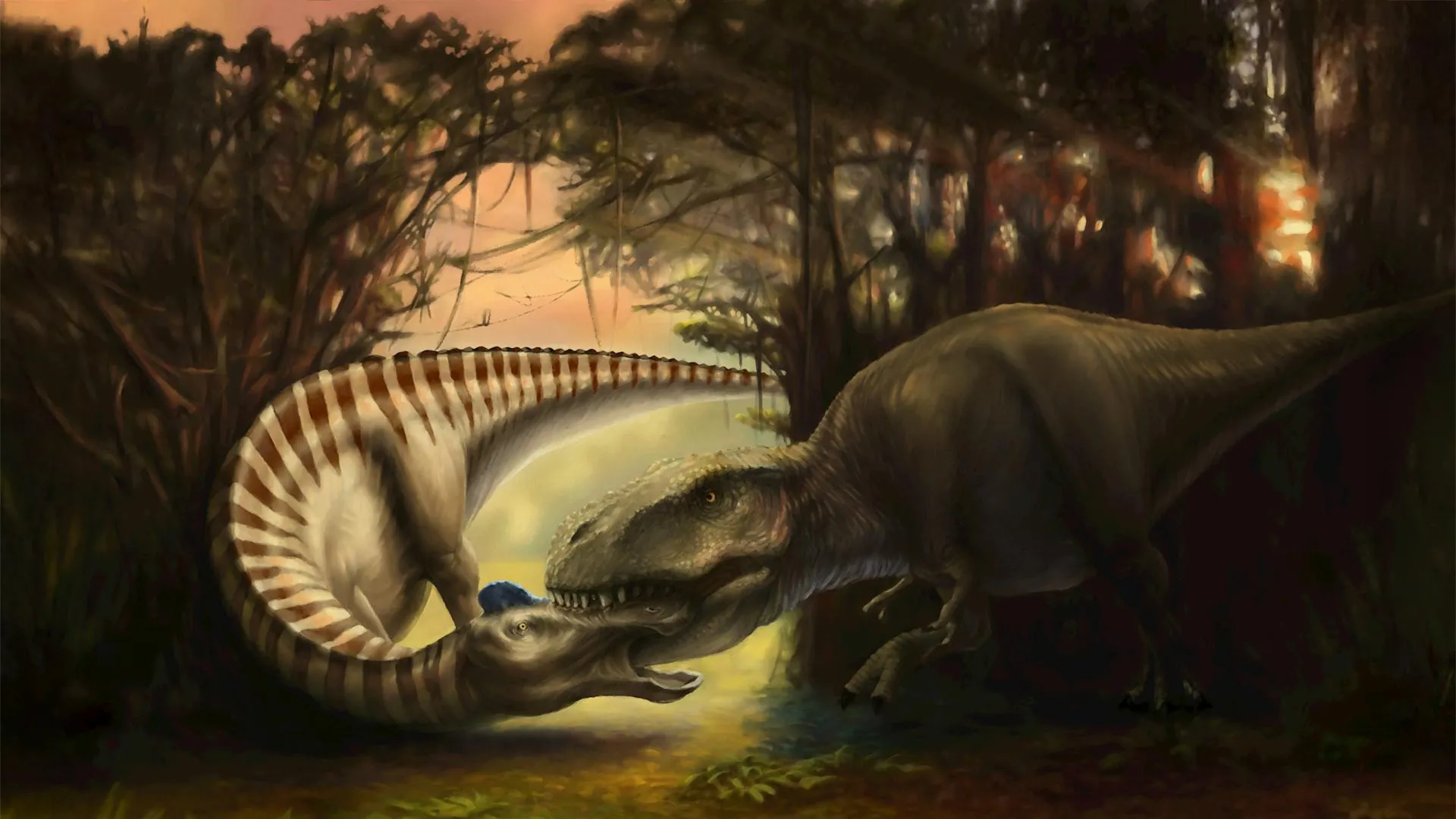
A remarkable fossil housed within the extensive paleontology collections at Montana State University’s Museum of the Rockies is offering the global scientific community an unprecedented, high-definition glimpse into the predatory mechanics of the Late Cretaceous apex predator, Tyrannosaurus. The specimen, characterized by a shattered tyrannosaur tooth lodged firmly within the nasal bones of a duck-billed herbivore, serves as the cornerstone of a comprehensive new study conducted by researchers from Montana State University and Canada’s University of Alberta. Published in the peer-reviewed scientific journal PeerJ, the investigation leverages advanced medical imaging and comparative osteology to reconstruct a prehistoric predatory event that unfolded approximately 66 million years ago in the sundrenched floodplains of what is now the American West.
The Hell Creek Formation: A Crucible of Late Cretaceous Megafauna
To understand the magnitude of this fossil discovery, paleobiologists must look back to the final chapters of the Mesozoic Era. Approximately 66 million years ago, during the Maastrichtian age of the Cretaceous period, the landscape of eastern Montana was a low-lying, subtropical coastal plain characterized by winding river systems, dense coastal swamps, and sprawling forested floodplains. This fertile ecosystem supported an astonishing diversity of megafauna, creating a dynamic predator-prey interface that has captivated paleontologists for over a century.
Within this ancient biome, Tyrannosaurus reigned supreme as the undisputed apex predator, routinely achieving lengths exceeding 12 meters and body masses scaling upwards of eight to ten metric tons. However, the tyrant lizard king did not rule in a vacuum. It shared this complex habitat with a formidable suite of herbivores, including the heavily armored, three-horned Triceratops, the tank-like armored ankylosaur Ankylosaurus, and abundant herds of large duck-billed dinosaurs known as Edmontosaurus.
Edmontosaurus was a massive, facultatively bipedal ornithopod that routinely grew up to 12 meters in length, making it a substantial meal for a hungry tyrannosaur. While paleontologists have long understood that Tyrannosaurus regularly preyed upon these herbivores—evidenced by countless shed teeth, gnaw marks, and tooth-scored bones found throughout the Hell Creek formation—the physical mechanics of how these titanic beasts interacted during fatal encounters have remained a subject of intense academic debate.
Unearthing the Specimen: The 2005 Discovery at Hell Creek
The story of this extraordinary fossil began nearly two decades ago, in the summer of 2005. During a routine paleontological expedition in the rugged terrain of the Hell Creek Formation in eastern Montana, field researchers stumbled upon a nearly complete Edmontosaurus skull. The excavation site was located on public lands managed by the United States Department of the Interior’s Bureau of Land Management (BLM), an agency that frequently collaborates with academic institutions to preserve and study significant paleontological resources.
Upon careful extraction, stabilization, and transport to the laboratory, the fossil was accessioned into the permanent collections of the Museum of the Rockies in Bozeman, Montana. For years, the cranium sat among the museum’s vast holdings, appreciated as a fine specimen of an Edmontosaurus skull. However, a closer inspection of the facial architecture revealed an anomalous, highly significant detail: a distinct fragment of a serrated tyrannosaur tooth was deeply embedded within the bone of the duckbill’s snout, having broken off cleanly during the traumatic event and remaining entombed in the mineralized matrix for tens of millions of years.
Today, the fossil occupies a prominent place within the Museum of the Rockies’ renowned Hall of Horns and Teeth exhibition, serving as a tangible bridge between the physical reality of the fossil record and the dynamic behaviors of extinct animals. The specimen recently became the focal point of an intensive, multi-institutional investigation spearheaded by Taia Wyenberg-Henzler, a doctoral student at the University of Alberta, working in close collaboration with Dr. John Scannella, the Museum of the Rockies’ Curator of Paleontology.
Forensic Paleontology: Acting as Cretaceous Crime Scene Investigators
The collaboration between Wyenberg-Henzler and Scannella approached the fossil not merely as a static museum piece, but as physical evidence from a prehistoric crime scene. In modern forensic science, ballistic evidence and embedded fragments offer definitive clues regarding the nature of an assault. In the realm of paleontology, finding a predator’s tooth locked inside the skeletal remains of its prey provides an equally undeniable smoking gun.
"Although bite marks on bones are relatively common in the fossil record, finding an embedded tooth is extremely rare," stated Wyenberg-Henzler during the release of the study findings. "The great thing about an embedded tooth, particularly in a skull, is it gives you the identity of not only who was bitten, but also who did the biting. This allowed us to paint a picture of what happened to this Edmontosaurus, kind of like Cretaceous crime scene investigators."
To establish absolute certainty regarding the identity of the biter, the research team undertook a rigorous comparative analysis. They systematically measured, mapped, and compared the morphology, serration density, and cross-sectional geometry of the embedded tooth fragment against the dental anatomy of every known carnivorous dinosaur species documented within the Hell Creek Formation. The anatomical match pointed directly to Tyrannosaurus rex, ruling out smaller theropods such as Nanotyrannus or dromaeosaurids.
CT Scanning and the Mechanics of the Strike
To delve deeper into the structural interaction between the predator’s tooth and the victim’s bone without damaging the priceless fossil, the research team utilized advanced non-destructive imaging technology. The Edmontosaurus skull was transported to Advanced Medical Imaging at Bozeman Health Deaconess Hospital, where high-resolution Computed Tomography (CT) scans were performed.
The resulting digital scans allowed the paleontologists to peer inside the bone matrix, revealing the precise trajectory of the bite, the depth of penetration, and the structural stress placed upon the tyrannosaur’s jaw during the attack. The imaging confirmed that the crown of the tooth had sheared off under immense mechanical load, remaining permanently wedged within the cranial sutures of the herbivore’s nasal region.
"A fossil like this is extra exciting because it captures a behavior: a tyrannosaur biting into this duckbill’s face," noted Dr. John Scannella, co-author of the study and Curator of Paleontology at the Museum of the Rockies. "The skull shows no signs of healing around the tyrannosaur tooth, so it may have already been dead when it was bitten, or it may be dead because it was bitten."
This distinction regarding the presence or absence of bone healing is critical in paleopathology. When an animal survives a predatory attack, its immune and skeletal systems respond by initiating bone remodeling, leaving visible signs of healing, such as smooth bone growth around the trauma site. The complete absence of such healing signatures on the Edmontosaurus skull indicates that the strike occurred either during the fatal skirmish itself or immediately post-mortem during the initial stages of scavenging.
Behavioral Implications: Reconstructing the Final Moments of Prey
According to the research team, the specific anatomical placement of the embedded tooth provides crucial behavioral context regarding the tactical nature of the encounter. Herbivores of the Cretaceous did not simply submit to predation; animals like Triceratops and Edmontosaurus possessed formidable defensive adaptations capable of inflicting lethal counter-attacks against an attacking carnivore.
"Looking at the way the tooth is embedded in the nose of the Edmontosaurus suggests that it met its attacker face-to-face, something that usually happens to an animal that was killed by a predator," Wyenberg-Henzler explained. "The amount of force necessary for a tooth to have become broken off in bone also points to the use of deadly force. For me, this paints a terrifying picture of the last moments of this Edmontosaurus."
A face-to-face orientation implies a dynamic, active confrontation. Rather than delivering a sneak attack to the rear flanks or the tail—a strategy often associated with modern mammalian predators hunting large ungulates—a Tyrannosaurus engaging an Edmontosaurus head-on would have had to contend with the duckbill’s sheer mass and powerful head movements. The immense bite force of Tyrannosaurus, estimated by biomechanists to exceed 12,800 pounds of force, was more than sufficient to fracture bone and crush armor, but the extreme resistance offered by the thick nasal bones of the Edmontosaurus was enough to snap the dense enamel and dentin of the predator’s tooth, leaving the tip behind as a permanent historical record.
Decades of Scientific Debate Over Tyrannosaurus Feeding Strategies
The publication of this study arrives amid a long-standing academic discourse concerning the exact behavioral ecology of Tyrannosaurus. For decades, paleontologists have debated whether the iconic predator operated strictly as an active apex hunter, an opportunistic scavenger, or a dynamic generalist capable of employing both strategies depending on energetic availability and ecological opportunity.
Pioneered by researchers studying tooth-marked bones, coprolites, and skeletal trauma, the prevailing consensus within modern vertebrate paleontology leans heavily toward active predation, supplemented by scavenging when easy meals presented themselves. However, concrete physical evidence capturing the precise mechanics of a lethal encounter remains exceptionally scarce. While shed tyrannosaur teeth are frequently found isolated in sedimentary deposits—indicating that predators routinely lost and replaced teeth while feeding—finding a tooth physically trapped inside the healed or unhealed bone of a targeted prey species provides empirical data that statistical dental surveys alone cannot supply.
By bridging the gap between isolated bite marks and complete behavioral reconstruction, the discovery at the Museum of the Rockies contributes a vital piece of empirical evidence to the broader puzzle of Late Cretaceous predator-prey dynamics.
Broader Impacts and Future Research Directions
The implications of the study extend far beyond the specific interaction between a single Tyrannosaurus and an Edmontosaurus in prehistoric Montana. By demonstrating the efficacy of combining high-resolution hospital CT scanning with rigorous comparative paleontology, the research team has established a methodological framework that can be applied to other traumatized dinosaur fossils housed in museums worldwide.
Furthermore, institutions such as the Museum of the Rockies continue to emphasize the importance of public land management and collaborative academic research. Specimens recovered from formations like Hell Creek under the stewardship of agencies like the Bureau of Land Management underscore the necessity of protecting fossil-bearing lands to ensure that future generations of scientists can utilize emerging technologies to unlock secrets preserved for millions of years.
As analytical techniques in paleohistology, biomechanical simulation, and non-invasive imaging continue to advance, researchers anticipate uncovering even finer details regarding the physiological stresses, hunting strategies, and ecological pressures that shaped the Age of Dinosaurs. For now, the silent, terrifying face-to-face encounter captured in the Hell Creek Edmontosaurus skull remains a stark reminder of the brutal, dynamic realities of survival at the top of the Cretaceous food chain.
