
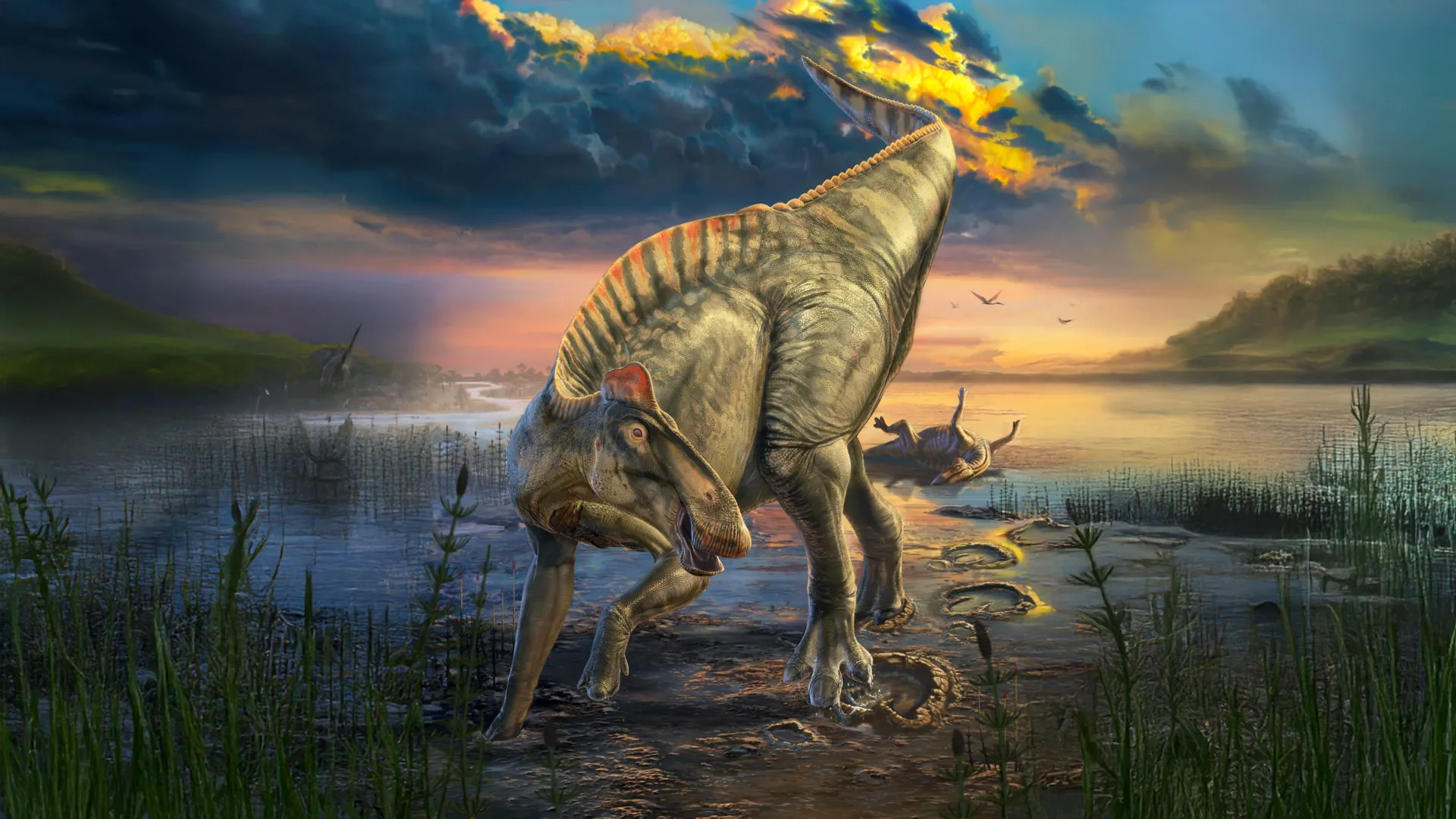
In a landmark paper published in the esteemed journal Science, researchers from the University of Chicago have unveiled a profound discovery that redefines our understanding of dinosaur anatomy and fossil preservation. Approximately 66 million years ago, just before the cataclysmic end of the Cretaceous period, the formidable bodies of the duck-billed dinosaur Edmontosaurus annectens underwent an extraordinary transformation, culminating in remarkably detailed "mummies" that have preserved intricate features of skin, scales, and even hooves. The scientific team, led by senior author Paul Sereno, PhD, Professor of Organismal Biology and Anatomy at UChicago, has termed this novel preservation process "clay templating." This mechanism involves the outer soft tissues of the deceased animal being exquisitely preserved as a delicate clay coating, less than 1/100th of an inch thick, which settled over the skeleton shortly after burial, effectively forming a three-dimensional mask of the dinosaur’s exterior.
A Glimpse into the Late Cretaceous: The World of Edmontosaurus
The Edmontosaurus annectens roamed the North American continent during the final epoch of the Cretaceous period, the Maastrichtian Age, a mere blink of an eye before the asteroid impact that heralded the end of the dinosaurs. These colossal herbivores, reaching lengths of up to 40 feet and weighing several tons, were among the most common dinosaurs of their time, often congregating in vast herds across floodplains and coastal regions. They belonged to the Hadrosauridae family, colloquially known as "duck-billed dinosaurs" due to their distinctive broad, flat snouts. Fossil evidence, particularly from formations like the Hell Creek Formation spanning parts of Montana, North Dakota, South Dakota, and Wyoming, suggests they were a dominant presence in their ecosystems.
Historically, paleontologists have largely relied on skeletal remains to reconstruct these ancient giants. While bones provide a robust framework, they offer limited insight into the integumentary structures—the skin, scales, crests, and other soft tissues that would have defined their living appearance. For decades, the precise external morphology of many dinosaurs, including Edmontosaurus, remained largely speculative, often based on inferences from related species or artistic interpretations. The discovery of these new mummies, however, transcends mere speculation, offering an unprecedented, high-fidelity window into the external anatomy of this iconic dinosaur.
The Enigma of Soft Tissue Preservation: Why "Mummies" Are Rare
The fossil record is overwhelmingly dominated by bones and teeth, the hard parts of organisms that are most resistant to decay and geological processes. The preservation of soft tissues—skin, muscle, internal organs, and other non-skeletal elements—is an exceptionally rare phenomenon, requiring a confluence of specific and often unusual environmental conditions. Typically, after an animal dies, its soft tissues rapidly decompose through the action of scavengers, microbes, and environmental factors like oxidation and moisture. For soft tissues to fossilize, they must be protected from these destructive forces almost immediately.
Previous instances of what were termed "dinosaur mummies" have indeed been unearthed throughout paleontological history. One of the most famous examples, the "Trachodon mummy" (later identified as Edmontosaurus annectens), was discovered in 1908 by Charles H. Sternberg in Wyoming. This specimen, though remarkable for its time, still presented challenges in fully interpreting the exact nature of its soft tissue preservation. Often, these earlier finds provided tantalizing but fragmented glimpses of skin impressions. What distinguishes the current University of Chicago discovery is not just the extent of preservation, but the clarity, detail, and the scientifically elucidated mechanism behind it, offering a more complete and confidently reconstructed view than ever before. This new research provides a robust framework to re-evaluate and understand these historical "mummy" finds, placing them within a coherent taphonomic model.
Rediscovering Wyoming’s "Mummy Zone": A Century of Discovery
The story of these extraordinary fossils begins not in a single moment, but through a tapestry woven across a century. The "mummy zone" in east-central Wyoming, where these latest discoveries were made, is not a new site to paleontology. It was here, in the early 1900s, that pioneering paleontologists first uncovered several classic dinosaur mummies, including the aforementioned "Trachodon mummy." These early finds, while revolutionary for their time, were often collected with methods less advanced than today’s, and their exact geological context sometimes became obscured over the decades.
Through meticulous detective work, which included poring over old field photographs and archival records, Professor Sereno and his team embarked on an ambitious quest to retrace the original locations of these historic finds. Their perseverance paid off, leading them to map a compact "mummy zone" within the distinctive rock layers of the region. These layers, characterized by stacked river sands, provided the unique environmental conditions necessary for such exceptional preservation. Over years of dedicated visits, often accompanied by teams of enthusiastic university undergraduates, the UChicago researchers systematically excavated two new Edmontosaurus mummies from this rediscovered zone: a younger individual and a somewhat older one. Crucially, both specimens preserved large, continuous patches of the external skin surface, providing the invaluable, contiguous pieces required to construct a comprehensive, fleshy profile of the animal.
Unraveling the "Clay Templating" Phenomenon
A central pillar of this research is the identification and detailed explanation of "clay templating," the specific taphonomic process responsible for these mummies. Sereno emphasizes that these dinosaur mummies are fundamentally different from human-created mummies found in ancient Egyptian tombs. Unlike the latter, which retain some original organic material, the dinosaur mummies contain none of the dinosaur’s original soft tissue. Instead, the preserved skin, spikes, and hooves exist as an incredibly thin, almost ephemeral, clay coating that formed on the outside of the carcass.
To decipher this rare preservation style, the team employed a sophisticated suite of advanced imaging and analytical approaches. These included non-invasive hospital and micro-CT scans, allowing for detailed internal and external examination without damaging the fragile specimens. Thin sections provided microscopic views of the clay layers, while X-ray spectroscopy and clay mineral analyses identified the precise composition of the preserving medium. A close study of the surrounding rock layers provided crucial environmental context. All lines of evidence converged to paint a clear picture of a precise sequence of events:
- Desiccation: After the Edmontosaurus died, its body likely dried out in the sun, possibly bloat-and-burst scenarios allowing for initial dehydration. This desiccation would have helped to stabilize the outer tissues, preventing immediate putrefaction.
- Rapid Burial: The dried carcass was then rapidly interred, likely in sudden, high-energy flash floods common in riverine environments. This swift burial protected the body from scavengers and further atmospheric decomposition.
- Microbial Biofilm: Crucially, a microbial film formed on the outer surface of the carcass. These biofilms are communities of microorganisms encased in an extracellular polymeric substance, which can act as a sticky layer.
- Electrostatic Attraction of Clay: This microbial film, through electrostatic forces, then attracted fine clay particles suspended in the surrounding wet sediment. Clay particles, often negatively charged, would adhere to the positively charged components of the decaying organic matter and the biofilm.
- Wafer-Thin Template Formation: This process created an incredibly thin, yet remarkably faithful, clay template that perfectly captured the animal’s outer shape in three dimensions. As Sereno eloquently put it, "This is a mask, a template, a clay layer so thin you could blow it away. It was attracted to the outside of the carcass in a fluke event of preservation."
- Decay and Fossilization: Over extended periods, the original soft tissues within the clay mask decayed completely, leaving behind the empty clay film and the skeleton. Both the clay template and the skeleton subsequently underwent fossilization on longer geological timescales, converting the clay into mineralized rock and the bones into petrified remains.
A Digital Reconstruction: Bringing a Dinosaur to Life
The painstaking work of revealing such a fragile boundary—a paper-thin clay layer—demanded immense skill and patience. Tyler Keillor, the Fossil Lab manager and a co-author on the study, spearheaded countless hours of meticulous preparation. His expertise was critical in uncovering the crucial surfaces without inadvertently destroying the delicate clay impressions. This manual preparation was complemented by cutting-edge digital techniques.
Another key figure, postdoctoral scholar Evan Saitta, led the efforts in 3D surface imaging and CT scans. His team meticulously traced the preserved soft anatomy, examining the subtle nuances of the sediments both inside and outside the mummy. A pivotal aspect of their work involved matching the dinosaur’s newly discovered hooves back into fossilized footprints from the same time period. This comparison provided vital confirmation of the anatomical reconstructions and offered insights into the dinosaur’s locomotion. Finally, a team of digital artists collaborated closely with the scientists, translating the detailed anatomical data into lifelike reconstructions. These models not only depicted the static appearance of Edmontosaurus but also showed how the duckbill would have moved as it walked across soft mud near the very end of the dinosaur age, offering a dynamic and visceral connection to the past.
Revolutionary Anatomy: Crests, Spikes, Scales, and the Unexpected Hoof
Working from the two newly described mummies, the researchers were able to assemble an unprecedentedly complete, fleshy outline of Edmontosaurus annectens. "The two specimens complemented each other beautifully," Sereno remarked, "For the first time, we could see the whole profile rather than scattered patches." This holistic view allowed for several groundbreaking anatomical discoveries:
-
A Dragon-like Dorsal Crest and Spiked Tail: Perhaps one of the most visually striking revelations was the discovery of a continuous feature running along the center of the dinosaur’s back. This began as a fleshy, almost dragon-like crest over the neck and torso. As it extended over the hips, this structure transitioned into a single, prominent row of spikes along the tail. Each spike was precisely aligned above a vertebra, fitting neatly with its neighbors, suggesting a robust and integrated anatomical feature that likely played a role in display or species recognition.
-
Scale Patterns and Skin Texture: The mummies also provided an intricate record of the dinosaur’s scale patterns. The team documented distinct variations: larger polygonal scales were observed along the lower body and tail, offering protection to these more exposed areas. However, surprisingly, the majority of the animal was covered in very small, pebble-like scales, only 1-4 millimeters across. This is remarkably tiny for a dinosaur that could reach over 40 feet in length, suggesting a relatively fine-grained skin texture across much of its body. Furthermore, fine wrinkles preserved over the ribcage provided evidence that the skin of this massive duckbill was relatively thin, challenging some previous assumptions about dinosaur skin thickness.
-
The Groundbreaking Discovery of Hooves: The most unexpected and arguably revolutionary discovery emerged from the larger mummy’s hind feet: Edmontosaurus annectens possessed hooves. The tips of each of its three hind toes were enclosed in a wedge-shaped hoof with a flat underside, bearing a striking resemblance to the hooves of modern-day horses or rhinos. This finding has profound implications for our understanding of dinosaur evolution and locomotion. To confirm this, researchers meticulously combined CT scans of the mummified feet with 3D images of the best-preserved duckbill footprint from the same time period. By carefully aligning the bones and soft-tissue impressions, they produced a detailed reconstruction of the hind foot, revealing that unlike the forefoot, which made contact with the ground primarily through its hooves, the hind feet also included a fleshy heel pad behind the hooves, providing additional support and cushioning.
Sereno highlighted the immense significance of this discovery, stating, "There are so many amazing ‘firsts’ preserved in these duck-billed mummies—the earliest hooves documented in a land vertebrate, the first confirmed hooved reptile, and the first hooved four-legged animal with different forelimb and hindlimb posture." This not only reconfigures our image of Edmontosaurus but also opens new avenues for exploring the evolution of integumentary structures in terrestrial vertebrates.
Expert Insights and Collaborative Science
The success of this research is a testament to the collaborative spirit and expertise of the diverse team involved. Paul Sereno, with his extensive experience in dinosaur paleontology, emphasized the unparalleled nature of the findings. "It’s the first time we’ve had a complete, fleshed-out view of a large dinosaur that we can really feel confident about," he stated, underlining the scientific rigor behind the reconstruction. He also acknowledged the unique environment that made it possible, referring to the Wyoming badlands as a "unique ‘mummy zone’ that has more surprises in store from fossils collected over years of visits by teams of university undergrads." This highlights the importance of sustained fieldwork and the role of aspiring scientists in major discoveries.
The intricate preparation work by Tyler Keillor was crucial, as handling such fragile clay layers required a steady hand and deep understanding of fossil preservation. Similarly, Evan Saitta’s leadership in leveraging advanced imaging and 3D modeling technologies transformed raw data into compelling visual and anatomical insights. The integration of digital artists into the scientific process further underscores the team’s commitment to not only rigorous science but also effective public communication. Sereno noted, "I believe it’s worth taking the time to assemble a dream team in order to generate science that can be appreciated by the general public." This approach bridges the gap between complex scientific findings and broader understanding, particularly timely as the findings were released near Halloween, offering a fascinating, tangible glimpse into prehistoric life.
Shaping the Future of Paleontology: A New Toolkit for Soft Tissue Research
Beyond the striking anatomical revelations, this research provides a practical and comprehensive framework for future studies of dinosaur soft tissue. The authors have meticulously outlined new preparation techniques tailored for fragile clay-templated fossils, a clear set of standardized terms for describing soft structures and scale types, and a step-by-step imaging pathway that guides researchers from initial fossil specimen to fully fleshed-out digital model. Crucially, they have also provided a detailed "recipe" for how a dinosaur mummy can form under natural conditions, laying the groundwork for a predictive model of preservation.
This work offers more than a series of isolated findings; it proposes a general model for dinosaur mummification based on "clay templating." This model can now be rigorously tested against other fossils that exhibit similar preservation styles, both known and yet to be discovered. It provides a benchmark for understanding exceptional preservation events and can guide paleontologists in identifying potential "mummy zones" in other geological formations worldwide. The methodological innovations, from field recovery to laboratory analysis and digital reconstruction, represent a significant leap forward in the paleontological toolkit.
Beyond the Bones: Broader Implications for Dinosaur Understanding
The implications of this study extend far beyond the specific anatomy of Edmontosaurus annectens. From a biomechanical perspective, having accurate external body outlines will revolutionize studies of dinosaur movement, locomotion, and posture. Previous biomechanical models often relied on approximations of soft tissue envelopes; now, researchers have a detailed, empirically derived reference. This will lead to more precise estimations of muscle mass, center of gravity, and gait, fundamentally altering our understanding of how these massive animals walked, ran, and interacted with their environment.
From an evolutionary biology standpoint, the discovery of hooves in a dinosaur challenges long-held assumptions about the evolution of integumentary structures. The identification of the earliest hooves documented in a land vertebrate, the first confirmed hooved reptile, and the first hooved four-legged animal with different forelimb and hindlimb posture is a significant evolutionary milestone. It prompts new questions about convergent evolution with mammals (like horses) and the selective pressures that might have led to the development of such specialized structures in dinosaurs. It also offers insights into the diversity of integumentary adaptations within the dinosaurian clade, suggesting that their external appearances were far more varied and complex than previously imagined.
Looking ahead, the team has already outlined critical next steps. These include focused searches for additional specimens with this type of preservation in the same Wyoming rock layers and in other regions with similar depositional environments. Further biomechanical studies, now armed with accurate external body outlines, will delve deeper into the functional aspects of Edmontosaurus anatomy. Complementary analyses will also be designed to understand the precise conditions—geological, environmental, and microbiological—under which clay templating is most likely to occur, potentially leading to the discovery of even more "mummy zones" globally.
Reflecting on the monumental effort and the profound results, Paul Sereno expressed immense satisfaction: "This may be the single best paper I’ve released. From field to lab to 3D reconstructions along with a suite of useful terms defined, it’s a tour de force, and it tells a coherent story about how these remarkable fossils come to be and what we can learn from them." Indeed, this research represents a pivotal moment in paleontology, offering not just new facts, but a new paradigm for unlocking the secrets of life 66 million years ago.
