
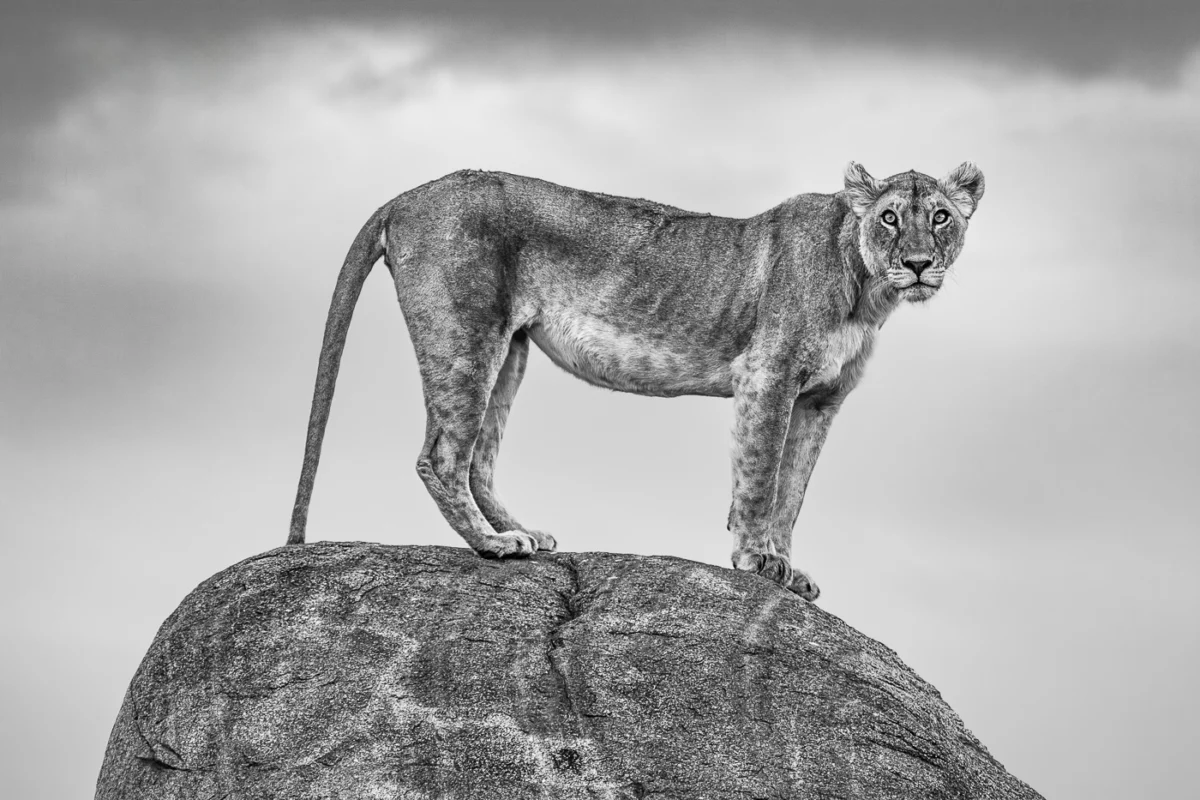
The artistic journey of Gabi Guiard, a renowned wildlife photographer, is a compelling narrative of passion, evolution, and an unwavering commitment to a distinctive monochrome aesthetic. Her work transcends mere documentation, aiming instead to distill the raw essence of nature and its inhabitants into powerful, emotionally resonant images. This singular focus on black and white is not merely a stylistic choice but a fundamental philosophical approach that shapes every aspect of her creative process.

From Commercial Art to Wild Canvas: A Journey of Rediscovery
Guiard’s initial professional path diverged significantly from her innate calling. Early in her career, she immersed herself in the dynamic world of graphic design and art direction within advertising. While this period honed her visual communication skills and exposed her to the sophisticated artistry of black-and-white fashion and advertising photography, it ultimately felt misaligned with her deepest inclinations. Her lifelong fascination with wildlife, a curiosity sparked in early childhood by the intricate behaviors and powerful presence of animals, remained a constant undercurrent. This natural attraction steadily intensified, subtly influencing her perception and connection with the world.

The pivotal shift from a commercial art director to a dedicated wildlife photographer was a gradual but decisive one. Drawing inspiration from the masters of black-and-white imagery she admired in her advertising days, Guiard found photography to be the perfect conduit for merging her acquired artistic knowledge with her profound love for the wild. This transition exemplifies a broader trend among creatives who, after careers in commercially driven fields, seek more personal and profound expressions through fine art. For Guiard, it was about finding an authentic voice, one that allowed her to communicate her unique perspective on nature’s grandeur.
The Language of Monochrome: Stripping Away the Superfluous

At the heart of Guiard’s artistic philosophy lies her steadfast dedication to black-and-white photography. Far from being a mere aesthetic preference or a nod to classicism, monochrome serves as her primary language for storytelling. "Black-and-white is much more than a style," Guiard explains, "it is my way of speaking, telling stories, and showing what I feel when I am in front of nature." This deliberate choice allows her to move beyond superficial beauty, delving into the core elements that define a scene or a subject.
By consciously removing color, Guiard eliminates a significant layer of visual information that can often distract the viewer. In a world saturated with vibrant, high-definition imagery, her black-and-white palette compels the audience to engage with the fundamental qualities of the photograph: textures, shapes, and contrasts. This approach is an exercise in honesty, as she describes it: "what you see is what remains when everything superfluous disappears." This echoes a sentiment shared by many photographic purists, who believe that the absence of color forces a deeper appreciation for light, form, and composition. Historically, black-and-white photography has been lauded for its ability to convey mood, drama, and timelessness, often revealing a profound truth that color might obscure. Pioneering photographers like Ansel Adams and Henri Cartier-Bresson demonstrated how monochrome could elevate a scene from a mere snapshot to an enduring artistic statement, a tradition Guiard consciously embraces.

Mastery of Minimalism: The Power of "Less Is More"
Guiard firmly adheres to the principle of "less is more." Her work is characterized by a deliberate simplification of reality, designed to highlight what truly matters. This often means isolating a subject, stripping away busy backgrounds, and focusing on a singular gesture, a piercing gaze, or an evocative silhouette. "Simplifying reality and taking it to the most essential so that the wild character of nature… takes center stage," she states, encapsulating her objective.

This minimalist approach guides the viewer’s eye directly to the emotional core of the image. When an image is sparse, devoid of distracting elements, the remaining components become profoundly compelling. A single shadow, a distinct line, or a subtle expression can imbue a photograph with immense power. This intentional "emptiness" or "noise-free space" is not a void but an invitation. It allows viewers to project their own emotions and interpretations onto the scene, creating a deeply personal and interactive experience. This artistic strategy is particularly effective in wildlife photography, where the raw, untamed spirit of an animal can be profoundly communicated without the potential interference of environmental colors.
Guiding the Eye: Composition as Foundational Artistry

For Guiard, composition is not merely an arrangement of elements but the structural backbone of every photograph. In the absence of color, which often serves as a natural guide for the eye in color photography, composition becomes even more critical in monochrome. Lines, shapes, and the strategic use of positive and negative space are meticulously orchestrated to direct the viewer’s gaze and unfold the intended narrative.
The placement of an animal within its environment, the delicate balance between areas of light and shadow, and the deliberate inclusion of empty space all contribute to a dynamic interplay of harmony and tension. Guiard often employs techniques such as leading lines—a diagonal branch pointing towards a lion’s intense stare—or natural framing, like the curve of a tree embracing a distant silhouette. Negative space, often overlooked, is utilized as a powerful element to emphasize the subject and create a sense of scale, solitude, or grandeur. This meticulous attention to compositional detail ensures that the viewer connects with the strength of the moment, almost as if they can "hear the silence of the instant." Guiard’s philosophy on composition is not about rigid adherence to rules but about understanding when to thoughtfully break them to evoke a more profound emotional response, creating an "invisible structure that allows the image to breathe and, at the same time, gives it power."

Painting with Light and Shadow: The Strategic Use of Contrast
In Guiard’s monochrome world, light and shadow are not passive elements but active tools, "two brushes with which I paint each image." Contrast, in this context, is far more than an aesthetic choice; it is a profound communicative device. The deep blacks in her photographs serve to conceal what is deemed unnecessary, guiding attention away from distractions and towards the focal point. Conversely, the luminous whites and carefully modulated grays reveal precisely what Guiard intends the viewer to feel and observe.

This strategic manipulation of chiaroscuro—the interplay of light and shadow—imbues her images with dramatic depth and a palpable sense of mood. Shadows carry as much narrative weight as the illuminated subjects, contributing to the overall emotional landscape of the photograph. They can evoke mystery, quietude, or a sense of foreboding, enriching the emotional resonance beyond simple visual representation. The interplay of light defining form against a shadowy expanse often creates a sculptural quality, enhancing the textural details that black and white inherently emphasizes.
Beyond Depiction: Evoking Emotion in Wildlife

While Guiard’s subjects are undeniably rooted in wildlife observation, her ultimate objective transcends mere depiction. Her photographs aim to convey a deeper emotional truth—be it power, solitude, majesty, or even fragility. Lions, for instance, are not simply anatomical studies; they are portrayed as "kings and queens of a territory that breathes at its own rhythm." Each image strives to preserve a fragment of their story: the quiet intensity of a gaze hinting at inner strength, or a serene posture conveying inherent dignity.
This focus on emotion aligns with the broader movement in fine art wildlife photography that seeks to foster a deeper connection between humans and the natural world. By isolating and emphasizing these emotional narratives, Guiard’s work subtly advocates for empathy and understanding towards wildlife. In an era of escalating environmental challenges and biodiversity loss, such artistic expressions serve as vital reminders of the inherent value and profound beauty of these creatures. Black and white, by stripping away the literal colors of the wild, paradoxically intensifies this emotional narrative, forcing the viewer to confront the raw feeling and essential character of the subject.

Echoes Through Time: The Timeless Appeal of Black and White
A significant aspect of Guiard’s choice to work in black and white is its inherent timelessness. Monochrome images possess a unique quality that defies temporal boundaries. A photograph captured today, rendered in black and white, could easily be mistaken for one taken decades ago, and it retains its impact just as powerfully for future generations. This attribute allows Guiard to present nature as an eternal entity, a timeless mirror reflecting our past, present, and future connection to the wild.

This timelessness also creates an expansive space for personal interpretation. By removing the specific, often transient colors of a particular moment, Guiard invites each viewer to infuse the image with their own memories, experiences, and emotions. The absence of color becomes a canvas for individual projection, transforming every photograph into an intimate dialogue between the image and its observer. This universal appeal ensures her work resonates across cultures and generations, fostering a profound, enduring connection.
Sensitivity Over Spectacle: The Heart of the Craft

Guiard readily acknowledges the technical prowess required in her craft—the meticulous search for optimal light, the precise composition, and the unwavering attention to detail. However, she emphatically asserts that the true meaning and power of her work stem from the "sensitivity with which I observe." This sensitivity is paramount, dictating crucial decisions: what to reveal and what to deliberately obscure in shadow, the exact moment to press the shutter, and when to simply "remain silent," observing without intervention.
This emphasis on intuition and deep observation highlights the difference between merely taking a picture and creating a photograph. "Technique without sensitivity tells nothing," Guiard believes. It is the fusion of technical mastery with an acute, empathetic understanding of her subjects and environment that gives birth to photographs capable of moving, inspiring, and provoking profound reflection. This approach demands patience, respect for wildlife, and an ability to connect with the subtle nuances of the natural world, allowing the artist to capture not just an image, but a feeling, a moment of truth.

Legacy and Impact: A Vision for Nature
Gabi Guiard’s distinctive black-and-white wildlife photography stands as a testament to the enduring power of artistic vision and deliberate choice. Her images are built upon fundamental principles: the relentless pursuit of the essential, the power of simplification, the foundational role of strong composition, and the strategic mastery of contrast.

For Guiard, black and white is far more than a technical filter; it is a vital, conscious decision. It is her profound way of "asking the world for silence so I can listen to what nature has to say." In that profound silence, stripped of the clamor of color and superficial detail, she discovers the images that most authentically represent her artistic soul and her profound connection to the wild. Her work serves as a powerful reminder that sometimes, by taking something away, we gain a deeper understanding and appreciation for what truly remains. Guiard’s monochromatic vision not only elevates wildlife photography to a high art form but also invites viewers into a quieter, more reflective engagement with the natural world, fostering a timeless appreciation for its intrinsic beauty and enduring spirit.
