
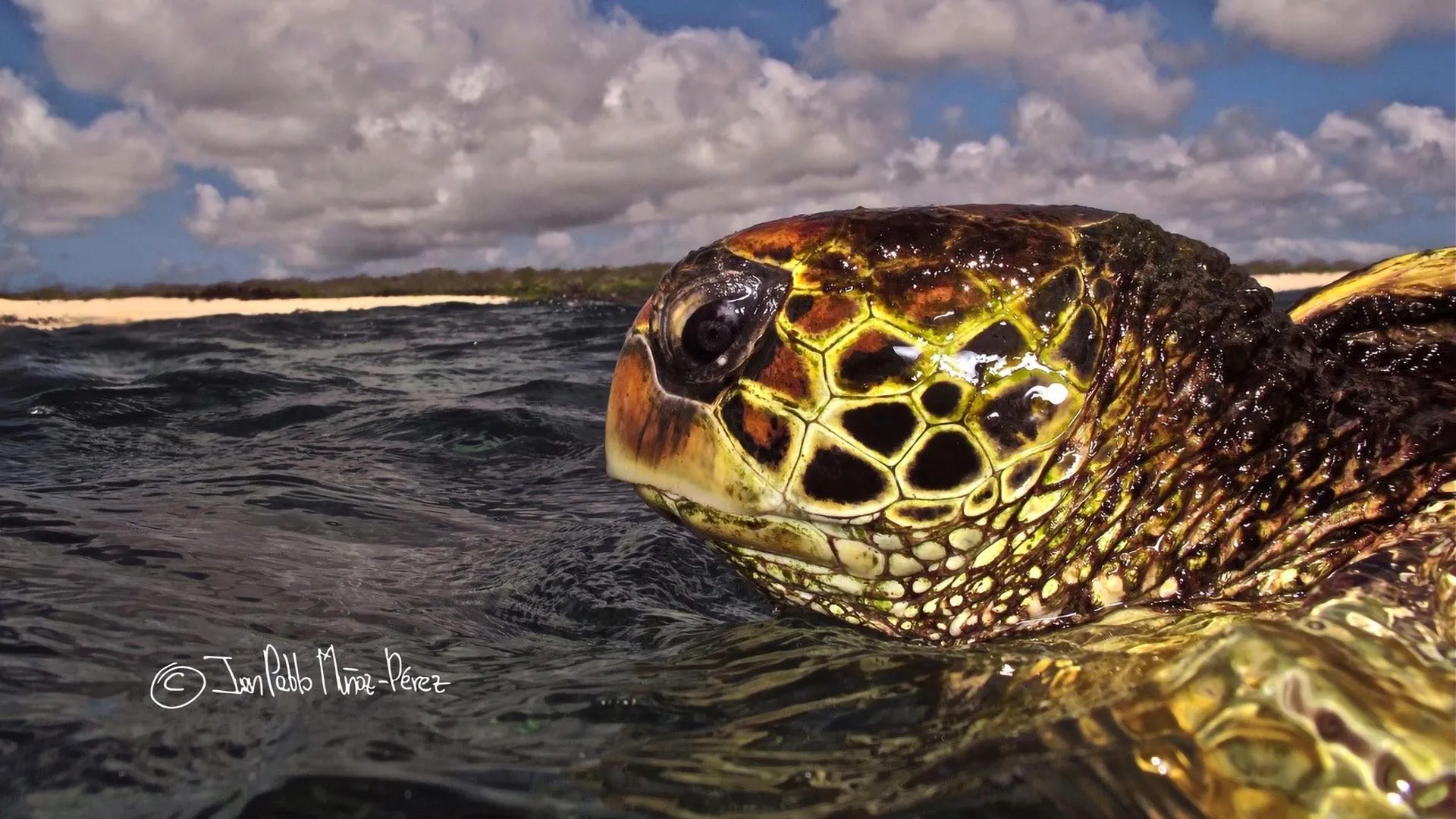
Sea turtles have long captivated marine biologists and oceanographers alike with their epic, transoceanic migrations. Driven by an innate evolutionary compass, these ancient reptiles cross thousands of miles of open ocean, orienting themselves using the Earth’s magnetic field, the position of the sun, and complex ocean currents. Their journeys typically take them from feeding grounds to distant nesting beaches where they were born, perpetuating a life cycle that spans decades. However, a groundbreaking new study conducted in the pristine waters of the Galápagos archipelago has upended conventional wisdom regarding one specific population of green sea turtles, revealing an unexpectedly localized and sedentary lifestyle that challenges long-held assumptions about marine reptile behavior.
The research, recently published in the scientific journal Frontiers in Amphibian and Reptile Science, focuses on the "yellow-morph" green sea turtle—one of two genetically distinct forms of the species inhabiting the Galápagos waters. Led by Dr. John W. Rowe, a professor of biology at Alma College in the United States, alongside co-author Dr. Juan Pablo Muñoz Pérez, a professor at the Universidad San Francisco de Quito in Ecuador, the research team utilized advanced satellite telemetry to monitor the movements of these elusive creatures. To the profound astonishment of the scientific community, the tracking data demonstrated that none of the study subjects left the protective boundaries of the Galápagos Marine Reserve over a three-year observation window, upending the hypothesis that these animals regularly traverse vast expanses of the Pacific Ocean.
Taxonomic Context and the Unique Galápagos Ecosystem
To fully understand the significance of this discovery, it is essential to examine the unique biological and ecological status of green sea turtles (Chelonia mydas). Among the seven extant species of sea turtles, green sea turtles occupy a distinct ecological niche. While juveniles are omnivorous, consuming a mix of animal and plant matter to fuel their rapid early growth, adults undergo a profound dietary shift, becoming strict herbivores. As they mature, their diet transitions primarily to marine algae and seagrasses, making them vital architects of healthy coastal ecosystems by maintaining the productivity of seagrass beds and coral reefs.
Within the species, scientists recognize distinct color and genetic morphs, most notably the yellow morph and the black morph. Yellow-morph green sea turtles are predominantly distributed across tropical and subtropical regions of the western Pacific. Conversely, black-morph green sea turtles are native to the eastern Pacific, inhabiting waters west of the Americas and south of southern California.
The Galápagos Islands represent a rare and fascinating ecological crossroads: it is the only known geographic location on Earth where these two genetically distinct forms converge, mingling in the same waters and feeding on identical marine vegetation. Despite sharing overlapping habitats, the two morphs exhibit noticeable physiological differences. For instance, young yellow morphs consistently display faster growth rates than their black-morph counterparts, hinting at underlying metabolic and physiological divergences that researchers are only beginning to decipher.
Chronology and Methodology of the Galápagos Tracking Initiative
The genesis of this study dates back to 2015, when Dr. Rowe and his international team set out to map the spatial ecology of yellow-morph green sea turtles in the Galápagos. The primary objective was to determine the geographic boundaries of their foraging ranges, measure their habitat use, and evaluate whether individuals frequently traversed open waters between the various islands comprising the sprawling 198,000-square-kilometer Galápagos Marine Reserve.
In a meticulously planned field operation, researchers captured nine healthy adult green sea turtles—seven males and two females—in the shallow coastal waters surrounding four distinct islands within the archipelago. To ensure individual identification and track their real-time movements, the team assigned descriptive nicknames to each turtle and securely attached high-tech electronic transmitters to their shells. These transmitters were programmed to relay precise location coordinates via the low-orbit Argos satellite network whenever the turtles surfaced for air.
The monitoring phase extended significantly over time, with individual turtles tracked for durations reaching up to 418 days. In accordance with standard marine telemetry operations, tracking concluded naturally when the satellite tags eventually detached due to biological fouling or natural wear, or when the units ceased transmitting signals.
Data Analysis: Preferred Habitats and Island-Hopping Patterns
When the telemetry data was finally compiled and analyzed, it painted a vivid picture of marine life defined by coastal fidelity rather than pelagic wandering. The spatial analysis revealed an overwhelming preference for shallow, nearshore marine habitats. Although individual turtles occasionally ventured as far as 25 kilometers from the safety of the nearest shoreline, the vast majority of their time was spent lingering in immediate proximity to the islands.
Among the cohort, behavioral patterns varied intriguingly from animal to animal. Five of the nine tracked turtles confined their activities almost exclusively to the waters surrounding a single island for the duration of the monitoring period. Others demonstrated a willingness to traverse inter-island channels. For instance, individuals named Bernardo and Sara regularly commuted between the waters of Isabela Island and San Cristóbal Island, while a turtle named Leandro established a home range bridging Isabela and Española.
The most prolific traveler of the group was a female designated as Ainoa. Initially tagged near San Cristóbal, Ainoa embarked on a wider journey across the archipelago, subsequently visiting the coastal zones of Santa Cruz before finally settling around Isabela.
Furthermore, the research team identified a distinct temporal and seasonal rhythm to these movements. Inter-island transit was not distributed randomly throughout the year; rather, travel between separate landmasses occurred strictly during the cooler seasonal window spanning from April through October. During the warmer months, the turtles appeared even more localized. On average, each individual maintained an expansive home range covering approximately 1,498 square kilometers, though the absolute size of these territories fluctuated considerably based on individual behavioral variations.
Paradoxes of Reproduction and Migration
The discovery that yellow-morph green sea turtles remain so resolutely within the Galápagos Marine Reserve raises profound questions regarding their life cycle, particularly concerning reproduction. Sea turtles are fundamentally bound to terrestrial environments for egg-laying, requiring sandy beaches where females can haul themselves ashore to nest.
Dr. Muñoz Pérez noted a critical dichotomy between the two morphs regarding their reproductive habits. While some female black-morph green turtles are documented nesters within the Galápagos—acting either as year-round resident populations, undertaking localized trips to neighboring oceanic islands, or migrating all the way to distant feeding grounds off the coasts of Central and South America—the same cannot be said for the yellow morphs.
To date, female yellow-morph green sea turtles have never been documented laying eggs on Galápagos beaches. This glaring biological discrepancy leads researchers to infer a monumental migratory obligation that must occur outside the temporal window of the study.
"Since female yellow-morph green sea turtles are not known to lay eggs on the beaches of the Galápagos, we believe that they will eventually leave the area to return to their natal beaches in the western Pacific," explained Muñoz Pérez. The research team emphasizes that the three-year study captures only a narrow snapshot of these long-lived reptiles’ lives. It remains entirely plausible, and indeed biologically necessary, that adults undertake episodic, transoceanic migrations back to their ancestral birthplaces to reproduce, evading detection simply because the tracking period concluded before such an event transpired.
Implications for Marine Conservation and Archipelago Management
Beyond adding a fascinating chapter to marine biology literature, the findings carry urgent and actionable implications for conservation policy and the spatial management of the Galápagos Marine Reserve. For decades, marine protected area planning has often relied on static boundaries designed to safeguard localized habitats or single biological hotspots. However, this study demonstrates that effective protection must account for the fluid, multi-island connectivity required by mobile marine species.
Because individual yellow-morph turtles routinely cross deep channels to forage across the waters of multiple islands, protecting a single localized feeding ground is mathematically and ecologically insufficient to ensure their survival. Environmental degradation, pollution, or unsustainable fishing pressures in the open channels or secondary feeding sites could catastrophically disrupt the animals’ ability to sustain themselves across their expansive home ranges.
Dr. Rowe underscored the necessity of a holistic, archipelago-wide approach to conservation management. "Since individual turtles may rely on waters around multiple islands, the quality of habitat that is available for foraging should be maintained intact across all islands, and not allowed to degrade anywhere," he emphasized.
As climate change, shifting ocean currents, and anthropogenic pressures continue to alter marine ecosystems worldwide, studies like this provide the empirical foundation required by conservationists and policymakers. By illuminating the hidden, localized lives of sea turtles that are typically famed for their vast ocean crossings, researchers have provided vital insights that will help safeguard the biodiversity of the Galápagos for generations to come, proving that even the most well-traveled species still hold evolutionary secrets close to home.
