
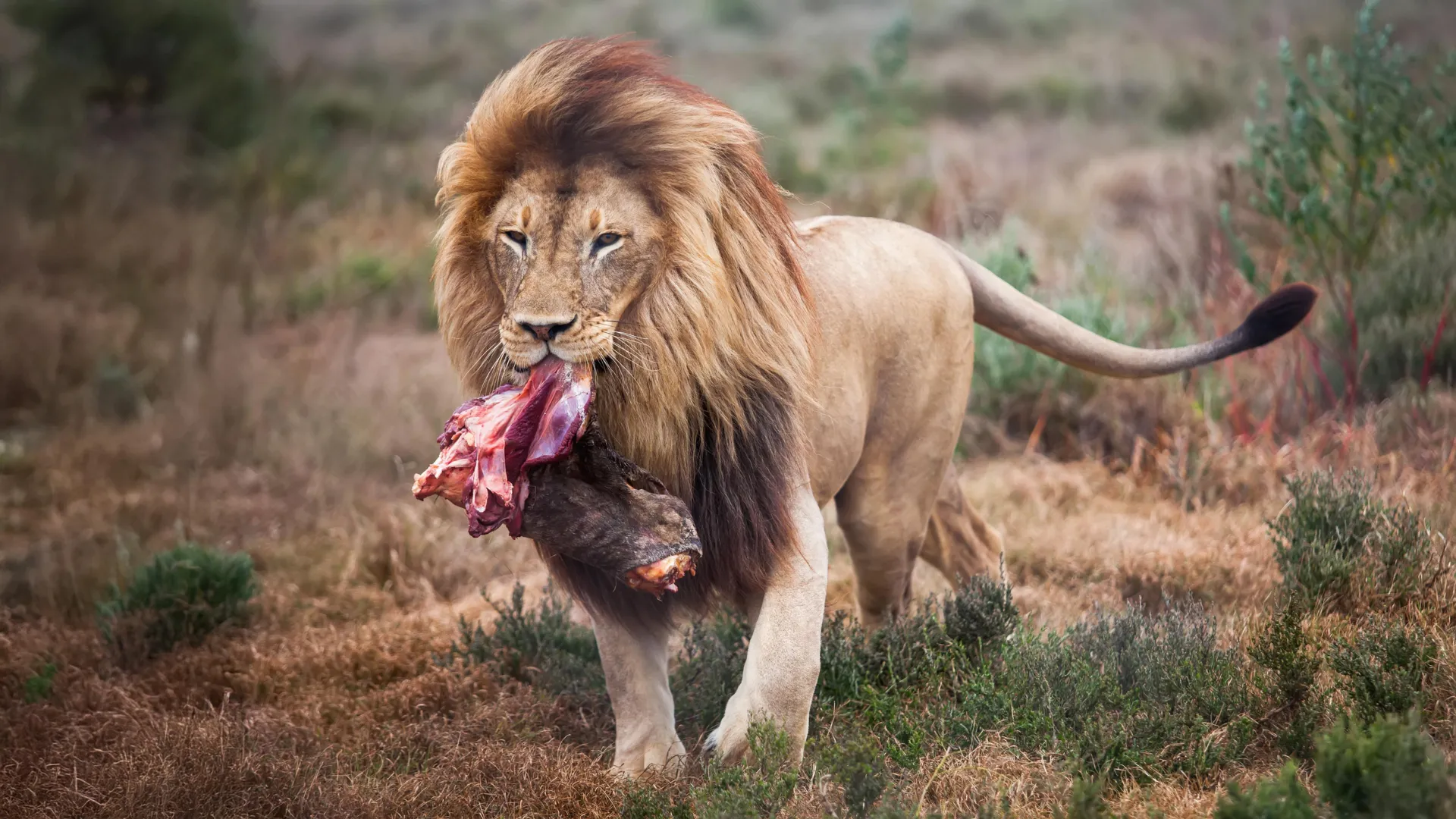
A groundbreaking study conducted by researchers from the University of Adelaide in collaboration with Monarto Safari Park in South Australia has shed new light on the behavioral welfare of captive carnivores. Published in the peer-reviewed journal Applied Animal Behaviour Science, the research demonstrates that adult male African lions housed in a zoo environment exhibit behaviors remarkably similar to their wild counterparts when subjected to a naturalistic feast and fast feeding schedule incorporating whole animal carcasses.
The findings offer a profound rethinking of conventional zoo management practices. For decades, standard protocol across many zoological institutions has involved daily, highly predictable feeding routines designed to ensure consistent nutrition and predictable animal management. However, this new research challenges the long-term psychological and physical efficacy of such regimented approaches, suggesting that mimicking the unpredictable hunting success and feeding ecology of the wild can significantly enrich the lives of apex predators under human care.
A Controlled Experiment in Captive Carnivore Welfare
The research team, which included international collaboration from visiting Master’s student Florence Demoulin of the University of Liège in Belgium, focused its observations on a coalition of three adult male African lions residing at Monarto Safari Park. The park, one of the largest open-range zoos in the world, provided an ideal setting for observing large carnivores in expansive, naturalistic habitats.
Prior to the experimental intervention, the lions were maintained on a standard, highly predictable daily feeding schedule. To test the hypothesis that irregularity and structural complexity in feeding could positively alter behavior, animal care staff introduced a revolutionary modification: every nine days, the lions were provided with whole animal carcasses. Over the course of the experimental phase, approximately 200 kilograms of whole carcasses were distributed to the animals. These food items were left accessible within the habitat for up to three consecutive days, allowing the lions to feed at will before entering a natural phase of rest, digestion, and subsequent physiological recovery.
To capture the full scope of behavioral shifts, the research team deployed an extensive network of eight infrared security and behavioral monitoring cameras. This technology recorded the animals continuously, 24 hours a day, over a rigorous three-month observation window. The resulting dataset is widely considered one of the most comprehensive and detailed chronological records ever assembled regarding the continuous behavior of African lions under a specialized carcass-feeding regime in captivity.
Chronology of the Behavioral Shift
The observational data revealed a striking, highly structured cyclical pattern in the lions’ behavior that directly mirrored the ecological realities faced by wild prides across the African savanna.
On days when whole carcasses were introduced, the behavioral profile of the lions shifted dramatically. The animals spent nearly three times as long engaged in feeding activities compared to their baseline routines. Rather than simply consuming easily manageable chunks of meat, the lions exhibited complex manipulation behaviors. They tore, pulled, sheared, and maneuvered the heavy carcasses, using muscle groups in their jaws, neck, and shoulders that rarely see such rigorous application during standard zoo feedings. They also fed more frequently and in extended, sustained sessions as they worked through the large biomass.
Once the immediate feast concluded and the carcasses were consumed or removed, the animals transitioned into the second phase of the cycle. They spent considerably more time lying down, inactive, and resting, dedicating extended periods to digestion.
As the fasting portion of the nine-day cycle progressed and the time since their last heavy meal increased, a third distinct behavioral phase emerged. The lions gradually increased their locomotor activity, moving around their enclosure more frequently as their internal state shifted from satiation back toward a state of active foraging and alertness. This repeating cadence of intense consumption, prolonged postprandial rest, and a slow, steady climb in physical activity prior to the next feeding event matched the ecological rhythms documented among wild lions, whose access to prey is dictated by the unpredictable nature of the hunt.
Insights from the Research Team
Lead author Lesia Hryhorenko, a researcher from the University of Adelaide’s School of Animal and Veterinary Sciences, emphasized that the introduction of whole carcasses alters far more than simply the nutritional intake of the animals. It fundamentally alters their psychological engagement with their environment.
"Wild lions don’t eat at the same time every day. They experience natural periods of feasting and fasting depending on hunting success," Hryhorenko noted. "We wanted to understand how African lions in human care respond when feeding routines more closely resemble those natural patterns. Providing whole carcasses changes much more than the nutritional content of the diet. It gives lions the opportunity to engage in behaviors such as tearing, pulling, and manipulating food over extended periods, which are important components of their natural feeding ecology."
Associate Professor Alexandra Whittaker, a co-author on the study, pointed out that the findings underscore a critical methodological flaw in many historical studies of zoo animal welfare: the tendency to observe animals only in short bursts immediately following a stimulus.
"Many zoo studies focus only on what happens immediately after food is provided," Associate Professor Whittaker stated. "Our results show that feeding schedules can influence behavior for days afterwards, making it essential to look at behavioral patterns across the entire feeding cycle rather than a single feeding event."
Debunking Myths Surrounding Anticipation and Pacing
One of the most persistent concerns among zoo operators and animal welfare advocates regarding irregular feeding schedules or periods of fasting is the potential increase in stereotypic behaviors, such as pacing. Pacing—a repetitive, unvarying locomotor habit often interpreted as a sign of stress, frustration, or intense anticipation—is a frequent metric used to assess the psychological well-being of captive carnivores.
To address this concern, the research team meticulously tracked the movement patterns and pacing frequencies of the three male lions throughout the multi-month study. Interestingly, while pacing showed minor fluctuations over the duration of the project, it did not consistently increase as the duration of the fast lengthened. The lions did not become progressively more agitated or restless the longer they went without food.
Instead, the data revealed a different trigger for stereotypic behavior. The most pronounced spikes in pacing activity occurred around entirely predictable daily events, such as the arrival of animal care staff or scheduled transitions when the animals were moved between different holding areas and management zones of their habitat. This suggests that pacing in these animals was more strongly linked to temporal conditioning and familiar daily routines associated with human presence than to physiological hunger.
Furthermore, the study addressed potential concerns regarding social stability. Introducing high-value, limited-resource items like whole carcasses to a coalition of male lions can theoretically trigger intense competition and aggression. However, the researchers observed no increase in aggressive incidents or disruption to the social hierarchy among the lions during the carcass-feeding events, indicating that the animals were capable of sharing and managing the resource within their established social framework.
Broader Implications for Modern Zoo Management
The implications of the Adelaide University and Monarto Safari Park study extend far beyond a single enclosure of African lions. As modern zoological institutions increasingly transition from traditional entertainment hubs to centers for conservation, education, and advanced animal welfare science, optimizing the psychological and physical health of captive species is paramount.
Carnivores, in particular, present unique welfare challenges in captivity. Evolution has sculpted these species for complex problem-solving, endurance, stamina, and the high-stakes physical demands of tracking, subduing, and consuming large prey. Providing meals that require zero physical effort—such as pre-chopped, uniform pieces of meat delivered at the exact same hour every single day—can inadvertently lead to under-stimulation, behavioral atrophy, and stereotypic habits.
By demonstrating that a feast and fast schedule utilizing whole carcasses can be implemented safely—without escalating aggression or inducing stress-related pacing—the study provides a viable, evidence-based framework that other zoological facilities can adapt. Animal care professionals now have empirical backing to advocate for structural changes in dietary delivery systems that prioritize behavioral enrichment and naturalistic physical exertion.
Future Horizons in Carnivore Welfare Science
While the findings from Monarto Safari Park offer a compelling look at the benefits of naturalistic feeding regimes, the research team views this study as merely the first step in a broader scientific investigation.
Future research initiatives are already being discussed within the academic and zoological communities. Scientists hope to expand upon this work by combining continuous, long-term behavioral monitoring with precise physiological measurements—such as fecal glucocorticoid metabolite analysis to track stress hormone levels, or metabolic rate tracking. Such multidisciplinary approaches will provide an even more holistic understanding of how varying nutritional delivery systems impact the internal health, immune function, and overall welfare of apex predators living under human care.
As zoos worldwide continue to refine their husbandry standards, studies of this caliber bridge the gap between rigorous scientific inquiry and practical animal care, ensuring that the animals living in human sanctuaries can experience lives that are not only physically healthy, but behaviorally rich and deeply aligned with their evolutionary heritage.
