
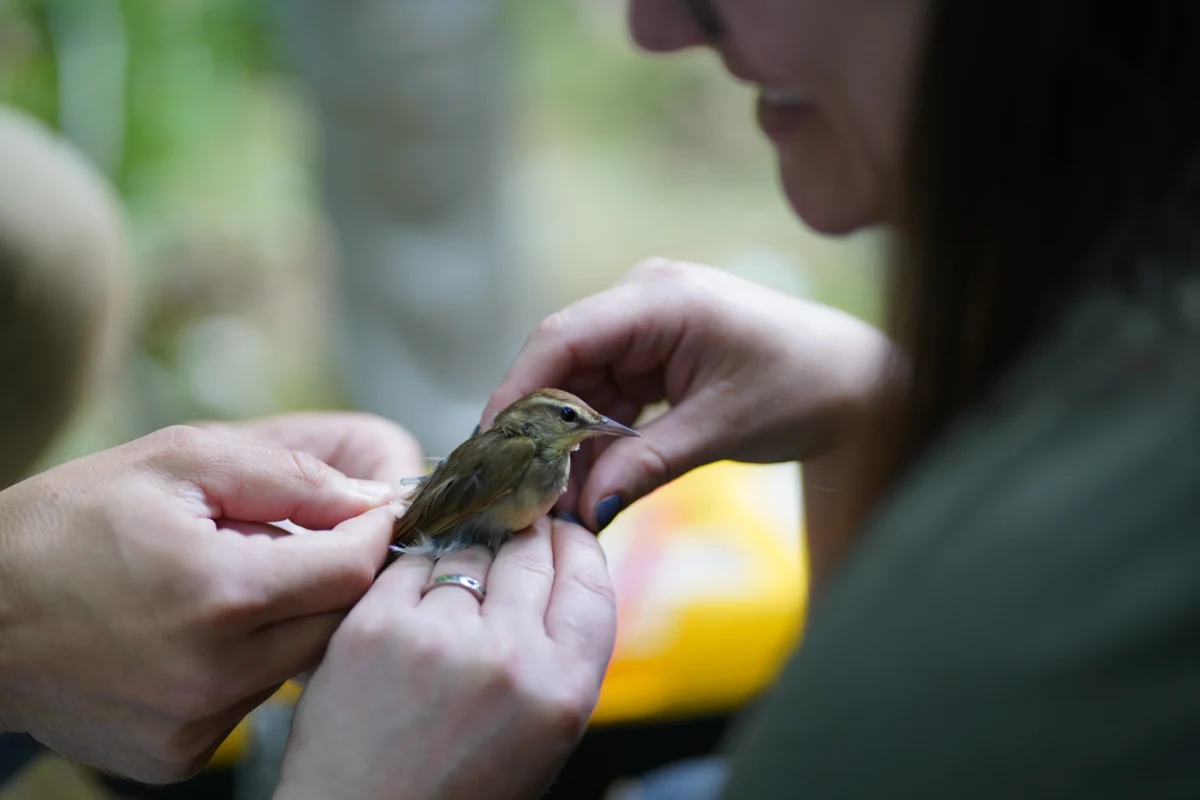
A recently published study by Audubon and its partners has provided an unprecedented, detailed look into the continental movements of the Swainson’s Warbler, a species long celebrated by birdwatchers yet notoriously difficult for scientists to track. This significant research, leveraging cutting-edge tracking technology, has illuminated the previously mysterious migratory pathways connecting the warbler’s breeding grounds in the southern United States with its wintering habitats across Latin America, offering crucial insights for future conservation strategies.
The Enigma of the Swainson’s Warbler
The Swainson’s Warbler (Limnothlypis swainsonii) is a small, olive-brown songbird, often described as rather drab in appearance, a characteristic that belies its captivating presence and distinctive, ringing song. Prized by avian enthusiasts, it remains one of North America’s most elusive neotropical migrants. Its preferred breeding habitats across South Carolina and the broader southern U.S. are formidable landscapes: dense lowland swamps, thick canebrakes, and mountainous rhododendron ravines. These environments, characterized by their almost impenetrable vegetation, offer the warbler perfect camouflage and protection, but simultaneously present immense challenges for researchers.
“I call it machete habitat,” stated Jen Tyrrell, community science and research program manager at Audubon South Carolina, underscoring the physical difficulty of navigating these areas. “They are in places that are thick and hard to get to, usually occupied by snakes and mosquitoes.” This natural secrecy has historically left the species relatively understudied, with significant gaps in understanding its full life cycle, particularly its movements beyond the breeding season. Even for experienced birders, a glimpse of the Swainson’s Warbler flitting through the understory is a rare treat; its sweet, ascending song is far more commonly heard than the bird itself is seen. The species’ cryptic plumage, blending seamlessly with the shadows and foliage of its preferred dense undergrowth, further contributes to its reclusive nature.
Bridging the Knowledge Gap with Innovative Technology
For decades, the precise migratory routes and wintering grounds of many Neotropical migrants, including the Swainson’s Warbler, remained largely unknown. Traditional methods, such as banding birds with identification tags, provided some data but were limited by recapture rates and the sheer scale of continental migration. Light-level geolocators, a technological leap, allowed researchers to estimate locations based on day length, but these devices faced significant accuracy challenges, particularly for birds living under dense forest canopies where light levels are consistently low and variable. This limitation made them less reliable for species like the Swainson’s Warbler, whose entire life cycle unfolds beneath a thick vegetative cover.
The recent breakthrough, detailed in a research paper published in Ornithological Applications, marks a new era in avian tracking. Led by Garrett Rhyne, an avian ecologist trained at Louisiana State University and now with the American Bird Conservancy, the study employed next-generation lightweight tracking devices. These cutting-edge geolocators combine traditional light-level data with barometric pressure readings. This innovation provides not only more accurate location data but also offers unprecedented insights into altitude and the duration of migratory flights. Researchers can now observe distinct spikes in barometric pressure data, indicating when birds are flying high overhead during their arduous journeys, providing a clearer picture of their flight paths and energetic demands. Rhyne’s study holds the distinction of being the first in the U.S. to successfully deploy and utilize barometric pressure tracking devices on birds, setting a new standard for migratory connectivity research.
A Detailed Look at the Study’s Execution and Findings
The ambitious project involved tagging Swainson’s Warblers at multiple strategic locations across their breeding range. Researchers established trapping sites at Audubon’s Francis Beidler Forest Center and Sanctuary in South Carolina, a critical conservation area renowned for its old-growth cypress-tupelo swamp, as well as at various points in Louisiana, Arkansas, Missouri, Tennessee, and Virginia. The tagging process, meticulously executed to minimize stress on the delicate birds, involved attaching tiny, feather-light geolocators to the warblers’ backs, weighing less than 5% of the bird’s body mass to ensure no impediment to flight or foraging.
“We really just had no handle on where these populations are going, how they’re connected, what migratory routes they’re taking,” Rhyne explained, highlighting the fundamental knowledge gap the study aimed to address. The subsequent retrieval of these tags, often a challenging endeavor requiring the recapture of the same individuals, allowed for the downloading and analysis of invaluable data. The information collected painted a vivid picture of two distinct and remarkable migratory pathways, revealing a nuanced pattern of connectivity between different breeding populations and their respective wintering grounds.
The study uncovered that eastern breeders, originating from the Appalachian Mountains and the Atlantic Coastal Plain, embark on a primarily land-based migratory route. Their journey takes them southward through Florida, utilizing the peninsula as a critical flyway before making relatively short, but still significant, overwater hops to the Bahamas and Cuba. This route suggests a reliance on a chain of islands and coastal habitats, potentially indicating specific stopover sites and habitat requirements in these Caribbean nations. For these birds, the risks associated with long oceanic flights are minimized, favoring a more terrestrial progression.
In stark contrast, warblers breeding in the Mississippi Valley and the Missouri Ozarks undertake a far more perilous journey. These western populations adopt a riskier trans-Gulf migration, launching themselves across the vast expanse of the Gulf of Mexico directly to the Yucatán Peninsula in Mexico. This direct oceanic crossing, spanning hundreds of miles of open water, demands immense physiological endurance and precise navigational abilities. The energetic demands of such a flight are substantial, making favorable weather conditions and robust physical condition paramount for survival. The Yucatán Peninsula then serves as a crucial gateway to their wintering territories, likely extending into other parts of Central America.
Implications for Conservation and Transnational Collaboration
The revelation of these distinct migratory pathways is not merely an academic curiosity; it carries profound implications for conservation efforts. As Jen Tyrrell emphasized, “This kind of migratory connectivity data can help identify threats to habitat and target conservation efforts throughout the species’ range.” Understanding these connections allows conservationists to implement a full annual cycle approach, recognizing that threats at any stage—breeding, migration, or wintering—can impact the entire population.
For the eastern populations, conservation efforts must consider not only the health of Appalachian forests and Atlantic coastal plain swamps but also the integrity of stopover habitats in Florida and the critical wintering grounds in the Bahamas and Cuba. These island nations face unique pressures, including habitat loss due to tourism development, agricultural expansion, and the impacts of severe weather events.
Conversely, the western populations, traversing the Gulf of Mexico, are vulnerable to the myriad perils of trans-Gulf migration, including severe storms, offshore oil spills, and the general scarcity of suitable land-based stopover sites upon arrival. Their reliance on the Yucatán Peninsula means that habitat degradation in this region, whether from deforestation, agricultural conversion, or climate change impacts, could have devastating consequences for these populations. The Gulf itself also poses threats, from light pollution disorienting nocturnal migrants to the cumulative effects of plastic pollution and other anthropogenic disturbances.
This data underscores the urgent need for international cooperation. Effective conservation of the Swainson’s Warbler—and indeed, many other migratory species—requires coordinated strategies that transcend national borders. Collaborations between the United States, Mexico, Cuba, the Bahamas, and potentially other Central American countries are essential to protect the diverse habitats these birds depend on throughout their annual cycle. Such partnerships can facilitate shared research, develop common conservation goals, and implement cross-border habitat management programs.
Audubon South Carolina: A Legacy of Habitat Management
In South Carolina, this new research provides invaluable insight that directly informs Audubon’s Healthy Forests work, a long-standing conservation focus for the organization. The Swainson’s Warbler thrives in young, overgrown habitat, which often emerges naturally after significant disturbances like storms, wildfires, or timber harvests. This early successional habitat provides the dense understory and insect prey necessary for successful breeding.
Audubon staff witnessed this phenomenon firsthand at Silver Bluff Sanctuary after a tornado tore through the property. The subsequent dense regrowth created ideal conditions, and Swainson’s Warblers quickly colonized the area, establishing territories and raising young. However, as the forest canopy eventually closed in, shading out the understory, the birds gradually disappeared. This observation provided a critical lesson: warbler habitat is dynamic and ephemeral, requiring ongoing disturbance to maintain its suitability.
“That led us to look at how we could create habitat for this species on an ongoing basis,” said Tim Evans, land conservation director at Audubon South Carolina. Recognizing the transient nature of naturally occurring disturbed habitats, Audubon staff began experimenting with innovative forestry techniques designed to mimic these natural disturbances. This involves creating small, strategically placed openings within otherwise uniform forest habitats. These "holes" are then allowed to regenerate naturally, fostering the thick, tangled understory that the warblers prefer. This active management ensures a continuous supply of suitable breeding habitat within a larger forest matrix.
Audubon has expanded this pioneering work through crucial partnerships with private landowners. By demonstrating how active, sustainable forest management practices can not only support bird populations but also generate economic income through selective timber harvests, Audubon encourages broader adoption of these beneficial techniques. “When landowners can selectively harvest timber for birds and earn income at the same time, they’re more likely to keep those forests intact,” Evans explained. This economic incentive is vital in South Carolina, where forest conversion—the transformation of forested land into residential, commercial, or agricultural use—remains one of the most significant threats to wildlife habitat. By promoting sustainable forestry, Audubon helps to maintain critical ecological corridors and prevent the fragmentation of valuable ecosystems.
A Two-Decade Commitment and Future Directions
This latest research represents a significant milestone in Audubon South Carolina’s two-decade-long commitment to better understand and conserve the Swainson’s Warbler. This enduring effort integrates rigorous scientific research, proactive habitat management, and strategic partnerships, all working in concert to shed light on the complex conservation needs of this secretive species across the entire hemisphere.
The study opens avenues for further research. Future investigations could focus on the specific microhabitats utilized during stopovers, the physiological condition of birds before and after trans-Gulf flights, and the genetic distinctiveness of populations utilizing different migratory pathways. Long-term monitoring of tagged individuals and breeding populations will be essential to assess the effectiveness of conservation interventions and adapt strategies in response to environmental changes, including climate change.
Ultimately, the groundbreaking work on the Swainson’s Warbler exemplifies the power of combining advanced technology with dedicated on-the-ground conservation. By unraveling the mysteries of its continental journey, scientists and conservationists are now better equipped to safeguard this remarkable bird and the diverse, often imperiled, habitats it depends on from the dense swamps of the American South to the tropical forests of Latin America. This comprehensive approach, integrating scientific discovery with practical application, is crucial for ensuring the continued survival of the Swainson’s Warbler and countless other migratory species in an increasingly interconnected world.
