
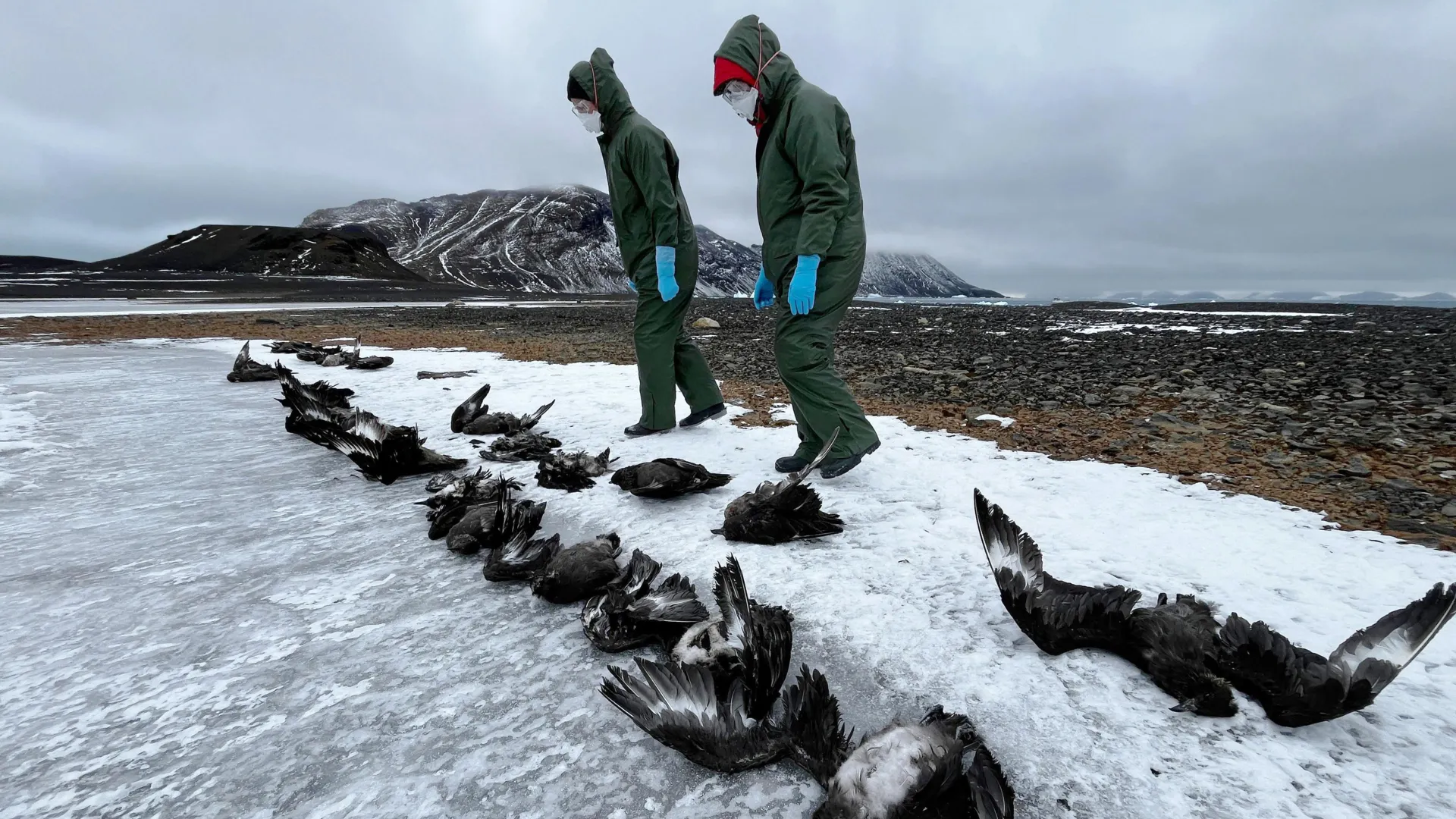
More than 50 skuas perished in Antarctica during the austral summers of 2023 and 2024, victims of the highly pathogenic avian influenza (HPAI) virus H5N1, marking the first confirmed wildlife die-off from the virus on the continent. This grim milestone, a stark indicator of the virus’s relentless global march, was detailed in a study led by Erasmus MC in The Netherlands and the University of California, Davis, and recently published in the esteemed journal Scientific Reports. The findings underscore a profound shift in the continent’s ecological vulnerability, challenging its long-held status as a sanctuary from widespread infectious diseases.
Skuas are robust, large brown seabirds, evolutionarily linked to gulls, predominantly inhabiting the planet’s polar and subpolar latitudes. These formidable birds function as both opportunistic predators and diligent scavengers within their ecosystems, often likened to birds of prey in their ecological niche. Their crucial role involves the natural cleanup of carcasses, a service that maintains ecosystem health. Paradoxically, this very scavenging behavior, essential for the Antarctic environment, also positions them at an elevated risk for contracting and disseminating the H5N1 virus across the vast, icy expanse of Antarctica, as highlighted by the research team.
The Global Spread of H5N1 and its Antarctic Incursion
The H5N1 strain, which has now breached Antarctica’s natural defenses, traces its origins back to 1996, when it was first identified on a domestic goose farm in Southeast China. For several years, the virus circulated largely unchecked within commercial poultry populations, gradually evolving and increasing its virulence. This sustained presence in dense agricultural settings eventually led to its spillover into wild bird populations, unleashing a global pandemic that has since reshaped ecosystems and agricultural practices worldwide.
From its initial foothold in Asia, the virus embarked on an inexorable journey, spreading across Europe, the Middle East, and Africa. By the early 2020s, a particularly virulent lineage, clade 2.3.4.4b, had emerged, demonstrating an unprecedented ability to infect a wide array of avian species and, critically, to jump species barriers into mammals. This aggressive variant rapidly disseminated across North and South America, causing devastating mortality events in wild bird colonies and marine mammal populations alike. The arrival of H5N1 in Antarctica by early 2024 was, therefore, not an isolated incident but the culmination of a decade-long, relentless global expansion. Prior to its confirmed presence on the Antarctic mainland, the virus had already been detected in sub-Antarctic regions, including South Georgia and the Falkland Islands, signaling its inevitable approach to the continent.
Confirmation of a Crisis: The HPAI Australis Expedition
The initial alerts regarding H5N1 in the Antarctic region emerged earlier in 2024. Scientists had detected the virus in a kelp gull and two skuas found deceased in January and February. While these findings were deeply concerning, definitive proof that H5N1 was the direct cause of death remained elusive, pending rigorous pathological investigation.
This critical gap was filled by the HPAI Australis Expedition. In March 2024, a specialized research team, comprising wildlife veterinarians, virologists, and ecologists, embarked on a crucial mission to Antarctica. Their timing, shortly after the intense breeding season for skuas and penguins, was strategic, allowing them to assess the aftermath of potential outbreaks. The team meticulously examined wildlife at ten distinct sites spread across the South Shetland Islands, the northern Weddell Sea, and the Antarctic Peninsula, regions vital for Antarctic biodiversity.
The methodology was comprehensive: whenever sick or deceased animals were encountered, scientists diligently collected tissue and environmental samples. Crucially, they conducted necropsies – detailed post-mortem examinations – to ascertain the precise cause of death. While the expedition also examined the remains of gentoo penguins, Adélie penguins, and Antarctic fur seals, H5N1 was not identified as the primary cause of death in these species during this specific investigation. However, this does not preclude the possibility of infection or future outbreaks in these populations, given the virus’s broad host range and observed impacts on other pinniped species globally.
"We knew there were animals with the infection, but this is the first study to show they died of the viral infection," affirmed co-senior author Ralph Vanstreels, a wildlife veterinarian affiliated with the UC Davis One Health Institute within the Weill School of Veterinary Medicine. He emphasized the profound significance of this distinction in the nascent stages of an outbreak, providing crucial clarity on the pathogen’s direct lethality. As the expedition progressed, the pattern became disturbingly clear. "As the expedition progressed, it became obvious quickly that skuas were a major victim," Vanstreels recounted, highlighting the disproportionate impact on these birds.
The virus was definitively detected in skuas across three key locations: Hope Bay, Devil Island, and Beak Island. Beak Island, in particular, witnessed a significant die-off of south polar skuas, providing the starkest evidence of the virus’s lethal potential. "We diagnosed high pathogenicity avian influenza as the cause of death for nearly all of the dead skuas we found at Beak Island," stated first author Matteo Iervolino, a Ph.D. candidate at Erasmus MC in Rotterdam, The Netherlands. His firsthand observation reinforced the gravity of the situation: "There, I could really see with my eyes the impact this virus can have on these populations."
Vanstreels vividly characterized the unfolding scenario as a "crisis in animal suffering." H5N1, particularly this clade, has a notorious predilection for attacking the central nervous system, leading to severe neurological symptoms. Infected birds display unsettling behaviors: twisted necks, unusual body stretching, disorientation, walking or swimming in circles, crashing into objects, and even falling inexplicably from the sky. These agonizing manifestations underscore the high pathogenicity of the virus and the immense suffering it inflicts. The researchers unequivocally stress that human activities were instrumental in the emergence and global proliferation of this virus and, consequently, human intervention is equally critical in limiting its further spread and impact.
Broader Ecological and Global Health Implications
The Antarctic skua die-off is not an isolated event but a chilling echo of the broader global H5N1 crisis. The same virulent strain now ravaging Antarctic skuas previously wrought catastrophic losses among marine mammal populations along the coastlines of South America. In Argentina, for instance, H5N1 caused massive mortality events in elephant seals and sea lions, with thousands succumbing to the disease. The sheer scale of the global impact is staggering: H5N1 has been responsible for the deaths of over 400 million poultry worldwide, leading to immense economic losses and food security concerns. Beyond birds, the virus has demonstrated an alarming capacity for cross-species transmission, infecting a diverse range of mammals, including dairy cows, mink, foxes, bears, otters, and various other wild mammalian species across multiple continents.
The zoonotic potential of H5N1 also remains a significant concern for public health authorities globally. Of the approximately 1,000 reported human cases of H5N1 infection, about half have regrettably proven fatal. While human-to-human transmission remains rare and inefficient, the widespread circulation of the virus in wild animals, particularly those interacting with human environments, increases the risk of viral mutation and adaptation, potentially leading to a strain with greater transmissibility among humans.
Corresponding senior author Thijs Kuiken, a professor at Erasmus MC, articulated the profound regret and consequence of early inaction: "We let the virus slip out through our fingers when it first emerged in the poultry industry." He added, "Once it got into wild bird populations, we lost ability to control this virus. Now it’s established in wild bird populations in all the continental regions of the world except Oceania," referring to the current global distribution of the highly pathogenic H5N1 clade. This statement underscores the critical role of biosecurity in poultry farming and the dire consequences when such measures fail, allowing a pathogen to establish itself in a wild reservoir.
Antarctica’s Vulnerability and the Urgency for Action
The arrival of HPAI H5N1 adds an unprecedented and severe pressure to an already beleaguered Antarctic ecosystem. Wildlife on the continent already confronts a formidable array of challenges, including the accelerating impacts of climate change, the increasing footprint of tourism, the threat of invasive species, the strain of overfishing on marine food webs, and persistent pollution. The introduction of a highly lethal pathogen into this delicate balance could have cascading and unpredictable consequences for biodiversity.
The study strongly emphasizes the critical need for significantly strengthened surveillance and monitoring efforts across Antarctica. Such measures are vital not only for tracking the spread of the virus but also for understanding its full ecological impact and developing strategies to mitigate further dissemination. However, a significant complication arises from a pervasive lack of contemporary population data for many Antarctic species. The last comprehensive census of Antarctic skuas, for example, dates back to the 1980s, when researchers estimated a population of approximately 800 breeding pairs. Without updated and reliable baseline numbers, accurately measuring the true significance and long-term consequences of the loss of even 50 birds, or potentially many more, becomes a formidable challenge.
"Everything points toward this virus spreading further," Professor Kuiken warned, highlighting the likely trajectory of the outbreak. He underscored the peril of complacency: "If nobody is watching, we won’t know what is happening." This sentiment encapsulates the urgent call for international collaboration and sustained scientific vigilance to protect Antarctica’s unique and irreplaceable wildlife.
The implications extend beyond the immediate mortality. The high density of many Antarctic bird and mammal colonies, such as those of penguins and seals, creates ideal conditions for rapid viral transmission once H5N1 establishes itself within these populations. While penguins and seals were not confirmed as victims in this specific skua-focused study, their vulnerability remains a significant concern, especially given the virus’s proven ability to infect marine mammals elsewhere.
Effective surveillance in Antarctica, a continent renowned for its remoteness and extreme conditions, presents substantial logistical and financial hurdles. Yet, the findings from this expedition underscore that such investment is no longer merely advisable but imperative. It necessitates a coordinated international response involving national Antarctic programs, research institutions, and conservation organizations. Biosecurity protocols for researchers, tourists, and all personnel visiting the continent will need to be rigorously reviewed and implemented to minimize any potential human-mediated spread.
The HPAI Australis Expedition, a testament to international scientific collaboration, received crucial funding from the International Association of Antarctica Tour Operators (IAATO) and Ocean Expeditions. Further support for the study was provided by the European Union, the Consejo Superior de Investigaciones Científicas (CSIC), and PTI Global Health. This multi-organizational backing highlights the global recognition of the severity of this emerging threat to one of Earth’s last great wildernesses. The confirmation of H5N1 die-offs in Antarctica serves as a stark reminder that even the most remote corners of our planet are intrinsically linked to global health crises, particularly those amplified by human activity. The future of Antarctic wildlife hinges on concerted efforts to monitor, understand, and respond to this new and formidable challenge.
