
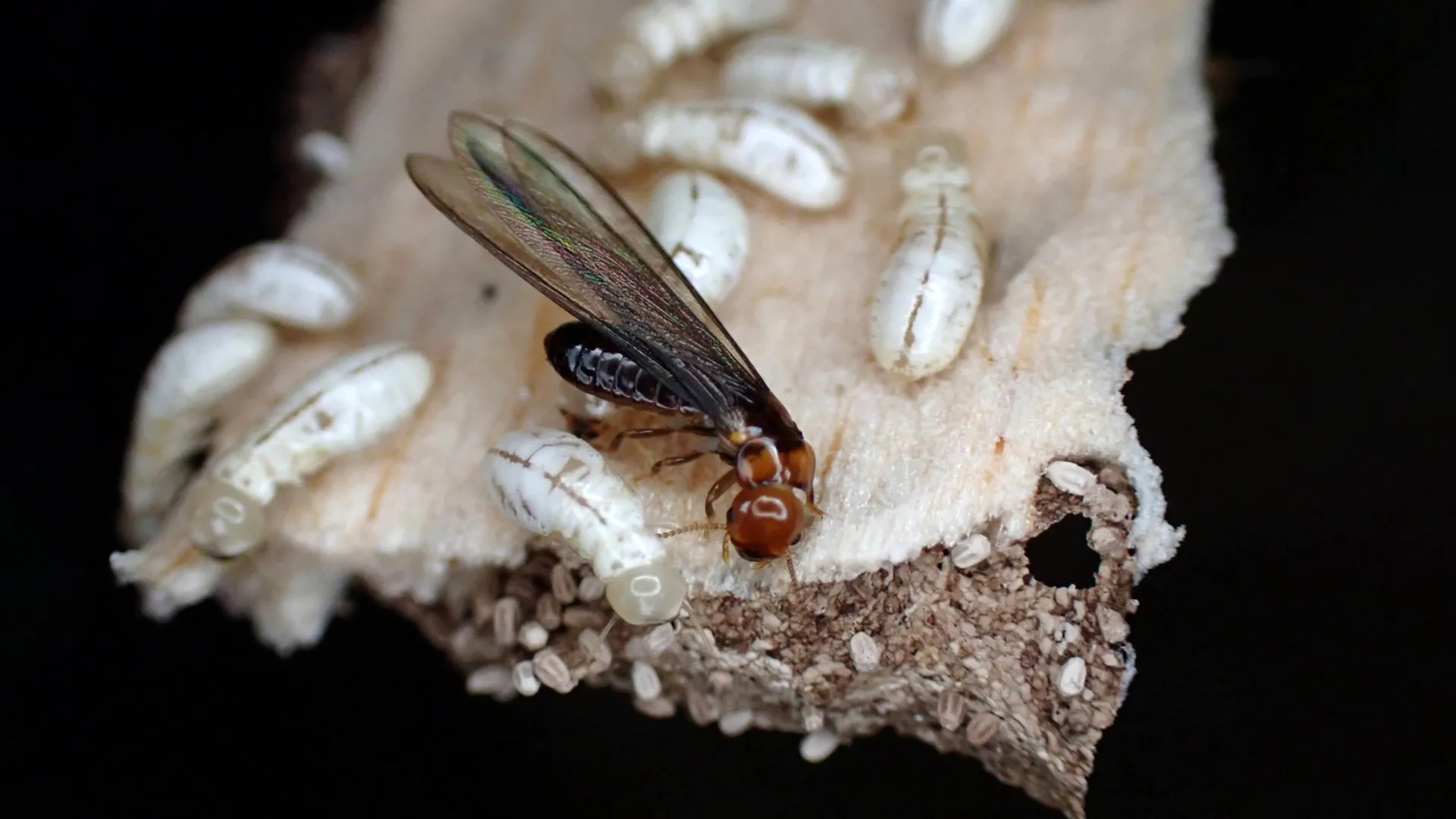
For decades, homeowners and pest management professionals have faced a frustrating adversary in the western drywood termite. Unlike their subterranean counterparts, which maintain continuous contact with the soil and leave clear mud tubes as evidence of their presence, drywood termites are masters of stealth. They spend virtually their entire lifecycles entirely concealed within the very structural beams, furniture, framing members, and architectural woodwork they consume, quietly excavating intricate internal galleries as colonies mature.
This hidden lifestyle has long rendered drywood termites exceptionally difficult to detect and even harder to eliminate without drastic measures. Traditional pest control protocols typically rely on whole-structure fumigation—a massive, disruptive, and costly undertaking that requires residents to temporarily relocate, forces the removal or sealing of food supplies, and leaves behind zero residual protection against future infestations. However, a comprehensive body of recent research conducted at the University of California, Riverside (UCR) is charting a radically different course for the pest control industry. By leveraging the biological mechanisms, social behaviors, and microbial footprints of these elusive insects, entomologists are developing targeted, low-impact strategies that could soon provide viable alternatives to widespread fumigation.
Capitalizing on an Inevitable Biological Vulnerability
At the core of the UCR research team’s recent breakthroughs is a focus on an inescapable biological reality: insects must molt to grow. Unlike mammals and other vertebrates that possess internal skeletons, insects rely on a rigid, exterior structural casing known as an exoskeleton. This protective armor provides critical structural support, physical defense, and sturdy attachment points for muscle movement. A primary component of this exoskeleton is chitin, a remarkably durable natural substance that is also found in fungal cell walls, fish scales, and the anatomical beaks of cephalopods such as squid and octopuses.
Because a growing drywood termite cannot simply stretch its rigid armor indefinitely, it must undergo a series of periodic molts—shedding its old exoskeleton roughly seven times throughout its lifecycle to accommodate its expanding body size.
A 2025 study published in the Journal of Economic Entomology demonstrated that this unavoidable biological process can be weaponized against the insects using bistrifluron, an advanced insect growth regulator classified as a chitin synthesis inhibitor. Rather than acting as a conventional, fast-acting neurotoxin that kills instantly upon contact, bistrifluron interferes directly with the insect’s ability to synthesize sufficient chitin for the formation of a new exoskeleton.
In controlled laboratory evaluations, the chemical yielded extraordinary mortality rates among western drywood termites. When test subjects were given a choice between treated and untreated wood, the compound produced an impressive 95.7 percent mortality rate. When termites faced continuous, unescapable exposure to treated wood, the mortality rate soared to approximately 99 percent over a 60-day testing window at a 0.1 percent concentration.
Researchers emphasize that this approach offers significant environmental advantages over legacy chemicals. "This chemical is more environmentally friendly than ones traditionally used for drywood termite infestations," noted Nicholas Poulos, the corresponding author of the study and a doctoral student in UCR’s Department of Entomology. "It’s specific to insects and can’t harm humans." Because mammals lack exoskeletons and chitin-based biological structures, the targeted toxicity profile of chitin synthesis inhibitors minimizes collateral ecological and mammalian risks.
Chronology of UCR Discoveries and Technological Advancements
The path toward these targeted termite control solutions has unfolded through a steady progression of laboratory breakthroughs, patent filings, and behavioral analyses over recent years:
- May 2024: UCR researchers published foundational findings regarding pinene, a naturally occurring fragrant chemical emitted by various tree species, demonstrating its capacity to act as an olfactory attractant for western drywood termites.
- Early 2025: A landmark study published in the Journal of Economic Entomology detailed the high-efficiency mortality rates of bistrifluron against western drywood termites under varying exposure conditions.
- April to October 2025: A University of California patent application was filed in April 2025 and officially published in October 2025, detailing the integration of alpha-pinene and beta-pinene into localized insecticide injection formulas to attract termites toward treatment zones.
- 2026: Follow-up research by the UCR team provided unprecedented visual documentation—via advanced imaging and video—of western drywood termites engaging in proctodeal trophallaxis, shedding light on how gut-fluid exchanges facilitate internal colony sharing.
Social Behaviors and the Domino Effect of Slow-Acting Poisons
One of the most significant discoveries of the 2025 study involves the speed of the chemical’s action and the peculiar social dynamics of the colonies. Traditional pest control heavily favors rapid knockdown agents; however, researchers realized that a poison that kills instantly is counterproductive when dealing with social insects. A fast-acting agent would kill exposed foragers before they could return to the nest or interact with nestmates.
Because bistrifluron works relatively slowly—allowing exposed termites to continue feeding and moving toward their next scheduled molt before ultimately failing to complete it—it inadvertently creates a biochemical Trojan horse. Termites are intensely social insects that routinely exchange food, fluids, and biological material.
To track this internal transmission, researchers utilized colored food markers in laboratory trials. When a small fraction of a colony—as few as 5 percent of the total population—was exposed to bistrifluron and reintroduced to unexposed nestmates, the chemical was rapidly disseminated throughout the group. Within 24 to 48 hours, marked material from the exposed individuals had reached previously untouched members. Remarkably, test groups in which only 5 percent of the population initially encountered the chemical ultimately reached 100 percent mortality by day 90. Groups beginning with a 50 percent exposure rate demonstrated similarly devastating multi-week survival curves.
This cascading mortality is heavily facilitated by specialized behaviors unique to lower termites. In 2026, the UCR research team captured detailed imagery and video footage of western drywood termites performing proctodeal trophallaxis. This specialized feeding behavior involves one termite receiving nutritional fluids and essential symbiotic gut microbes directly from the hindgut of another. While this intense cooperation is normally the evolutionary cornerstone that allows colonies to thrive in nutrient-poor wooden environments, it acts as a fatal vulnerability when exposed to slow-acting chitin synthesis inhibitors. The behavior guarantees that localized treatments can propagate deep into the concealed architecture of a colony, reaching hidden queens, soldiers, and immature nymphs that never made direct physical contact with the treated wood.
Luring Termites Toward Targeted Defenses
Beyond chemical ingestion, the UCR laboratory has sought to solve the persistent logistical challenge of ensuring termites actually encounter localized treatments. In May 2024, researchers explored the integration of pinene, a natural organic compound responsible for the distinct pine-tree aroma.
For western drywood termites navigating the interior matrices of dry timber, pinene functions as a powerful chemical beacon, signaling an attractive environmental niche. By combining pinene with aqueous insecticide formulations—such as fipronil—researchers observed a dramatic leap in treatment efficacy. While standalone insecticides achieved roughly 70 percent mortality in experimental settings, the addition of pinene elevated mortality rates to over 95 percent by actively drawing insects out of isolated pockets and toward the lethal deposit.
This concept transitioned toward commercial application with a University of California patent application filed in April 2025 and published in October of that same year. The filing proposes incorporating alpha-pinene or beta-pinene into localized insecticide injections. According to the application framework, this olfactory lure could eventually allow pest management professionals to space treatment injection holes significantly farther apart in structural lumber, simultaneously reducing labor overhead, minimizing structural damage, and decreasing the total volume of chemical applied per building. While these practical applications remain prospective developments pending commercial formulation and field validation, they underscore a paradigm shift toward precision pest management.
Solving the Practical Hurdles of Field Implementation
Despite promising laboratory results, translating these academic discoveries into commercially viable household treatments presents ongoing engineering challenges. In the controlled environment of the UCR laboratories, researchers dissolved bistrifluron in acetone, applying the solution directly to wood samples and allowing the volatile solvent to completely evaporate prior to introducing the termites.
While acetone serves as an ideal laboratory carrier, its high flammability and potent chemical odor make it completely impractical for routine residential or commercial structural treatments. "We are working to make it more feasible for practical application in real-life scenarios," acknowledged co-author Nicholas Poulos, highlighting the ongoing effort to engineer stable, low-odor, and safe carrier formulations.
Furthermore, effective pest management requires reliable diagnostic tools to confirm whether an infestation is actively ongoing. A perennial frustration for homeowners is the discovery of tiny, hard, hexagonal fecal pellets ejected by drywood termites from their galleries. Because these residual piles can persist inside walls and crawlspaces for months or years after a colony has naturally died out or been previously treated, the mere presence of frass does not confirm an active infestation.
To address this diagnostic ambiguity, subsequent research led by Poulos and his colleagues investigated the microbial ecology inside termite droppings as a potential biological clock. By analyzing fresh pellets alongside samples aged for three months, six months, and one year, the team discovered that bacterial DNA within the frass degrades at a predictable and precipitous rate. In pellets generated by termites feeding on natural hardwoods and Douglas fir—a standard lumber material used widely in home framing—estimated bacterial DNA levels plummeted by up to 190-fold between fresh samples and those aged for twelve months.
Additionally, the research identified specific bacterial families consistently present in fresh Douglas fir-derived pellets that vanished entirely after defined periods of environmental exposure. The development of a diagnostic kit based on these microbial signatures could soon allow pest control technicians to perform rapid molecular screenings of frass piles, verifying whether an infestation warrants immediate intervention.
Broader Economic, Environmental, and Global Implications
The cumulative trajectory of this research points toward a future where whole-structure fumigation is no longer the default reaction to drywood termite discoveries. While fumigation remains undeniably effective for sweeping, multi-room infestations, its drawbacks—including high financial costs, resident displacement, lack of residual preventive power, and massive environmental gas footprints—make low-impact, localized alternatives increasingly attractive.
Senior author Dong-Hwan Choe emphasizes the broader defensive value of these emerging technologies. "Low-impact strategies like this one will become an attractive option in many cases. Furthermore, the chemical may stay active in the wood for some time, potentially providing protection from future infestations," Choe noted. If chitin synthesis inhibitors can be successfully formulated to remain stable within structural lumber, treated zones could resist colonization attempts by vagrant termites for extended periods.
These preventative capabilities are increasingly urgent on a global scale. Native to the southwestern United States and northwestern Mexico, the western drywood termite has historically been an economic pest of primary concern in California and neighboring arid regions. However, globalized trade, the movement of antique and modern wooden furniture, and the international shipping of raw lumber have steadily expanded the insect’s footprint far beyond its natural endemic boundaries. Established introduced populations have already been documented across diverse international climates, including Hawaii, Florida, New York, parts of Canada, China, Japan, Korea, and Australia.
As global climate patterns shift and international shipping volumes grow, the risk of western drywood termites establishing viable colonies in novel geographic regions continues to rise. "As we move lumber around the world, the termites are constantly transported to new locations. If they find the climate there acceptable, the problem will spread," Choe warned. "In areas where these termites are common, it’s just a matter of time before homes are infested, so this study is a good initial step toward alternative strategies for controlling them."
By pivoting away from brute-force chemical eradication and instead exploiting the deeply ingrained biological dependencies, social communication channels, and microbial ecosystems of the insects themselves, modern entomology is steadily dismantling the veil of invisibility that has protected drywood termites for centuries.
