
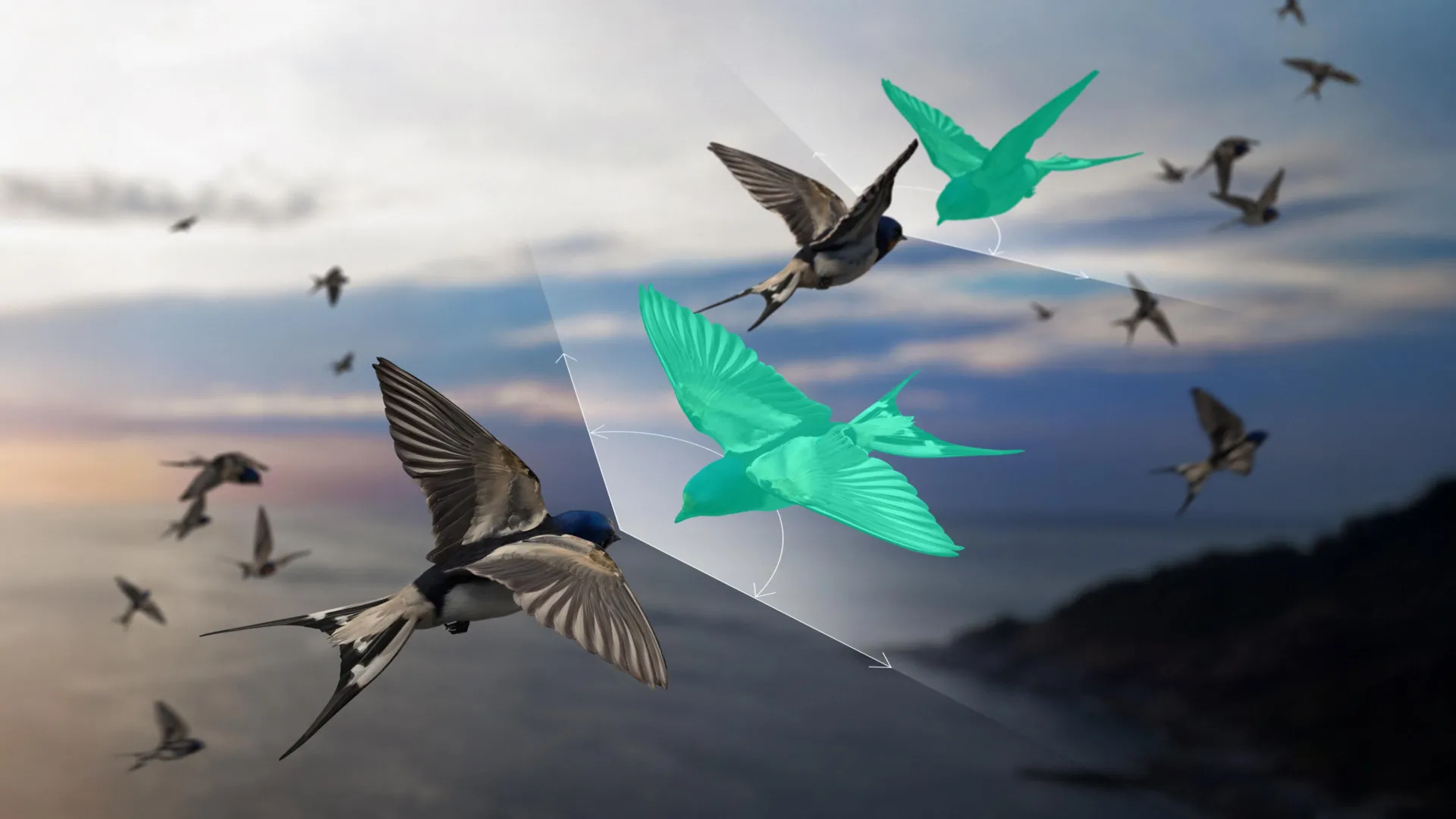
A groundbreaking development in theoretical physics has provided a long-sought solution for describing and simulating complex systems where interactions do not conform to Newton’s third law, the fundamental principle of action and reaction. Researchers in Dresden have unveiled a novel framework that allows physicists to accurately model phenomena such as bird flocks, bacterial swarms, and cellular groups, systems previously intractable with traditional methods. This breakthrough promises to revolutionize understanding across biology, materials science, and even the esoteric realm of quantum matter, opening new avenues for scientific inquiry that have remained closed for over three centuries.
The Enduring Legacy of Newton’s Third Law
For more than 300 years, Isaac Newton’s third law of motion, famously encapsulated as "for every action, there is an equal and opposite reaction," has stood as a bedrock of classical physics. Its elegance and universality underpin our understanding of virtually every physical interaction in the macroscopic world. The principle is intuitively observable in countless everyday scenarios: when a person walks, their foot pushes against the ground, and the ground simultaneously pushes back with an equal and opposite force, propelling them forward. Similarly, the propulsion of cars, the mechanics of rowing a boat, and the thrust generated by a balloon as air escapes are all direct manifestations of this reciprocal exchange of forces. In essence, whenever two objects interact, the forces they exert on each other are always equal in magnitude and opposite in direction. This symmetrical exchange has formed the very foundation of theoretical mechanics taught in universities worldwide, as research group leader Marín Bukov emphasizes: "Whatever we normally teach our students in theoretical mechanics, it ultimately rests on the action-reaction principle."
The Enigma of Non-Reciprocal Interactions
Despite its pervasive applicability, scientists have long observed systems that appear to defy the elegant symmetry of Newton’s third law. These are known as non-reciprocal systems, where the interaction between individual components is decidedly one-sided or directional, meaning that action and reaction are no longer balanced. A prime example, and the impetus for much of the recent research, is the collective motion of bird flocks. While birds possess an impressive visual field, allowing them to perceive a significant portion of their surroundings, their flight coordination within a flock is remarkably selective. Individual birds primarily align their movements with those directly beside or ahead of them, largely disregarding the birds flying behind. This selective responsiveness creates an imbalance: a bird ahead influences one behind, but the influence is not equally reciprocated.
This non-reciprocal behavior is not unique to avian formations. It is a pervasive feature of what physicists term "active matter," a burgeoning field of study focusing on systems composed of many self-propelled entities. Bacterial swarms, for instance, exhibit intricate patterns and collective movements driven by individual bacteria responding to local chemical gradients or mechanical cues, often without an equal and opposite push-back from their neighbors. Crowds of people navigating a public space also display non-reciprocal dynamics, where an individual’s movement is often dictated by those immediately in front or to the sides, with less consideration for those trailing. Even at the microscopic level, within living tissues, groups of cells demonstrate similar behaviors, responding to cues from neighboring cells in ways that can drive tissue formation, wound healing, or even tumor growth, all without the balanced forces classical physics predicts.
The inherent challenge in studying these systems lay in the limitations of traditional theories. Designed for reciprocal interactions where forces are balanced, these established models proved inadequate for accurately simulating the complex, emergent behaviors observed in non-reciprocal systems. This analytical gap has hindered progress in diverse fields, from understanding fundamental biological processes to predicting crowd behavior in urban environments and deciphering the intricate collective motion of animal groups. The scientific community has been grappling with this problem for decades, acknowledging a significant blind spot in their theoretical toolkit.
A Breakthrough from Dresden: The Solution Emerges
The scientific community’s long-standing quest for a robust framework to describe non-reciprocal systems has now culminated in a significant breakthrough. A team of researchers in Dresden, led by physicist Roderich Moessner, a Principal Investigator of the Würzburg-Dresden Cluster of Excellence ctd.qmat (Complexity, Topology and Dynamics in Quantum Matter) and director of the Max Planck Institute for the Physics of Complex Systems, has developed and rigorously proven a novel theory. This new approach effectively extends the traditional action-reaction framework, rendering it applicable to the very systems that previously appeared to defy its principles.
The core of their innovation lies in a remarkably elegant conceptual "trick": the introduction of additional, artificial variables, or "auxiliary degrees of freedom." Physicists typically describe natural systems using mathematical variables that correspond directly to real, measurable properties – a bird’s position and velocity, a fish’s exact coordinates within a school, or a car’s location in a traffic jam. These variables are directly tied to observable reality. However, for non-reciprocal systems, the Dresden team proposed a departure from this direct correspondence.
"The research team has developed and proven a theory that makes much of what we teach our students applicable to non-reciprocal systems as well. These systems, where Newton’s third law does not apply, can now finally be described exactly and simulated precisely — even using established methods. This is exactly the kind of tool that has been missing in recent years," states Marín Bukov, highlighting the profound impact of this development.
The Case of the Imaginary Bird: A Conceptual Leap
To illustrate their innovative concept, the researchers offered a compelling example centered on the initial enigma of bird flocks. Biophysicist Ricard Alert, a colleague of Bukov’s, explains the methodology: "The trick behind the new theory is that it constructs a partner for each component of the system – a fictitious partner that doesn’t exist in nature. The original non-reciprocal interactions are replaced by reciprocal interactions with these auxiliary degrees of freedom."
In practice, this means that to accurately simulate the movements of a real bird flock, the researchers "artificially place a fictitious bird in front of each real bird, aligned in exactly the opposite direction," as Alert describes. These imaginary partners are not meant to represent actual birds; they are purely mathematical constructs. Their purpose is to transform the inherently one-way, non-reciprocal interactions of the real birds into a reciprocal form that can then be analyzed using the extensive array of tools and established methodologies already developed for ordinary reciprocal systems. By essentially "balancing the books" of interaction through these conceptual stand-ins, the team has found a way to bridge the analytical gap. This elegant solution allows for the precise description and simulation of these complex systems, effectively extending the reach of classical physics into domains previously considered beyond its scope.
Historical Context and the Rise of Active Matter Physics
The journey to this breakthrough is rooted in a long history of scientific inquiry into collective phenomena. While Newton’s laws provided a robust framework for inanimate objects and simple systems, the study of living matter and complex adaptive systems presented unique challenges. The 20th century saw the emergence of statistical mechanics, providing tools to understand systems with many interacting particles, but largely still within the reciprocal interaction paradigm. The late 20th and early 21st centuries witnessed a surge in interest in "active matter," a class of non-equilibrium systems where individual components consume energy to generate directed motion. Examples range from molecular motors within cells to self-propelled colloids and, of course, animal collectives.
Researchers realized that active matter systems often exhibit emergent properties – complex behaviors that arise from simple local interactions, but which are not easily predictable from the properties of individual components alone. The non-reciprocal nature of many of these interactions became a central puzzle. Traditional theories, built upon equilibrium principles and reciprocal forces, simply could not capture the dynamic, often chaotic, yet frequently ordered behaviors observed in active matter. This theoretical void spurred intense research efforts, with many physicists seeking to adapt or entirely reinvent the mathematical tools necessary to tackle these challenging systems. The Dresden team’s work can be seen as a culmination of these efforts, offering a comprehensive and generalizable solution that integrates these seemingly anomalous systems back into a broader, more unified physical framework.
Far-Reaching Implications and Future Horizons
The implications of this new theoretical framework are vast and span multiple scientific disciplines. By enabling accurate simulations of non-reciprocal systems, the Dresden breakthrough promises to accelerate discovery in areas previously hampered by theoretical limitations.
Advancements in Biological Understanding:
The ability to precisely model collective cellular behavior could unlock new insights into fundamental biological processes. This includes understanding how cells organize into tissues and organs, how immune cells coordinate their attack on pathogens, and even the mechanisms behind cancer metastasis, where cells migrate and interact in complex, often one-sided ways. Furthermore, the detailed simulation of animal collectives – from the murmurations of starlings to the schooling of fish and the swarming of insects – could reveal deeper principles of biological communication, decision-making, and evolutionary adaptation. This could lead to better conservation strategies or even biomimetic designs.
Revolutionizing Crowd Dynamics and Social Systems:
Beyond the biological realm, the framework has significant potential for understanding human collective behavior. More accurate simulations of crowd dynamics could lead to improved urban planning, optimizing traffic flow, designing safer public spaces, and developing more effective strategies for emergency evacuation and disaster management. The principles might even extend to modeling social contagion, understanding how ideas, trends, or behaviors spread through populations, offering new tools for public health campaigns or understanding societal shifts.
Pioneering New Materials Science:
The concept of non-reciprocal interactions could also inspire the design of novel "active materials." These are materials whose components are self-propelled or consume energy, leading to emergent properties like self-assembly, self-repair, or dynamic reconfigurability. Understanding and controlling non-reciprocal interactions at the microscopic level could pave the way for creating materials with unprecedented functionalities, potentially revolutionizing fields from robotics to soft matter engineering.
Exploring the Quantum Realm:
Perhaps one of the most exciting and profound implications lies in the realm of quantum physics. As Roderich Moessner explains, "In Würzburg and Dresden, we study quantum matter whose particles interact under certain conditions in ways that give rise to new phenomena such as magnetism or lossless current transport. The exciting question now is whether these exceptions to Newton’s law lead to entirely new forms of collective quantum behavior. We still know very little about this — and that is precisely what makes this so fascinating." The possibility that non-reciprocal interactions could manifest at the quantum level opens up entirely new frontiers for research. Could these interactions lead to exotic new phases of quantum matter, novel forms of superconductivity or superfluidity, or even entirely new paradigms for quantum computing? The implications for fundamental physics are immense, suggesting that the universe may harbor quantum phenomena far stranger and more complex than previously imagined, all driven by interactions that defy the classical notion of balanced forces.
Expert Reactions and Scientific Validation
The scientific community is poised to embrace this significant advance. The publication of these findings in the prestigious journal Nature Physics underscores the rigor and importance of the Dresden team’s work. The ability to leverage the well-established framework of many-body physics, while simultaneously producing far more accurate simulations of complex systems, represents a major step forward. As Bukov noted, this is "exactly the kind of tool that has been missing in recent years," suggesting a pent-up demand for such a solution. The work not only provides practical computational tools but also deepens the fundamental understanding of physics itself, potentially laying the groundwork for future discoveries that are currently unforeseen.
In conclusion, the development of a theoretical framework capable of accurately describing non-reciprocal systems represents a monumental achievement in physics. By ingeniously extending the applicability of classical mechanics through the introduction of auxiliary degrees of freedom, researchers in Dresden have bridged a critical gap in our understanding of the natural world. From the intricate dances of bird flocks to the mysterious collective behaviors of quantum particles, this breakthrough promises to illuminate previously opaque phenomena, spur innovation across diverse scientific disciplines, and ultimately expand the very boundaries of what we can comprehend about the universe.
