
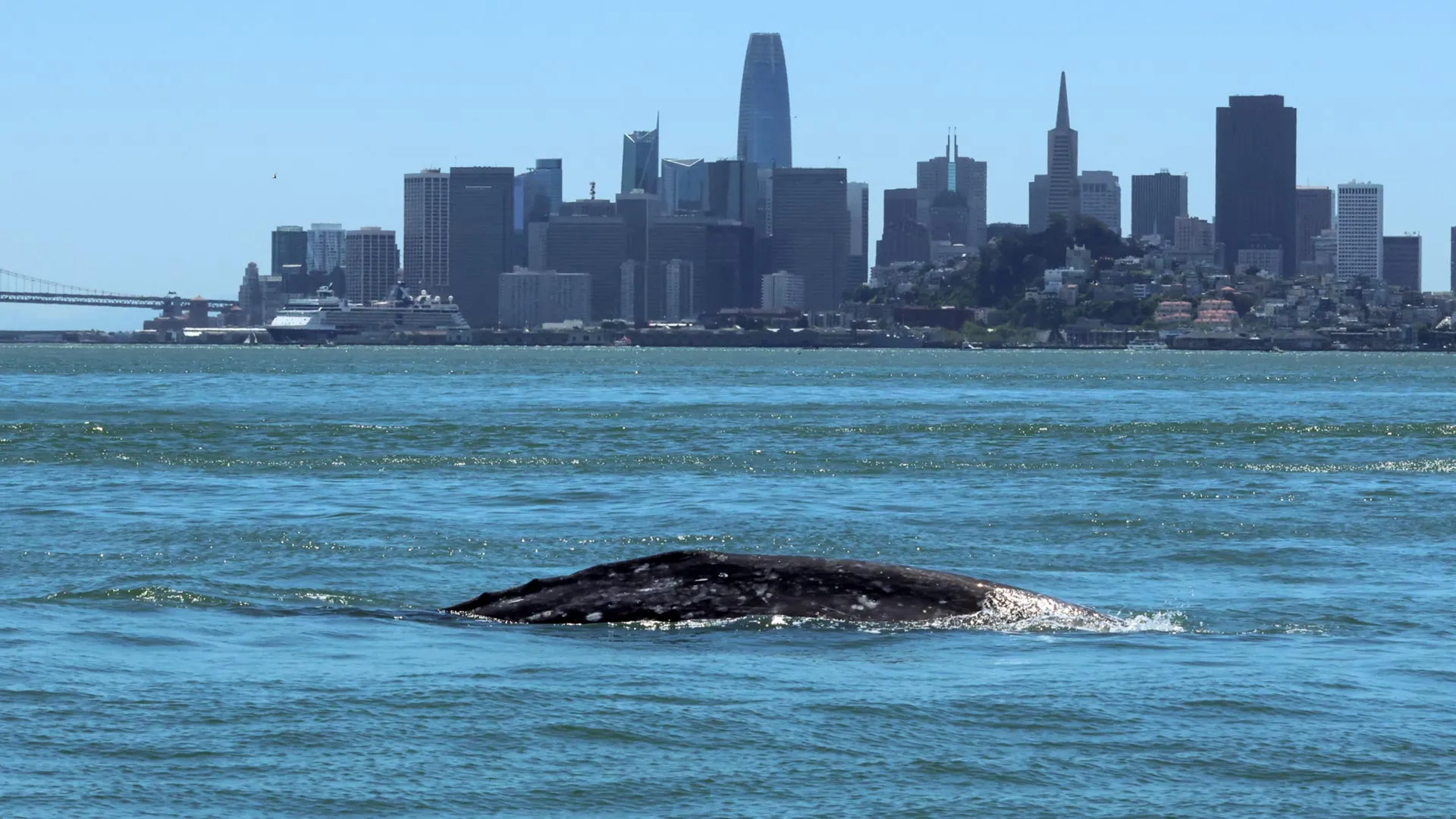
The majestic gray whale, celebrated for undertaking one of the longest migrations of any mammal on Earth, is confronting unprecedented challenges as climate change rapidly reshapes ocean environments. Traditionally traversing vast distances between the bountiful feeding grounds of the Arctic and the warm, sheltered lagoons of Baja California, Mexico, these cetaceans are now exhibiting concerning shifts in behavior. A particularly alarming trend has seen a growing number of gray whales diverting from their ancient migratory paths to forage in unfamiliar and dangerous waters, most notably the highly urbanized and trafficked expanse of San Francisco Bay. This new pattern has coincided with a tragic rise in whale mortality, prompting an urgent scientific investigation and a desperate plea for enhanced protective measures.
An Unforeseen Refuge Becomes a Death Trap
Researchers studying an unusually high incidence of whale deaths in the region have uncovered a stark reality: nearly 20% of the gray whales observed entering San Francisco Bay do not survive their stay. A significant proportion of these fatalities are attributed to devastating collisions with vessels, a risk dramatically amplified by the Bay’s inherent characteristics. Josephine Slaathaug, a lead author of the pivotal study published in Frontiers in Marine Science and a researcher at Sonoma State University, highlights the unique dangers. "Gray whales have a low profile to the water when they surface, making them incredibly difficult to spot in conditions like the fog, which is a frequent occurrence in San Francisco Bay," Slaathaug explained. "Furthermore, San Francisco Bay is a highly trafficked waterway, with the Golden Gate Strait acting as a critical bottleneck through which all maritime traffic and whales must navigate." This confluence of challenging visibility, dense shipping lanes, and the narrow confines of the Golden Gate creates a deadly gauntlet for these immense marine mammals.
The Ancient Migration Under Threat
For millennia, the annual migration of the Pacific Coast Feeding Group of gray whales, or Eschrichtius robustus, has been a marvel of natural endurance. Covering up to 12,000 miles round trip, it is a journey dictated by seasonal abundance and the imperative of reproduction. Whales typically spend their summers gorging on energy-rich amphipods and other invertebrates in the food-rich waters of the Bering, Chukchi, and Beaufort Seas in the Arctic. These immense stores of blubber sustain them through their long southward journey to warmer breeding lagoons in Mexico, where calves are born, and the subsequent return north. Crucially, gray whales typically do not feed extensively during this arduous migration, relying almost entirely on the caloric reserves accumulated in the Arctic.
However, this delicate ecological balance is being profoundly disrupted by rapidly warming global temperatures. The Arctic, warming at a rate two to three times faster than the rest of the planet, is experiencing unprecedented changes. Melting sea ice, shifts in ocean currents, and alterations in phytoplankton blooms are directly impacting the availability and distribution of the benthic invertebrates, particularly amphipods, that form the cornerstone of the gray whale’s diet. These disruptions are leaving whales increasingly undernourished and vulnerable, unable to build sufficient energy reserves for their epic journey. The National Oceanic and Atmospheric Administration (NOAA) declared an "Unusual Mortality Event" (UME) for gray whales along the west coast of North America in 2019, an event that continues to this day. This declaration followed a disturbing trend: the population has plummeted by more than half since 2016, falling from an estimated 27,000 individuals to approximately 14,500. Sightings of calves, vital indicators of reproductive health and population recovery, have become distressingly rare.
A Chronology of Concern: The Rise of "Bay Grays"
Historically, San Francisco Bay was not considered a regular stop on the gray whale migration route, nor was it a known feeding ground. This began to change dramatically around 2018. That year, observations of gray whales within the Bay’s confines became notably more frequent, coinciding with a discernible increase in local whale deaths. This unexpected shift prompted scientists to launch a dedicated effort to understand these "Bay Grays" – a term coined for the individuals venturing into the estuary. The core objective was to determine if these were transient, one-time visitors seeking an emergency meal or if a new sub-population was beginning to integrate the Bay into its regular foraging patterns.
To investigate this phenomenon, researchers meticulously compiled a comprehensive catalog of individual whales. This Herculean task relied on a combination of opportunistic sightings and photographic contributions from an engaged public between 2018 and 2023, augmented by more structured and targeted surveys conducted from 2023 through 2025. Identification of individual whales was achieved by analyzing unique markings, scars, and pigmentation patterns on their skin – a kind of natural fingerprint. These records were then cross-referenced with necropsy data obtained from stranded whales found deceased in the broader region. A significant challenge in this process was the potential for unique markings to fade or become obscured after death, which meant that some matches between live sightings and deceased individuals might have been inadvertently missed.
Grim Statistics: Mortality in the Bay
The study period ultimately documented 114 distinct individual gray whales utilizing San Francisco Bay. The analysis of this catalog revealed a critical insight: only four of these individuals were observed returning to the Bay in more than one year. This low rate of return strongly suggests that for the vast majority, the Bay is not becoming a habitual feeding ground but rather an emergency stop. Scientists hypothesize that the Bay functions as a desperate feeding refuge for whales in extremely poor physical condition, a theory supported by observations of unusually thin individuals foraging in other non-traditional habitats along the coast. These emaciated whales, starved by dwindling Arctic food sources, are likely seeking any available calories, even in perilous environments.
Despite their apparent need for sustenance, many of these whales do not survive their foray into the Bay. Between 2018 and 2025, a staggering 70 gray whales were discovered dead within the San Francisco Bay region. Of these, 30 fatalities were definitively confirmed to have been caused by vessel strikes, a testament to the dangers of the Bay’s busy shipping lanes. For the remaining whales where a cause of death could be determined, a significant number exhibited clear signs of severe malnutrition, underscoring the underlying physiological stress driving them into the Bay. Researchers successfully matched 21 of the 45 identifiable deceased whales to individuals previously documented in their live-sighting catalog, providing a direct link between Bay usage and subsequent death.
Bekah Lane, a co-author of the study from the Center for Coastal Studies, underscored the severity of the mortality rate directly linked to Bay visits. "At least 18% of the individuals identified within San Francisco Bay later died in the immediate area," Lane stated. Expanding on the broader regional impact, she added, "Our comprehensive analysis of local strandings, encompassing those both inside and outside San Francisco Bay, found that over 40% of these whales ultimately succumbed to trauma inflicted by vessels." These figures paint a stark picture of a population under immense pressure, with human activity posing a direct and lethal threat.
Urgent Call for Protection Measures and Policy Implications
The scientific community is unanimous in its emphasis on the critical need for more extensive and detailed research to fully comprehend the intricate ‘how’ and ‘why’ behind the whales’ increasing reliance on San Francisco Bay. The scale of the phenomenon continues to grow, with 2025 alone witnessing 36 individual gray whales entering the area, sometimes congregating in groups exceeding 10 individuals. More advanced tracking technologies, such as satellite tagging, coupled with additional necropsies, are essential to definitively ascertain whether the observed low number of returning whales is primarily a consequence of the exceptionally high mortality rates within the Bay, or if other factors are at play. Such research would also help clarify whether deaths are predominantly caused by starvation, vessel strikes, or, as suspected, a deadly combination where weakened, malnourished whales are less capable of detecting and evading oncoming ships.
Addressing the immediate threat requires proactive and collaborative intervention from multiple stakeholders. Preventive steps, if swiftly implemented, could significantly mitigate the risk of vessel strikes. These measures include:
- Educating Commercial Vessel Operators: Comprehensive outreach programs targeting commercial shipping companies, tugboat operators, ferry services, and recreational boaters can raise awareness about the presence of whales in the Bay, the dangers they face, and best practices for avoiding collisions. This could involve mandatory briefings, informational materials, and real-time alerts.
- Adjusting Ferry Routes: Rerouting or modifying the pathways of high-frequency ferry services, particularly in known whale hot spots or narrow channels, could reduce the probability of encounters.
- Implementing Speed Restrictions: Establishing mandatory or voluntary vessel speed reduction (VSR) zones in identified high-risk areas, especially around the Golden Gate and within the central Bay, has proven effective in reducing vessel strike mortality for large whales in other regions. Such restrictions could be implemented seasonally or when whales are known to be present. The United States Coast Guard, in collaboration with NOAA and port authorities, would play a crucial role in enforcing such measures.
Bekah Lane reiterated the primary threat and the proven efficacy of mitigation strategies. "In San Francisco Bay, the biggest threat to these whales is unequivocally vessel traffic," she stated. "Continued monitoring will be vital in illuminating their distribution patterns and specific behaviors while within the Bay, which in turn can inform and impact risk assessments. Route changes and speed restrictions have been demonstrably found to significantly reduce vessel strike mortality to large whales globally, and a thorough assessment of the specific risks in San Francisco Bay can help us identify and implement the most effective strategies to protect these vulnerable animals."
A Population Under Pressure: Broader Implications
While researchers acknowledge that there are still inherent gaps in the day-to-day understanding of individual whale movements and behaviors within the complex San Francisco Bay environment, these findings offer a critical, high-resolution snapshot. They reveal, in real-time, how a keystone marine species is attempting to adapt to the profound and rapidly accelerating changes wrought by climate change. The presence of gray whales in San Francisco Bay is not merely a local anomaly; it is a stark indicator of a much larger ecological crisis unfolding in the Arctic and across the entire migratory range of these magnificent creatures.
Slaathaug emphasized the ongoing nature of the scientific endeavor. "This study represents our most comprehensive analysis of the data we’ve collected thus far, but it’s crucial to acknowledge that we don’t yet possess the full picture of each whale’s daily movements and interactions within the Bay," she cautioned. "Nevertheless, these results constitute an exceptionally important piece of the much larger, intricate puzzle of what is transpiring within the overall gray whale population as they strive to adapt to the realities of climate change in real time."
The plight of the "Bay Grays" serves as a poignant and urgent reminder of the interconnectedness of global climate patterns, marine ecosystems, and human activities. It underscores the immediate need for robust conservation strategies, international cooperation, and a fundamental reevaluation of humanity’s impact on the delicate balance of the planet’s oceans. The future of the gray whale, an icon of resilience and migration, hangs precariously in the balance, demanding immediate and decisive action.
