
In the dynamic and often technically driven world of wildlife photography, Rachel Bigsby has carved a distinct niche, advocating for an approach she terms "natural artistry." This philosophy transcends the mere capture of an image, aiming instead to convey the profound experience of witnessing nature, translating its inherent grammar into a visceral feeling for the viewer. For Bigsby, the moment before pressing the shutter is a sacred pause, a sharpening of attention where the natural world’s intricate movements – the tilt of a seabird, the shift of light on feathers – coalesce into a narrative far older than human language. It is this elusive, deeply felt connection that she consistently seeks to immortalize.
Bigsby defines natural artistry not as an imposed style or aesthetic, but as an unveiling of beauty already present in the wild. It resides in the fluid grace of a seabird riding the wind, the delicate interplay of light and feather, the stillness preceding a dive, or the magnificent chaos of a densely populated colony. Her work strives to capture not just the visual appeal but the very essence of a species – its deeper story communicated through light, movement, texture, color, behavior, environment, and perspective. A foundational principle guiding her lens is the desire to photograph seabirds not as mere objects, but to evoke the profound sensation of being in their presence.
A Journey Rooted in Reverence: Rachel Bigsby’s Formative Years
Rachel Bigsby’s profound connection with the natural world predates her photographic endeavors. Her late grandfather, a dedicated naturalist and fisherman, instilled in her a crucial lesson: not merely to observe, but to truly see. He imparted a sense of reverence for nature, framing it as a vast, living text rather than a collection of facts. This foundational teaching laid the groundwork for a life deeply entwined with the wild.
At the tender age of six, Bigsby joined the Scout Association, an affiliation that, unbeknownst to her at the time, would irrevocably shape her trajectory. Weekends were dedicated to navigating rugged trails with weathered maps, fostering an intimate, practical relationship with the outdoors. Through prolonged exposure, the land transitioned from mere "scenery" to a profound companion, serving as her primary classroom.

Photography entered her life more subtly. A childhood friend introduced her to the medium, prompting Bigsby to experiment with an iPod camera. These early attempts were small but significant: capturing the way morning light illuminated dewdrops, or how a dandelion’s silhouette mimicked a drawing. While her friend’s interest waned, Bigsby’s deepened, marking the genesis of a lifelong passion.
A pivotal moment arrived when Bigsby observed a Northern Fulmar gliding along coastal cliffs. Its wings, held stiff and resolute, demonstrated an oceanic mastery, a seemingly effortless defiance of gravity. This encounter sparked an intense curiosity, leading her to research the species with the fervor of someone discovering a hidden realm. The revelation of the Fulmar’s kinship with the albatross, a bird of legend and her childhood dreams, was not merely interesting; it was a calling. From that point forward, seabirds ceased to be merely a subject for Bigsby; they became her entire world.
Driven by this newfound passion, Bigsby diligently saved for her first DSLR camera. This acquisition broadened her horizons, opening doors to new species, remote colonies, and a wealth of unanswered questions. As her images began to gain public recognition, opportunities emerged, revealing a path that was far from linear. She embraced volunteer work in exchange for unparalleled access to seabird habitats, undertaking tasks such as scrubbing compost toilets on isolated islands, scything bracken in the summer heat, and repairing weather-beaten doors with antiquated tools. Her days were spent in labor, but as dusk settled, the seabird colonies reclaimed their domain, and Bigsby found her place among them – observing, listening, and learning. This immersive period, characterized by deep understanding of behaviors, biology, and ecology rather than just photography, underpins the credibility and authenticity of her current work.
Beyond Technical Perfection: The Evolution of an Artistic Vision
In contemporary wildlife photography, the pursuit of technical perfection—razor-sharp eyes, pristine backgrounds, and adherence to textbook compositions—often dominates the discourse. However, Bigsby contends that an overly zealous chase for such flawlessness can lead to images that, while competent, are ultimately forgettable. These photographs, she argues, may accurately depict a bird’s appearance but fail to capture its true essence.
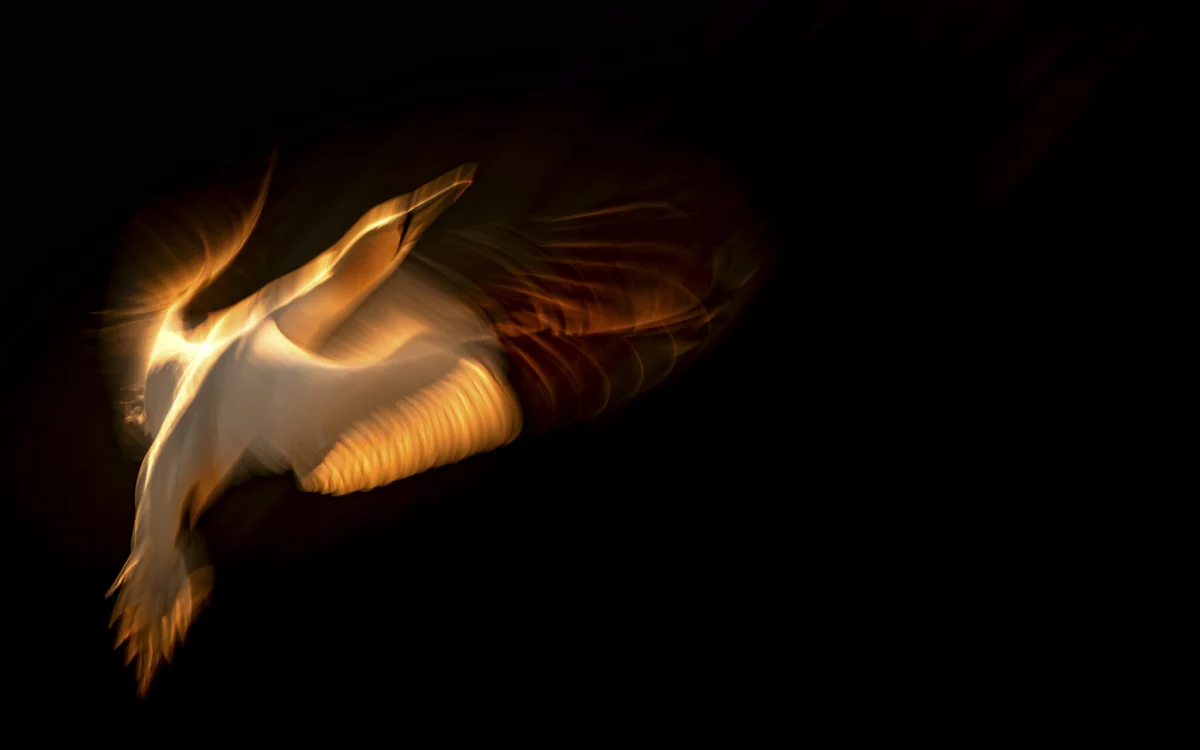
A transformative experience occurred with a photograph Bigsby captured of an Atlantic Puffin in flight. By conventional standards, it was far from "perfect": the focus was soft, the shutter speed deliberately slow, and the background cluttered. Yet, the golden light piercing through the puffin’s delicate wings, rendering its movement as a blur, created an image that was less a frozen subject and more a "whisper of motion," dissolving into the atmosphere like breath on the wind. This image resonated deeply with Bigsby precisely because it defied the typical checklist; it conveyed a powerful feeling. It was at this juncture that she understood a fundamental truth: wildlife photography is not solely about documentation, but profoundly about storytelling, emotion, and artistry.

The wild, Bigsby emphasizes, is inherently untamed. Seabirds do not conform to human expectations; their lives are governed by the relentless forces of weather, tide, hunger, fear, devotion, and instinct. They do not pause for ideal backdrops or perfect lighting. Their existence is a chaotic, fluid, and vibrant reality. To pretend otherwise in photographic representation, she posits, would be disingenuous.
For a considerable period, Bigsby found herself waiting for what she perceived as necessary conditions: calm air, soft light, clear sight-lines. However, a week spent volunteering on an island, where the weather offered nothing but incessant rain, fog, and mist, challenged this preconception. Initially heartbroken, convinced she had arrived at the wrong time, Bigsby eventually realized her error. She was viewing the conditions as a problem, attempting to impose an artificial idea of perfection. For the birds, these were not "bad weather" conditions; this was simply life.
This realization prompted a profound shift. Bigsby ceased resisting the elements and began to collaborate with what the island presented. The fog transformed into a blank canvas, its ethereal whiteness becoming a medium for expression. Unintentionally, she embraced high-key imagery, an approach that subsequently became a hallmark of her visual signature. This wasn’t a pursuit of style; it was an honest, authentic response to the environment. That week fundamentally altered her perception of light, teaching her that the most meaningful images often emerge when one stops demanding specific outcomes and instead opens to what is already present.
Seabirds as Muse: Capturing Essence Amidst Environmental Challenges
Seabirds, with their inherent elegance and indomitable spirit, serve as Bigsby’s primary muse. These creatures, sculpted by millennia of wind and tide, inhabit environments often perceived as the very edge of the world. Globally, seabird populations face unprecedented threats, having declined by an estimated 70% since the 1950s. Major drivers of this decline include climate change, which alters food availability and breeding grounds, incidental bycatch in fisheries, plastic pollution leading to ingestion and entanglement, and habitat degradation. Bigsby’s work, by focusing on the emotional and artistic representation of these species, aims to foster a deeper connection and empathy in viewers, subtly advocating for their conservation.
Her photographic journey often involves significant personal investment and ethical considerations. Understanding seabird behavior requires immense patience and observation. For instance, knowing that many seabird species, such as albatrosses and gannets, mate for life, adds a layer of depth to photographs capturing their interactions. The sight of a Northern Gannet diving at speeds up to 60 mph for fish, or a King Penguin navigating the sub-Antarctic waters, speaks to incredible adaptations and resilience. These biological facts enrich Bigsby’s ability to anticipate moments and frame compositions that resonate with authenticity.

Bigsby’s photographs often depict the harsh realities of seabird existence, from the chaotic energy of a bustling colony, such as those found at RSPB Bempton Cliffs, to a solitary bird battling stormy seas. These scenes are not romanticized; they are presented with a raw honesty that speaks to the species’ struggle and endurance. Her commitment to showing the environment as character, not just background, emphasizes the symbiotic relationship between the birds and their often-perilous habitats. This approach implicitly highlights the fragility of these ecosystems and the urgent need for conservation efforts, aligning her artistic practice with broader environmental advocacy.
The Elements of Emotional Storytelling: Light, Shape, Texture, and Environment
At its core, natural artistry for Bigsby is about perceiving beyond the obvious. It involves recognizing the inherent patterns, textures, forms, and subtle geometries that render nature a masterpiece. These elements, she posits, have existed for millions of years; the photographer’s role is not to invent them but to discern and translate their energy into a still frame.
Bigsby actively seeks artistry in elements often overlooked as "the subject." This includes the wind-textured ripples of the sea, the rugged, time-worn cliff faces, the delicate barbs of a feather catching light at a specific angle, the negative space of the sky that bestows weightlessness upon a single bird, and the dense repetition within a colony that transforms into powerful patterns and designs. By moving away from the conventional demand for clean portraits, Bigsby encourages a more abstract and expressive interpretation of nature, shifting focus from merely hunting for a "good subject" to actively listening for composition: shape, line, rhythm, contrast, and restraint.
She asserts that the most impactful images are frequently the simplest. Minimalism in nature photography, such as a single bird against a vast sky, or a lone gesture framed by emptiness, can be breathtaking. Negative space, for Bigsby, is a powerful carrier of emotion—freedom, loneliness, resilience, endurance. Allowing the frame to "breathe" deepens the narrative rather than forcing it into a shout.
This perspective leads Bigsby to diverge from the belief that a wildlife image must be technically perfect to be powerful. In nature, she argues, imperfection often is artistry. A seabird battered by wind, its feathers ruffled into a wild disarray, conveys a more profound story than one captured in still air. A blur of motion can speak more truthfully about the essence of flight than a perfectly frozen wing. Mist and rain are not obstacles but integral components of the atmosphere, part of the emotional reality of a seabird’s world.

Light, for Bigsby, is not a mere technical parameter but the emotional spine of an image. While a subject inherently exists, light dictates how it is perceived, felt, and remembered. She recalls a morning on the Shetland cliffs where the colony remained in darkness, yet the highest rock peaks caught the first light, glowing against the abyss. A single gannet then lifted from shadow into illumination, its white wings bright against the dark cliff, suspended like a brushstroke. This moment taught her an invaluable lesson: light is not just clarity; it is drama, mood made visible.
Similarly, color is approached with intentionality. Bigsby rarely pursues bold colors for their own sake, instead considering how they contribute to the emotional tone of a scene. Northern Fulmars, with their subtle, stormy tones of slate-grey, are best cradled by a chalk-white cliff or dark grey rock, allowing their inherent mood to resonate, rather than being overwhelmed by a bright blue background. When color becomes a distraction, she opts for monochrome, but always with intention. Black and white is not a shortcut to seriousness; it is a deliberate choice to direct attention to the fundamental elements of shape, light, and texture—the very bones of the image.
Texture renders a photograph tangible, allowing the viewer to almost feel the salt in the air. Shape makes it intentional. Together, these elements transform wildlife into design—a symphony of curves, arcs, symmetry, and contrast. One of Bigsby’s most compelling insights is that the environment is not merely a background; it is an intrinsic character. A bird devoid of context is "just" an animal; a bird honestly situated in its world becomes a narrative of scale, struggle, intimacy, resilience, and fragility. This environment can also convey difficult truths—beauty intertwined with grief, life alongside loss. The natural world is not a romanticized postcard, but a complex reality, and Bigsby believes photography can capture this complexity truthfully, respectfully, and intentionally, without exploitation.
Patience and Presence: Decoding the Language of the Wild
For Rachel Bigsby, patience extends beyond simply waiting; it is an informed anticipation, a knowing of what one is waiting for. Understanding animal behavior, she likens to learning a new language. Once patterns and cues are recognized, the wild transitions from a random spectacle to a readable narrative. Photography then becomes an act of intention rather than mere luck.
Bigsby has dedicated countless hours to observing seabirds in seemingly ordinary acts: preening, shifting, calling, settling, rising. Yet, she notes, the most subtle changes—a tightening posture, a momentary glance upwards, a repeated gesture—often presage significant events. This deep observational practice fosters a profound satisfaction, fundamentally altering the relationship between photographer and subject. The act shifts from "taking" an image to "listening" to the environment.

When one listens long enough, Bigsby explains, moments that feel like genuine gifts emerge: a reunion ritual between mates, a delicate courtship exchange, a synchronized movement between bonded birds, or a sudden moment of tenderness amidst the colony’s chaos. These are more than mere behaviors; they are stories of devotion, endurance, and survival, unfolding on cliff edges perpetually swept by the wind.
It is this profound connection that keeps seabirds as Bigsby’s enduring muse. They embody freedom and resilience, sculpted by time and tide. Their habitats, often at the world’s periphery, evoke a sense of liberation in her presence.
Implications for Wildlife Photography and Conservation
While technical proficiency is undeniably important, Bigsby argues that camera settings are merely scaffolding. They can produce an image, but they cannot imbue it with soul. The enduring quality of a photograph, what makes it linger in the memory, is not found in a dial setting, but in the photographer’s unique vision: the way they see, feel, and connect.
In a photographic landscape often dictated by rigid rules and conventions, Bigsby champions honesty and emotional resonance. The images that truly endure—the ones that move us—rarely conform to every convention. Instead, they carry authenticity and evoke genuine feeling.
Bigsby hopes her work grants others "permission": permission to create photographs that resonate personally, even if they deviate from established expectations. The world, she posits, does not require more wildlife photographs crafted by formula. Instead, it needs images born of the heart, photographs that educate through their beauty, and honor the wild by telling its unvarnished truth. Her advice is a mantra for mindful engagement: "Go gently. Look closely. Wait longer than you think you should. Let the weather shape the frame rather than ruin it. Photograph the world not only as it is, but as it feels." Ultimately, she reminds us, no one else perceives the world precisely as we do, underscoring the invaluable nature of individual artistic vision in communicating the profound narratives of the wild.

Bigsby’s "natural artistry" approach holds significant implications for both the practice of wildlife photography and broader conservation efforts. By prioritizing emotional impact and authentic representation over mere technical perfection, her work can cultivate a deeper sense of empathy and urgency among viewers regarding environmental issues. In an era saturated with images, photographs that "feel" rather than just "show" have a greater capacity to cut through the noise and inspire action. Her methodology also serves as a valuable counterpoint to the often competitive and gear-focused culture within wildlife photography, encouraging practitioners to develop their unique artistic voice and an intimate understanding of their subjects. This shift towards a more soulful and less prescriptive approach to wildlife photography could foster a new generation of visual storytellers dedicated not just to capturing beauty, but to advocating for the preservation of the wild places and creatures they so passionately observe.
