
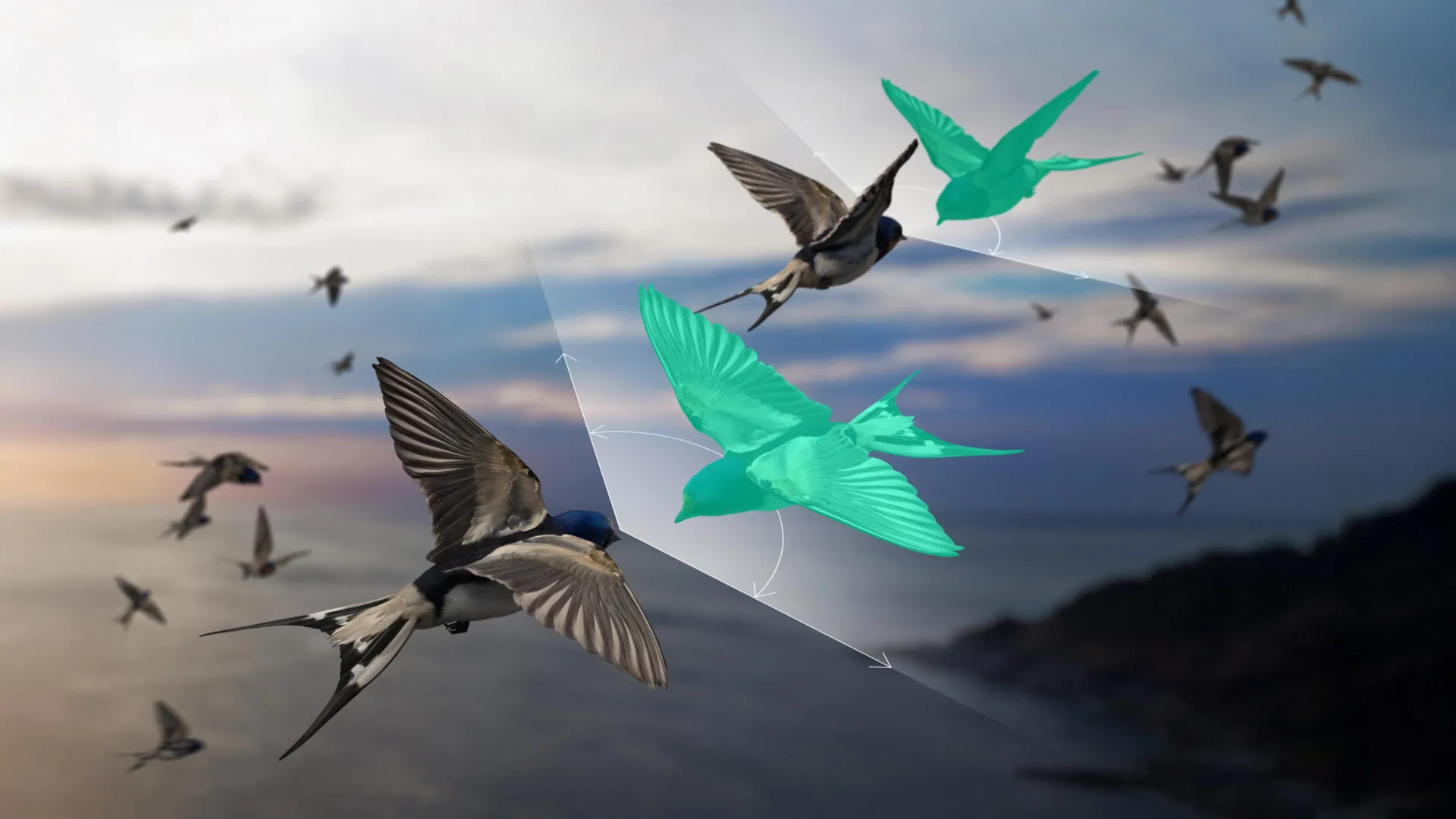
A groundbreaking development from researchers in Dresden has unveiled a novel theoretical framework capable of accurately describing and simulating complex systems where the venerable principles of classical physics, particularly Newton’s Third Law of Motion, previously fell short. For over three centuries, Isaac Newton’s famous action-reaction principle, often summarized as "for every action, there is an equal and opposite reaction," has stood as an unshakeable cornerstone of theoretical mechanics, explaining everything from the propulsion of a car to the flight of a rocket. However, a wide array of natural phenomena, from the intricate movements of bird flocks to the coordinated actions of cellular collectives, exhibit behaviors that appear to directly conflict with this fundamental law. The new theory, developed by a team including physicists Roderich Moessner and Marín Bukov, promises to bridge this long-standing gap, enabling a more precise understanding of these "non-reciprocal" interactions and opening new avenues for scientific inquiry across multiple disciplines.
The Enduring Legacy of Newton’s Third Law
Newton’s Third Law, first articulated in his seminal 1687 work Philosophiæ Naturalis Principia Mathematica, posits that when two objects interact, the force exerted by the first object on the second is equal in magnitude and opposite in direction to the force exerted by the second object on the first. This reciprocal relationship is intuitive and pervasive in our everyday experience. When a runner pushes against the ground, the ground pushes back with an equivalent force, propelling the runner forward. Similarly, the mechanics of a car’s engine driving wheels against the road, the oars of a boat pushing water, or the escaping air from a balloon creating thrust, all neatly align with this principle. It has provided the bedrock for understanding mechanics, engineering, and much of the physical world. As research group leader Marín Bukov emphatically states, "Whatever we normally teach our students in theoretical mechanics, it ultimately rests on the action-reaction principle." This profound simplicity and universal applicability have made it one of the most powerful and enduring concepts in science.
When Action and Reaction Don’t Balance: The Rise of Non-Reciprocal Systems
Despite the law’s pervasive influence, scientists have increasingly encountered systems in nature that defy its elegant symmetry. These are known as non-reciprocal systems, characterized by interactions where the ‘action’ does not elicit an ‘equal and opposite reaction.’ The classic example cited by the Dresden team is the behavior of bird flocks. While individual birds possess impressive visual acuity, capable of perceiving a vast portion of their surroundings, their movements within a flock are governed by a more localized interaction rule. They primarily align their movements with birds immediately beside or ahead of them, largely disregarding the birds trailing behind. This directional, asymmetric interaction means that the influence is predominantly one-way, breaking the balance inherent in Newton’s Third Law.
Beyond avian formations, numerous other active matter systems exhibit similar non-reciprocal dynamics. Bacterial swarms, for instance, display complex collective motion where individual microorganisms respond to local chemical gradients or physical cues from their immediate neighbors, leading to emergent patterns that are not simply the sum of reciprocal pairwise forces. Human crowds, too, demonstrate non-reciprocal behavior, where an individual’s movement might be influenced by those ahead or to the sides, but their back often serves as a barrier rather than an interactive point. Even within living tissues, groups of cells, such as those migrating during wound healing or embryonic development, operate under rules where their interactions are not always perfectly balanced in the Newtonian sense. These systems, composed of individual components that actively generate their own motion and respond to only a subset of their environment, present a significant challenge to traditional physics.
A Decades-Long Scientific Conundrum
The study of active matter, a relatively newer field in physics, has brought these non-reciprocal systems into sharper focus over the last few decades. Researchers recognized that the self-propulsion and localized interactions characteristic of these systems meant that their collective behavior could not be accurately captured by models built upon the assumption of reciprocal forces. Traditional theories, meticulously crafted for systems where every action has an equal and opposite reaction, struggled to provide accurate simulations or predictions for active matter. This limitation had profound practical consequences across various fields.
For biologists, understanding the collective dynamics of cells is crucial for insights into cancer metastasis, tissue morphogenesis, and immune responses. Without accurate models, simulating drug effects on cell migration or predicting developmental abnormalities remained an uphill battle. In urban planning and public safety, predicting crowd behavior during large events or evacuations is paramount, yet the non-reciprocal nature of human interactions often renders simple physical models inadequate. Ecologists and zoologists have sought to understand the complex schooling of fish, swarming of insects, and flocking of birds, which are vital for survival, foraging, and predator evasion. The absence of precise theoretical tools hindered a deeper understanding of these intricate biological processes and their evolutionary underpinnings. The scientific community faced a fundamental gap: a world filled with active, complex systems whose behaviors defied the very laws that had so successfully described the inanimate universe.
A Novel Theoretical Framework Emerges from Dresden
The long-standing problem of accurately describing and simulating non-reciprocal systems has now been addressed by the research team in Dresden, working in collaboration with physicist Roderich Moessner. Moessner, a Principal Investigator of the Würzburg-Dresden Cluster of Excellence ctd.qmat — Complexity, Topology and Dynamics in Quantum Matter — and director of the Max Planck Institute for the Physics of Complex Systems in Dresden, has been at the forefront of exploring complex phenomena. The team, including Marín Bukov and biophysicist Ricard Alert, has devised a solution that extends the traditional action-reaction framework, effectively making many established theoretical mechanics tools applicable to these previously intractable systems.
"The research team has developed and proven a theory that makes much of what we teach our students in theoretical mechanics applicable to non-reciprocal systems as well," explains Bukov. "These systems, where Newton’s third law does not apply, can now finally be described exactly and simulated precisely — even using established methods. This is exactly the kind of tool that has been missing in recent years." This statement underscores the profound impact of their work: it’s not merely a niche improvement, but a fundamental expansion of physics’ descriptive power, allowing established methodologies to tackle a new class of problems. The significance lies in the ability to leverage a vast existing body of knowledge and computational techniques that were previously inaccessible for non-reciprocal interactions.
The ‘Imaginary Partner’ and Auxiliary Degrees of Freedom
The core ingenuity of the Dresden team’s approach lies in the introduction of additional, artificial variables, which they term "auxiliary degrees of freedom" or "fictitious partners." Physicists typically describe natural systems using mathematical variables that correspond directly to real, measurable properties—a bird’s position and velocity, a molecule’s energy state, or a car’s location in traffic. However, these new variables do not correspond to anything physically observable in the original system.
"The trick behind the new theory is that it constructs a partner for each component of the system — a fictitious partner that doesn’t exist in nature," explains Ricard Alert. "The original non-reciprocal interactions are replaced by reciprocal interactions with these auxiliary degrees of freedom." This conceptual leap is akin to introducing a mathematical ‘ghost’ or ‘shadow’ for each real entity in the system.
To illustrate this with the bird flock example, Alert elaborates: "To simulate the birds’ movements precisely, we describe the dynamic system ‘flock of birds’ using established methods — as if it were a reciprocal system, even though it is not. The elegant solution is to artificially place a fictitious bird in front of each real bird, aligned in exactly the opposite direction." These imaginary partners do not represent actual birds; they are purely mathematical constructs. Their purpose is to transform the one-way, non-reciprocal interactions of the real birds into a reciprocal form when considered in conjunction with these auxiliary variables. This transformation allows the entire system—real birds plus imaginary partners—to be analyzed using the powerful, well-understood mathematical tools of reciprocal systems, such as Hamiltonian mechanics, which are typically used for conservative systems obeying Newton’s Third Law.
While the concept of using auxiliary degrees of freedom is not entirely new in physics (e.g., gauge fields in quantum field theory), its application to explicitly model and accurately simulate non-reciprocal interactions represents a significant methodological breakthrough. It provides a means to reconcile the seemingly disparate worlds of classical mechanics and active matter physics, offering a unified framework for analysis.
Opening New Frontiers: Implications Across Disciplines
The ramifications of this new theoretical framework are vast and multidisciplinary, promising to unlock deeper insights into some of nature’s most intricate phenomena.
Biology and Medicine: The ability to precisely simulate collective cell migration could revolutionize our understanding of embryogenesis, wound healing, and crucially, the metastasis of cancer cells. By modeling how cells interact non-reciprocally, scientists could develop more accurate predictive models for disease progression and test potential therapeutic interventions in silico, reducing the need for costly and time-consuming experimental trials. Similarly, understanding the non-reciprocal interactions within bacterial colonies could lead to novel strategies for combating antibiotic resistance or designing beneficial microbial communities.
Sociology and Urban Planning: The dynamics of human crowds are inherently complex and often non-reciprocal. A person’s decision to move might be influenced by the crowd density ahead, but their presence simultaneously impedes those behind them. Accurate simulations based on this new theory could dramatically improve crowd management strategies for large public events, optimize evacuation plans in emergencies, and even refine traffic flow algorithms in congested urban environments, leading to safer and more efficient public spaces.
Ecology and Animal Behavior: From the mesmerizing murmurations of starlings to the synchronized schooling of fish, collective animal motion is a testament to complex, often non-reciprocal, interactions. This framework will allow ecologists to build more realistic models of these behaviors, shedding light on their evolutionary advantages, predator-prey dynamics, and responses to environmental changes. Such models could inform conservation efforts and help predict the impact of human activities on animal populations.
Fundamental Physics and Quantum Matter: Perhaps one of the most exciting implications lies in the realm of fundamental physics, particularly in the study of quantum matter. Roderich Moessner highlights this potential: "In Würzburg and Dresden, we study quantum matter whose particles interact under certain conditions in ways that give rise to new phenomena such as magnetism or lossless current transport. The exciting question now is whether these exceptions to Newton’s law lead to entirely new forms of collective quantum behavior. We still know very little about this — and that is precisely what makes this so fascinating." This opens a speculative yet tantalizing frontier: could non-reciprocal interactions manifest at the quantum scale, leading to exotic phases of matter, novel topological states, or entirely new mechanisms for quantum information processing? The theoretical tools to explore such possibilities now exist, potentially leading to breakthroughs in materials science and quantum technologies.
Future Directions and the Path Ahead
The publication of these findings in the prestigious journal Nature Physics marks a significant milestone in the scientific community. It signals a paradigm shift in how physicists approach complex, active systems, moving beyond the traditional constraints of reciprocal interactions. The work by the Dresden team provides not just a computational tool but also a deeper conceptual understanding of the underlying physics governing these systems. This kind of fundamental insight is often the precursor to transformative discoveries and technological advancements.
The integration of this new theory into the broader framework of physics will undoubtedly spur further research. Scientists across various disciplines will now have a more robust toolkit to model, analyze, and predict the behavior of systems previously considered too complex or too unconventional for precise description. The ongoing work at institutions like the Würzburg-Dresden Cluster of Excellence ctd.qmat will continue to push the boundaries, exploring the implications of non-reciprocal interactions from the macroscopic scale of animal collectives down to the quantum realm. This breakthrough represents a pivotal step towards unlocking the secrets of complexity, offering a more complete and nuanced picture of the dynamic world around us.
