
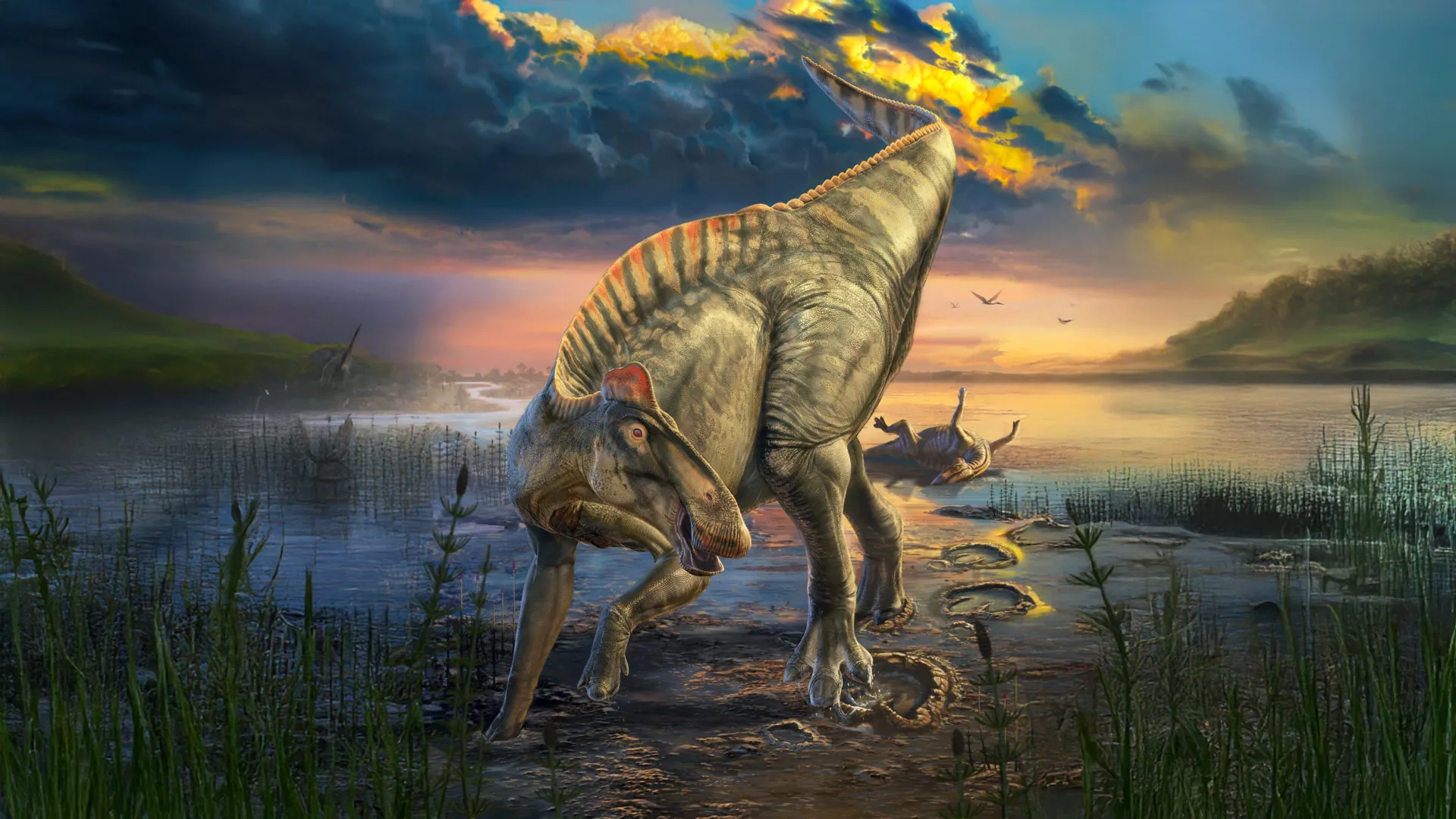
In a groundbreaking study published in the prestigious journal Science, researchers from the University of Chicago have unveiled the extraordinary mechanism behind the preservation of remarkably detailed dinosaur "mummies" from approximately 66 million years ago. These fossils, belonging to the duck-billed dinosaur Edmontosaurus annectens, offer an unparalleled glimpse into the external anatomy of a large prehistoric reptile, including minute features of skin, scales, and even hooves. The team has coined the unique preservation process "clay templating," where a delicate, wafer-thin clay coating, less than 1/100th of an inch thick, settled over the animal’s outer soft tissues after burial, effectively forming a three-dimensional mask that meticulously captured its surface contours.
This monumental discovery, spearheaded by a multidisciplinary team, leverages advanced imaging techniques to digitally reconstruct the dinosaur’s appearance in life with unprecedented accuracy. The reconstructions reveal anatomical features long speculated about but never before definitively documented, including a prominent crest adorning the neck and torso, a distinctive row of spikes tracing the length of the tail, and robust hooves enclosing the toes. When integrated with data from fossilized footprints, the comprehensive profile of this iconic duck-billed dinosaur emerges with startling clarity, fundamentally altering previous artistic and scientific representations.
Unveiling the "Clay Templating" Phenomenon
The rarity of soft-tissue preservation in the fossil record makes the Edmontosaurus mummies an exceptional find. While skeletal remains are common, the delicate skin, muscles, and other external features typically decompose rapidly after death, leaving little trace for paleontologists. "Clay templating" offers a novel explanation for this extraordinary phenomenon, distinguishing these dinosaur mummies sharply from the human-created mummies found in ancient Egyptian tombs. Unlike the latter, where original organic material is meticulously preserved, the dinosaur mummies contain no remnant of the animal’s original soft tissues. Instead, the preserved skin, spikes, and hooves exist as an exquisitely thin mineral cast.
The researchers propose a specific, yet fortuitous, sequence of events that led to this unique preservation style. Following the death of the Edmontosaurus, their bodies likely underwent a period of desiccation under the sun, a crucial step that would have helped maintain the structural integrity of the outer layers. Subsequently, these carcasses were rapidly buried, most probably during sudden and intense flash floods. In the wet, anoxic sediment, a microbial film would have developed on the outer surface of the decaying carcass. This film, through electrostatic forces, acted as a magnet, attracting clay particles from the surrounding environment. Over time, this interaction created a robust yet incredibly thin clay template that faithfully mirrored the dinosaur’s external morphology in three dimensions. As geological timescales advanced, the underlying soft tissues decayed entirely, leaving behind the clay film and the skeleton, which then underwent traditional fossilization processes, wherein organic material is replaced by minerals.
To unravel the intricacies of this ultra-thin preservation, the scientific team employed a sophisticated arsenal of imaging and analytical methodologies. These included high-resolution hospital and micro-CT scans, allowing for detailed internal and external structural analysis without destructive sampling. Thin sections provided microscopic views of the clay layers, while X-ray spectroscopy and clay mineral analyses identified the precise chemical composition and mineralogy of the preserving medium. Furthermore, a meticulous study of the specific rock layers where the fossils were discovered offered critical geological context, corroborating the rapid burial and environmental conditions hypothesized for the "mummy zone."
A Glimpse into the Past: Redefining Edmontosaurus Anatomy
The two newly excavated Edmontosaurus mummies – one a younger individual and the other somewhat older – provided continuous and extensive patches of external skin surface, offering critical data points that, when combined, allowed for the construction of a complete and fleshy profile of Edmontosaurus annectens. This species, a late-surviving member of the Hadrosauridae family, thrived in North America during the late Maastrichtian stage of the Late Cretaceous period, just prior to the devastating K-Pg extinction event approximately 66 million years ago. Reaching lengths of over 40 feet and weighing up to 4 tons, Edmontosaurus was one of the largest duck-billed dinosaurs, known for its massive dental batteries adapted for processing tough plant material.
The Crest and Spikes: An Unexpected Ornamentation
One of the most striking revelations was the discovery of a continuous, elaborate feature running along the dinosaur’s dorsal midline. This structure began as a fleshy, tall crest over the neck and torso, a characteristic previously unknown for Edmontosaurus annectens and often only hypothesized for other hadrosaurs based on cranial crests. Over the hips, this feature transitioned seamlessly into a single row of prominent spikes, meticulously aligned with each underlying vertebra and interlocking neatly with its neighbors along the tail. This intricate dorsal ornamentation would have presented a formidable display, potentially playing roles in species recognition, sexual display, or even defense. The precise nature and extent of this crest and spike arrangement were entirely absent from previous skeletal reconstructions, underscoring the transformative power of soft-tissue preservation.
Scales and Skin Texture: A Fine Detail in a Giant
The mummies also provided unprecedented detail on the dinosaur’s integumentary patterns. The researchers documented two primary types of scales. Larger, polygonal scales were concentrated along the lower body and tail, likely providing increased durability in areas prone to abrasion. However, surprisingly, the vast majority of the animal’s body was covered in remarkably small, pebble-like scales, measuring only 1-4 millimeters across. This is an unexpectedly fine texture for a dinosaur that could grow to such immense proportions. Furthermore, delicate wrinkles preserved over the ribcage indicate that the skin of Edmontosaurus annectens was relatively thin, challenging potential assumptions of thick, armor-like hide, and suggesting a more flexible and perhaps sensitive outer layer.
The Revelation of Dinosaur Hooves: A Paradigm Shift
Perhaps the most unexpected and scientifically significant discovery came from the larger mummy’s hind feet: Edmontosaurus annectens possessed hooves. The tips of each of the three hind toes were encased in a robust, wedge-shaped hoof with a flat underside, bearing a striking resemblance to the hooves of modern horses. This finding revolutionizes our understanding of dinosaur locomotion and foot anatomy. To confirm this remarkable feature, the researchers meticulously combined high-resolution CT scans of the mummified feet with 3D images obtained from the best-preserved duckbill footprint from the same geological period. By carefully aligning the preserved bones and soft-tissue impressions within the footprint, they were able to produce a highly detailed and accurate reconstruction of the hind foot. The reconstruction further revealed that, unlike the forefoot—which made ground contact primarily through its hooves—the hind feet also featured a substantial fleshy heel pad situated behind the hooves, suggesting a different load-bearing and locomotive dynamic between the front and rear limbs.
Senior author Paul Sereno, PhD, Professor of Organismal Biology and Anatomy at UChicago, highlighted the profound implications of this discovery: "There are so many amazing ‘firsts’ preserved in these duck-billed mummies—the earliest hooves documented in a land vertebrate, the first confirmed hooved reptile, and the first hooved four-legged animal with different forelimb and hindlimb posture." These revelations force a re-evaluation of how we categorize and understand the evolutionary development of specialized limb structures in vertebrates, placing Edmontosaurus in a unique position within the broader tapestry of life on Earth.
The Resurgence of Wyoming’s "Mummy Zone"
The extraordinary fossils originated from the badlands of east-central Wyoming, a region now recognized as a unique "mummy zone." This area had yielded several classic dinosaur mummies in the early 1900s, discoveries that, while remarkable, lacked the modern technological capabilities for in-depth analysis. Leveraging old field photographs and meticulous detective work, Sereno and his colleagues embarked on an ambitious project to retrace and precisely map the original discovery locations. Their efforts led to the identification of a compact "mummy zone" within specific rock layers, characterized by stacked river sands – an environment consistent with the rapid burial and depositional conditions necessary for "clay templating."
The team’s renewed excavations in this historically significant area led to the uncovering of the two new Edmontosaurus mummies. These specimens, collected over years of dedicated fieldwork, often involving university undergraduates, provided the crucial, continuous patches of external skin surface that proved indispensable for building a complete, fleshed-out profile of the animal. Sereno underscored the invaluable contributions of the field teams, emphasizing that "the badlands in Wyoming where the finds were made is a unique ‘mummy zone’ that has more surprises in store from fossils collected over years of visits by teams of university undergrads." This collaborative, generational approach to fieldwork underscores the sustained effort required for such discoveries.
Scientific Methodology and Digital Reconstruction
Revealing and analyzing a boundary as delicate as the paper-thin clay layer required not only advanced technology but also painstaking human skill. Fossil Lab manager Tyler Keillor, a co-author on the study, led countless hours of meticulous preparation, carefully exposing the crucial surfaces without risking their destruction. This painstaking manual work was foundational to the subsequent analytical phases.
Another critical component of the research was led by postdoctoral scholar Evan Saitta, whose team relied on a combination of 3D surface imaging, CT scans, and comparative analyses with existing fossil footprints from the same geological period. They meticulously traced the preserved soft anatomy, examined the sedimentary matrix both inside and outside the mummy, and precisely matched the dinosaur’s hooves back into a corresponding footprint. This detailed reconciliation between the preserved soft tissue and trace fossils provided a robust framework for reconstruction. Finally, digital artists worked in close collaboration with the scientists, translating the scientific data into lifelike reconstructions that not only depicted the Edmontosaurus‘s static appearance but also how it might have moved and walked across the soft, muddy landscapes of the Late Cretaceous, near the very end of the age of dinosaurs. Sereno emphasized the importance of this interdisciplinary approach, stating, "I believe it’s worth taking the time to assemble a dream team in order to generate science that can be appreciated by the general public."
Broader Implications for Paleontology
Beyond revealing striking new anatomical details, this research provides a comprehensive and practical framework that promises to revolutionize future studies of dinosaur soft tissue. The authors have meticulously outlined novel preparation techniques specifically adapted for these fragile clay templates, established a clear and consistent set of terms for describing soft structures and various scale types, and detailed a step-by-step imaging pathway from initial fossil specimen to a fully fleshed-out digital model. Crucially, they have also presented a compelling "recipe" for how dinosaur mummification can occur under natural conditions, offering a testable hypothesis for future discoveries.
This work transcends a mere series of isolated findings; it proposes a generalized model for dinosaur mummification based on "clay templating." This model can now be rigorously tested against other fossils that exhibit unusual preservation, potentially unlocking secrets from other geological periods and locales. The paleontological community is abuzz with these findings, recognizing the significant leap forward in understanding not only Edmontosaurus but also the broader taphonomic processes that govern fossil preservation. Experts suggest this discovery marks a significant advancement in paleontology, offering a template for how interdisciplinary research can unravel long-standing mysteries about extinct life.
The team has already highlighted the critical next steps in this line of inquiry. These include focused searches for additional specimens exhibiting this rare type of preservation, not only within the known Wyoming "mummy zone" but also in other promising sedimentary rock layers globally. Furthermore, the newly acquired accurate external body outlines will enable more precise biomechanical studies, allowing scientists to model dinosaur locomotion, musculature, and physiology with unprecedented fidelity. Complementary analyses will also be designed to understand the precise environmental and geological conditions under which "clay templating" is most likely to occur, guiding future expeditions.
Paul Sereno encapsulated the significance of the entire endeavor, stating, "This may be the single best paper I’ve released. From field to lab to 3D reconstructions along with a suite of useful terms defined, it’s a tour de force, and it tells a coherent story about how these remarkable fossils come to be and what we can learn from them." The Edmontosaurus mummies, preserved through a geological fluke, offer a vivid and tactile connection to a world that vanished 66 million years ago, just in time, Sereno quipped, "for Halloween." The insights gleaned from these ancient remains continue to reshape our understanding of dinosaur biology, evolution, and the extraordinary processes that allow glimpses into Earth’s deep past.
