
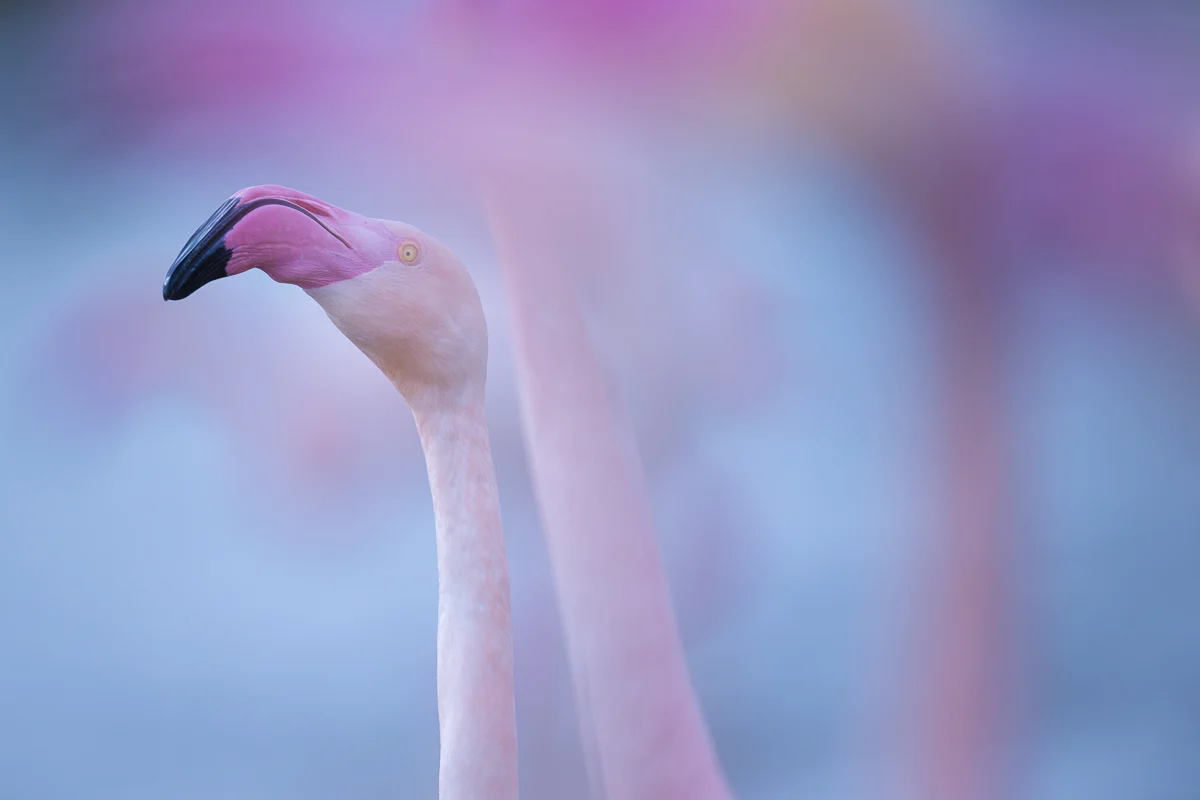
In the contemporary landscape of wildlife photography, the prevailing technical obsession often leans heavily toward absolute optical sharpness, lightning-fast autofocus tracking, and resolving microscopic detail on feathers and fur. However, a growing faction of professional conservation photographers and visual artists is deliberately shifting focus toward what lies entirely out of frame or purposefully blurred. By integrating soft, out-of-focus elements directly into the foreground of a composition, photographers are transforming straightforward documentary captures into evocative, painterly interpretations of the natural world. This technique, commonly referred to as foreground blurring or natural framing, challenges the traditional dogma of hyper-clarity, offering a nuanced approach that prioritizes mood, atmosphere, and emotional resonance over clinical precision.

To understand the mechanics and aesthetic implications of this approach, one must examine how the human eye naturally perceives space. In a three-dimensional environment, human vision rarely isolates a subject in a vacuum; rather, obstacles, vegetation, shifting light, and atmospheric particles continually pass through our field of view. When a photographer places an obstruction—such as a branch, a blade of grass, or even another animal—extremely close to the camera lens and renders it entirely out of focus, it mimics this natural optical filtering. Rather than serving as a distraction, this soft veil creates an immediate sense of profound depth, pulling the viewer past the barrier and into an intimate, concealed relationship with the subject.
Industry data and visual arts analyses indicate a rising appreciation for impressionistic and minimalist approaches within nature and wildlife portfolios. Competitions such as Wildlife Photographer of the Year and Nature Photographer of the Year have increasingly recognized images that favor artistic interpretation, tonal harmony, and atmospheric storytelling over mere technical documentation. This evolution reflects a broader cultural shift in how audiences consume imagery, moving away from flat, encyclopedic representations of wildlife toward deeply immersive visual narratives that evoke the raw, unpredictable essence of wild habitats.

The historical evolution of soft-focus and atmospheric techniques in photography dates back to the pictorialist movement of the late 19th and early 20th centuries, when photographers sought to emulate the look of paintings and etchings. Pioneers of the craft utilized soft-focus lenses, textured filters, and specialized printing processes to soften harsh details and elevate photography to a fine art medium. In the realm of wildlife photography, this philosophy was initially constrained by heavy, slow equipment and primitive film stocks with limited ISO latitudes. Early wildlife pioneers rarely had the optical luxury or shutter speeds required to experiment with extreme foreground separation while freezing erratic animal movements.
However, the advent of modern digital sensor technology, high-speed continuous shooting, and advanced telephoto optics has revolutionized field practices. During the digital transition of the early 2000s, telephoto lenses with wide maximum apertures—such as the 300mm f/2.8, 400mm f/2.8, and 500mm f/4—became more widely accessible to professional and advanced amateur practitioners. These ultra-fast lenses possess exceptionally shallow depths of field, making it mathematically effortless to dissolve foreground elements into creamy, abstract washes of color and light. Over the past two decades, as camera sensors gained superior low-light performance and dynamic range, photographers began systematically pushing the boundaries of lens physics, intentionally positioning foliage and natural debris directly against their front elements to sculpt light and shadow in real time.

Implementing foreground blur successfully in the field requires a delicate balance of opportunistic reaction and meticulous environmental control. Wildlife photographers generally categorize their working methods into two distinct operational environments: controlled setups and dynamic field encounters. In controlled environments, such as permanent wildlife hides, blinds, or specialized feeding stations managed for conservation and photography, practitioners maintain a high degree of agency over their surroundings. Within these spaces, photographers can meticulously arrange natural branches, position water features, or wait for specific lighting conditions to align with a pre-visualized composition.
Conversely, dynamic field encounters—often described by field photographers as reactive photographic hunts—offer virtually no control over the immediate environment. When tracking mobile species across expansive landscapes, photographers must rely entirely on intuition, spatial awareness, and rapid decision-making. In these scenarios, the presence of a natural screen, such as a thicket of high-altitude shrubs, morning mist, or drifting snow, must be utilized on the fly. The photographer must adjust their physical position by inches to allow a wild animal to move naturally into a pre-determined visual corridor, aligning the out-of-focus foreground elements with the subject’s eye line or silhouette.

Wildlife conservationists and ethical field practitioners emphasize that the pursuit of artistic framing must never compromise the welfare of the subject. Ethical guidelines established by major nature photography organizations mandate that photographers maintain safe distances, avoid altering critical habitat during sensitive breeding seasons, and refrain from stressing animals to achieve a specific compositional goal. Consequently, utilizing natural elements already present within the ecosystem—such as native underbrush, ambient atmospheric haze, or naturally occurring shadows—is widely regarded as the most responsible method for achieving soft atmospheres without disturbing wildlife behavior.
From a technical standpoint, mastering foreground blurs demands a departure from standard autofocus protocols. Modern mirrorless and DSLR camera systems rely heavily on phase-detection autofocus points that track contrast and movement. When a large, out-of-focus object occupies the immediate foreground, sophisticated autofocus algorithms can become confused, repeatedly attempting to snap focus onto the barrier rather than the distant subject. To circumvent this limitation, professional wildlife photographers frequently switch to manual focus or utilize specialized autofocus limiter switches and pin-point focus modes. This ensures the lens locks onto the intended subject while allowing the foreground element to remain gloriously, abstractly blurred.

Furthermore, the choice of lens focal length and aperture setting directly dictates the physical character of the blur, often referred to in photography by the Japanese term bokeh. Wide-aperture telephoto lenses render foreground objects as soft, luminous washes that can completely obscure distracting background elements, effectively isolating the animal within a cocoon of gentle light. Depending on the density and distance of the obstructing element, photographers can create various visual structures:
- Complete foreground veils that drape a hazy, ethereal layer across the entire frame.
- Partial framing devices, such as "look-throughs," where the camera lens is pointed through a natural aperture in foliage.
- Ground-level "look-overs," where blurred grasses fill the lower third of the composition to anchor the image and establish a sense of place.
Professional analysis of contemporary nature portfolios reveals that these techniques are most successfully deployed in portraiture and intimate behavioral studies. In high-speed action genres—such as raptors diving, mammalian predators in high-speed pursuit, or large herds migrating—the rapid pace of events leaves little margin for error, rendering deliberate foreground placement nearly impossible. However, in quieter moments—such as a capercaillie displaying at a forest lek, a deer resting in early morning frost, or a lone bird perched amidst spring foliage—the introduction of soft atmospheres elevates the image from a mere species identification record into a profound narrative statement.

Industry leaders and master photographers who champion this aesthetic argue that the integration of foreground blur fosters a deeper psychological connection between the viewer and the natural world. By leaving certain details to the imagination and guiding the eye along a curated visual journey, these images evoke the quiet solitude of the wilderness. As the photographic community continues to explore the intersection of technical capability and artistic expression, the deliberate use of soft atmospheres stands out as a powerful reminder that what is left unsaid—or unseen—is often just as important as what is laid bare before the lens.
