
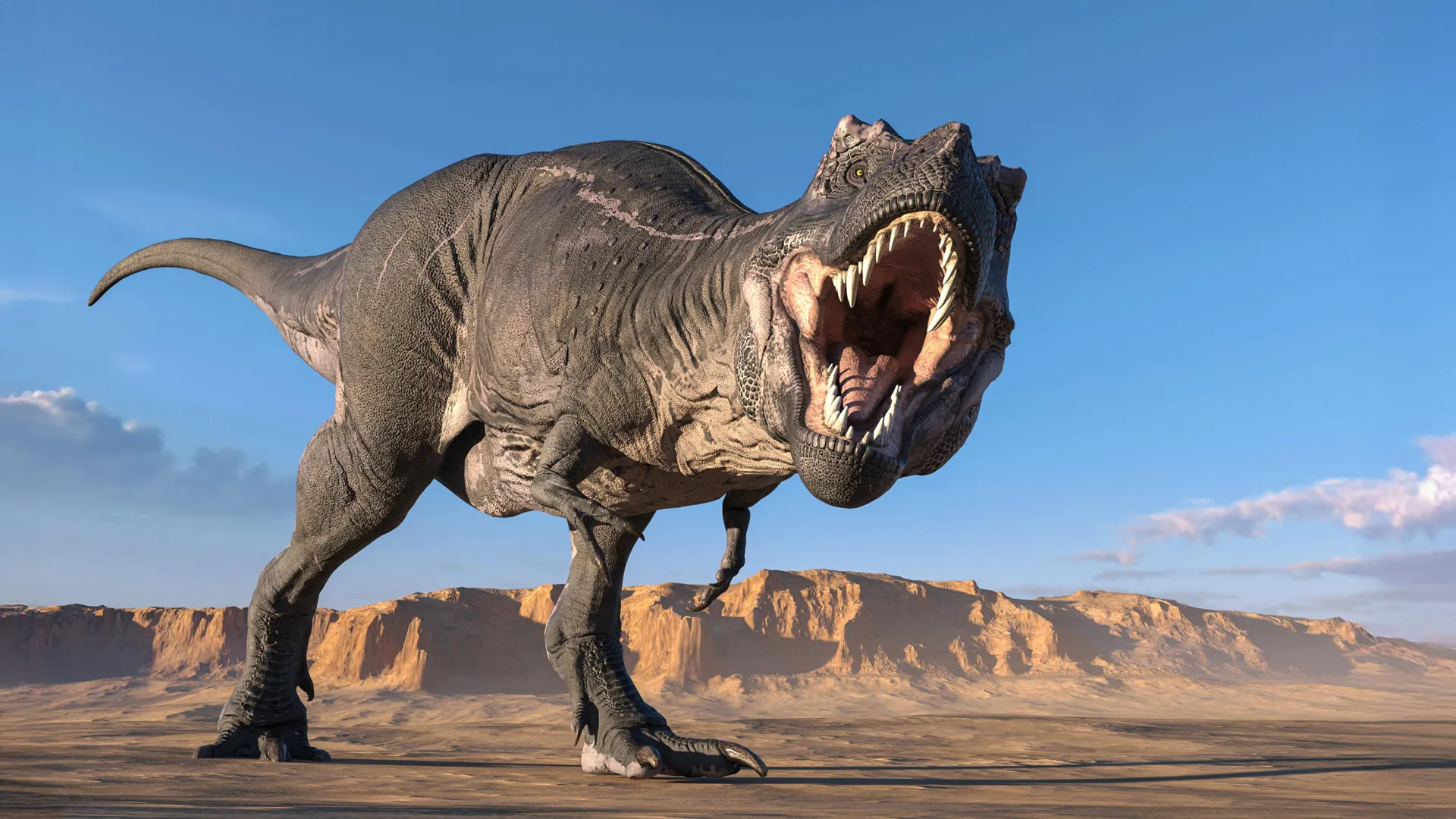
For more than a century, the fundamental biology of Tyrannosaurus rex has been reconstructed primarily from static fragments: fossilized bones, serrated teeth, heavy footprints, and scattered trace fossils left behind more than 60 million years ago. These artifacts painted a vivid picture of a towering apex predator, but a central physiological question remained stubbornly unanswered: Was the king of the dinosaurs a sluggish, cold-blooded reptile dependent on the sun’s warmth, or a dynamic, warm-blooded animal with an internal furnace closer to that of modern mammals and birds? While previous discoveries of T. rex fossils as far north as Alaska hinted at a creature capable of enduring harsh cold conditions—strongly implying a departure from traditional reptile biology—concrete physiological proof remained elusive.
Now, a team of researchers at the University of California, Los Angeles (UCLA), has achieved what was once considered impossible. By developing and refining a novel geochemical technique, scientists have effectively taken the body temperature of T. rex, bypassing millions of years of evolutionary history to read the thermal signature locked inside fossilized teeth.
Main Facts and the Groundbreaking Discovery
Published in the September 16 issue of the scientific journal Science Advances, the study reveals that T. rex maintained a steady body temperature of approximately 97 degrees Fahrenheit (36 degrees Celsius). This reading places the iconic dinosaur remarkably close to the average internal temperature of a modern human, bridging a crucial gap in our understanding of dinosaurian physiology.
The finding heavily reinforces the prevailing scientific consensus that T. rex was an active, high-metabolism predator or scavenger rather than a sluggish basking animal. Furthermore, the ability to generate and internally regulate body heat sheds light on how tyrannosaurs successfully colonized and survived in polar regions that would have been entirely inhospitable to typical cold-blooded reptiles.
Although various anatomical and ecological lines of evidence have increasingly pointed toward warm-bloodedness in dinosaurs over recent decades, this research provides the first empirical temperature measurement for Tyrannosaurus rex. The study was spearheaded by UCLA geobiologist Robert Eagle and lead author Randy Flores, in collaboration with an international team of paleontologists and geochemists, including Alessandro Chiarenza of University College London.
A Decade of Technological Refinement: The Evolution of a Fossil Thermometer
The journey to taking a dinosaur’s temperature began approximately ten years ago, when UCLA researchers first set out to determine whether extinct creatures were endothermic (warm-blooded) or ectothermic (cold-blooded). Their innovative method targeted the chemical composition of skeletal remains, but applying it to T. rex immediately hit a major methodological wall.
The initial iteration of the technique required a substantial amount of fossil material—far more than any reputable museum would reasonably allow scientists to extract from such an iconic, rare, and irreplaceable specimen. Preserving the structural and aesthetic integrity of museum pieces routinely takes precedence over destructive testing.
Determined to overcome this obstacle, the UCLA research team spent the subsequent decade dramatically optimizing their methodology. Through meticulous engineering and chemical refinement, they successfully reduced the quantity of ancient tooth material required for testing by roughly 90 percent.
This technological leap was the turning point. Armed with a technique that required only minute, non-destructive samples, the research team approached the Natural History Museum of Los Angeles County (NHM). Convinced by the precision of the updated protocol, museum authorities agreed to grant access to tiny portions of two teeth belonging to "Thomas"—one of the most complete T. rex skeletons housed within the institution’s dinosaur hall.
Inside the Science: How the Geochemical Thermometer Works
The underlying mechanism of this breakthrough relies on microscopic chemical bonds preserved safely within tooth enamel over tens of millions of years.
During the formation of enamel, rare isotopes of carbon and oxygen occasionally bond together. The frequency with which these specific isotope bonds form is dictated directly by temperature: cooler conditions encourage a higher rate of bond formation, while warmer environments inhibit them. By measuring the abundance of these bonded pairs within fossilized enamel, scientists can effectively read an ancient thermometer frozen in time.
While researchers theoretically could apply this isotope analysis to any skeletal remains, bones present a major complication. Biological bone is dynamic; it is constantly remodeled, dissolved, and replaced throughout an animal’s life. Tooth enamel, however, features large, highly durable crystalline structures that resist chemical alteration by groundwater and environmental pressures over eons, making it the most pristine chemical archive in the vertebrate skeleton.
To execute the analysis, Eagle and Flores used a specialized dental drill to harvest a minute quantity of powdered enamel from the T. rex teeth. This powder was then dissolved in phosphoric acid, releasing carbon dioxide gas containing the coveted isotope bonds. A high-precision mass spectrometer subsequently measured the isotope ratios within the gas. To compensate for the minuscule sample size, the researchers pressurized the gas, generating a denser stream of carbon dioxide that allowed the mass spectrometer to yield accurate, usable measurements from unprecedentedly small quantities of fossil material.
Chronology of Discovery and Comparative Analysis
The timeline of this research underscores the cautious, rigorous nature of modern paleontology. Following the initial conceptualization of the isotope-clumping thermometer a decade ago, years were consumed by miniaturizing the required sample threshold. Once the UCLA team achieved their 90 percent reduction in material requirements, negotiations with museum curators began.
The testing of Thomas the T. rex was not performed in a vacuum. To ensure that geological contamination or environmental heat over millions of years had not skewed the results, the researchers analyzed ancient crocodilian fossils excavated from the exact same geological formation: the Hell Creek formation in Montana.
The results provided a crucial biological control. While the T. rex registered a warm 36 degrees Celsius (97 degrees Fahrenheit), the contemporaneous crocodilian fossils yielded a body temperature of 30 degrees Celsius (86 degrees Fahrenheit). This sharp divergence ruled out the possibility that regional geological processes had uniformly altered the molecular composition of all fossils at the site. If the surrounding earth had chemically rewritten the isotopic signatures, both animals would have displayed identical temperature readings. Instead, the contrasting data confirmed that the measurements reflected genuine, intrinsic biological differences between the species.
Contextualizing the T. rex data further clarifies its evolutionary standing. Modern cold-blooded reptiles generally maintain internal temperatures ranging from 28 to 30 degrees Celsius (82 to 86 degrees Fahrenheit), while modern birds—the direct evolutionary descendants of theropod dinosaurs—often exhibit much higher body temperatures between 40 and 43 degrees Celsius (104 to 109 degrees Fahrenheit). At 36 degrees Celsius, T. rex occupied a distinct metabolic middle ground: much warmer than a standard reptile or a sluggish mammal like a sloth, yet slightly cooler than modern avian species.
Official Responses and the Ethics of Museum Curation
Granting permission to drill into a world-famous dinosaur specimen is a decision fraught with institutional anxiety. Luis Chiappe, curator of the Dinosaur Institute and head of research and collections at the Natural History Museum of Los Angeles County, highlighted the delicate balancing act museums must perform daily.
"We’re asked for fossils for use in destructive analysis all the time," Chiappe noted. "The museum contains tens of millions of specimens of minerals, animals, and fossils that are irreplaceable. We have to make decisions that balance the damage to the specimen against gaining knowledge about the natural world. Sacrificing small portions of two teeth to learn about T. rex’s body temperature is definitely worth the trade-off."
The careful collaboration between UCLA geobiologists and NHM curators ultimately paved the way for a landmark publication, supported in part by grants from the National Science Foundation.
Broader Impact and Implications for Cretaceous Ecology
The confirmation of a 97-degree Fahrenheit body temperature carries profound implications for our understanding of Cretaceous ecosystems and the evolutionary trajectory of dinosaurs.
Maintaining an internally regulated, elevated body heat would have granted T. rex the sustained physical stamina required to hunt active prey or secure scavenging rights across vast territories. A higher metabolism demands immense caloric intake, but it also provides the muscular efficiency and endurance necessary to dominate an ecosystem.
Furthermore, this physiological adaptation solves a longstanding ecological riddle regarding polar dinosaurs. During the Cretaceous Period, Earth experienced a greenhouse climate significantly warmer than today’s global averages. Yet, even within this warmer world, high-latitude environments such as ancient Alaska experienced prolonged, dark, and bitterly cold winters.
While the fossil record of Cretaceous Alaska conspicuously lacks cold-blooded ectotherms such as modern-style lizards, turtles, and crocodiles, Tyrannosaurus remains have been reliably recovered from the region. According to study co-author Alessandro Chiarenza, an internally regulated body temperature provided the evolutionary key that unlocked these forbidding northern territories. By synthesizing the new empirical temperature data with paleoclimate models, researchers can now accurately map a vast prehistoric geographic range stretching from Mexico to the Arctic circle—delineating the precise ecological boundaries where a 97-degree body temperature allowed the king of the dinosaurs to thrive while other reptiles froze out.
