
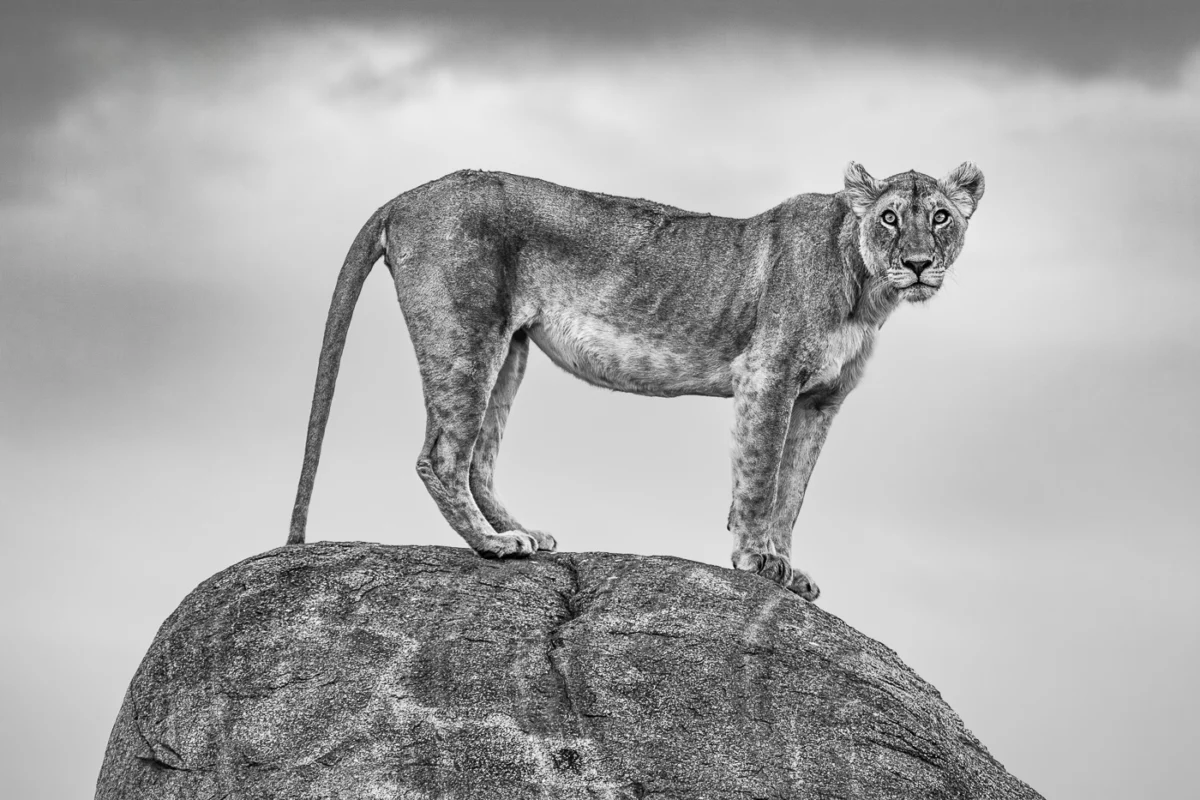
Gabi Guiard’s profound connection to wildlife, cultivated from a tender age, has evolved into a distinctive photographic philosophy that marries the raw essence of nature with the timeless eloquence of black and white. This intrinsic attraction to the animal kingdom, marked by a deep curiosity about behavior and a fascination with presence, fundamentally shaped her worldview and artistic trajectory. While her initial professional path led her into the vibrant world of graphic design and art direction within advertising, the subtle yet persistent pull towards photography, inspired by the masters of monochrome fashion and advertising, ultimately guided her to fuse her two passions: the untamed wilderness and the art of capturing it through the lens.

A Career Forged by Passion: From Advertising to the Wild
Guiard’s journey is a compelling narrative of professional evolution, demonstrating how foundational skills can be repurposed for a higher calling. Her early career in graphic design and art direction immersed her in visual communication, composition, and the profound impact of imagery. This period, rich with exposure to the iconic black-and-white works of esteemed fashion and advertising photographers, laid critical groundwork. It was here that she honed her understanding of light, shadow, form, and narrative – elements that would later become the cornerstones of her wildlife photography. The transition was not an abrupt departure but a gradual convergence, as her growing interest in photography became the natural conduit for applying her refined artistic knowledge to the subjects closest to her heart. This unique blend of commercial art discipline and an innate love for nature distinguishes her approach, allowing her to craft images that are not merely documentation but evocative artistic statements.

Black and White: A Language of the Soul
For Gabi Guiard, black and white is far more than a stylistic choice; it is a fundamental language, an expressive medium through which she articulates her deepest feelings and observations of nature. She asserts that her preference for monochrome is not driven by a desire to appear "artistic" or "classic," but rather by its unparalleled ability to strip away the superfluous and focus on the essential. This deliberate removal of color eliminates potential distractions, forcing the viewer to engage with the core elements of the image: textures, shapes, and the intricate interplay of light and shadow. In an age saturated with high-definition, full-color imagery, Guiard’s commitment to black and white stands as a powerful testament to the enduring potency of simplification. Her work becomes an exercise in visual honesty, presenting reality in its most distilled form, where "what you see is what remains when everything superfluous disappears."

Historically, black and white photography has held a unique place in art and journalism. Born from the earliest photographic processes, it evolved from a technical necessity into a powerful artistic tool. Pioneering photographers like Ansel Adams demonstrated its capacity to convey immense grandeur and detail in landscapes, while portraitists used it to reveal profound human emotion. In the realm of wildlife photography, while color often serves to highlight the vibrancy of species and their habitats, black and white offers an alternative, introspective view. It can elevate an animal from a mere biological specimen to an archetypal figure, emphasizing its form, movement, and intrinsic character without the potential distraction of environmental hues. This tradition underscores Guiard’s philosophy, positioning her within a lineage of artists who leverage monochrome for its expressive depth rather than its historical quaintness.
The Essential Over the Superfluous: A Philosophy of Focus

Guiard’s artistic philosophy is firmly rooted in the belief that true impact lies not in comprehensive detail but in selective revelation. "Simplifying reality and taking it to the most essential so that the wild character of nature takes center stage," she states, encapsulating her core objective. This principle dictates that a solitary gaze, a distinctive silhouette, or a subtle gesture should suffice to narrate a compelling story. In her black-and-white renditions, the aim is to forge an immediate, unmediated connection between the viewer and the inherent strength of the moment. By excising extraneous elements, she endeavors to evoke the "silence of the instant," allowing the raw power and dignity of her subjects to resonate without visual clutter.
This approach aligns with the broader artistic concept of minimalism, which emphasizes simplicity and the reduction of elements to their fundamental components. In photography, minimalism often involves vast negative space, strong lines, and a singular, impactful subject. For wildlife photography, this means isolating the animal, focusing on its form against a stark background, or highlighting a specific interaction. This deliberate choice to show "what truly matters" contrasts sharply with the often overwhelming visual information present in many modern wildlife photographs. The implication is that by reducing the visual "noise," the viewer is compelled to delve deeper, to interpret, and to feel, rather than merely observe.

Less Is More: Guiding the Viewer’s Gaze
The adage "less is more" is a guiding tenet in Guiard’s practice. She believes that by simplifying an image, she effectively removes distractions, directing the viewer’s attention precisely to the critical elements. A single gesture, the interplay of shadow, a penetrating look, or a decisive line can imbue a photograph with immense power. This reductionist approach ensures that the viewer is not overwhelmed by unnecessary details but is instead drawn organically to the very essence of the scene. The "apparent emptiness" or "noise-free space" that results from this simplification is not a void but an invitation—a canvas upon which each observer can project their own emotions and complete the narrative with their individual experiences. This interactive quality fosters a more profound and personal engagement with her work.

Composition as the Backbone: Structuring Emotion
Composition, in Guiard’s oeuvre, transcends mere arrangement; it is the structural backbone of every photograph, a deliberate guide for the viewer’s eye towards the narrative she intends to unfold. In black-and-white photography, where the vibrant cues of color are absent, composition assumes an even more paramount role. Lines, shapes, and the strategic use of space become critical tools for establishing visual harmony and tension. The precise placement of an animal within its environment, the delicate balance between areas of light and shadow, and the evocative power of empty space—all coalesce to create a coherent and impactful visual statement.

Guiard frequently seeks simplicity in her compositions, meticulously avoiding superfluous elements that could dilute the message. She cites examples such as a diagonal line drawing the eye to a lion’s gaze, the organic curve of a tree framing a powerful silhouette, or the intentional negative space surrounding a subject, all capable of generating strength and intimacy. This deliberate manipulation of visual elements transforms the photograph from a mere snapshot into a carefully constructed experience. Her understanding of composition is not rigid adherence to rules but an intuitive grasp of when to subtly bend them to elicit a stronger emotional response. It is the "invisible structure that allows the image to breathe and, at the same time, gives it power." This mastery of composition, combined with her monochrome palette, ensures that every image is both visually arresting and deeply resonant.
Contrast as a Tool: Painting with Light and Shadow

For Guiard, light and shadow are not simply photographic phenomena; they are the fundamental "brushes" with which she paints each image. Contrast, in her artistic vocabulary, is not merely an aesthetic choice but a potent communicative device. The deep blacks serve to obscure what she deems unnecessary, guiding the viewer away from peripheral details, while the illuminating lights reveal precisely what she wishes the observer to feel and understand. In the absence of color, shadows assume an extraordinary weight, becoming as significant to the narrative as the subjects themselves. They define form, create mood, and add layers of mystery and depth, transforming the two-dimensional image into a multi-sensory experience.
The effective use of contrast in black-and-white photography is a cornerstone of its enduring appeal. High contrast can create drama and intensity, drawing stark lines between light and dark, while subtle gradations can evoke softness and nuance. Guiard’s application of contrast allows her to sculpt her subjects, emphasizing their strength, vulnerability, or majesty. This technique is particularly effective in wildlife photography, where the natural environment offers a rich tapestry of textures and forms that are amplified when stripped of color. The interplay of light filtering through leaves, the texture of fur, or the stark outline of an animal against a bright sky becomes intensely dramatic, serving to heighten the emotional impact of the scene.

Emotion Behind Every Image: The Soul of the Wild
While Guiard’s photographs originate from meticulous observation of wildlife, her ultimate quest is the evocation of emotion. Her objective transcends mere depiction; she strives for her images to convey a deeper resonance—be it power, solitude, majesty, or even fragility. Lions, for instance, are not merely biological subjects but symbolic "kings and queens of a territory that breathes at its own rhythm." Each photograph, in her vision, endeavors to preserve a fragment of their story: a tranquil gaze harboring immense strength, a serene gesture communicating profound dignity. This approach elevates her work beyond reportage, positioning it as an interpretive art form that seeks to reveal the intrinsic spirit of her subjects.

The choice of black and white serves to intensify this emotional narrative, compelling the viewer to focus on the irreducible core of the subject. Without the immediate cognitive processing of color, the brain is free to engage more deeply with the forms, expressions, and implied narratives. This can lead to a more direct and potent emotional response. The timelessness inherent in monochrome further amplifies this, allowing the images to transcend specific moments and speak to universal themes of wildness, existence, and connection.
The Timelessness of Black and White: An Eternal Dialogue

One of the most compelling reasons Guiard embraces black and white is its inherent timelessness. She observes that a monochrome photograph taken today possesses a quality that could easily place it decades in the past, and conversely, ensures its impact will remain undiminished decades into the future. This unique characteristic allows her to present nature as an eternal entity, a profound mirror reflecting both our present selves and our historical lineage.
Beyond its historical resonance, the absence of color in her photographs deliberately creates space for individual interpretation, inviting each viewer to project their own memories, experiences, and emotions onto the image. This interactive quality transforms every photograph into an intimate dialogue between the artwork and its observer, fostering a deeply personal and reflective experience. In an era dominated by fleeting digital content, Guiard’s timeless monochrome compositions offer a deliberate pause, an invitation to contemplation that transcends the ephemeral. This approach has significant implications for conservation messaging, as images that evoke a timeless sense of wonder and fragility can foster a deeper, more enduring connection to the natural world and inspire action to protect it.

Technique, Yes… but Above All, Sensitivity
Guiard acknowledges the undeniable role of technique in her craft—the meticulous pursuit of optimal light, the precise execution of composition, and the unwavering attention to detail. However, she emphatically states that the true meaning and power of her work derive primarily from the sensitivity with which she observes her subjects. This sensitivity manifests in critical artistic decisions: discerning what to reveal and what to deliberately conceal within the shadows, knowing the precise moment to release the shutter, and understanding when to simply remain silent, observing without intrusion.

She firmly believes that technique, in isolation, is devoid of narrative power. It is only when technical proficiency converges with profound sensitivity that a photograph is truly born—an image capable of moving the spirit, inspiring introspection, and inviting profound reflection. This philosophy underscores the human element at the heart of her art, positing that the emotional intelligence and empathetic connection of the photographer are as crucial as the camera settings or compositional rules. This balance between technical mastery and emotional depth is what elevates Guiard’s wildlife photography from mere documentation to profound artistic expression.
Implications for Wildlife Photography and Conservation

Gabi Guiard’s distinctive approach to black-and-white wildlife photography carries significant implications for both the artistic genre and the broader field of conservation. In a world increasingly inundated with vibrant, high-definition color images of wildlife, her monochrome work offers a refreshing counterpoint. By simplifying the visual information, she forces viewers to engage on a deeper, more emotional and intellectual level, bypassing the immediate aesthetic appeal of color to connect with the subject’s intrinsic character and story. This can be particularly powerful in conservation efforts, as it moves beyond showcasing biodiversity to fostering empathy and a timeless appreciation for the wild.
Her emphasis on "less is more" and the power of composition provides a valuable lesson for aspiring wildlife photographers, highlighting that impact often comes from careful observation and selective framing rather than sheer technical complexity or exotic subject matter. It champions the idea that compelling narratives can be found in a single gaze or a subtle silhouette, encouraging a more thoughtful and artistic engagement with subjects.

Furthermore, the timeless quality of her black-and-white images ensures their longevity and continued relevance. In a rapidly changing world, photographs that evoke a sense of the eternal can serve as powerful reminders of what is at stake and the enduring beauty that requires protection. Her work, by transcending the specifics of a particular time or place, speaks to universal themes of nature’s majesty and fragility, potentially reaching a wider audience and inspiring a deeper, more enduring commitment to conservation.
In Summary: The Guiding Principles of a Monochrome Vision

Gabi Guiard’s compelling body of work is anchored in a set of foundational principles that define her artistic vision:
- Monochrome as a Language: Black and white is not a stylistic filter but a deliberate choice to communicate the essence of nature.
- Focus on the Essential: Stripping away distractions to highlight textures, shapes, and the core narrative.
- The Power of Simplicity: Embracing "less is more" to guide the viewer’s gaze and evoke personal emotion.
- Composition as Narrative: Utilizing lines, shapes, and space to build harmony, tension, and direct the story.
- Contrast as Expression: Employing light and shadow to reveal and conceal, adding depth and emotion.
- Emotion over Depiction: Aiming to convey profound feelings rather than just illustrating subjects.
- Timelessness: Creating images that transcend time, fostering an intimate dialogue with the observer.
- Sensitivity as the Soul: Merging technical skill with deep observation to create photographs that move and inspire.
For Guiard, black and white is not merely an artistic technique; it is a vital philosophical choice. It represents her deliberate act of inviting silence into the visual cacophony of the world, allowing her to truly listen to the profound narratives that nature perpetually unfolds. Within this cultivated silence, she discovers and captures the images that most authentically represent her unique vision and unwavering passion. Her work stands as a powerful testament to the enduring power of art to connect humanity with the wild, fostering not just admiration, but a deeper understanding and respect for the natural world.
