
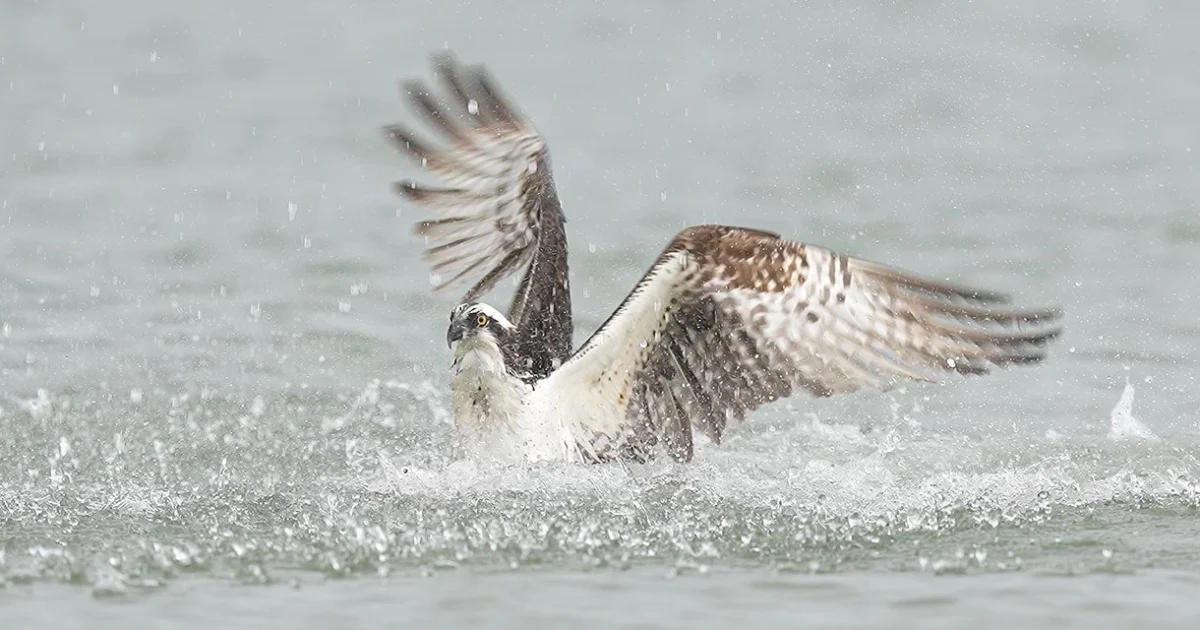
The majestic Osprey, a symbol of nature’s resilience and a testament to successful conservation, is once again facing a perilous decline, particularly in the critical Chesapeake Bay region and along the Atlantic Coast. This dramatic reversal comes decades after the raptor’s celebrated comeback from the brink of extinction caused by DDT, raising urgent questions about human impact on marine ecosystems and the future of an iconic species.
A Return from the Brink: The DDT Legacy and Osprey Resurgence
For many, the sight of an Osprey plunging feet-first into water, talons extended to seize a fish, is one of nature’s most breathtaking spectacles. This long-winged raptor, hovering with precision before a lightning-fast dive at over 40 miles per hour, represents a pinnacle of predatory efficiency. Yet, for much of the 20th century, this sight was increasingly rare, particularly along the Atlantic seaboard. The widespread use of the synthetic insecticide DDT, introduced in the 1940s, had devastating effects on apex predators like Ospreys. The chemical accumulated in the food chain, leading to thinner eggshells in raptors, causing adult birds to inadvertently crush their own progeny during incubation. This ecological catastrophe led to a precipitous drop in Osprey populations, with many traditional nesting grounds, such as Cape Cod, becoming eerily silent.
The turning point arrived with the publication of Rachel Carson’s seminal book, Silent Spring, in 1962. Carson’s meticulously researched exposé on the environmental damage wrought by pesticides ignited public outrage and galvanized a powerful environmental movement. Her work directly led to a comprehensive re-evaluation of DDT’s safety, culminating in the U.S. Environmental Protection Agency (EPA) banning the insecticide in 1972. This landmark decision marked the beginning of a remarkable recovery for Ospreys and numerous other bird species. As the chemical gradually dissipated from the environment, eggshell thickness normalized, and populations began to rebound. By the 1990s, the skies above places like Cape Cod, once devoid of Ospreys, were again filled with their distinctive calls, and nests adorned jetties and specially erected platforms, a poignant testament to collective conservation efforts and a symbol of environmental penance.
A New, Unsettling Silence: The Current Crisis Unfolds
The inspiring narrative of the Osprey’s recovery, however, is now under threat. In recent years, a new, unsettling pattern has emerged from the mid-Atlantic region: Osprey nests are sitting empty, and those adults that do breed are failing to produce young, or their chicks are starving to death. What began as anecdotal reports among birders, fishermen, and local observers has rapidly solidified into a grim reality confirmed by scientific investigation. This new crisis, experts warn, could prove as dire as the DDT era, and the alarm bells are now ringing far beyond the Chesapeake Bay.
The Chesapeake Bay, the largest estuary in the United States and the third largest on Earth, has historically been a stronghold for Ospreys, hosting an estimated 10,000 breeding pairs—close to 20 percent of the global population. This vibrant ecosystem, fed by over 150 rivers and streams, was instrumental in the species’ recovery. For over three decades, Bryan Watts, director of the Center for Conservation Biology (CCB) at William & Mary in Virginia, has meticulously studied the Bay’s Ospreys, with records extending back to the low point of 1,450 breeding pairs in the early 1970s. His recent findings paint a bleak picture. In 2023, a survey of 81 pairs in Mobjack Bay, a sub-estuary of the Chesapeake, yielded a mere three live chicks – a reproductive rate less than one-tenth of what is needed to sustain the local population. Expanding the survey in subsequent years to include 571 nests in the greater Chesapeake in 2024 and 1,025 nests in 2025, Watts and his colleagues found that Ospreys throughout the main stem of the Bay were producing less than half the young required for the population’s survival. This reproductive failure rate is even lower than during the height of the DDT crisis.
The Menhaden Mystery: A Vanishing Food Source
The primary culprit behind this devastating decline, according to Watts, is a severe scarcity of Atlantic menhaden, the Ospreys’ essential food source. "Osprey chicks are starving in their nests," Watts stated, emphasizing the direct link. "And the reason is simple. Their primary food source is menhaden. And that food source is no longer abundant." Data from the CCB reveals a staggering 80 percent drop in the number of menhaden delivered to Osprey nests over the past 40 years. Menhaden are oily, energy-packed, and highly nutritious, making them the perfect meal for Ospreys and other fish-eating predators.
Both Ospreys and menhaden play distinct and crucial ecological roles. Ospreys are considered an "indicator species," their population health reflecting the overall vitality of the ecosystem they inhabit. Menhaden, on the other hand, are a "keystone species," forming the foundational base upon which a vast web of marine life relies. These small, schooling fish swim with their mouths open, filter-feeding on phytoplankton and algae. In doing so, they prevent harmful algal blooms and accumulate omega-3 fatty acids, which then nourish a diverse array of predators: striped bass, bluefish, dolphins, sharks, and numerous fish-eating birds including loons, eagles, gannets, puffins, and herons. Watts’s analysis suggests that the dire state of the indicator species (Ospreys) is a clear warning that the keystone species (menhaden) – and by extension, the entire Chesapeake ecosystem – is in deep trouble. The only Osprey populations showing relative stability in recent studies are those nesting further up tributaries in tidal freshwater areas, where they have access to a greater diversity of fish. In saline areas, where they are heavily menhaden-dependent, nest failures are rampant.
The Industrial Fishery: Competition in the Commons
The scarcity of menhaden is exacerbated by intense competition from human industrial fishing. Virginia is the last state on the East Coast to permit a menhaden reduction fishery, an industry that processes the fish into meal or oil for various commercial products. The primary operator is Omega Protein, a subsidiary of the Canadian company Cooke Inc., with Virginia-based Ocean Harvesters conducting the actual catch. This operation utilizes massive purse seine nets, up to 1,600 feet long, to encircle vast schools of fish. The trapped menhaden are then pumped into vessels for transport to the processing plant in Reedville, Virginia.
Historically, this was a thriving industry along the entire Atlantic Coast, but today, Omega Protein’s Reedville plant is the sole remaining facility. In recent years, Ocean Harvesters has been permitted to harvest approximately 350 million pounds of menhaden annually, including a significant 110 million pounds directly from the Chesapeake Bay. This amounts to roughly 70 percent of the total catch for the entire Atlantic menhaden population. Watts highlighted the stark parallel: "Ospreys go after menhaden because they pack twice as many calories as other fish… Which is the same reason that Omega Protein is after them." Both the birds and the industrial fishery utilize spotter planes to locate the shimmering schools of menhaden, which, though far less numerous than in historical accounts (like the billions-strong schools that stretched for 40 miles, akin to Passenger Pigeon flocks that once darkened the sky), are still visible from above. The critical difference, however, lies in their purpose: Ospreys rely on menhaden for their species’ survival, while Omega Protein grinds them up for pet food, cosmetics, nutritional supplements, and feed for livestock and farmed salmon. This means Atlantic menhaden are increasingly present on our dinner plates, indirectly, as a component of other food products.
A Crisis Spreading North: Eyewitness Accounts Along the Coast
The menhaden crisis and its devastating impact on Ospreys are not confined to the Chesapeake Bay. Evidence of declining populations and starving chicks is emerging further north along the Atlantic Coast. In Colonial Beach, Virginia, Joanie Millward, who founded the Virginia Osprey Foundation, has witnessed a stark decline in her local Osprey community along the Potomac River. Her initial passion for Ospreys, sparked by a nest visible from her home, has turned to despair. She recounted numerous dark narratives: abandoned nests, starved chicks, and even siblicide—where the strongest chick kills its weaker nestmates due to insufficient food. In prior years, Colonial Beach’s 35 nests produced 55 successful fledglings; last summer, that number plummeted to just 8. Millward noted, "It used to be we had so many fledglings that the sky was full of Ospreys… And it was so quiet last summer."
Further north, in New Jersey’s Barnegat Bay, Ben Wurst, a senior wildlife biologist for the Conserve Wildlife Foundation of New Jersey, confirms the grim trend. On Sedge Island, a marine conservation zone, 40 historically successful nests produced only 5 young last year, down from 55 the previous year. Wurst observed the scarcity of adult menhaden, noting that bait fishermen now see only "peanut menhaden"—young, smaller fish—swim through their nets. The once-reliable adult menhaden, a food source for thousands of years, are now scarce. The problem extends to Massachusetts, where Alan Poole, author of Ospreys: A Natural and Unnatural History, reported two out of every three nestlings starving in a robust colony. Volunteers with the Connecticut Audubon Society have also documented incidents of starving chicks and nest abandonment, prompting a study into local fish delivery rates. Tracking apps reveal that Ocean Harvesters’ spotter planes are making frequent trips as far north as Sandy Hook, New Jersey, and even Long Island, New York, fishing in federal waters three nautical miles from shore as menhaden schools shift seasonally.
Compounding Pressures: Climate Change and the Regulatory Labyrinth
The menhaden crisis is not a singular issue but a complex ecological problem compounded by other environmental stressors. Climate change is frequently cited as a contributing factor. Observers like Joanie Millward have noted warmer waters off Colonial Beach, and scientists like Watts suspect that forage fish, including menhaden, are shifting their distribution northwards in search of cooler habitats. Ben Wurst points to more frequent and intense nor’easters keeping menhaden from nearshore waters. Scientists largely agree that climate change exacerbates existing pressures, making both fish and bird populations less resilient to challenges like overfishing.
The regulatory landscape governing menhaden fishing is complex and fraught with contention. The Atlantic States Marine Fisheries Commission (ASMFC) is responsible for regulating the interstate fishery. While the ASMFC has not officially declared Atlantic menhaden "overfished," its technical committee recently concluded that it had overestimated the coastwide population by as much as 37 percent. Crucially, there remains a significant knowledge gap: no one accurately knows the true abundance of menhaden within the Chesapeake Bay itself. Conservationists and other stakeholders universally agree on the urgent need for a robust scientific study of menhaden in these critical coastal waters. However, efforts to secure funding for a comprehensive suite of scientific studies proposed by the Virginia Institute of Marine Science (VIMS), developed with input from diverse stakeholders including industry representatives, failed in the Virginia legislature due to opposition from the fishing industry.
The industry, represented by groups like Ocean Fleet Services (parent company of Ocean Harvesters), argues that blaming Osprey starvation solely on the menhaden fishery is "an oversimplified explanation for a complex ecological issue." They advocate for examining a broader range of factors, including water conditions, abundance of other prey fish, competition from other predators, habitat change, and more. Meanwhile, the Science Center for Marine Fisheries, a cooperative research center partly funded by industry dues and operating "under industry partner oversight," has announced its own research plan, leading to skepticism among some observers regarding its objectivity. These studies, regardless of their funding source, could take years to yield conclusive results, a timeline that starving Ospreys cannot afford.
The Economic Divide and a Glimmer of Hope
The debate over menhaden management is not just an ecological one; it has significant economic implications. Omega Protein and Ocean Harvesters argue that closing or shrinking the reduction fishery would result in job losses for their 270 employees. However, conservationists counter that the collapse of the menhaden population would jeopardize far more livelihoods across the entire marine economy, including bait fishermen, crabbers, lobstermen, and those supporting the lucrative recreational fishery for species like striped bass and bluefin tuna, all of which depend on menhaden as a food source. Don Lyons, director of conservation science for Audubon’s Seabird Institute, underscored this interconnectedness: "The Ospreys are telling us that something is changing. They are telling Omega, too."
Despite the legislative setbacks and regulatory inertia, a powerful and increasingly bipartisan wave of public pressure and advocacy offers a glimmer of hope. A recent poll revealed that an overwhelming 92 percent of Virginia voters believe fewer menhaden should be taken from the Bay. In January, Congress passed a bill allocating $2.5 million toward studying menhaden, signaling growing federal recognition of the issue. Furthermore, diverse alliances are forming, bridging traditional political divides. Environmental groups are joining forces with organizations like the Theodore Roosevelt Conservation Partnership and the American Sportfishing Association, recognizing that the health of sport fish like striped bass is inextricably linked to menhaden abundance. Even fishermen, some wearing "MAGA" hats, have been featured in videos urging an industrial fishing ban, demonstrating a rare unity across the political spectrum in defense of shared natural resources.
The original Osprey recovery story itself provides a powerful template for action. In banning DDT, society chose to prioritize the lives of Ospreys and the health of the environment over the will of an industry. Paul Spitzer, an elder statesman of Osprey science whose research helped link Ospreys to DDT and Common Loon populations to crashing Chesapeake menhaden decades ago, points to a contemporary precedent: New York’s 2019 ban on purse seining for menhaden. Since the ban, Spitzer notes, whales, dolphins, and other marine animals are now regularly sighted off Manhattan, demonstrating how rapidly ecosystems can respond when significantly more fish are left in the sea.
As Ospreys return to their nests each spring, their high-pitched calls carry an urgent message. The oceans are a global commons, shared by humanity and a myriad of other species. The critical question, as Spitzer articulates, is "How does this commons get distributed among human beings and other species?" The fate of these "birds of hope," symbols of past environmental triumphs, may very well hinge on how we choose to answer this urgent question.
