
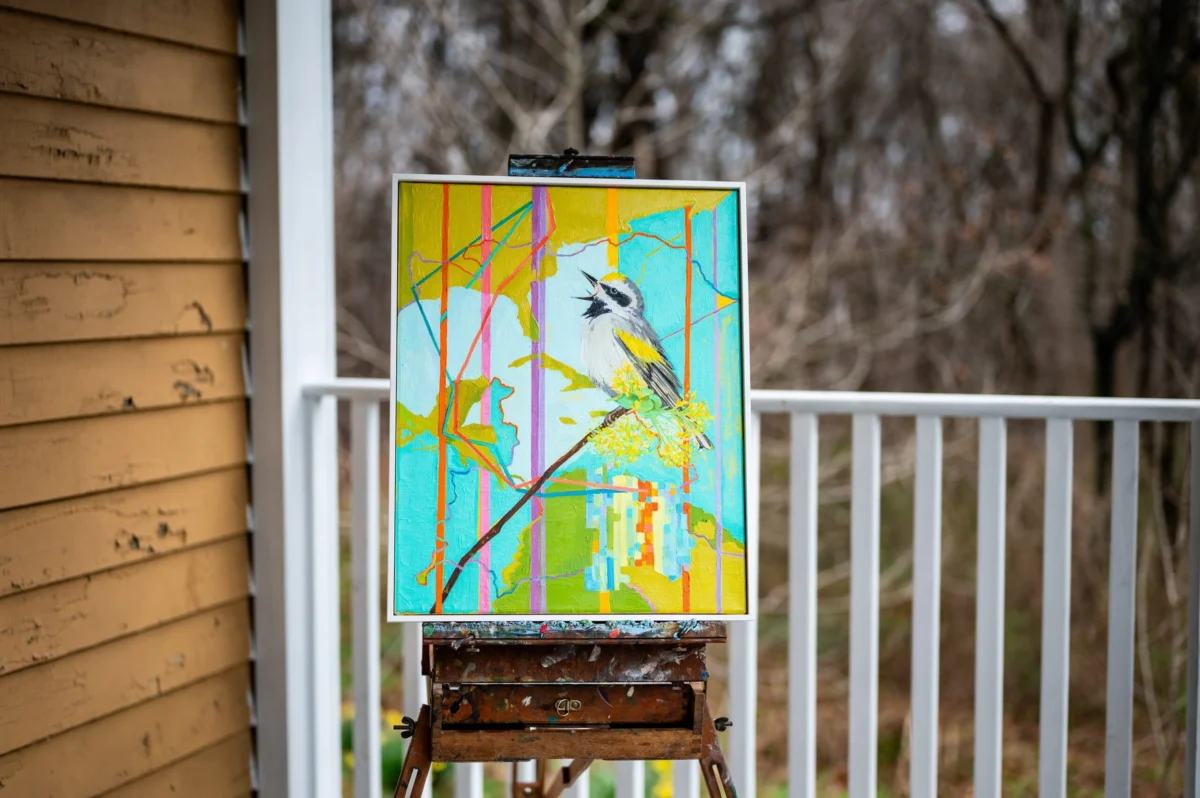
Artist Deirdre Murphy, known for her intricate layering of colorful maps and scientific data beneath strikingly lifelike portraits, has unveiled her latest masterpiece, "Trill for Tomorrow," featuring a bold Golden-winged Warbler. This oil-on-canvas painting, a central piece in her current exhibition at the John James Audubon Center at Mill Grove in Pennsylvania, serves not merely as an aesthetic display but as a profound intersection of art, ecological research, and a compelling call to action for conservation. Murphy, a Philadelphia-based artist and educator at Lehigh University, consistently grounds her artistic practice in rigorous scientific inquiry, transforming complex ecological data into accessible and emotionally resonant visual narratives.
The Genesis of "Trill for Tomorrow": A Scientific Immersion
Murphy’s artistic process begins far from the easel, delving deep into the scientific underpinnings of her chosen subjects. For "Trill for Tomorrow," her journey commenced with an extensive consultation with researchers and an immersion in ecological data. A pivotal first step involved visiting the Academy of Natural Sciences at Drexel University, a renowned institution housing an extensive specimen collection. Within its hallowed halls, Murphy spent considerable time examining dozens of Golden-winged Warbler specimens, some dating back a century and a half, collected by generations of naturalists, ornithologists, and zoologists.
This hands-on engagement allowed her to glean minute details often invisible in photographs. With a magnifying glass, she meticulously studied the intricate variations in feather shape and texture across different parts of the bird’s body – from the delicate primaries to the soft contour feathers. This tactile interaction fostered a profound connection. "I was able to hold the little warbler and have this visceral connection to this ephemeral being, and this tenderness, this finiteness," Murphy recounted, highlighting the emotional depth derived from direct contact with these preserved forms. The experience was not just analytical; it was a meditation on life, fragility, and the passage of time.
During her time at the academy, Murphy established a mini-studio, sketching the warblers using colored pencils and watercolors, capturing their essence and physical nuances. Her research extended beyond visual study to behavioral insights, gained through discussions with Nate Rice, the associate curator of the ornithology collection. Rice provided invaluable information about the Golden-winged Warbler’s behavior, particularly its distinctive singing posture. He described how the birds throw back their heads, lift their chests, and emit their characteristic high-pitched seee-bzzz, bzzz call. This description immediately resonated with Murphy, who sought out photographs depicting the bird in this proud, vocal stance. This specific posture was deliberately chosen for the final oil painting to convey a powerful message: "Sound the alarm." It imbues the bird with agency, transforming it from a mere subject into an active herald of its own narrative.
The Canvas as a Data Visualization: Weaving Science into Art
Murphy identifies herself as a research-driven studio artist, a designation underscored by her long-standing interest in science and her frequent collaborations with experts ranging from ornithologists and behavioral biologists to botanists. For "Trill for Tomorrow," this interdisciplinary approach was paramount. Beyond the physical examination of specimens, she dedicated significant time to studying maps and data visualizations charting the Golden-winged Warbler’s extensive migratory routes and habitat ranges. These birds undertake remarkable journeys, breeding in diverse habitats across the Great Lakes region and the Appalachian Mountains before migrating south to their wintering grounds in Central and South America.
The artist meticulously analyzed various data sets, including population trends, habitat loss projections, and climate impact models. This scientific information, often presented in graphs, charts, and GIS maps, became a wellspring of inspiration for the painting’s background. Murphy consciously "remixed" the colors and textures from these academic sources, integrating them into the abstract, layered backdrop of her portrait. She humorously noted her appreciation for the aesthetic choices made by scientists: "I like how quirky scientists are, the way that they visualize their data," she commented. "The colors that they use sometimes are so oddly weird that I’ll borrow them." This unique approach transforms the background from a simple backdrop into a complex, visually engaging narrative layer, hinting at the ecological forces at play.
The final composition of "Trill for Tomorrow" is reminiscent of a kaleidoscopic collage, where distinct elements converge to form a cohesive whole. The Golden-winged Warbler, rendered with meticulous detail, is depicted as a male, identifiable by its deep black throat patch and eye mask. It perches on a branch of a maple tree, its head thrown back in song. Around it, the familiar outline of the Gulf of Mexico is subtly woven into the background, signifying its migratory path. Bright, abstract lines of color, borrowed directly from scientific data visualizations, crisscross the canvas, symbolizing the intricate web of ecological data that defines the species’ existence. This fusion of realistic portraiture with abstract data visualization creates a powerful visual metaphor for the bird’s life intertwined with its environment and the scientific efforts to understand and protect it.
The Golden-winged Warbler: A Species at a Critical Juncture
The choice of the Golden-winged Warbler (Vermivora chrysoptera) as the subject for "Trill for Tomorrow" is deliberate and deeply resonant with Murphy’s conservation-oriented ethos. Classified as "Near Threatened" by the International Union for Conservation of Nature (IUCN), this species represents a critical juncture in conservation efforts. Unlike many species already teetering on the brink of extinction, the Golden-winged Warbler offers a window of opportunity for intervention and recovery, a theme Murphy explicitly wished to convey.
Its population has experienced a steep decline in recent decades, with some estimates indicating a loss of over 60% since the 1960s. This decline is attributed to a complex interplay of factors. Primary among them is habitat loss, particularly the disappearance of early successional forests and shrubby clearings – the young, regenerating woodlands that the warblers depend on for breeding. These habitats are often lost to mature forest growth, agricultural conversion, or suburban development. Additionally, hybridization with the closely related Blue-winged Warbler (Vermivora cyanoptera) poses a significant threat, especially where their ranges overlap. Climate change also plays a role, altering migratory patterns, food availability, and breeding success.
Murphy consciously chose not to depict an endangered species whose fate might feel predetermined. "I know the anxiety that comes with that," she explained. "That helplessness of, ‘Something’s already gone,’ or, ‘Something’s almost ready to disappear.’" Instead, by focusing on a species at a "tipping point," she aims to inspire a sense of agency and hope. The Golden-winged Warbler’s situation, while precarious, is not irreversible, providing a tangible focus for conservation efforts. Its status underscores the urgent need for action, yet offers the promise of a positive outcome through concerted human intervention.
A Timeline of Decline and the Rise of Conservation Efforts
The history of the Golden-winged Warbler’s population trajectory can be traced over several decades, illustrating a concerning trend that has spurred recent conservation initiatives.
- Mid-20th Century (1950s-1970s): Initial observations begin to indicate localized declines, particularly in the easternmost parts of its breeding range.
- Late 20th Century (1980s-1990s): Broader regional declines become evident, prompting initial scientific studies into the causes, with habitat loss and hybridization emerging as key suspects. Breeding Bird Survey data begins to show significant negative trends.
- Early 21st Century (2000s-Present): Population declines accelerate, leading to the species being listed as "Near Threatened" by the IUCN and various state-level classifications as endangered or threatened. This period also sees a significant increase in scientific research, monitoring programs, and collaborative conservation efforts. The Golden-winged Warbler Working Group, a coalition of government agencies, NGOs, and academic institutions, is formed to coordinate conservation strategies across its range.
Despite these alarming trends, there is substantial ongoing work to reverse the decline. Conservation efforts focus primarily on habitat restoration and management. Private landowners, often incentivized through programs like the USDA’s Natural Resources Conservation Service (NRCS) Working Lands for Wildlife, have restored thousands of acres of the birds’ preferred early successional forest habitat. These initiatives aim to create and maintain young forest patches, typically 1-20 years old after disturbance (such as timber harvests or prescribed burns), which provide the dense shrubby cover and open canopy favored by breeding Golden-wings.
Organizations like the National Audubon Society are actively involved in promoting sustainable forestry practices and educating landowners about habitat management. For instance, projects in the Appalachian Mountains and the Great Lakes region focus on creating a mosaic of forest ages and types, ensuring suitable breeding grounds while also supporting other wildlife. Furthermore, efforts are underway to understand and mitigate the impacts of hybridization with Blue-winged Warblers, including habitat management strategies designed to favor Golden-winged Warblers in areas where both species coexist.
Broader Impact and a Call to Empowerment
Deirdre Murphy’s "Trill for Tomorrow" is more than just a beautiful painting; it is a powerful tool for science communication and conservation advocacy. Her work exemplifies how art can bridge the gap between complex scientific data and public understanding, fostering an emotional connection to environmental issues that purely factual reports might not achieve.
The exhibition at the John James Audubon Center at Mill Grove, the historic first home of renowned ornithologist John James Audubon, provides a fitting context for Murphy’s work. It underscores the historical legacy of bird study and conservation, while simultaneously presenting a contemporary artistic interpretation that resonates with current ecological challenges. Representatives from the Audubon Center, while not providing direct quotes for this article, consistently emphasize the critical role of public engagement in conservation. It can be logically inferred that they view Murphy’s art as an invaluable asset in inspiring visitors to connect with nature and understand the urgency of protecting species like the Golden-winged Warbler.
Similarly, academic institutions like Drexel University’s Academy of Natural Sciences and Lehigh University, where Murphy holds a faculty position, likely commend her interdisciplinary approach. Such collaborations highlight the growing recognition that environmental solutions require contributions from diverse fields, with art playing a crucial role in translating scientific findings into public action. Nate Rice, associate curator of ornithology at the Academy of Natural Sciences, would likely underscore the value of artists like Murphy who take the time to deeply engage with scientific collections and experts, bringing a fresh perspective and broader audience to conservation science.
Murphy’s art delivers a clear message of empowerment. While acknowledging the gravity of species decline, she deliberately focuses on actionable solutions. She points out that individuals can make a tangible difference through simple, affordable steps. Planting native pollinator gardens not only supports insects vital to ecosystems but can also provide crucial habitat and food sources for birds. Furthermore, addressing the pervasive issue of window strikes – a leading cause of bird mortality – through simple measures like applying window decals or using external screens, can save countless lives, including Golden-winged Warblers during their arduous migrations.
In her own words, Murphy encapsulates the core philosophy driving her art: "To do the right thing is the only thing to do. Be a good person—leave this planet better than we found it." This ethos permeates "Trill for Tomorrow," transforming it from a mere depiction of a bird into an urgent yet hopeful testament to the power of human responsibility and collective action. The painting stands as a vibrant reminder that the fate of the Golden-winged Warbler, and countless other species, is intrinsically linked to our choices, urging viewers to become active participants in the ongoing narrative of conservation.
This piece originally ran in the Summer 2026 issue. To receive our print magazine, become a member by making a donation today.
