
Shorebirds arriving in Alaska’s Upper Cook Inlet face an immediate and formidable challenge: to transition from a grueling 10,000-mile migration straight into the intense demands of breeding and chick-rearing within the all-too-brief boreal spring and summer. This annual spectacle of endurance and instinct plays out against a backdrop of increasing environmental pressures, making the success of each breeding season critically important for the long-term viability of these avian populations. While some pairs successfully fledge their young, integrating new individuals into the broader population, many breeding attempts unfortunately fail, prompting urgent scientific inquiry into the underlying reasons. This spring, a collaborative research initiative, spearheaded by Dr. Nathan Senner of the University of Massachusetts Amherst, aims to definitively identify the ecological factors that dictate breeding success versus failure for shorebirds across the diverse wetland landscapes of Cook Inlet. The findings are expected to illuminate not only what constitutes an optimal breeding site but also how many such vital areas remain in the region, providing crucial data for conservation strategies.
The Perilous Migration and Arrival
The journey undertaken by these shorebirds is one of the most remarkable feats in the natural world. Species like the Hudsonian Godwit, Greater and Lesser Yellowlegs, Short-billed Dowitchers, and Wilson’s Snipe embark on hemispheric migrations, often covering distances exceeding 10,000 miles from their wintering grounds in South America, Central America, or the southern United States. This epic voyage demands immense energy reserves, navigated across vast oceans and continents, relying on instinct and favorable winds. They traverse multiple ecological zones, facing predators, storms, and the constant threat of habitat degradation at critical stopover sites.
Upon their arrival in Upper Cook Inlet, typically in late April and May, the birds are physically depleted but driven by an innate biological clock. The mudflats and wetlands of the Inlet serve as a vital staging ground, offering a rich bounty of invertebrates to replenish their energy stores. This period is a race against time; they must quickly recover from migration to prepare for the even more demanding task of reproduction. The timing of their arrival is finely tuned to the availability of food and suitable nesting conditions, a delicate balance that is increasingly disrupted by climate change and its effects on the phenology of ecosystems.
The Intense Breeding Cycle: From Nest to Fledgling
A shorebird breeding season is an extraordinary burst of activity compressed into mere weeks. Almost immediately after touching down, pairs form, and the arduous process of territory establishment begins. These birds, often having returned to the same general breeding grounds year after year, fiercely defend their chosen patches of wetland. Nests are typically simple depressions in the ground, often scraped into moss or short vegetation, lined with sparse plant material. For instance, species like Wilson’s Snipe meticulously craft well-concealed nests in dense grasses, while Yellowlegs might opt for more open areas near water.
Egg-laying follows, with clutches typically consisting of four dappled eggs, perfectly camouflaged to blend with the surrounding environment. The incubation period, lasting several tense weeks, is a period of heightened vulnerability. Both parents often share incubation duties, taking turns to keep the eggs warm and protected. During this time, the nest and the incubating adults are highly susceptible to predation from foxes, ravens, gulls, and other opportunistic predators. Human disturbance, even unintentional, can also force adults off nests, leaving eggs exposed to temperature fluctuations and predation.
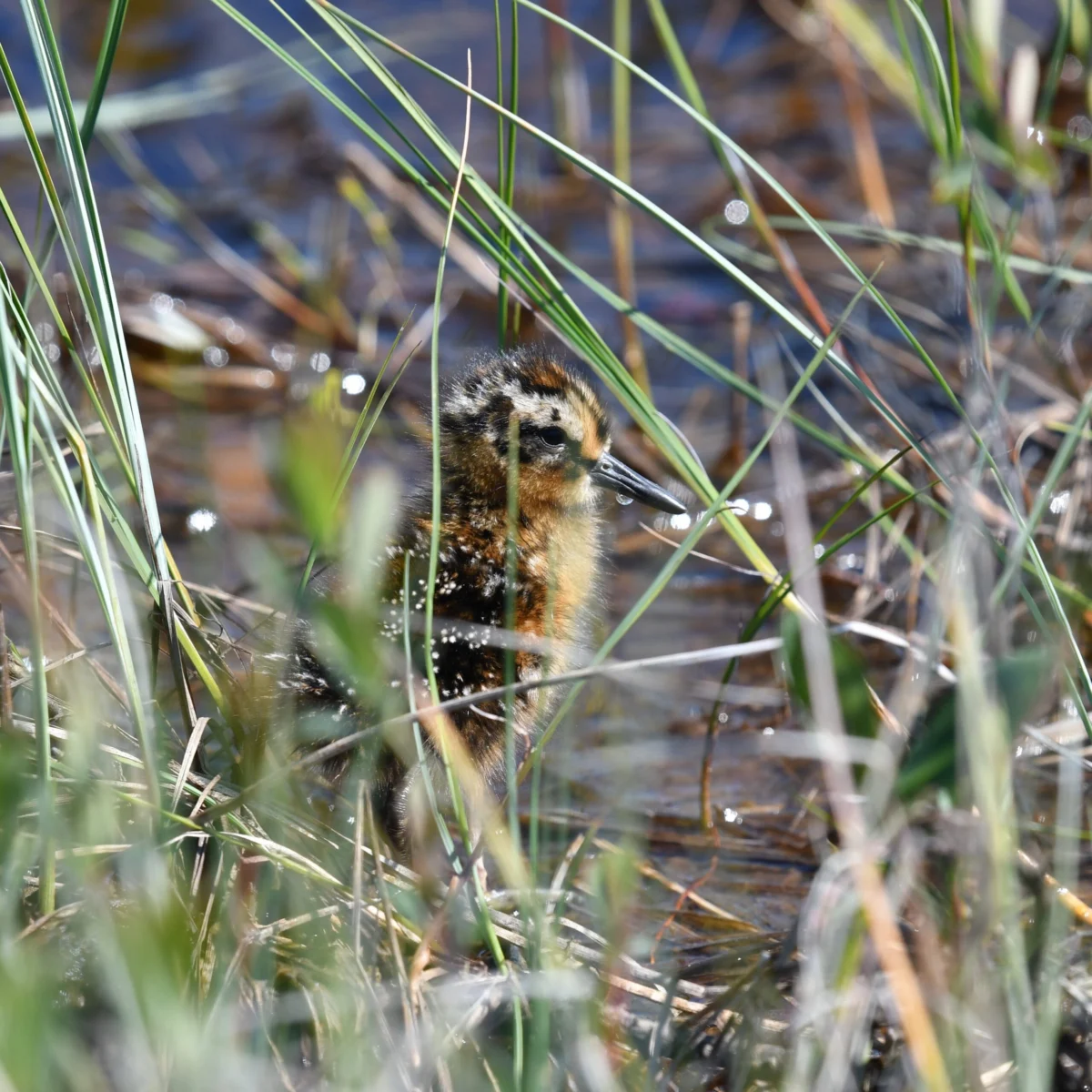
If the pair is fortunate, and the myriad risks are avoided, hatching day arrives, usually in early June. Faint chipping sounds emanating from within the eggs signal the impending arrival of new life. Eventually, the eggs crack open, revealing tiny, precocial chicks – miniature balls of fluff perched atop comically long, spindly legs. These chicks are remarkably self-sufficient from birth, able to walk and forage within hours, a critical adaptation for ground-nesting species in predator-rich environments.
The immediate post-hatching period is arguably the most critical. Within hours of hatching, the parents shepherd their chicks away from the nest site, leading them into the wider, more complex world of the wetlands. For the next three to four weeks, until the chicks develop their flight feathers and can take to the air, the family remains grounded and highly mobile. The chicks, despite their initial awkwardness, quickly adapt to their gangly legs, spending their days relentlessly chasing down a diverse diet of invertebrates – insects, larvae, and small crustaceans – essential for rapid growth. Meanwhile, the vigilant parents are constantly on alert, employing elaborate distraction displays and alarm calls to protect their vulnerable offspring from a host of disturbances and predators. This period of rapid growth and high mobility is where the "million-dollar question" truly lies: Do these intrepid yet terribly vulnerable scraps of fluff and sinew manage to survive to fledging? Ultimately, chick survival and subsequent recruitment into the adult population is the primary determinant of whether a population remains stable, or if it shifts to the ominous past tense: "used to be here."
Dr. Senner’s Research: Pinpointing Success and Failure
Dr. Nathan Senner’s collaborative research project is meticulously designed to answer these previously unanswered questions about breeding success. Over the next three months, his team will intensely follow the breeding season, incorporating multiple shorebird species and assessing wetland breeding areas around the entire Upper Cook Inlet. The methodology involves closely tracking families from hatching through fledging, gathering granular data on various environmental parameters.
A key focus of the study is to understand the habitat characteristics crucial for chick survival. Where do parents lead their chicks once they have hatched? What are the specific features of these post-hatching habitats? This includes detailed assessments of vegetation type and density, critically important for camouflage and cover from predators, as well as the height and fluctuation of water levels. Water levels are particularly significant, influencing access to invertebrate prey and providing refuge from terrestrial predators. The research aims to establish a definitive link between these environmental variables and the ultimate survival rates of the chicks.
The project builds upon foundational work conducted in the late 1990s by retired U.S. Geological Survey biologist Lee Tibbitts, whose observations motivated this renewed and expanded inquiry. Tibbitts’ earlier studies highlighted the alarming vulnerability of shorebird chicks navigating human-dominated landscapes, underscoring the urgency for a deeper understanding of current threats. By combining modern tracking technologies and intensive field observations with a broader geographical scope, Senner’s team expects to develop a comprehensive model for predicting breeding success. This will involve analyzing data across a spectrum of environments, from relatively undisturbed remote wetlands to those impacted by urban expansion.
Anchorage’s Unique Urban Wetlands: A Double-Edged Sword
The eastern side of Cook Inlet, particularly the Anchorage bowl, presents a unique and increasingly challenging environment for shorebirds. Thanks to a distinctive mosaic of boggy wetlands, shorebirds have historically bred and raised chicks even within the city limits. This provides Anchorage residents with the highly unusual privilege of observing species like Greater Yellowlegs, Lesser Yellowlegs, Short-billed Dowitchers, and Wilson’s Snipe as "backyard birds." However, this urban coexistence comes at a significant cost.
The biodiverse, sheltered habitats that shorebirds have historically relied upon for nesting and chick-rearing are under relentless pressure. A potent combination of accelerated urban development, the pervasive effects of climate change, and the increased presence of people and their pets is degrading these critical areas. Dr. Senner, who grew up in Anchorage’s Turnagain neighborhood, recounts a poignant personal observation: "When I was a kid, I used to be able to walk a few blocks to see breeding Hudsonian Godwits. Those are gone now." This anecdotal evidence underscores a broader, documented trend of shorebird population declines, particularly in developed areas. For instance, the U.S. Fish and Wildlife Service and other conservation organizations have reported significant declines in many North American shorebird populations over the past few decades, with habitat loss and degradation cited as primary drivers.
The challenges for urban-nesting shorebirds extend beyond habitat availability. As Lee Tibbitts noted, "In early June, you’ve got birds moving down through the roads and through people’s yards with little chicks." This forced migration of flightless chicks through a human-dominated landscape is fraught with peril. Chicks can become trapped behind fences, ambushed by curious domestic dogs and cats – significant predators in urban settings – or tragically run over by traffic. Tibbitts emphasizes the public awareness gap: "The chicks are just trying to get across the road. People don’t know to watch out." This highlights the critical need for public education and engagement to foster a greater understanding of the presence and vulnerability of these ground-dwelling families.
The Silent Threat of Drying Boreal Bogs
While the urban environment poses acute, direct threats, the western side of Cook Inlet, largely less developed and more remote, faces a more insidious danger: the drying out of boreal bogs. These vast peatland ecosystems are crucial for many shorebird species, providing specific nesting microhabitats and rich invertebrate foraging grounds. However, even in these relatively undisturbed areas, shorebird numbers have been ticking steadily downward over the past decade. This decline appears to be closely linked with changes in hydrology driven by climate change.
Boreal bogs are highly sensitive to shifts in precipitation patterns and temperature increases. Warmer temperatures can lead to increased evaporation, while altered snowmelt and rainfall regimes can reduce water retention. As these bogs dry, their ecological character changes, potentially reducing the availability of suitable nesting sites, altering invertebrate communities, and making chicks more susceptible to predation due to reduced cover. Dr. Senner’s team will be collecting essential hydrological data, alongside their biological observations, to definitively measure the connection between shorebird breeding success and bog water levels. This will provide empirical evidence for the impact of climate change on these vital ecosystems and their avian inhabitants.
Globally, peatlands like boreal bogs store vast amounts of carbon, making their degradation a double-edged sword: not only do they cease to support critical biodiversity, but they can also release stored carbon, further exacerbating climate change. Understanding their hydrological dynamics and the impact on sensitive species like shorebirds is therefore of paramount importance for both local conservation and global environmental health.
Broader Implications and a Call to Awareness
The fate of Cook Inlet’s shorebirds has implications far beyond the boundaries of Alaska. These birds are integral components of hemispheric migratory flyways, connecting diverse ecosystems across continents. Their decline in one critical breeding area can have ripple effects throughout their entire range, impacting ecosystems from the Arctic to the Tropics. As indicator species, their struggles serve as a bellwether for the health of the broader wetland ecosystems upon which countless other species, including humans, depend.
For the majority of Alaska’s human population, Cook Inlet is a vibrant natural landscape right on their doorstep. Lee Tibbitts eloquently states, "The best thing about Alaska is everybody’s interested in the natural world. It’s why people move here. And, if they move here and they don’t know that yet, they will become interested in the natural world just because it’s everywhere." This inherent connection to nature offers a unique opportunity for community engagement in conservation efforts.
Protecting shorebirds, their salt marshes, and boreal bogs is not merely an ecological imperative; it is about preserving what makes Cook Inlet home and recognizing its pivotal role in a much larger, interconnected global ecosystem. The research conducted by Dr. Senner and his team will provide the detailed scientific understanding needed to inform effective conservation strategies. These strategies might include targeted habitat restoration, land-use planning that prioritizes wetland preservation, and robust public awareness campaigns to minimize human disturbance during the critical breeding season.
The thousands of newly returned shorebirds gracing the mudflats of Cook Inlet offer a powerful visual reminder of the incredible biodiversity that relies on this region. Their continued presence is a testament to the resilience of nature, but also a stark warning of the increasing pressures they face. As the details of their struggles and successes become clearer from the data collected this spring and summer, the hope is that this scientific endeavor will galvanize broader efforts to ensure that these magnificent migratory birds continue to thrive in Alaska for generations to come, preventing their story from ever shifting fully into the past tense. The future of these intrepid travelers hinges on our collective understanding and action.
Alice McBride is a freelance science writer/academic editor/ecologist from Maine.
