
A groundbreaking new study, spearheaded by a researcher from the University of Hawaiʻi at Mānoa, has unveiled a critical and alarming reality: nearly every forest bird species inhabiting Hawaiʻi possesses the capacity to transmit avian malaria. This pervasive ability to spread infection provides a definitive explanation for the disease’s ubiquitous presence across the islands, manifesting wherever mosquito populations thrive. The findings underscore the immense, multifaceted challenge facing conservation efforts for Hawaiʻi’s unique avifauna, particularly its iconic and imperiled honeycreepers.
The comprehensive research, published on February 10 in the prestigious journal Nature Communications, documented the presence of avian malaria in an astounding 63 out of 64 tested locations statewide. These sites encompassed a diverse array of forest ecosystems, each characterized by significantly different compositions of bird species, ranging from pristine native habitats to areas with a mix of indigenous and introduced birds. The illness itself is caused by Plasmodium relictum, a generalist parasite that has played an undeniably central role in the precipitous declines and, tragically, the outright extinctions of numerous native Hawaiian honeycreeper species over the past century.
"Avian malaria has exacted a devastating toll on Hawaiʻi’s native forest birds, and this study unequivocally demonstrates why the disease has proven so extraordinarily difficult to contain," stated Christa M. Seidl, who serves as the mosquito research and control coordinator for the Maui Forest Bird Recovery Project and conducted this pivotal research as an integral part of her PhD studies at the University of California, Santa Cruz. "When such a broad spectrum of bird species can quietly sustain transmission, it severely constrains the available options for effectively protecting native birds and elevates mosquito control from merely helpful to absolutely essential."
The Unveiling Study: A Deeper Look into Transmission Dynamics
Seidl’s research marks a significant advancement in understanding the complex epidemiology of avian malaria in Hawaiʻi. Previous assumptions often focused on a limited number of "super-spreaders" or specific native species as primary reservoirs. This study dismantles that notion, revealing a far more insidious and widespread mechanism of transmission. The generalist nature of Plasmodium relictum, combined with the susceptibility of a vast range of avian hosts, creates an ecological conundrum that amplifies the threat.
The investigation meticulously examined blood samples collected from over 4,000 individual birds across the islands of Kauaʻi, Oʻahu, Maui, and Hawaiʻi Island. This extensive field data was then meticulously paired with rigorous laboratory experiments designed to precisely quantify how readily mosquitoes became infected after feeding on these birds. The results were stark: both native and introduced bird species frequently exhibited comparable levels of infectiousness, unequivocally indicating that both groups contribute significantly to the propagation of the parasite across the archipelago.
A particularly concerning revelation was that even birds harboring very minute quantities of the parasite were fully capable of infecting mosquitoes. This implies that a wide array of bird communities, regardless of their specific composition or the apparent health of individual birds, possess the potential to maintain and perpetuate ongoing malaria transmission. This challenges conventional epidemiological models where only highly infected individuals are considered significant drivers of disease spread.
A Silent Scourge: The Nature of Avian Malaria and its Lifecycle
Avian malaria is a parasitic disease that specifically targets the red blood cells of birds. Once infected, birds can suffer from a range of severe pathological effects, including anemia, organ failure, and significantly reduced survival rates. For certain highly susceptible species, infection is almost invariably a death sentence. The causative agent, Plasmodium relictum, is a protozoan parasite belonging to the same genus as the parasites responsible for human malaria.
The lifecycle of Plasmodium relictum is intricate and obligately requires both an avian host and a mosquito vector. An infected mosquito, primarily the Southern House Mosquito (Culex quinquefasciatus) in Hawaiʻi, takes a blood meal from a susceptible bird. During this process, sporozoites (an infective stage of the parasite) are injected into the bird’s bloodstream. These sporozoites then travel to various organs, where they multiply asexually before invading red blood cells. Within the red blood cells, they develop into merozoites, which continue to replicate and destroy red blood cells, leading to the clinical symptoms of malaria.
Crucially, some merozoites develop into gametocytes, the sexual stage of the parasite. When a healthy mosquito feeds on an infected bird carrying these gametocytes, the gametocytes are ingested by the mosquito. Inside the mosquito’s gut, they undergo sexual reproduction, forming oocysts that mature and release new sporozoites, which then migrate to the mosquito’s salivary glands, ready to infect another bird. This cyclical transmission ensures the persistence of the disease as long as both susceptible birds and competent mosquito vectors are present.
Hawaiʻi’s Endemic Treasures Under Threat: The Plight of Honeycreepers
The consequences of avian malaria have been particularly dire for Hawaiʻi’s iconic birds, especially the endemic Hawaiian honeycreepers. These birds represent a remarkable example of adaptive radiation, having evolved into over 50 distinct species from a single ancestral finch that colonized the islands millions of years ago. Their diverse bill shapes and feeding ecologies allowed them to exploit a wide range of niches, playing vital roles in pollination, seed dispersal, and insect control across the islands’ unique ecosystems.
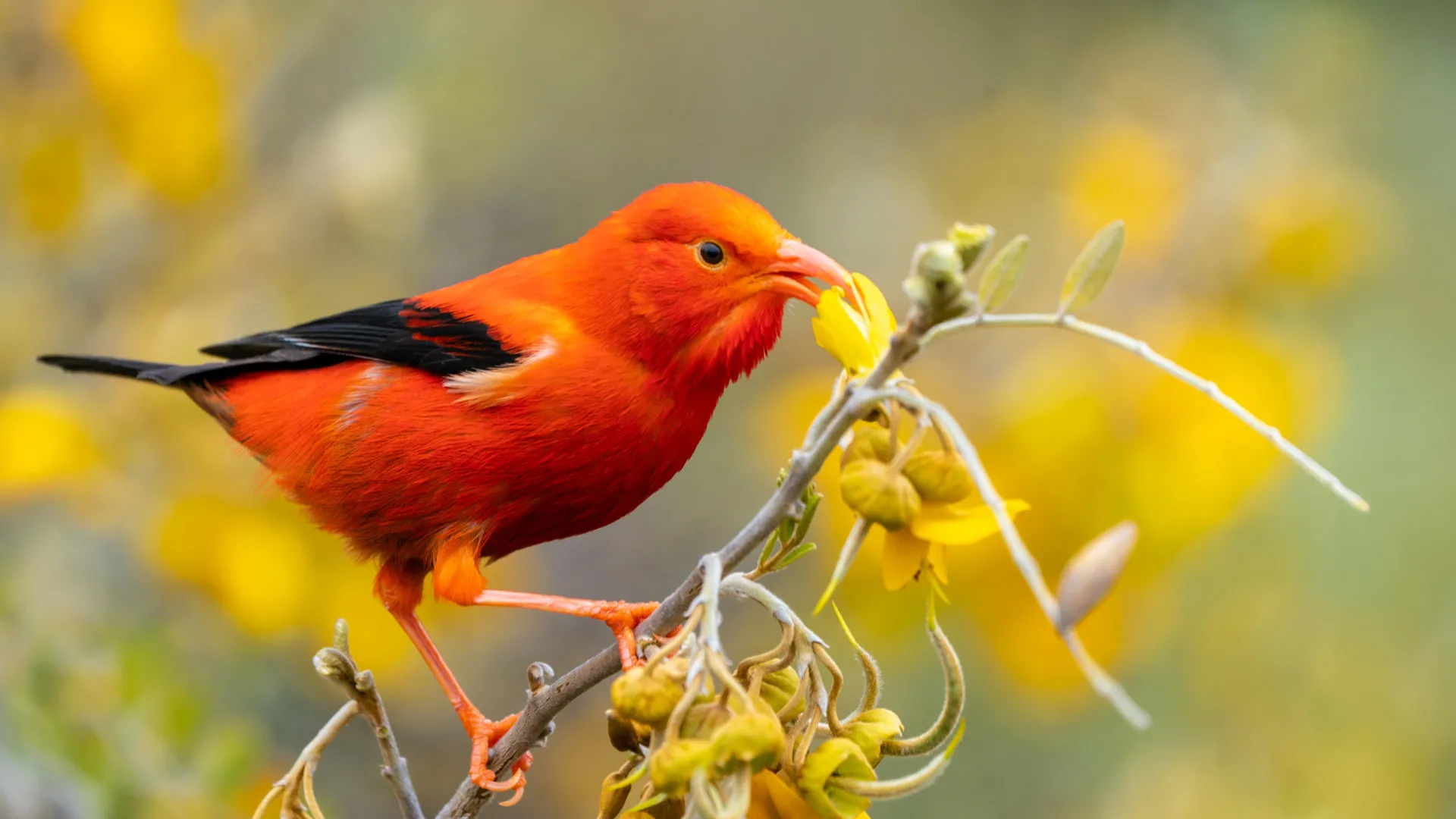
However, their evolutionary isolation meant they had no natural immunity to diseases carried by introduced species. The ‘I’iwi (Drepanis coccinea), also known as the scarlet honeycreeper, is a vibrant, crimson-feathered bird with a distinctive curved beak, essential for nectaring on native flowers. Studies have tragically shown that ‘I’iwi face an astonishing mortality rate of approximately 90 percent if infected with avian malaria. Once abundant, their populations have plummeted, and they are now listed as endangered.
Even more critically endangered, or already extinct in the wild, is the ‘Akikiki (Oreomystis bairdi), a small, cryptic honeycreeper native only to the island of Kauaʻi. Its population, already critically low due to habitat loss and predation, has been decimated by avian malaria, with the species now considered functionally extinct in the wild, largely as a direct consequence of the disease’s relentless pressure. Similar fates have befallen other honeycreeper species, pushing many to the brink or over the edge of extinction. The Alauahio (Maui Parrotbill) and the Kiwikiu (Maui Nui ‘Akepa) are other examples of species facing imminent threats from this disease.
The Vector and Its History: Culex quinquefasciatus
The primary vector for avian malaria in Hawaiʻi is the Southern House Mosquito, Culex quinquefasciatus. This mosquito is not native to the Hawaiian Islands. Its introduction, believed to have occurred around 1826 via whaling ships carrying contaminated water barrels, marked a catastrophic turning point for Hawaiʻi’s native birds. Prior to its arrival, the islands’ ecosystems were largely free of mosquito-borne diseases, and native birds had evolved in an environment devoid of such pathogens, leaving them exquisitely vulnerable.
Culex quinquefasciatus thrives in warm, humid environments and can breed in a variety of standing water sources, including artificial containers, which became increasingly prevalent with human settlement. Its rapid proliferation across the islands, coupled with the introduction of non-native birds that could act as reservoirs for Plasmodium relictum, created a perfect storm for the emergence and widespread transmission of avian malaria. The mosquito’s generalist feeding habits, biting both native and introduced birds, further facilitated the parasite’s spread, establishing a robust transmission cycle.
Chronic Infections: Sustaining the Threat Over Time
The study also shed light on another crucial aspect of avian malaria’s persistence: the ability of birds to harbor chronic infections for extended durations, often months or even years. During these prolonged periods, infected birds may exhibit only mild symptoms or appear outwardly healthy, making them difficult to identify as sources of infection. Yet, throughout this chronic phase, they remain fully capable of transmitting the parasite to mosquitoes.
The researchers estimate that this long-lasting, low-to-moderate infectious stage accounts for the vast majority of malaria transmission statewide. This finding has profound implications for disease management. It means that simply targeting acutely sick birds would be insufficient, as a large, seemingly healthy population can continuously replenish the parasite pool in mosquitoes. The chronic nature of the infection creates a persistent reservoir, making eradication exceptionally challenging.
Chronology of a Crisis: From Introduction to Extinction Threat
The timeline of avian malaria in Hawaiʻi is a stark narrative of ecological disruption:
- Circa 1826: Introduction of the Southern House Mosquito (Culex quinquefasciatus) to Hawaiʻi, likely via European whaling ships.
- Late 19th – Early 20th Century: Introduction of numerous non-native bird species, some of which carried Plasmodium relictum and acted as initial reservoirs. These non-native birds often exhibited greater resistance to the parasite.
- Mid-20th Century: First documented cases of avian malaria in native Hawaiian birds. Mosquito populations become well-established across lower elevations.
- 1970s – 1980s: Significant declines in native honeycreeper populations observed, with avian malaria identified as a primary contributing factor, alongside habitat loss and introduced predators.
- 1990s – Present: Increasing evidence of mosquito and malaria presence at higher elevations due to climate warming, encroaching on the last refugia of susceptible native birds. Intensification of conservation efforts, including captive breeding and habitat restoration, but with limited success against the disease.
- February 2024: Publication of the Nature Communications study, revealing the widespread transmissibility across nearly all forest bird species, highlighting the urgency of comprehensive mosquito control.
Climate Change: Shrinking Havens and Expanding Threats
Compounding the already dire situation is the undeniable impact of climate change. For decades, higher elevation forests in Hawaiʻi served as crucial refuges for vulnerable native birds. These areas were historically too cool for the Culex quinquefasciatus mosquito to thrive and for the Plasmodium relictum parasite to complete its development cycle within the mosquito. The cooler temperatures acted as a natural barrier, limiting the upward spread of the disease.
However, as global temperatures rise, Hawaiʻi is experiencing its own localized warming trends. This gradual increase in average temperatures allows mosquitoes to expand their range into previously inhospitable higher elevation areas. Concurrently, the warmer temperatures accelerate the parasite’s developmental rate within the mosquito, shortening its extrinsic incubation period and making transmission more efficient.
This relentless upward creep of the "mosquito zone" is systematically eroding the last remaining havens for highly susceptible species like the ‘I’iwi and ‘Akikiki. What were once cool, disease-free sanctuaries are progressively becoming new battlegrounds against avian malaria. This climate-driven expansion of the disease frontier represents a critical and rapidly escalating threat, pushing several species towards an irreversible tipping point.
A Call to Action: Conservation Strategies and the "Birds, Not Mosquitoes" Initiative
The gravity of these findings underscores the immediate and paramount need for aggressive and innovative conservation interventions. Traditional approaches, such as habitat restoration and predator control, while vital, are insufficient to combat a pervasive disease that transcends specific geographical boundaries or localized threats. The new study reinforces that comprehensive, landscape-scale mosquito control is not merely an option but an imperative.
This realization has galvanized a collaborative effort known as "Birds, Not Mosquitoes." This coalition brings together a diverse array of academic institutions, state and federal agencies, non-profit organizations, and industry partners, all united by the urgent mission to advance effective mosquito control strategies for the sake of Hawaiian bird conservation.
The flagship strategy being pursued by "Birds, Not Mosquitoes" is the Incompatible Insect Technique (IIT), which utilizes naturally occurring Wolbachia bacteria. Wolbachia are common bacteria that infect a wide range of insects, including mosquitoes, but typically do not harm them. The IIT strategy involves releasing male Culex quinquefasciatus mosquitoes infected with a specific strain of Wolbachia into the wild. When these Wolbachia-infected males mate with wild female mosquitoes that are either uninfected or infected with a different Wolbachia strain, their eggs fail to hatch. This renders the mating "incompatible," effectively reducing the mosquito population over time without the use of chemical pesticides.
This targeted, self-sustaining method holds immense promise for reducing mosquito numbers in critical high-elevation habitats, thereby disrupting the avian malaria transmission cycle and providing a desperately needed reprieve for native birds. Other potential strategies, such as the use of mosquito traps or biological control agents, are also being explored, though IIT currently stands as the most viable and scalable solution.
Expert Perspectives and Broader Implications
The implications of Seidl’s study extend far beyond the immediate threat to individual bird species; they encompass the broader ecological integrity of Hawaiʻi. Losing honeycreepers means losing critical pollinators and seed dispersers, potentially triggering cascading effects throughout the native forest ecosystems. This could lead to further declines in native plant species, impacting the overall biodiversity and resilience of these unique environments.
"This research solidifies the understanding that the fight for Hawaiʻi’s forest birds is fundamentally a fight against the mosquito," remarked a spokesperson from the "Birds, Not Mosquitoes" coalition, emphasizing the urgency. "It’s a complex challenge, but the science now points to a clear path forward: we must significantly reduce the mosquito population in critical bird habitats to give these species a fighting chance."
From a national and international perspective, Hawaiʻi’s struggle with avian malaria serves as a potent microcosm of the challenges faced by island ecosystems globally. Islands, with their high rates of endemism and evolutionary isolation, are disproportionately vulnerable to introduced species and diseases. The lessons learned in Hawaiʻi regarding disease ecology, climate change impacts, and innovative conservation solutions could inform efforts to protect biodiversity in other vulnerable regions worldwide. The economic implications are also significant; Hawaiʻi’s unique natural beauty and biodiversity are major draws for ecotourism, contributing substantially to the state’s economy. The continued decline of iconic species like the honeycreepers diminishes this natural heritage and could impact future tourism.
The Road Ahead: Challenges and Hope
While the new study paints a stark picture of widespread vulnerability, it also provides crucial scientific grounding for focused intervention. The challenges are formidable: the logistical complexities of implementing large-scale mosquito control across rugged, remote forest landscapes; the ongoing pressure from climate change; and the need for sustained funding and public support.
However, the collaborative spirit embodied by initiatives like "Birds, Not Mosquitoes," coupled with the dedicated efforts of researchers like Christa Seidl and conservationists across the islands, offers a glimmer of hope. By understanding the intricate mechanisms of disease transmission, identifying the most effective control strategies, and acting decisively, there remains a chance to pull Hawaiʻi’s unique forest birds back from the precipice of extinction. The fate of these irreplaceable species now hinges on the swift and effective implementation of science-backed mosquito control, safeguarding not just individual birds, but the ecological soul of the Hawaiian Islands.
All birds involved in this extensive study were captured and handled with the utmost care and professionalism by trained ornithologists, operating strictly under the necessary state and federal permits, ensuring ethical research practices throughout the investigation. The Maui Forest Bird Recovery Project, a key partner in this research, operates under the auspices of the Pacific Cooperative Studies Unit within the College of Natural Sciences at the University of Hawaiʻi at Mānoa.
