
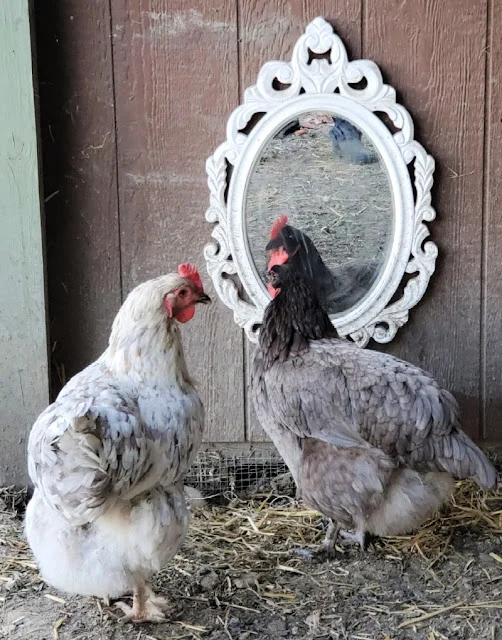
The traditional understanding of avian intelligence has undergone a significant paradigm shift following recent behavioral studies suggesting that domestic chickens (Gallus gallus domesticus) may possess a level of self-awareness previously thought to be reserved for a select group of highly cognitive mammals and specific corvids. For decades, the "mirror test" has served as the gold standard for determining whether an animal possesses the capacity for self-recognition. While many domestic animals, including dogs and cats, generally fail to recognize their own reflections—often treating the image as a stranger or ignoring it entirely—new research utilizing species-specific behavioral markers indicates that chickens may indeed understand that the bird in the glass is themselves. This discovery challenges long-held assumptions about the "bird brain" and carries profound implications for animal welfare, cognitive ethology, and the ethical treatment of poultry in both agricultural and domestic settings.

The Evolution of the Mirror Self-Recognition Test
To understand the significance of the chicken’s performance, one must look at the history of the Mirror Self-Recognition (MSR) test. Developed in 1970 by psychologist Gordon Gallup Jr., the classic experiment involves placing a scentless dye or mark on a part of the animal’s body that it cannot see without the aid of a mirror. If the animal looks in the mirror and then touches or investigates the mark on its own body, it is interpreted as evidence that the animal perceives the reflection as an image of itself rather than another individual.
Historically, only a handful of species have passed this test. These include great apes (chimpanzees, bonobos, and orangutans), bottlenose dolphins, Eurasian magpies, and Asian elephants. Even human children do not typically pass the test until they reach approximately 18 months of age. However, researchers have long criticized the mark test for being heavily biased toward species with the manual dexterity to touch a mark (like primates) or those that prioritize vision over other senses. For species like dogs, which rely primarily on olfaction, or chickens, which may not be motivated to groom a random spot of dye, the traditional mark test may be an inadequate measure of consciousness.

Rethinking Methodology: The Rooster Alarm Call Study
In 2023, a landmark study published in the journal PLOS ONE by researchers from the University of Bonn and Ruhr University Bochum sought to bypass the limitations of the traditional mark test. Led by Sonja Hillemacher and Inga Tiemann, the research team designed an experiment based on the natural social behaviors of roosters.
Roosters are known for their "audience effect" behavior. In the wild and in domestic flocks, a rooster will emit a specific alarm call when it spots a predator, such as a hawk, to warn its hens and offspring. Crucially, a rooster will typically remain silent if it is alone when a predator appears. Sounding an alarm when no peers are present would unnecessarily draw the predator’s attention to the rooster without providing any social benefit.

The researchers utilized this binary behavior—calling in the presence of others versus remaining silent when alone—to test self-recognition. The experiment involved 58 roosters and was conducted in several stages:
- The Peer Test: A rooster was placed in a compartment where it could see another rooster. When a silhouette of a hawk was projected overhead, the rooster emitted alarm calls frequently.
- The Solitary Test: The rooster was placed alone in the compartment. When the hawk silhouette appeared, the rooster remained largely silent.
- The Mirror Test: The rooster was placed in the compartment with a mirror. If the rooster perceived the reflection as another bird, it should, theoretically, sound the alarm. If it recognized the reflection as itself, it should remain silent, as if it were alone.
The results were striking. When faced with their own reflection, the roosters remained silent, behaving as if they were solitary. This suggested that they did not perceive the reflection as a rival or a flock mate, but rather as a representation of themselves.

Chronology of Avian Cognitive Research
The journey to proving chicken self-awareness has been decades in the making, built upon a foundation of increasing evidence regarding bird intelligence.
- 1970: Gordon Gallup Jr. introduces the MSR test, setting the benchmark for animal self-awareness.
- 2002: Research at Oxford University demonstrates that New Caledonian crows can manufacture and use tools, sparking renewed interest in avian cognition.
- 2008: The Eurasian magpie becomes the first non-mammal to pass the traditional mirror mark test, proving that a neocortex (which birds lack) is not a prerequisite for self-recognition.
- 2013-2017: Studies into the "social intelligence" of chickens reveal they can perform basic arithmetic, exercise self-control, and possess structural complexity in their communication.
- 2023: The PLOS ONE study provides a new behavioral framework for testing self-recognition in poultry, successfully demonstrating that roosters distinguish their reflections from other birds.
Supporting Data and Experimental Controls
The validity of the rooster mirror study was reinforced by rigorous control measures. One of the primary concerns for researchers was whether the roosters were simply "scared into silence" by the mirror or if they were using other senses to identify the presence of another bird.

To control for scent and sound, the researchers conducted a "Hidden Peer" test. In this scenario, another rooster was placed behind a mirror or a translucent screen where it could be smelled and heard but not seen. In these instances, the test rooster still did not sound the alarm. This provided two critical pieces of data: first, it confirmed that roosters rely almost exclusively on visual cues to trigger their social alarm calls; second, it proved that the absence of a call in the mirror test was specifically due to the visual recognition (or lack thereof) of a "peer."
The statistical significance was high. In the presence of a visible peer, roosters gave an average of 1.33 alarm calls per predator sighting. In contrast, when alone or in front of a mirror, the number of calls dropped to near zero (approximately 0.01 calls). The researchers concluded that the roosters’ behavior in front of the mirror was statistically indistinguishable from their behavior when completely alone.

Scientific Reactions and the Debate on Consciousness
The scientific community has reacted to these findings with a mixture of excitement and cautious skepticism. While the behavioral data is compelling, some ethologists argue that "self-recognition" does not necessarily equate to "self-awareness" or a "sense of self" in the human philosophical sense.
Dr. Inga Tiemann, one of the study’s authors, noted that while the roosters passed the behavioral version of the test, the traditional mark test results for chickens remain inconsistent. Some chickens in separate trials have attempted to scratch off marks, while others ignore them. This suggests that "self-recognition" might be a spectrum or that different species prioritize different types of self-relevant information.

Critics of the study suggest that the roosters might not be recognizing "themselves," but rather realizing that the bird in the mirror is not a "functional" peer because it mimics their every move, thereby failing to provide the social feedback required to trigger an alarm call. However, proponents argue that this level of visual processing and comparison is, in itself, a high-order cognitive function that brings chickens much closer to the level of "higher" mammals than previously acknowledged.
Broader Impact and Implications for Animal Welfare
The enrichment of our understanding of chicken cognition has immediate and practical implications for the poultry industry and backyard hobbyists. If chickens are capable of self-recognition, it implies a level of mental complexity that makes environmental enrichment a necessity rather than a luxury.

- Coop Enrichment: The use of mirrors in chicken coops and brooders has long been a practice among hobbyists to prevent boredom. The scientific backing of self-recognition suggests that mirrors provide a unique form of cognitive stimulation. For a solitary bird, a mirror might provide the illusion of company, reducing stress and "boredom-based" behaviors like feather pecking.
- Ethical Farming Standards: As evidence of avian intelligence grows, there is increasing pressure on industrial farming operations to move away from high-density battery cages. If chickens possess a sense of self, the psychological toll of restrictive environments is likely much higher than previously estimated.
- Public Perception: Chickens are often viewed as "low-intelligence" food sources. This research contributes to a growing body of work—alongside studies showing chickens can empathize with their chicks and navigate complex social hierarchies—that may shift public opinion and lead to stronger legal protections for poultry.
Conclusion: A New View of the Flock
The realization that a rooster can look into a mirror and conclude that no alarm is necessary because he is only looking at himself is a profound moment in cognitive biology. It suggests that the "biological hardware" for self-awareness is more ancient and more widely distributed across the animal kingdom than the scientific community once believed.
While the jury may still be out on other domestic birds, such as ducks, the evidence for chickens is becoming increasingly difficult to ignore. As research continues, the focus will likely shift from whether these animals are self-aware to how they experience that awareness. For the millions of people who keep backyard flocks, these studies confirm what many have long suspected: there is much more going on behind those golden eyes than simple instinct. The chicken, it seems, is not just a bird of the flock, but an individual capable of recognizing its own place in the world.
